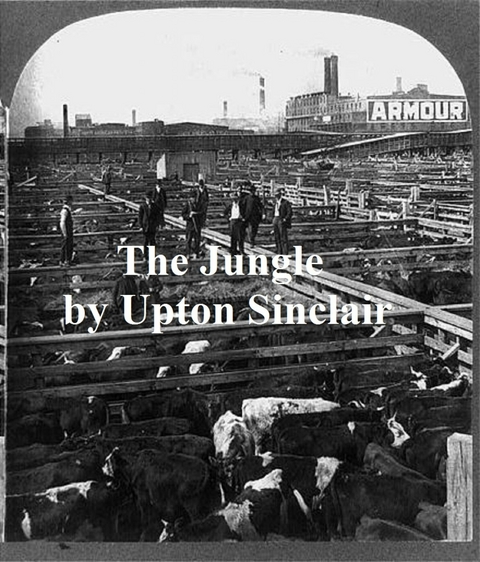
Sinclair's masterpiece. According to Wikipedia: 'Upton Beall Sinclair, Jr. (1878 - 1968), was a prolific American author who wrote over 90 books in many genres and was widely considered to be one of the best investigators advocating socialist views. He achieved considerable popularity in the first half of the 20th century. He gained particular fame for his 1906 novel The Jungle, which dealt with conditions in the U.S. meat packing industry and caused a public uproar that partly contributed to the passage of the Pure Food and Drug Act and the Meat Inspection Act in 1906.'
Sinclair's masterpiece. According to Wikipedia: "e;Upton Beall Sinclair, Jr. (1878 - 1968), was a prolific American author who wrote over 90 books in many genres and was widely considered to be one of the best investigators advocating socialist views. He achieved considerable popularity in the first half of the 20th century. He gained particular fame for his 1906 novel The Jungle, which dealt with conditions in the U.S. meat packing industry and caused a public uproar that partly contributed to the passage of the Pure Food and Drug Act and the Meat Inspection Act in 1906."e;
Chapter 9
One of the first consequences of the discovery of the union was that Jurgis became desirous of learning English. He wanted to know what was going on at the meetings, and to be able to take part in them, and so he began to look about him, and to try to pick up words. The children, who were at school, and learning fast, would teach him a few; and a friend loaned him a little book that had some in it, and Ona would read them to him. Then Jurgis became sorry that he could not read himself; and later on in the winter, when some one told him that there was a night school that was free, he went and enrolled. After that, every evening that he got home from the yards in time, he would go to the school; he would go even if he were in time for only half an hour. They were teaching him both to read and to speak English--and they would have taught him other things, if only he had had a little time.
Also the union made another great difference with him--it made him begin to pay attention to the country. It was the beginning of democracy with him. It was a little state, the union, a miniature republic; its affairs were every man's affairs, and every man had a real say about them. In other words, in the union Jurgis learned to talk politics. In the place where he had come from there had not been any politics-- in Russia one thought of the government as an affliction like the lightning and the hail. "Duck, little brother, duck," the wise old peasants would whisper; "everything passes away." And when Jurgis had first come to America he had supposed that it was the same. He had heard people say that it was a free country--but what did that mean? He found that here, precisely as in Russia, there were rich men who owned everything; and if one could not find any work, was not the hunger he began to feel the same sort of hunger?
When Jurgis had been working about three weeks at Brown's, there had come to him one noontime a man who was employed as a night watchman, and who asked him if he would not like to take out naturalization papers and become a citizen. Jurgis did not know what that meant, but the man explained the advantages. In the first place, it would not cost him anything, and it would get him half a day off, with his pay just the same; and then when election time came he would be able to vote--and there was something in that. Jurgis was naturally glad to accept, and so the night watchman said a few words to the boss, and he was excused for the rest of the day. When, later on, he wanted a holiday to get married he could not get it; and as for a holiday with pay just the same--what power had wrought that miracle heaven only knew! However, he went with the man, who picked up several other newly landed immigrants, Poles, Lithuanians, and Slovaks, and took them all outside, where stood a great four-horse tallyho coach, with fifteen or twenty men already in it. It was a fine chance to see the sights of the city, and the party had a merry time, with plenty of beer handed up from inside. So they drove downtown and stopped before an imposing granite building, in which they interviewed an official, who had the papers all ready, with only the names to be filled in. So each man in turn took an oath of which he did not understand a word, and then was presented with a handsome ornamented document with a big red seal and the shield of the United States upon it, and was told that he had become a citizen of the Republic and the equal of the President himself.
A month or two later Jurgis had another interview with this same man, who told him where to go to "register." And then finally, when election day came, the packing houses posted a notice that men who desired to vote might remain away until nine that morning, and the same night watchman took Jurgis and the rest of his flock into the back room of a saloon, and showed each of them where and how to mark a ballot, and then gave each two dollars, and took them to the polling place, where there was a policeman on duty especially to see that they got through all right. Jurgis felt quite proud of this good luck till he got home and met Jonas, who had taken the leader aside and whispered to him, offering to vote three times for four dollars, which offer had been accepted.
And now in the union Jurgis met men who explained all this mystery to him; and he learned that America differed from Russia in that its government existed under the form of a democracy. The officials who ruled it, and got all the graft, had to be elected first; and so there were two rival sets of grafters, known as political parties, and the one got the office which bought the most votes. Now and then, the election was very close, and that was the time the poor man came in. In the stockyards this was only in national and state elections, for in local elections the Democratic Party always carried everything. The ruler of the district was therefore the Democratic boss, a little Irishman named Mike Scully. Scully held an important party office in the state, and bossed even the mayor of the city, it was said; it was his boast that he carried the stockyards in his pocket. He was an enormously rich man--he had a hand in all the big graft in the neighborhood. It was Scully, for instance, who owned that dump which Jurgis and Ona had seen the first day of their arrival. Not only did he own the dump, but he owned the brick factory as well, and first he took out the clay and made it into bricks, and then he had the city bring garbage to fill up the hole, so that he could build houses to sell to the people. Then, too, he sold the bricks to the city, at his own price, and the city came and got them in its own wagons. And also he owned the other hole near by, where the stagnant water was; and it was he who cut the ice and sold it; and what was more, if the men told truth, he had not had to pay any taxes for the water, and he had built the icehouse out of city lumber, and had not had to pay anything for that. The newspapers had got hold of that story, and there had been a scandal; but Scully had hired somebody to confess and take all the blame, and then skip the country. It was said, too, that he had built his brick-kiln in the same way, and that the workmen were on the city payroll while they did it; however, one had to press closely to get these things out of the men, for it was not their business, and Mike Scully was a good man to stand in with. A note signed by him was equal to a job any time at the packing houses; and also he employed a good many men himself, and worked them only eight hours a day, and paid them the highest wages. This gave him many friends--all of whom he had gotten together into the "War Whoop League," whose clubhouse you might see just outside of the yards. It was the biggest clubhouse, and the biggest club, in all Chicago; and they had prizefights every now and then, and cockfights and even dogfights. The policemen in the district all belonged to the league, and instead of suppressing the fights, they sold tickets for them. The man that had taken Jurgis to be naturalized was one of these "Indians," as they were called; and on election day there would be hundreds of them out, and all with big wads of money in their pockets and free drinks at every saloon in the district. That was another thing, the men said--all the saloon-keepers had to be "Indians," and to put up on demand, otherwise they could not do business on Sundays, nor have any gambling at all. In the same way Scully had all the jobs in the fire department at his disposal, and all the rest of the city graft in the stockyards district; he was building a block of flats somewhere up on Ashland Avenue, and the man who was overseeing it for him was drawing pay as a city inspector of sewers. The city inspector of water pipes had been dead and buried for over a year, but somebody was still drawing his pay. The city inspector of sidewalks was a barkeeper at the War Whoop Cafe--and maybe he could make it uncomfortable for any tradesman who did not stand in with Scully!
Even the packers were in awe of him, so the men said. It gave them pleasure to believe this, for Scully stood as the people's man, and boasted of it boldly when election day came. The packers had wanted a bridge at Ashland Avenue, but they had not been able to get it till they had seen Scully; and it was the same with "Bubbly Creek," which the city had threatened to make the packers cover over, till Scully had come to their aid. "Bubbly Creek" is an arm of the Chicago River, and forms the southern boundary of the yards: all the drainage of the square mile of packing houses empties into it, so that it is really a great open sewer a hundred or two feet wide. One long arm of it is blind, and the filth stays there forever and a day. The grease and chemicals that are poured into it undergo all sorts of strange transformations, which are the cause of its name; it is constantly in motion, as if huge fish were feeding in it, or great leviathans disporting themselves in its depths. Bubbles of carbonic acid gas will rise to the surface and burst, and make rings two or three feet wide. Here and there the grease and filth have caked solid, and the creek looks like a bed of lava; chickens walk about on it, feeding, and many times an unwary stranger has started to stroll across, and vanished temporarily. The packers used to leave the creek that way, till every now and then the surface would catch on fire and burn furiously, and the fire department would...
| Erscheint lt. Verlag | 1.3.2018 |
|---|---|
| Sprache | englisch |
| Themenwelt | Literatur ► Anthologien |
| Literatur ► Klassiker / Moderne Klassiker | |
| Literatur ► Romane / Erzählungen | |
| ISBN-10 | 1-4553-8811-4 / 1455388114 |
| ISBN-13 | 978-1-4553-8811-0 / 9781455388110 |
| Informationen gemäß Produktsicherheitsverordnung (GPSR) | |
| Haben Sie eine Frage zum Produkt? |
 EPUB (Ohne DRM)
Digital Rights Management: ohne DRM
Dieses eBook enthält kein DRM oder Kopierschutz. Eine Weitergabe an Dritte ist jedoch rechtlich nicht zulässig, weil Sie beim Kauf nur die Rechte an der persönlichen Nutzung erwerben.
Dateiformat: EPUB (Electronic Publication)
EPUB ist ein offener Standard für eBooks und eignet sich besonders zur Darstellung von Belletristik und Sachbüchern. Der Fließtext wird dynamisch an die Display- und Schriftgröße angepasst. Auch für mobile Lesegeräte ist EPUB daher gut geeignet.
Systemvoraussetzungen:
PC/Mac: Mit einem PC oder Mac können Sie dieses eBook lesen. Sie benötigen dafür die kostenlose Software Adobe Digital Editions.
eReader: Dieses eBook kann mit (fast) allen eBook-Readern gelesen werden. Mit dem amazon-Kindle ist es aber nicht kompatibel.
Smartphone/Tablet: Egal ob Apple oder Android, dieses eBook können Sie lesen. Sie benötigen dafür eine kostenlose App.
Geräteliste und zusätzliche Hinweise
Buying eBooks from abroad
For tax law reasons we can sell eBooks just within Germany and Switzerland. Regrettably we cannot fulfill eBook-orders from other countries.
aus dem Bereich