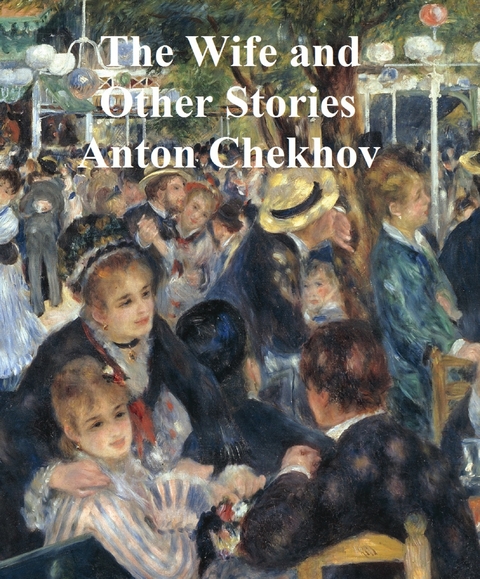
Wife and Other Stories (eBook)
737 Seiten
Seltzer Books (Verlag)
978-1-4553-9256-8 (ISBN)
This collection includes: The Wife, Difficult People, The Grasshopper, A Dreary Story, The Privy Councilor, The Man in Case, Gooseberries, About Love, and The Lottery Ticket. According to Wikipedia: "e;Anton Pavlovich Chekhov (1860 - 1904) was a Russian short-story writer, playwright and physician, considered to be one of the greatest short-story writers in world literature. His career as a dramatist produced four classics and his best short stories are held in high esteem by writers and critics Chekhov practised as a doctor throughout most of his literary career: "e;Medicine is my lawful wife,"e; he once said, "e;and literature is my mistress."e; Chekhov renounced the theatre after the disastrous reception of The Seagull in 1896; but the play was revived to acclaim in 1898 by Constantin Stanislavski's Moscow Art Theatre, which subsequently also produced Uncle Vanya and premiered Chekhov's last two plays, Three Sisters and The Cherry Orchard. These four works present a special challenge to the acting ensemble as well as to audiences, because in place of conventional action Chekhov offers a "e;theatre of mood"e; and a "e;submerged life in the text."e; Chekhov had at first written stories only for the money, but as his artistic ambition grew, he made formal innovations which have influenced the evolution of the modern short story. His originality consists in an early use of the stream-of-consciousness technique, later adopted by James Joyce and other modernists, combined with a disavowal of the moral finality of traditional story structure He made no apologies for the difficulties this posed to readers, insisting that the role of an artist was to ask questions, not to answer them."e;
A DREARY STORY
FROM THE NOTEBOOK OF AN OLD MAN
I
THERE is in Russia an emeritus Professor Nikolay Stepanovitch, a chevalier and privy councillor; he has so many Russian and foreign decorations that when he has occasion to put them on the students nickname him "The Ikonstand." His acquaintances are of the most aristocratic; for the last twenty-five or thirty years, at any rate, there has not been one single distinguished man of learning in Russia with whom he has not been intimately acquainted. There is no one for him to make friends with nowadays; but if we turn to the past, the long list of his famous friends winds up with such names as Pirogov, Kavelin, and the poet Nekrasov, all of whom bestowed upon him a warm and sincere affection. He is a member of all the Russian and of three foreign universities. And so on, and so on. All that and a great deal more that might be said makes up what is called my "name."
That is my name as known to the public. In Russia it is known to every educated man, and abroad it is mentioned in the lecture-room with the addition "honoured and distinguished." It is one of those fortunate names to abuse which or to take which in vain, in public or in print, is considered a sign of bad taste. And that is as it should be. You see, my name is closely associated with the conception of a highly distinguished man of great gifts and unquestionable usefulness. I have the industry and power of endurance of a camel, and that is important, and I have talent, which is even more important. Moreover, while I am on this subject, I am a well-educated, modest, and honest fellow. I have never poked my nose into literature or politics; I have never sought popularity in polemics with the ignorant; I have never made speeches either at public dinners or at the funerals of my friends. . . . In fact, there is no slur on my learned name, and there is no complaint one can make against it. It is fortunate.
The bearer of that name, that is I, see myself as a man of sixty-two, with a bald head, with false teeth, and with an incurable tic douloureux. I am myself as dingy and unsightly as my name is brilliant and splendid. My head and my hands tremble with weakness; my neck, as Turgenev says of one of his heroines, is like the handle of a double bass; my chest is hollow; my shoulders narrow; when I talk or lecture, my mouth turns down at one corner; when I smile, my whole face is covered with aged-looking, deathly wrinkles. There is nothing impressive about my pitiful figure; only, perhaps, when I have an attack of tic douloureux my face wears a peculiar expression, the sight of which must have roused in every one the grim and impressive thought, "Evidently that man will soon die."
I still, as in the past, lecture fairly well; I can still, as in the past, hold the attention of my listeners for a couple of hours. My fervour, the literary skill of my exposition, and my humour, almost efface the defects of my voice, though it is harsh, dry, and monotonous as a praying beggar's. I write poorly. That bit of my brain which presides over the faculty of authorship refuses to work. My memory has grown weak; there is a lack of sequence in my ideas, and when I put them on paper it always seems to me that I have lost the instinct for their organic connection; my construction is monotonous; my language is poor and timid. Often I write what I do not mean; I have forgotten the beginning when I am writing the end. Often I forget ordinary words, and I always have to waste a great deal of energy in avoiding superfluous phrases and unnecessary parentheses in my letters, both unmistakable proofs of a decline in mental activity. And it is noteworthy that the simpler the letter the more painful the effort to write it. At a scientific article I feel far more intelligent and at ease than at a letter of congratulation or a minute of proceedings. Another point: I find it easier to write German or English than to write Russian.
As regards my present manner of life, I must give a foremost place to the insomnia from which I have suffered of late. If I were asked what constituted the chief and fundamental feature of my existence now, I should answer, Insomnia. As in the past, from habit I undress and go to bed exactly at midnight. I fall asleep quickly, but before two o'clock I wake up and feel as though I had not slept at all. Sometimes I get out of bed and light a lamp. For an hour or two I walk up and down the room looking at the familiar photographs and pictures. When I am weary of walking about, I sit down to my table. I sit motionless, thinking of nothing, conscious of no inclination; if a book is lying before me, I mechanically move it closer and read it without any interest -- in that way not long ago I mechanically read through in one night a whole novel, with the strange title "The Song the Lark was Singing"; or to occupy my attention I force myself to count to a thousand; or I imagine the face of one of my colleagues and begin trying to remember in what year and under what circumstances he entered the service. I like listening to sounds. Two rooms away from me my daughter Liza says something rapidly in her sleep, or my wife crosses the drawing-room with a candle and invariably drops the matchbox; or a warped cupboard creaks; or the burner of the lamp suddenly begins to hum -- and all these sounds, for some reason, excite me.
To lie awake at night means to be at every moment conscious of being abnormal, and so I look forward with impatience to the morning and the day when I have a right to be awake. Many wearisome hours pass before the cock crows in the yard. He is my first bringer of good tidings. As soon as he crows I know that within an hour the porter will wake up below, and, coughing angrily, will go upstairs to fetch something. And then a pale light will begin gradually glimmering at the windows, voices will sound in the street. . . .
The day begins for me with the entrance of my wife. She comes in to me in her petticoat, before she has done her hair, but after she has washed, smelling of flower-scented eau-de-Cologne, looking as though she had come in by chance. Every time she says exactly the same thing: "Excuse me, I have just come in for a minute. . . . Have you had a bad night again?"
Then she puts out the lamp, sits down near the table, and begins talking. I am no prophet, but I know what she will talk about. Every morning it is exactly the same thing. Usually, after anxious inquiries concerning my health, she suddenly mentions our son who is an officer serving at Warsaw. After the twentieth of each month we send him fifty roubles, and that serves as the chief topic of our conversation.
"Of course it is difficult for us," my wife would sigh, "but until he is completely on his own feet it is our duty to help him. The boy is among strangers, his pay is small. . . . However, if you like, next month we won't send him fifty, but forty. What do you think?"
Daily experience might have taught my wife that constantly talking of our expenses does not reduce them, but my wife refuses to learn by experience, and regularly every morning discusses our officer son, and tells me that bread, thank God, is cheaper, while sugar is a halfpenny dearer -- with a tone and an air as though she were communicating interesting news.
I listen, mechanically assent, and probably because I have had a bad night, strange and inappropriate thoughts intrude themselves upon me. I gaze at my wife and wonder like a child. I ask myself in perplexity, is it possible that this old, very stout, ungainly woman, with her dull expression of petty anxiety and alarm about daily bread, with eyes dimmed by continual brooding over debts and money difficulties, who can talk of nothing but expenses and who smiles at nothing but things getting cheaper -- is it possible that this woman is no other than the slender Varya whom I fell in love with so passionately for her fine, clear intelligence, for her pure soul, her beauty, and, as Othello his Desdemona, for her "sympathy" for my studies? Could that woman be no other than the Varya who had once borne me a son?
I look with strained attention into the face of this flabby, spiritless, clumsy old woman, seeking in her my Varya, but of her past self nothing is left but her anxiety over my health and her manner of calling my salary "our salary," and my cap "our cap." It is painful for me to look at her, and, to give her what little comfort I can, I let her say what she likes, and say nothing even when she passes unjust criticisms on other people or pitches into me for not having a private practice or not publishing text-books.
Our conversation always ends in the same way. My wife suddenly remembers with dismay that I have not had my tea.
"What am I thinking about, sitting here?" she says, getting up. "The samovar has been on the table ever so long, and here I stay gossiping. My goodness! how forgetful I am growing!"
She goes out quickly, and stops in the doorway to say:
"We owe Yegor five months' wages. Did you know it? You mustn't let the servants' wages run on; how many times I have said it! It's much easier to pay ten roubles a month than fifty roubles every five months!"
As she goes out, she stops to say:
"The person I am sorriest for is our Liza. The girl studies at the Conservatoire, always mixes with people of good position, and goodness...
| Erscheint lt. Verlag | 1.3.2018 |
|---|---|
| Übersetzer | ANTON CHEKHOV |
| Sprache | englisch |
| Themenwelt | Literatur ► Anthologien |
| Literatur ► Klassiker / Moderne Klassiker | |
| Literatur ► Romane / Erzählungen | |
| ISBN-10 | 1-4553-9256-1 / 1455392561 |
| ISBN-13 | 978-1-4553-9256-8 / 9781455392568 |
| Informationen gemäß Produktsicherheitsverordnung (GPSR) | |
| Haben Sie eine Frage zum Produkt? |
 EPUB (Adobe DRM)
Größe: 736 KB
Kopierschutz: Adobe-DRM
Adobe-DRM ist ein Kopierschutz, der das eBook vor Mißbrauch schützen soll. Dabei wird das eBook bereits beim Download auf Ihre persönliche Adobe-ID autorisiert. Lesen können Sie das eBook dann nur auf den Geräten, welche ebenfalls auf Ihre Adobe-ID registriert sind.
Details zum Adobe-DRM
Dateiformat: EPUB (Electronic Publication)
EPUB ist ein offener Standard für eBooks und eignet sich besonders zur Darstellung von Belletristik und Sachbüchern. Der Fließtext wird dynamisch an die Display- und Schriftgröße angepasst. Auch für mobile Lesegeräte ist EPUB daher gut geeignet.
Systemvoraussetzungen:
PC/Mac: Mit einem PC oder Mac können Sie dieses eBook lesen. Sie benötigen eine
eReader: Dieses eBook kann mit (fast) allen eBook-Readern gelesen werden. Mit dem amazon-Kindle ist es aber nicht kompatibel.
Smartphone/Tablet: Egal ob Apple oder Android, dieses eBook können Sie lesen. Sie benötigen eine
Geräteliste und zusätzliche Hinweise
Buying eBooks from abroad
For tax law reasons we can sell eBooks just within Germany and Switzerland. Regrettably we cannot fulfill eBook-orders from other countries.
EPUB (Ohne DRM)Digital Rights Management: ohne DRM
Dieses eBook enthält kein DRM oder Kopierschutz. Eine Weitergabe an Dritte ist jedoch rechtlich nicht zulässig, weil Sie beim Kauf nur die Rechte an der persönlichen Nutzung erwerben.
Dateiformat: EPUB (Electronic Publication)
EPUB ist ein offener Standard für eBooks und eignet sich besonders zur Darstellung von Belletristik und Sachbüchern. Der Fließtext wird dynamisch an die Display- und Schriftgröße angepasst. Auch für mobile Lesegeräte ist EPUB daher gut geeignet.
Systemvoraussetzungen:
PC/Mac: Mit einem PC oder Mac können Sie dieses eBook lesen. Sie benötigen dafür die kostenlose Software Adobe Digital Editions.
eReader: Dieses eBook kann mit (fast) allen eBook-Readern gelesen werden. Mit dem amazon-Kindle ist es aber nicht kompatibel.
Smartphone/Tablet: Egal ob Apple oder Android, dieses eBook können Sie lesen. Sie benötigen dafür eine kostenlose App.
Geräteliste und zusätzliche Hinweise
Buying eBooks from abroad
For tax law reasons we can sell eBooks just within Germany and Switzerland. Regrettably we cannot fulfill eBook-orders from other countries.
aus dem Bereich