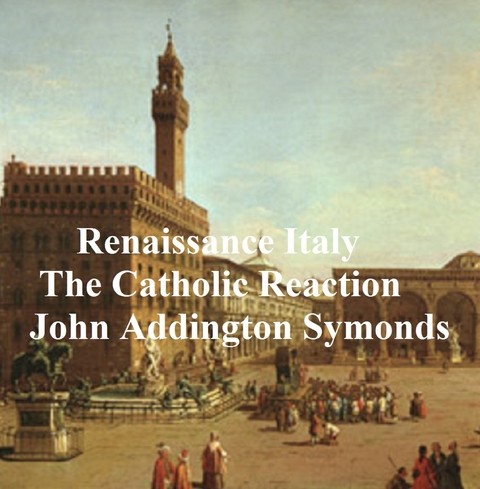
Renaissance in Italy: The Catholic Reaction (eBook)
791 Seiten
Seltzer Books (Verlag)
978-1-4553-2552-8 (ISBN)
According to Wikipedia: 'John Addington Symonds (5 October 1840 - 19 April 1893) was an English poet and literary critic... Meanwhile he was occupied with his major work, Renaissance in Italy, which appeared in seven volumes at intervals between 1875 and 1886. The Renaissance had been the subject of Symonds' prize essay at Oxford, and this had aroused a desire to produce a more complete picture of the reawakening of art and literature in Europe... He practically made his home at Davos. A charming picture of his life there is drawn in Our Life in the Swiss Highlands (1891). Symonds became a citizen of the town; he took part in its municipal business, made friends with the peasants and shared their interests. There he wrote most of his books: biographies of Shelley (1878), Philip Sidney (1886), Ben Jonson (1886) and Michelangelo (1893), several volumes of poetry and essays, and a translation of the Autobiography of Benvenuto Cellini (1887). There, too, he completed his study of the Renaissance, the work for which he is mainly remembered.'
According to Wikipedia: "e;John Addington Symonds (5 October 1840 - 19 April 1893) was an English poet and literary critic... Meanwhile he was occupied with his major work, Renaissance in Italy, which appeared in seven volumes at intervals between 1875 and 1886. The Renaissance had been the subject of Symonds' prize essay at Oxford, and this had aroused a desire to produce a more complete picture of the reawakening of art and literature in Europe... He practically made his home at Davos. A charming picture of his life there is drawn in Our Life in the Swiss Highlands (1891). Symonds became a citizen of the town; he took part in its municipal business, made friends with the peasants and shared their interests. There he wrote most of his books: biographies of Shelley (1878), Philip Sidney (1886), Ben Jonson (1886) and Michelangelo (1893), several volumes of poetry and essays, and a translation of the Autobiography of Benvenuto Cellini (1887). There, too, he completed his study of the Renaissance, the work for which he is mainly remembered."e;
CHAPTER II. THE PAPACY AND THE TRIDENTINE COUNCIL.
The Counter-Reformation--Its Intellectual and Moral Character--Causes of the Gradual Extinction of Renaissance Energy--Transition from the Renaissance to the Catholic Revival--New Religious Spirit in Italy--Attitude of Italians toward German Reformation--Oratory of Divine Love--Gasparo Contarini and the Moderate Reformers--New Religious Orders--Paul III.--His early History and Education--Political Attitude between France and Spain--Creation of the Duchy of Parma--Imminence of a General Council--Review of previous Councils--Paul's Uneasiness--Opens a Council at Trent in 1542--Protestants virtually excluded, and Catholic Dogmas confirmed in the first Sessions--Death of Paul in 1549--Julius III.--Paul IV.--Character and Ruling Passions of G.P. Caraffa--His Futile Opposition to Spain--Tyranny of his Nephews--Their Downfall--Paul Devotes himself to Church Reform and the Inquisition--Pius IV.--His Minister Morone--Diplomatic Temper of this Pope--His Management of the Council--Assistance rendered by his nephew Carlo Borromeo--Alarming State of Northern Europe--The Council reopened at Trent in 1562--Subsequent History of the Council--It closes with a complete Papal Triumph in 1563--Place of Pius IV. in History--Pius V.--The Inquisitor Pope--Population of Rome--Social Corruption--Sale of Offices and Justice--Tridentine Reforms depress Wealth--Ascetic Purity of Manners becomes fashionable--- Piety--The Catholic Reaction generates the Counter-Reformation--Battle of Lepanto--Gregory XIII.--His Relatives--Policy of Enriching the Church at Expense of the Barons--Brigandage in States of the Church--Sixtus V.--His Stern Justice--Rigid Economy--Great Public Works--Taxation--The City of Rome assumes its present form--Nepotism in the Counter-Reformation Period--Various Estimates of the Wealth accumulated by Papal Nephews--Rise of Princely Roman Families.
It is not easy to define the intellectual and moral changes which passed over Italy in the period of the Counter-Reformation[7]; it is still less easy to refer those changes to distinct causes. Yet some analysis tending toward such definition is demanded from a writer who has undertaken to treat of Italian culture and manners between the years 1530 and 1600.
In the last chapter I attempted to describe the depth of servitude to which the States of Italy were severally reduced at the end of the wars between France and Spain. The desolation of the country, the loss of national independence, and the dominance of an alien race, can be counted among the most important of those influences which produced the changes in question. Whatever opinions we may hold regarding the connection between political autonomy and mental vigor in a people, it can hardly be disputed that a sudden and universal extinction of liberty must be injurious to arts and studies that have grown up under free institutions.
But there were other causes at work. Among these a prominent place should be given to an alteration in the intellectual interests of the Italians themselves. The original impulses of the Renaissance, in scholarship, painting, sculpture, architecture, and vernacular poetry, had been exhausted.
[Footnote 7: I may here state that I intend to use this term Counter-Reformation to denote the reform of the Catholic Church, which was stimulated by the German Reformation, and which, when the Council of Trent had fixed the dogmas and discipline of Latin Christianity, enabled the Papacy to assume a militant policy in Europe, whereby it regained a large portion of the provinces, that had previously lapsed to Lutheran and Calvinistic dissent.]
Humanism, after recovering the classics and forming a new ideal of culture, was sinking into pedantry and academic erudition. Painting and sculpture, having culminated in the great work of Michelangelo, tended toward a kind of empty mannerism. Architecture settled down into the types fixed by Palladio and Barozzi. Poetry seemed to have reached its highest point of development in Ariosto. The main motives supplied to art by mediaeval traditions and humanistic enthusiasm were worked out. Nor was this all. The Renaissance had created a critical spirit which penetrated every branch of art and letters. It was not possible to advance further on the old lines; yet painters, sculptors, architects, and poets of the rising generation had before their eyes the masterpieces of their predecessors, in their minds the precepts of the learned. All alike were rendered awkward and self-conscious by the sense of laboring at a disadvantage, and by the dread of academical censorship.
In truth, this critical spirit, which was the final product of the Renaissance in Italy, favored the development of new powers in the nation: it hampered workers in the elder spheres of art, literature, and scholarship; but it set thinkers upon the track of those investigations which we call scientific. I shall endeavor, in a future chapter, to show how the Italians were now upon the point of carrying the ardor of the Renaissance into fresh fields of physical discovery and speculation, when their evolution was suspended by the Catholic Reaction. But here it must suffice to observe that formalism had succeeded by the operation of natural influences to the vigor and inventiveness of the national genius in the main departments of literature and fine art.
If we study the development of other European races, we shall find that each of them in turn, at its due season, passed through similar phases. The mediaeval period ends in the efflorescence of a new delightful energy, which gives a Rabelais, a Shakspere, a Cervantes to the world. The Renaissance riots itself away in Marinism, Gongorism, Euphuism, and the affectations of the Hotel Rambouillet. This age is succeeded by a colder, more critical, more formal age of obedience to fixed canons, during which scholarly efforts are made to purify style and impose laws on taste. The ensuing period of sense is also marked by profounder inquiries into nature and more exact analysis of mental operations. The correct school of poets, culminating in Dryden and Pope, holds sway in England; while Newton, Locke, and Bentley extend the sphere of science. In France the age of Rabelais and Montaigne yields place to the age of Racine and Descartes. Germany was so distracted by religious wars, Spain was so down-trodden by the Inquisition, that they do not offer equally luminous examples.[8] It may be added that in all these nations the end of the eighteenth and the beginning of the nineteenth centuries are marked by a similar revolt against formality and common sense, to which we give the name of the Romantic movement.
[Footnote 8: With regard to Germany, see Mr. T. S. Perry's acute and philosophical study, entitled From Opitz to Lessing (Boston).]
Quitting this sphere of speculation, we may next point out that the European system had undergone an incalculable process of transformation. Powerful nationalities were in existence, who, having received their education from Italy, were now beginning to think and express thought with marked originality. The Italians stood no longer in a relation of uncontested intellectual superiority to these peoples, while they met them under decided disadvantages at all points of political efficiency. The Mediterranean had ceased to be the high road of commercial enterprise and naval energy. Charles V.'s famous device of the two columns, with its motto Plus Ultra, indicated that illimitable horizons had been opened, that an age had begun in which Spain, England and Holland should dispute the sovereignty of the Atlantic and Pacific oceans. Italy was left, with diminished forces of resistance, to bear the brunt of Turk and Arab depredations. The point of gravity in the civilized world had shifted. The Occidental nations looked no longer toward the South of Europe.
While these various causes were in operation, Catholic Christianity showed signs of re-wakening. The Reformation called forth a new and sincere spirit in the Latin Church; new antagonisms were evoked, and new efforts after self-preservation had to be made by the Papal hierarchy. The center of the world-wide movement which is termed the Counter-Reformation was naturally Rome. Events had brought the Holy See once more into a position of prominence. It was more powerful as an Italian State now, through the support of Spain and the extinction of national independence, than at any previous period of history. In Catholic Christendom its prestige was immensely augmented by the Council of Trent. At the same epoch, the foreigners who dominated Italy, threw themselves with the enthusiasm of fanaticism into this Revival. Spain furnished Rome with the militia of the Jesuits and with the engines of the Inquisition. The Papacy was thus able to secure successes in Italy which were elsewhere only partially achieved. It followed that the moral, social, political and intellectual activities of the Italians at this period were controlled and colored by influences hostile to the earlier Renaissance. Italy underwent a metamorphosis, prescribed by the Papacy and enforced by Spanish rule. In the process of this transformation the people submitted to rigid ecclesiastical discipline, and adopted, without assimilating, the customs of a foreign troop of despots.
At first sight we may wonder that the race which had shone with such incomparable luster from Dante to Ariosto, and which had done so much to create...
| Erscheint lt. Verlag | 1.3.2018 |
|---|---|
| Sprache | englisch |
| Themenwelt | Literatur ► Briefe / Tagebücher |
| Kunst / Musik / Theater ► Kunstgeschichte / Kunststile | |
| Kunst / Musik / Theater ► Malerei / Plastik | |
| ISBN-10 | 1-4553-2552-X / 145532552X |
| ISBN-13 | 978-1-4553-2552-8 / 9781455325528 |
| Informationen gemäß Produktsicherheitsverordnung (GPSR) | |
| Haben Sie eine Frage zum Produkt? |
 EPUB (Adobe DRM)
Größe: 791 KB
Kopierschutz: Adobe-DRM
Adobe-DRM ist ein Kopierschutz, der das eBook vor Mißbrauch schützen soll. Dabei wird das eBook bereits beim Download auf Ihre persönliche Adobe-ID autorisiert. Lesen können Sie das eBook dann nur auf den Geräten, welche ebenfalls auf Ihre Adobe-ID registriert sind.
Details zum Adobe-DRM
Dateiformat: EPUB (Electronic Publication)
EPUB ist ein offener Standard für eBooks und eignet sich besonders zur Darstellung von Belletristik und Sachbüchern. Der Fließtext wird dynamisch an die Display- und Schriftgröße angepasst. Auch für mobile Lesegeräte ist EPUB daher gut geeignet.
Systemvoraussetzungen:
PC/Mac: Mit einem PC oder Mac können Sie dieses eBook lesen. Sie benötigen eine
eReader: Dieses eBook kann mit (fast) allen eBook-Readern gelesen werden. Mit dem amazon-Kindle ist es aber nicht kompatibel.
Smartphone/Tablet: Egal ob Apple oder Android, dieses eBook können Sie lesen. Sie benötigen eine
Geräteliste und zusätzliche Hinweise
Buying eBooks from abroad
For tax law reasons we can sell eBooks just within Germany and Switzerland. Regrettably we cannot fulfill eBook-orders from other countries.
EPUB (Ohne DRM)Digital Rights Management: ohne DRM
Dieses eBook enthält kein DRM oder Kopierschutz. Eine Weitergabe an Dritte ist jedoch rechtlich nicht zulässig, weil Sie beim Kauf nur die Rechte an der persönlichen Nutzung erwerben.
Dateiformat: EPUB (Electronic Publication)
EPUB ist ein offener Standard für eBooks und eignet sich besonders zur Darstellung von Belletristik und Sachbüchern. Der Fließtext wird dynamisch an die Display- und Schriftgröße angepasst. Auch für mobile Lesegeräte ist EPUB daher gut geeignet.
Systemvoraussetzungen:
PC/Mac: Mit einem PC oder Mac können Sie dieses eBook lesen. Sie benötigen dafür die kostenlose Software Adobe Digital Editions.
eReader: Dieses eBook kann mit (fast) allen eBook-Readern gelesen werden. Mit dem amazon-Kindle ist es aber nicht kompatibel.
Smartphone/Tablet: Egal ob Apple oder Android, dieses eBook können Sie lesen. Sie benötigen dafür eine kostenlose App.
Geräteliste und zusätzliche Hinweise
Buying eBooks from abroad
For tax law reasons we can sell eBooks just within Germany and Switzerland. Regrettably we cannot fulfill eBook-orders from other countries.
aus dem Bereich