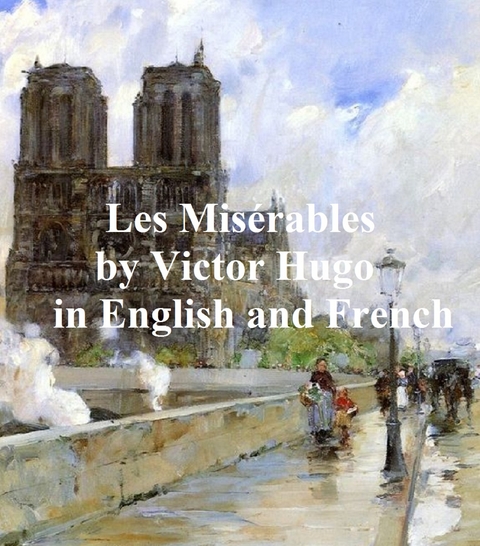
Les Miserables (eBook)
2897 Seiten
Seltzer Books (Verlag)
978-1-4554-2574-7 (ISBN)
Selon Wikipédia: 'Les Misérables, traduits différemment des Français comme Les Miserables, Les Misérables, Les Pauvres, Les Misérables Pauvres, ou Les Victimes', est un roman français de 1862 par l'auteur Victor Hugo et est largement considéré comme l'un des Il suit les vies et les interactions de plusieurs personnages français au cours d'une période de dix-sept ans au début du dix-neuvième siècle, à partir de 1815 et jusqu'à la rébellion de juin 1832 ... Les Misérables sont connus par beaucoup de nombreuses adaptations scéniques et scéniques, notamment la comédie musicale de scène du même nom. 'Selon Wikipédia: 'Les Misérables, traduits différemment des Français comme Les Miserables, Les Misérables, Les Pauvres, Les Misérables Pauvres, ou Les Victimes', est un roman français de 1862 par l'auteur Victor Hugo et est largement considéré comme l'un des Il suit les vies et les interactions de plusieurs personnages français au cours d'une période de dix-sept ans au début du dix-neuvième siècle, à partir de 1815 et jusqu'à la rébellion de juin 1832 ... Les Misérables sont connus par beaucoup de nombreuses adaptations scéniques et scéniques, notamment la comédie musicale de scène du même nom. '
Selon Wikipedia: "e;Les Miserables, traduits differemment des Francais comme Les Miserables, Les Miserables, Les Pauvres, Les Miserables Pauvres, ou Les Victimes"e;, est un roman francais de 1862 par l'auteur Victor Hugo et est largement considere comme l'un des Il suit les vies et les interactions de plusieurs personnages francais au cours d'une periode de dix-sept ans au debut du dix-neuvieme siecle, a partir de 1815 et jusqu'a la rebellion de juin 1832 ... Les Miserables sont connus par beaucoup de nombreuses adaptations sceniques et sceniques, notamment la comedie musicale de scene du meme nom. "e;Selon Wikipedia: "e;Les Miserables, traduits differemment des Francais comme Les Miserables, Les Miserables, Les Pauvres, Les Miserables Pauvres, ou Les Victimes"e;, est un roman francais de 1862 par l'auteur Victor Hugo et est largement considere comme l'un des Il suit les vies et les interactions de plusieurs personnages francais au cours d'une periode de dix-sept ans au debut du dix-neuvieme siecle, a partir de 1815 et jusqu'a la rebellion de juin 1832 ... Les Miserables sont connus par beaucoup de nombreuses adaptations sceniques et sceniques, notamment la comedie musicale de scene du meme nom. "e;
CHAPTER II PRUDENCE COUNSELLED TO WISDOM.
That evening, the Bishop of D----, after his promenade through the town, remained shut up rather late in his room. He was busy over a great work on Duties, which was never completed, unfortunately. He was carefully compiling everything that the Fathers and the doctors have said on this important subject. His book was divided into two parts: firstly, the duties of all; secondly, the duties of each individual, according to the class to which he belongs. The duties of all are the great duties. There are four of these. Saint Matthew points them out: duties towards God (Matt. vi.); duties towards one's self (Matt. v. 29, 30); duties towards one's neighbor (Matt. vii. 12); duties towards animals (Matt. vi. 20, 25). As for the other duties the Bishop found them pointed out and prescribed elsewhere: to sovereigns and subjects, in the Epistle to the Romans; to magistrates, to wives, to mothers, to young men, by Saint Peter; to husbands, fathers, children and servants, in the Epistle to the Ephesians; to the faithful, in the Epistle to the Hebrews; to virgins, in the Epistle to the Corinthians. Out of these precepts he was laboriously constructing a harmonious whole, which he desired to present to souls.
At eight o'clock he was still at work, writing with a good deal of inconvenience upon little squares of paper, with a big book open on his knees, when Madame Magloire entered, according to her wont, to get the silver-ware from the cupboard near his bed. A moment later, the Bishop, knowing that the table was set, and that his sister was probably waiting for him, shut his book, rose from his table, and entered the dining-room.
The dining-room was an oblong apartment, with a fireplace, which had a door opening on the street (as we have said), and a window opening on the garden.
Madame Magloire was, in fact, just putting the last touches to the table.
As she performed this service, she was conversing with Mademoiselle Baptistine.
A lamp stood on the table; the table was near the fireplace. A wood fire was burning there.
One can easily picture to one's self these two women, both of whom were over sixty years of age. Madame Magloire small, plump, vivacious; Mademoiselle Baptistine gentle, slender, frail, somewhat taller than her brother, dressed in a gown of puce-colored silk, of the fashion of 1806, which she had purchased at that date in Paris, and which had lasted ever since. To borrow vulgar phrases, which possess the merit of giving utterance in a single word to an idea which a whole page would hardly suffice to express, Madame Magloire had the air of a peasant, and Mademoiselle Baptistine that of a lady. Madame Magloire wore a white quilted cap, a gold Jeannette cross on a velvet ribbon upon her neck, the only bit of feminine jewelry that there was in the house, a very white fichu puffing out from a gown of coarse black woollen stuff, with large, short sleeves, an apron of cotton cloth in red and green checks, knotted round the waist with a green ribbon, with a stomacher of the same attached by two pins at the upper corners, coarse shoes on her feet, and yellow stockings, like the women of Marseilles. Mademoiselle Baptistine's gown was cut on the patterns of 1806, with a short waist, a narrow, sheath-like skirt, puffed sleeves, with flaps and buttons. She concealed her gray hair under a frizzed wig known as the baby wig. Madame Magloire had an intelligent, vivacious, and kindly air; the two corners of her mouth unequally raised, and her upper lip, which was larger than the lower, imparted to her a rather crabbed and imperious look. So long as Monseigneur held his peace, she talked to him resolutely with a mixture of respect and freedom; but as soon as Monseigneur began to speak, as we have seen, she obeyed passively like her mistress. Mademoiselle Baptistine did not even speak. She confined herself to obeying and pleasing him. She had never been pretty, even when she was young; she had large, blue, prominent eyes, and a long arched nose; but her whole visage, her whole person, breathed forth an ineffable goodness, as we stated in the beginning. She had always been predestined to gentleness; but faith, charity, hope, those three virtues which mildly warm the soul, had gradually elevated that gentleness to sanctity. Nature had made her a lamb, religion had made her an angel. Poor sainted virgin! Sweet memory which has vanished!
Mademoiselle Baptistine has so often narrated what passed at the episcopal residence that evening, that there are many people now living who still recall the most minute details.
At the moment when the Bishop entered, Madame Magloire was talking with considerable vivacity. She was haranguing Mademoiselle Baptistine on a subject which was familiar to her and to which the Bishop was also accustomed. The question concerned the lock upon the entrance door.
It appears that while procuring some provisions for supper, Madame Magloire had heard things in divers places. People had spoken of a prowler of evil appearance; a suspicious vagabond had arrived who must be somewhere about the town, and those who should take it into their heads to return home late that night might be subjected to unpleasant encounters. The police was very badly organized, moreover, because there was no love lost between the Prefect and the Mayor, who sought to injure each other by making things happen. It behooved wise people to play the part of their own police, and to guard themselves well, and care must be taken to duly close, bar and barricade their houses, and to fasten the doors well.
Madame Magloire emphasized these last words; but the Bishop had just come from his room, where it was rather cold. He seated himself in front of the fire, and warmed himself, and then fell to thinking of other things. He did not take up the remark dropped with design by Madame Magloire. She repeated it. Then Mademoiselle Baptistine, desirous of satisfying Madame Magloire without displeasing her brother, ventured to say timidly:--
"Did you hear what Madame Magloire is saying, brother?"
"I have heard something of it in a vague way," replied the Bishop. Then half-turning in his chair, placing his hands on his knees, and raising towards the old servant woman his cordial face, which so easily grew joyous, and which was illuminated from below by the firelight,--"Come, what is the matter? What is the matter? Are we in any great danger?"
Then Madame Magloire began the whole story afresh, exaggerating it a little without being aware of the fact. It appeared that a Bohemian, a bare-footed vagabond, a sort of dangerous mendicant, was at that moment in the town. He had presented himself at Jacquin Labarre's to obtain lodgings, but the latter had not been willing to take him in. He had been seen to arrive by the way of the boulevard Gassendi and roam about the streets in the gloaming. A gallows-bird with a terrible face.
"Really!" said the Bishop.
This willingness to interrogate encouraged Madame Magloire; it seemed to her to indicate that the Bishop was on the point of becoming alarmed; she pursued triumphantly:--
"Yes, Monseigneur. That is how it is. There will be some sort of catastrophe in this town to-night. Every one says so. And withal, the police is so badly regulated" (a useful repetition). "The idea of living in a mountainous country, and not even having lights in the streets at night! One goes out. Black as ovens, indeed! And I say, Monseigneur, and Mademoiselle there says with me--"
"I," interrupted his sister, "say nothing. What my brother does is well done."
Madame Magloire continued as though there had been no protest:--
"We say that this house is not safe at all; that if Monseigneur will permit, I will go and tell Paulin Musebois, the locksmith, to come and replace the ancient locks on the doors; we have them, and it is only the work of a moment; for I say that nothing is more terrible than a door which can be opened from the outside with a latch by the first passer-by; and I say that we need bolts, Monseigneur, if only for this night; moreover, Monseigneur has the habit of always saying `come in'; and besides, even in the middle of the night, O mon Dieu! there is no need to ask permission."
At that moment there came a tolerably violent knock on the door.
"Come in," said the Bishop.
CHAPTER III THE HEROISM OF PASSIVE OBEDIENCE.
The door opened.
It opened wide with a rapid movement, as though some one had given it an energetic and resolute push.
A man entered.
We already know the man. It was the wayfarer whom we have seen wandering about in search of shelter.
He entered, advanced a step, and halted, leaving the door open behind him. He had his knapsack on his shoulders, his cudgel in his hand, a rough, audacious, weary, and violent expression in his eyes. The fire on the hearth lighted him up. He was hideous. It was a sinister...
| Erscheint lt. Verlag | 1.3.2018 |
|---|---|
| Sprache | englisch |
| Themenwelt | Literatur ► Anthologien |
| Literatur ► Klassiker / Moderne Klassiker | |
| Literatur ► Romane / Erzählungen | |
| ISBN-10 | 1-4554-2574-5 / 1455425745 |
| ISBN-13 | 978-1-4554-2574-7 / 9781455425747 |
| Informationen gemäß Produktsicherheitsverordnung (GPSR) | |
| Haben Sie eine Frage zum Produkt? |
 EPUB (Adobe DRM)
Größe: 2,9 MB
Kopierschutz: Adobe-DRM
Adobe-DRM ist ein Kopierschutz, der das eBook vor Mißbrauch schützen soll. Dabei wird das eBook bereits beim Download auf Ihre persönliche Adobe-ID autorisiert. Lesen können Sie das eBook dann nur auf den Geräten, welche ebenfalls auf Ihre Adobe-ID registriert sind.
Details zum Adobe-DRM
Dateiformat: EPUB (Electronic Publication)
EPUB ist ein offener Standard für eBooks und eignet sich besonders zur Darstellung von Belletristik und Sachbüchern. Der Fließtext wird dynamisch an die Display- und Schriftgröße angepasst. Auch für mobile Lesegeräte ist EPUB daher gut geeignet.
Systemvoraussetzungen:
PC/Mac: Mit einem PC oder Mac können Sie dieses eBook lesen. Sie benötigen eine
eReader: Dieses eBook kann mit (fast) allen eBook-Readern gelesen werden. Mit dem amazon-Kindle ist es aber nicht kompatibel.
Smartphone/Tablet: Egal ob Apple oder Android, dieses eBook können Sie lesen. Sie benötigen eine
Geräteliste und zusätzliche Hinweise
Buying eBooks from abroad
For tax law reasons we can sell eBooks just within Germany and Switzerland. Regrettably we cannot fulfill eBook-orders from other countries.
EPUB (Ohne DRM)Digital Rights Management: ohne DRM
Dieses eBook enthält kein DRM oder Kopierschutz. Eine Weitergabe an Dritte ist jedoch rechtlich nicht zulässig, weil Sie beim Kauf nur die Rechte an der persönlichen Nutzung erwerben.
Dateiformat: EPUB (Electronic Publication)
EPUB ist ein offener Standard für eBooks und eignet sich besonders zur Darstellung von Belletristik und Sachbüchern. Der Fließtext wird dynamisch an die Display- und Schriftgröße angepasst. Auch für mobile Lesegeräte ist EPUB daher gut geeignet.
Systemvoraussetzungen:
PC/Mac: Mit einem PC oder Mac können Sie dieses eBook lesen. Sie benötigen dafür die kostenlose Software Adobe Digital Editions.
eReader: Dieses eBook kann mit (fast) allen eBook-Readern gelesen werden. Mit dem amazon-Kindle ist es aber nicht kompatibel.
Smartphone/Tablet: Egal ob Apple oder Android, dieses eBook können Sie lesen. Sie benötigen dafür eine kostenlose App.
Geräteliste und zusätzliche Hinweise
Buying eBooks from abroad
For tax law reasons we can sell eBooks just within Germany and Switzerland. Regrettably we cannot fulfill eBook-orders from other countries.
aus dem Bereich