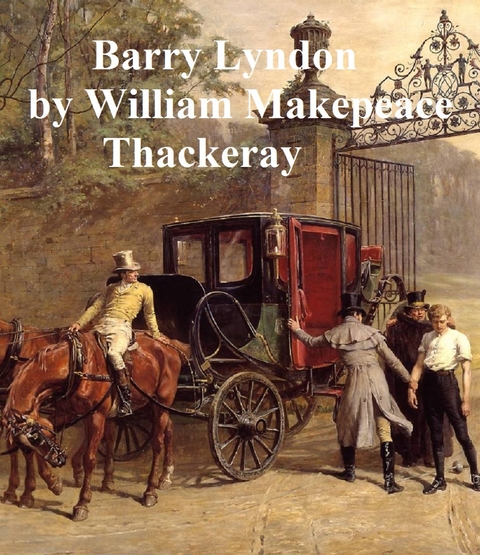
Barry Lyndon (eBook)
750 Seiten
Seltzer Books (Verlag)
978-1-4553-8925-4 (ISBN)

The classic novel. According to Wikipedia: "e;Thackeray is most often compared to one other great novelist of Victorian literature, Charles Dickens. During the Victorian era, he was ranked second only to Dickens, but he is now much less read and is known almost exclusively for Vanity Fair. In that novel he was able to satirize whole swaths of humanity while retaining a light touch. It also features his most memorable character, the engagingly roguish Becky Sharp. As a result, unlike Thackeray's other novels, it remains popular with the general reading public; it is a standard fixture in university courses and has been repeatedly adapted for movies and television. In Thackeray's own day, some commentators, such as Anthony Trollope, ranked his History of Henry Esmond as his greatest work, perhaps because it expressed Victorian values of duty and earnestness, as did some of his other later novels. It is perhaps for this reason that they have not survived as well as Vanity Fair, which satirizes those values."e;
CHAPTER VII BARRY LEADS A GARRISON LIFE, AND FINDS MANY FRIENDS THERE
After the war our regiment was garrisoned in the capital, the least dull, perhaps, of all the towns of Prussia: but that does not say much for its gaiety. Our service, which was always severe, still left many hours of the day disengaged, in which we might take our pleasure had we the means of paying for the same. Many of our mess got leave to work in trades; but I had been brought up to none: and besides, my honour forbade me; for as a gentleman, I could not soil my fingers by a manual occupation. But our pay was barely enough to keep us from starving; and as I have always been fond of pleasure, and as the position in which we now were, in the midst of the capital, prevented us from resorting to those means of levying contributions which are always pretty feasible in wartime, I was obliged to adopt the only means left me of providing for my expenses: and in a word became the ORDONNANZ, or confidential military gentleman, of my captain. I spurned the office four years previously, when it was made to me in the English service; but the position is very different in a foreign country; besides, to tell the truth, after five years in the ranks, a man's pride will submit to many rebuffs which would be intolerable to him in an independent condition.
The captain was a young man and had distinguished himself during the war, or he would never have been advanced to rank so early. He was, moreover, the nephew and heir of the Minister of Police, Monsieur de Potzdorff, a relationship which no doubt aided in the young gentleman's promotion. Captain de Potzdorff was a severe officer enough on parade or in barracks, but he was a person easily led by flattery. I won his heart in the first place by my manner of tying my hair in queue (indeed, it was more neatly dressed than that of any man in the regiment), and subsequently gained his confidence by a thousand little arts and compliments, which as a gentleman myself I knew how to employ. He was a man of pleasure, which he pursued more openly than most men in the stern Court of the King; he was generous and careless with his purse, and he had a great affection for Rhine wine: in all which qualities I sincerely sympathised with him; and from which I, of course, had my profit. He was disliked in the regiment, because he was supposed to have too intimate relations with his uncle the Police Minister; to whom, it was hinted, he carried the news of the corps.
Before long I had ingratiated myself considerably with my officer, and knew most of his affairs. Thus I was relieved from many drills and parades, which would otherwise have fallen to my lot, and came in for a number of perquisites; which enabled me to support a genteel figure and to appear with some ECLAT in a certain, though it must be confessed very humble, society in Berlin. Among the ladies I was always an especial favourite, and so polished was my behaviour amongst them, that they could not understand how I should have obtained my frightful nickname of the Black Devil in the regiment. 'He is not so black as he is painted,' I laughingly would say; and most of the ladies agreed that the private was quite as well-bred as the captain: as indeed how should it be otherwise, considering my education and birth?
When I was sufficiently ingratiated with him, I asked leave to address a letter to my poor mother in Ireland, to whom I had not given any news of myself for many many years; for the letters of the foreign soldiers were never admitted to the post, for fear of appeals or disturbances on the part of their parents abroad. My captain agreed to find means to forward the letter, and as I knew that he would open it, I took care to give it him unsealed; thus showing my confidence in him. But the letter was, as you may imagine, written so that the writer should come to no harm were it intercepted. I begged my honoured mother's forgiveness for having fled from her; I said that my extravagance and folly in my own country I knew rendered my return thither impossible; but that she would, at least, be glad to know that I was well and happy in the service of the greatest monarch in the world, and that the soldier's life was most agreeable to me: and, I added, that I had found a kind protector and patron, who I hoped would some day provide for me as I knew it was out of her power to do. I offered remembrances to all the girls at Castle Brady, naming them from Biddy to Becky downwards, and signed myself, as in truth I was, her affectionate son, Redmond Barry, in Captain Potzdorffs company of the Bulowisch regiment of foot in garrison at Berlin. Also I told her a pleasant story about the King kicking the Chancellor and three judges downstairs, as he had done one day when I was on guard at Potsdam, and said I hoped for another war soon, when I might rise to be an officer. In fact, you might have imagined my letter to be that of the happiest fellow in the world, and I was not on this head at all sorry to mislead my kind parent.
I was sure my letter was read, for Captain Potzdorff began asking me some days afterwards about my family, and I told him the circumstances pretty truly, all things considered. I was a cadet of a good family, but my mother was almost ruined and had barely enough to support her eight daughters, whom I named. I had been to study for the law at Dublin, where I had got into debt and bad company, had killed a man in a duel, and would be hanged or imprisoned by his powerful friends, if I returned. I had enlisted in the English service, where an opportunity for escape presented itself to me such as I could not resist; and hereupon I told the story of Mr. Fakenham of Fakenham in such a way as made my patron to be convulsed with laughter, and he told me afterwards that he had repeated the story at Madame de Kamake's evening assembly, where all the world was anxious to have a sight of the young Englander.
'Was the British Ambassador there?' I asked, in a tone of the greatest alarm, and added, 'For Heaven's sake, sir, do not tell my name to him, or he might ask to have me delivered up: and I have no fancy to go to be hanged in my dear native country.' Potzdorff, laughing, said he would take care that I should remain where I was, on which I swore eternal gratitude to him.
Some days afterwards, and with rather a grave face, he said to me, 'Redmond, I have been talking to our colonel about you, and as I wondered that a fellow of your courage and talents had not been advanced during the war, the general said they had had their eye upon you: that you were a gallant soldier, and had evidently come of a good stock; that no man in the regiment had had less fault found with him; but that no man merited promotion less. You were idle, dissolute, and unprincipled; you had done a deal of harm to the men; and, for all your talents and bravery, he was sure would come to no good.'
'Sir!' said I, quite astonished that any mortal man should have formed such an opinion of me, 'I hope General Bulow is mistaken regarding my character. I have fallen into bad company, it is true; but I have only done as other soldiers have done; and, above all, I have never had a kind friend and protector before, to whom I might show that I was worthy of better things. The general may say I am a ruined lad, and send me to the d--l: but be sure of this, I would go to the d--l to serve YOU.' This speech I saw pleased my patron very much; and, as I was very discreet and useful in a thousand delicate ways to him, he soon came to have a sincere attachment for me. One day, or rather night, when he was tete-a-tete with the lady of the Tabaks Rath von Dose for instance, I--But there is no use in telling affairs which concern nobody now.
Four months after my letter to my mother, I got, under cover to the Captain, a reply, which created in my mind a yearning after home, and a melancholy which I cannot describe. I had not seen the dear soul's writing for five years. All the old days, and the fresh happy sunshine of the old green fields in Ireland, and her love, and my uncle, and Phil Purcell, and everything that I had done and thought, came back to me as I read the letter; and when I was alone I cried over it, as I hadn't done since the day when Nora jilted me. I took care not to show my feelings to the regiment or my captain: but that night, when I was to have taken tea at the Garden-house outside Brandenburg Gate, with Fraulein Lottchen (the Tabaks Rathinn's gentlewoman of company), I somehow had not the courage to go; but begged to be excused, and went early to bed in barracks, out of which I went and came now almost as I willed, and passed a long night weeping and thinking about dear Ireland.
Next day, my spirits rose again and I got a ten-guinea bill cashed, which my mother sent in the letter, and gave a handsome treat to some of my acquaintance. The poor soul's letter was blotted all over with tears, full of texts, and written in the wildest incoherent way. She said she was delighted to think I was under a Protestant prince, though she feared he was not in the right way: that right way, she said, she had the blessing to find, under the guidance of the Reverend Joshua Jowls, whom she sat under. She said he was a precious chosen vessel; a sweet ointment and precious box of spikenard; and made use of a great number more phrases that I could not understand; but one thing was clear in the midst of all this jargon, that the good soul loved her son still, and thought and prayed day and night for her wild Redmond. Has it not come across many a poor fellow, in a solitary night's watch, or in sorrow, sickness, or captivity, that at that very minute, most likely, his mother is praying for...
| Erscheint lt. Verlag | 1.3.2018 |
|---|---|
| Sprache | englisch |
| Themenwelt | Literatur ► Anthologien |
| Literatur ► Klassiker / Moderne Klassiker | |
| Literatur ► Romane / Erzählungen | |
| ISBN-10 | 1-4553-8925-0 / 1455389250 |
| ISBN-13 | 978-1-4553-8925-4 / 9781455389254 |
| Informationen gemäß Produktsicherheitsverordnung (GPSR) | |
| Haben Sie eine Frage zum Produkt? |
 EPUB (Adobe DRM)
Größe: 750 KB
Kopierschutz: Adobe-DRM
Adobe-DRM ist ein Kopierschutz, der das eBook vor Mißbrauch schützen soll. Dabei wird das eBook bereits beim Download auf Ihre persönliche Adobe-ID autorisiert. Lesen können Sie das eBook dann nur auf den Geräten, welche ebenfalls auf Ihre Adobe-ID registriert sind.
Details zum Adobe-DRM
Dateiformat: EPUB (Electronic Publication)
EPUB ist ein offener Standard für eBooks und eignet sich besonders zur Darstellung von Belletristik und Sachbüchern. Der Fließtext wird dynamisch an die Display- und Schriftgröße angepasst. Auch für mobile Lesegeräte ist EPUB daher gut geeignet.
Systemvoraussetzungen:
PC/Mac: Mit einem PC oder Mac können Sie dieses eBook lesen. Sie benötigen eine
eReader: Dieses eBook kann mit (fast) allen eBook-Readern gelesen werden. Mit dem amazon-Kindle ist es aber nicht kompatibel.
Smartphone/Tablet: Egal ob Apple oder Android, dieses eBook können Sie lesen. Sie benötigen eine
Geräteliste und zusätzliche Hinweise
Buying eBooks from abroad
For tax law reasons we can sell eBooks just within Germany and Switzerland. Regrettably we cannot fulfill eBook-orders from other countries.
EPUB (Ohne DRM)Digital Rights Management: ohne DRM
Dieses eBook enthält kein DRM oder Kopierschutz. Eine Weitergabe an Dritte ist jedoch rechtlich nicht zulässig, weil Sie beim Kauf nur die Rechte an der persönlichen Nutzung erwerben.
Dateiformat: EPUB (Electronic Publication)
EPUB ist ein offener Standard für eBooks und eignet sich besonders zur Darstellung von Belletristik und Sachbüchern. Der Fließtext wird dynamisch an die Display- und Schriftgröße angepasst. Auch für mobile Lesegeräte ist EPUB daher gut geeignet.
Systemvoraussetzungen:
PC/Mac: Mit einem PC oder Mac können Sie dieses eBook lesen. Sie benötigen dafür die kostenlose Software Adobe Digital Editions.
eReader: Dieses eBook kann mit (fast) allen eBook-Readern gelesen werden. Mit dem amazon-Kindle ist es aber nicht kompatibel.
Smartphone/Tablet: Egal ob Apple oder Android, dieses eBook können Sie lesen. Sie benötigen dafür eine kostenlose App.
Geräteliste und zusätzliche Hinweise
Buying eBooks from abroad
For tax law reasons we can sell eBooks just within Germany and Switzerland. Regrettably we cannot fulfill eBook-orders from other countries.
aus dem Bereich