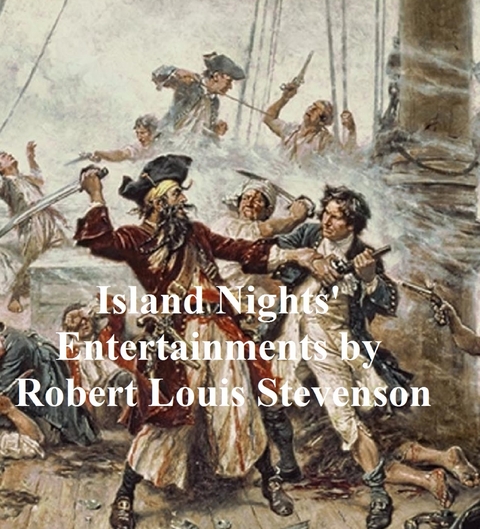
Island Nights' Entertainments (eBook)
528 Seiten
Seltzer Books (Verlag)
978-1-4553-7108-2 (ISBN)
Long stories/novellas including: The Beach at Falsea, The Bottle Imp, and The Isle of Voices According to Wikipedia: "e;Robert Louis (Balfour) Stevenson ( 1850 - 1894), was a Scottish novelist, poet, and travel writer, and a leading representative of Neo-romanticism in English literature. He was the man who "e;seemed to pick the right word up on the point of his pen, like a man playing spillikins"e;, as G. K. Chesterton put it. He was also greatly admired by many authors, including Jorge Luis Borges, Ernest Hemingway, Rudyard Kipling, Vladimir Nabokov, and J. M. Barrie. Most modernist writers dismissed him, however, because he was popular and did not write within their definition of modernism. It is only recently that critics have begun to look beyond Stevenson's popularity and allow him a place in the canon."e;
CHAPTER I. A SOUTH SEA BRIDAL.
I SAW that island first when it was neither night nor morning. The moon was to the west, setting, but still broad and bright. To the east, and right amidships of the dawn, which was all pink, the daystar sparkled like a diamond. The land breeze blew in our faces, and smelt strong of wild lime and vanilla: other things besides, but these were the most plain; and the chill of it set me sneezing. I should say I had been for years on a low island near the line, living for the most part solitary among natives. Here was a fresh experience: even the tongue would be quite strange to me; and the look of these woods and mountains, and the rare smell of them, renewed my blood.
The captain blew out the binnacle lamp.
"There!" said he, "there goes a bit of smoke, Mr. Wiltshire, behind the break of the reef. That's Falesa, where your station is, the last village to the east; nobody lives to windward - I don't know why. Take my glass, and you can make the houses out."
I took the glass; and the shores leaped nearer, and I saw the tangle of the woods and the breach of the surf, and the brown roofs and the black insides of houses peeped among the trees.
"Do you catch a bit of white there to the east'ard?" the captain continued. "That's your house. Coral built, stands high, verandah you could walk on three abreast; best station in the South Pacific. When old Adams saw it, he took and shook me by the hand. 'I've dropped into a soft thing here,' says he. - 'So you have,' says I, 'and time too!' Poor Johnny! I never saw him again but the once, and then he had changed his tune - couldn't get on with the natives, or the whites, or something; and the next time we came round there he was dead and buried. I took and put up a bit of a stick to him: 'John Adams, OBIT eighteen and sixty-eight. Go thou and do likewise.' I missed that man. I never could see much harm in Johnny."
"What did he die of?" I inquired.
"Some kind of sickness," says the captain. "It appears it took him sudden. Seems he got up in the night, and filled up on Pain-Killer and Kennedy's Discovery. No go: he was booked beyond Kennedy. Then he had tried to open a case of gin. No go again: not strong enough. Then he must have turned to and run out on the verandah, and capsized over the rail. When they found him, the next day, he was clean crazy - carried on all the time about somebody watering his copra. Poor John!"
"Was it thought to be the island?" I asked.
"Well, it was thought to be the island, or the trouble, or something," he replied. "I never could hear but what it was a healthy place. Our last man, Vigours, never turned a hair. He left because of the beach - said he was afraid of Black Jack and Case and Whistling Jimmie, who was still alive at the time, but got drowned soon afterward when drunk. As for old Captain Randall, he's been here any time since eighteen-forty, forty-five. I never could see much harm in Billy, nor much change. Seems as if he might live to be Old Kafoozleum. No, I guess it's healthy."
"There's a boat coming now," said I. "She's right in the pass; looks to be a sixteen-foot whale; two white men in the stern sheets."
"That's the boat that drowned Whistling Jimmie!" cried the Captain; "let's see the glass. Yes, that's Case, sure enough, and the darkie. They've got a gallows bad reputation, but you know what a place the beach is for talking. My belief, that Whistling Jimmie was the worst of the trouble; and he's gone to glory, you see. What'll you bet they ain't after gin? Lay you five to two they take six cases."
When these two traders came aboard I was pleased with the looks of them at once, or, rather, with the looks of both, and the speech of one. I was sick for white neighbours after my four years at the line, which I always counted years of prison; getting tabooed, and going down to the Speak House to see and get it taken off; buying gin and going on a break, and then repenting; sitting in the house at night with the lamp for company; or walking on the beach and wondering what kind of a fool to call myself for being where I was. There were no other whites upon my island, and when I sailed to the next, rough customers made the most of the society. Now to see these two when they came aboard was a pleasure. One was a negro, to be sure; but they were both rigged out smart in striped pyjamas and straw hats, and Case would have passed muster in a city. He was yellow and smallish, had a hawk's nose to his face, pale eyes, and his beard trimmed with scissors. No man knew his country, beyond he was of English speech; and it was clear he came of a good family and was splendidly educated. He was accomplished too; played the accordion first-rate; and give him a piece of string or a cork or a pack of cards, and he could show you tricks equal to any professional. He could speak, when he chose, fit for a drawing-room; and when he chose he could blaspheme worse than a Yankee boatswain, and talk smart to sicken a Kanaka. The way he thought would pay best at the moment, that was Case's way, and it always seemed to come natural, and like as if he was born to it. He had the courage of a lion and the cunning of a rat; and if he's not in hell to-day, there's no such place. I know but one good point to the man: that he was fond of his wife, and kind to her. She was a Samoa woman, and dyed her hair red, Samoa style; and when he came to die (as I have to tell of) they found one strange thing - that he had made a will, like a Christian, and the widow got the lot: all his, they said, and all Black Jack's, and the most of Billy Randall's in the bargain, for it was Case that kept the books. So she went off home in the schooner MANU'A, and does the lady to this day in her own place.
But of all this on that first morning I knew no more than a fly. Case used me like a gentleman and like a friend, made me welcome to Falesa, and put his services at my disposal, which was the more helpful from my ignorance of the native. All the better part of the day we sat drinking better acquaintance in the cabin, and I never heard a man talk more to the point. There was no smarter trader, and none dodgier, in the islands. I thought Falesa seemed to be the right kind of a place; and the more I drank the lighter my heart. Our last trader had fled the place at half an hour's notice, taking a chance passage in a labour ship from up west. The captain, when he came, had found the station closed, the keys left with the native pastor, and a letter from the runaway, confessing he was fairly frightened of his life. Since then the firm had not been represented, and of course there was no cargo. The wind, besides, was fair, the captain hoped he could make his next island by dawn, with a good tide, and the business of landing my trade was gone about lively. There was no call for me to fool with it, Case said; nobody would touch my things, everyone was honest in Falesa, only about chickens or an odd knife or an odd stick of tobacco; and the best I could do was to sit quiet till the vessel left, then come straight to his house, see old Captain Randall, the father of the beach, take pot-luck, and go home to sleep when it got dark. So it was high noon, and the schooner was under way before I set my foot on shore at Falesa.
I had a glass or two on board; I was just off a long cruise, and the ground heaved under me like a ship's deck. The world was like all new painted; my foot went along to music; Falesa might have been Fiddler's Green, if there is such a place, and more's the pity if there isn't! It was good to foot the grass, to look aloft at the green mountains, to see the men with their green wreaths and the women in their bright dresses, red and blue. On we went, in the strong sun and the cool shadow, liking both; and all the children in the town came trotting after with their shaven heads and their brown bodies, and raising a thin kind of a cheer in our wake, like crowing poultry.
"By-the-bye," says Case, "we must get you a wife."
"That's so," said I; "I had forgotten."
There was a crowd of girls about us, and I pulled myself up and looked among them like a Bashaw. They were all dressed out for the sake of the ship being in; and the women of Falesa are a handsome lot to see. If they have a fault, they are a trifle broad in...
| Erscheint lt. Verlag | 1.3.2018 |
|---|---|
| Sprache | englisch |
| Themenwelt | Literatur ► Anthologien |
| Literatur ► Klassiker / Moderne Klassiker | |
| Literatur ► Romane / Erzählungen | |
| ISBN-10 | 1-4553-7108-4 / 1455371084 |
| ISBN-13 | 978-1-4553-7108-2 / 9781455371082 |
| Informationen gemäß Produktsicherheitsverordnung (GPSR) | |
| Haben Sie eine Frage zum Produkt? |
 EPUB (Adobe DRM)
Größe: 527 KB
Kopierschutz: Adobe-DRM
Adobe-DRM ist ein Kopierschutz, der das eBook vor Mißbrauch schützen soll. Dabei wird das eBook bereits beim Download auf Ihre persönliche Adobe-ID autorisiert. Lesen können Sie das eBook dann nur auf den Geräten, welche ebenfalls auf Ihre Adobe-ID registriert sind.
Details zum Adobe-DRM
Dateiformat: EPUB (Electronic Publication)
EPUB ist ein offener Standard für eBooks und eignet sich besonders zur Darstellung von Belletristik und Sachbüchern. Der Fließtext wird dynamisch an die Display- und Schriftgröße angepasst. Auch für mobile Lesegeräte ist EPUB daher gut geeignet.
Systemvoraussetzungen:
PC/Mac: Mit einem PC oder Mac können Sie dieses eBook lesen. Sie benötigen eine
eReader: Dieses eBook kann mit (fast) allen eBook-Readern gelesen werden. Mit dem amazon-Kindle ist es aber nicht kompatibel.
Smartphone/Tablet: Egal ob Apple oder Android, dieses eBook können Sie lesen. Sie benötigen eine
Geräteliste und zusätzliche Hinweise
Buying eBooks from abroad
For tax law reasons we can sell eBooks just within Germany and Switzerland. Regrettably we cannot fulfill eBook-orders from other countries.
EPUB (Ohne DRM)Digital Rights Management: ohne DRM
Dieses eBook enthält kein DRM oder Kopierschutz. Eine Weitergabe an Dritte ist jedoch rechtlich nicht zulässig, weil Sie beim Kauf nur die Rechte an der persönlichen Nutzung erwerben.
Dateiformat: EPUB (Electronic Publication)
EPUB ist ein offener Standard für eBooks und eignet sich besonders zur Darstellung von Belletristik und Sachbüchern. Der Fließtext wird dynamisch an die Display- und Schriftgröße angepasst. Auch für mobile Lesegeräte ist EPUB daher gut geeignet.
Systemvoraussetzungen:
PC/Mac: Mit einem PC oder Mac können Sie dieses eBook lesen. Sie benötigen dafür die kostenlose Software Adobe Digital Editions.
eReader: Dieses eBook kann mit (fast) allen eBook-Readern gelesen werden. Mit dem amazon-Kindle ist es aber nicht kompatibel.
Smartphone/Tablet: Egal ob Apple oder Android, dieses eBook können Sie lesen. Sie benötigen dafür eine kostenlose App.
Geräteliste und zusätzliche Hinweise
Buying eBooks from abroad
For tax law reasons we can sell eBooks just within Germany and Switzerland. Regrettably we cannot fulfill eBook-orders from other countries.
aus dem Bereich