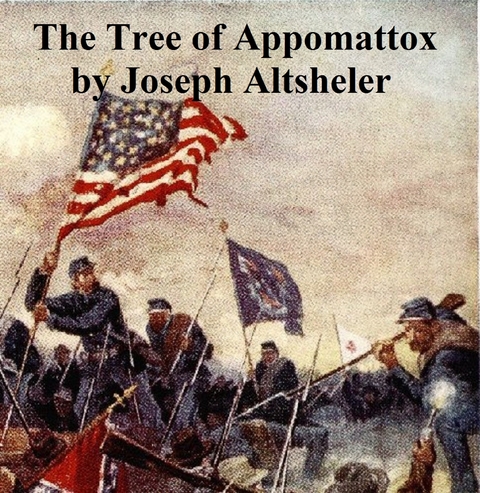
Tree of Appomattox (eBook)
780 Seiten
Seltzer Books (Verlag)
978-1-4553-6740-5 (ISBN)
Historical novel from the Civil War series. 'The Tree of Appomattox' concludes the series of connected romances dealing with the Civil War, begun in 'The Guns of Bull Run,' and
continued successively through 'The Guns of Shiloh,' 'The Scouts of Stonewall,' 'The Sword of Antietam,' 'The Star of Gettysburg,' 'The Rock of Chickamauga' and 'The Shades of the Wilderness' to the present volume. According to Wikipedia: 'Joseph Alexander Altsheler (1862 - 1919), was an American author of popular juvenile historical fiction. Altsheler was born in Three Springs, Kentucky to Joseph and Louise Altsheler. In 1885, he took a job at the Louisville Courier-Journal as a reporter and later, an editor. He started working for the New York World in 1892, first as the paper's Hawaiian correspondent and then as the editor of the World's tri-weekly magazine. Due to a lack of suitable stories, he began writing children's stories for the magazine.'
Historical novel from the Civil War series. "e;The Tree of Appomattox"e; concludes the series of connected romances dealing with the Civil War, begun in "e;The Guns of Bull Run,"e; andcontinued successively through "e;The Guns of Shiloh,"e; "e;The Scouts of Stonewall,"e; "e;The Sword of Antietam,"e; "e;The Star of Gettysburg,"e; "e;The Rock of Chickamauga"e; and "e;The Shades of the Wilderness"e; to the present volume. According to Wikipedia: "e;Joseph Alexander Altsheler (1862 - 1919), was an American author of popular juvenile historical fiction. Altsheler was born in Three Springs, Kentucky to Joseph and Louise Altsheler. In 1885, he took a job at the Louisville Courier-Journal as a reporter and later, an editor. He started working for the New York World in 1892, first as the paper's Hawaiian correspondent and then as the editor of the World's tri-weekly magazine. Due to a lack of suitable stories, he began writing children's stories for the magazine."e;
CHAPTER VII SHERIDAN'S ATTACK
More days passed and the army of Sheridan lay waiting at the head of the valley, apparently without any aim in view. But Dick knew that if Little Phil delayed it was with good cause. As Colonel Winchester was high in the general's confidence Dick saw the commander every day. He soon learned that he was of an intensely energetic and active nature, and that he must put a powerful rein upon himself to hold back, when he had such a fine army to lead.
Many of the younger officers expressed impatience and Dick saw by the newspapers that the North too was chafing at the delay. Newspapers from the great cities, New York, Philadelphia and Boston, reached their camp and they always read them eagerly. Criticisms were leveled at Sheridan, and from the appearance of things they had warrant, but Dick had faith in their leader. Yet another period of depression had come in the North. The loss of life in Grant's campaign through the Wilderness had been tremendous, and now he seemed to be held indefinitely by Lee in the trenches before Petersburg. The Confederacy, after so many great battles, and such a prodigious roll of killed and wounded, was still a nut uncracked, and Sheridan, who was expected to go up the valley and turn the Southern flank, was resting quietly in his camp.
Such was the face of matters, but Dick knew that, beneath, great plans were in the making and that the armies would soon stir. The more he saw of Sheridan the more he was impressed by him. He might prove to be the Stonewall Jackson of the North. Young, eager, brave, he never fell into the fault some of the other Union commanders had of overestimating the enemy. He always had a cheery word for his young officers, and when he was not poring over the maps with his lieutenant of engineers, Meigs, he was inspecting his troops, and seeing that their equipment and discipline were carried to the highest pitch. He was the very essence of activity and the army, although not yet moving, felt at all times the tonic of his presence.
Cavalry detachments were sent out on a wider circle. Slade and his men had no opportunity to come so close again, but Shepard informed Dick that he was in the mountains hemming in the valley on the west, and that the statement of his having formed a junction with a band under Skelly from the Alleghanies was true. He had seen the big man and the little man together and they had several hundred followers.
Shepard in these days showed an almost superhuman activity. He would leave the camp, disguised as a civilian, and after covering a great distance and risking his life a dozen times he would return with precious information. A few hours of rest and he was gone again on a like errand. He seemed to be burning with an inward fire, not a fire that consumed him, but a fire of triumph. Dick, who had formed a great friendship with him and who saw him often, had never known him to speak more sanguine words. Always cautious and reserved in his opinions, he talked now of the certainty of victory. He told them that the South was not only failing in men, having none to fill up its shattered ranks, but that food also was failing. The time would come, with the steel belt of the Northern navy about it and the Northern armies pressing in on every side, when the South would face starvation.
But a day arrived when there were signs of impending movements in the great Northern camp. Long columns of wagons were made ready and orders were issued for the vanguard of cavalry to start at an appointed time. Then, to the intense disappointment of the valiant young troops, the orders were countermanded and the whole army settled back into its quarters. Dick, who persistently refused to be a grumbler, knew that a cause must exist for such an action, but before he could wonder about it long Colonel Winchester told him, Warner and Pennington to have their horses saddled, and be ready to ride at a moment's notice.
"We're to be a part of General Sheridan's escort," he said, "and we're to go to a little place called Charlestown."
The three were delighted. They were eager to move, and above all in the train of Sheridan. The mission must be of great importance or the commander himself would not ride upon it. Hence they saddled up in five minutes, hoping that the call would come in the next five.
"Did Colonel Winchester tell you why we were going to ride?" asked Warner of Dick.
"No."
"Then perhaps we're going to receive the surrender of Early and all his men."
Dick laughed.
"I've heard that old Jube Early is one of the hardest swearers in the Southern army," he said, "and I've heard, too, that he's just as hard a fighter. I don't think he'll be handing us his surrender on a silver platter at Charlestown or anywhere else."
"I know it," said Warner. "I was only joking, but I'm wondering why we go."
In ten minutes an orderly came with a message for them and they were in the saddle as quickly as if they intended to ride to a charge. Sheridan himself and his staff and escort were as swift as they, and the whole troop swept away with a thunder of hoofs and the blood leaping in their veins. It was now almost the middle of September, and the wind that blew down from the crest of the mountains had a cool breath. It fanned Dick's face and the great pulse in his throat leaped. He felt that this ride must portend some important movement. Sheridan would not gallop away from his main camp, except on a vital issue.
It was not a long distance to Charlestown, and when they arrived there they dismounted and waited. Dick saw Colonel Winchester's face express great expectancy and he must know why they waited, but the youth did not ask him any questions, although his own curiosity increased.
An hour passed, and then a short, thickset, bearded man, accompanied by a small staff, appeared. Dick drew a deep breath. It was General Grant, Commander-in-Chief of all the armies of the Union, and Sheridan hastened forward to meet him. Then the two, with several of the senior officers, went into a house, while the younger men remained outside, and on guard.
"I knew that we were waiting for somebody of importance," said Warner, "but I didn't dream that it was the biggest man we've got in the field."
"Didn't your algebra give you any hint of it?" asked Dick.
"No. An algebra reasons. It doesn't talk and waste its time in idle chatter."
The young officers with their horses walked back and forth a long time, while Grant and Sheridan talked. Dick, surprised that Grant had left the trenches before Petersburg and had come so far to meet his lieutenant, felt that the meeting must be momentous. But it was even more crowded with the beginnings of great events than he thought. Grant, as he wrote long afterward, had come prepared with a plan of campaign for Sheridan, but, as he wrote, "seeing that he was so clear and so positive in his views I said nothing about this and did not take it out of my pocket." It was a quality of Grant's greatness, like that of Lee, to listen to a lieutenant, and when he thought his plan was better than his own to adopt the lieutenant's and put his own away.
In that memorable interview, from which such stirring campaigns dated, Grant was impressed more and more by the earnestness and clearness of the famous Little Phil, and, when they parted, he gave him a free rein and an open road. Sheridan, when they rode away from the conference, was sober and thoughtful. He was to carry out his own plan, but the full weight of the responsibility would be his, and it was very great for a young man who was not much more than thirty.
But Dick and his comrades felt exultation, and did not try to hide it. Now that Grant himself had come to see Sheridan the army was bound to move. Pennington looked toward the South and waved his hand.
"You've been waiting for us a long time, old Jube," he said, "but we're coming. And you'll see and hear our resistless tread."
"But don't forget, Frank," said Warner soberly, "that we'll have a big bill of lives to pay. We don't ride unhurt over the Johnnies."
"Don't I know it?" said Pennington. "Haven't I been learning it every day for three years?"
Action was prompt as the young officers had hoped. The very next day after the meeting with his superior, Sheridan prepared to march, and the hopes of Dick and his friends rose very high. They did not know that daring Southern spies had learned of the meeting of Grant and Sheridan, and Early, judging that it portended a great movement against him, was already consolidating his forces and preparing to meet it. And Jubal Early was an able and valiant general.
Dick did not sleep that night. All had received orders to hold themselves in readiness for an instant march, and his blood tingled with expectancy. At midnight the Winchester regiment rode off to the left to join the cavalry under Wilson...
| Erscheint lt. Verlag | 1.3.2018 |
|---|---|
| Sprache | englisch |
| Themenwelt | Literatur ► Anthologien |
| Literatur ► Klassiker / Moderne Klassiker | |
| Literatur ► Romane / Erzählungen | |
| ISBN-10 | 1-4553-6740-0 / 1455367400 |
| ISBN-13 | 978-1-4553-6740-5 / 9781455367405 |
| Informationen gemäß Produktsicherheitsverordnung (GPSR) | |
| Haben Sie eine Frage zum Produkt? |
 EPUB (Adobe DRM)
Größe: 779 KB
Kopierschutz: Adobe-DRM
Adobe-DRM ist ein Kopierschutz, der das eBook vor Mißbrauch schützen soll. Dabei wird das eBook bereits beim Download auf Ihre persönliche Adobe-ID autorisiert. Lesen können Sie das eBook dann nur auf den Geräten, welche ebenfalls auf Ihre Adobe-ID registriert sind.
Details zum Adobe-DRM
Dateiformat: EPUB (Electronic Publication)
EPUB ist ein offener Standard für eBooks und eignet sich besonders zur Darstellung von Belletristik und Sachbüchern. Der Fließtext wird dynamisch an die Display- und Schriftgröße angepasst. Auch für mobile Lesegeräte ist EPUB daher gut geeignet.
Systemvoraussetzungen:
PC/Mac: Mit einem PC oder Mac können Sie dieses eBook lesen. Sie benötigen eine
eReader: Dieses eBook kann mit (fast) allen eBook-Readern gelesen werden. Mit dem amazon-Kindle ist es aber nicht kompatibel.
Smartphone/Tablet: Egal ob Apple oder Android, dieses eBook können Sie lesen. Sie benötigen eine
Geräteliste und zusätzliche Hinweise
Buying eBooks from abroad
For tax law reasons we can sell eBooks just within Germany and Switzerland. Regrettably we cannot fulfill eBook-orders from other countries.
EPUB (Ohne DRM)Digital Rights Management: ohne DRM
Dieses eBook enthält kein DRM oder Kopierschutz. Eine Weitergabe an Dritte ist jedoch rechtlich nicht zulässig, weil Sie beim Kauf nur die Rechte an der persönlichen Nutzung erwerben.
Dateiformat: EPUB (Electronic Publication)
EPUB ist ein offener Standard für eBooks und eignet sich besonders zur Darstellung von Belletristik und Sachbüchern. Der Fließtext wird dynamisch an die Display- und Schriftgröße angepasst. Auch für mobile Lesegeräte ist EPUB daher gut geeignet.
Systemvoraussetzungen:
PC/Mac: Mit einem PC oder Mac können Sie dieses eBook lesen. Sie benötigen dafür die kostenlose Software Adobe Digital Editions.
eReader: Dieses eBook kann mit (fast) allen eBook-Readern gelesen werden. Mit dem amazon-Kindle ist es aber nicht kompatibel.
Smartphone/Tablet: Egal ob Apple oder Android, dieses eBook können Sie lesen. Sie benötigen dafür eine kostenlose App.
Geräteliste und zusätzliche Hinweise
Buying eBooks from abroad
For tax law reasons we can sell eBooks just within Germany and Switzerland. Regrettably we cannot fulfill eBook-orders from other countries.
aus dem Bereich