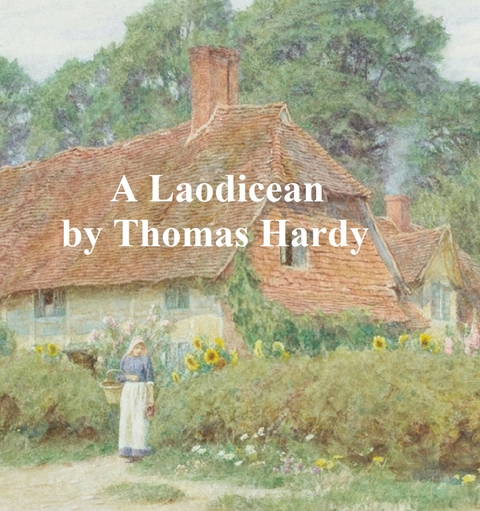
Laodicean (eBook)
710 Seiten
Seltzer Books (Verlag)
978-1-4553-4113-9 (ISBN)
According to Wikipedia: 'Thomas Hardy, (1840 - 1928) was an English author of the naturalist movement, though he regarded himself primarily as a poet and composed novels mainly for financial gain. The bulk of his work, set mainly in the semi-fictional land of Wessex, delineates characters struggling against their passions and circumstances. Hardy's poetry, first published in his 50s, has come to be as well regarded as his novels, especially after The Movement of the 1950s and 1960s.'
According to Wikipedia: "e;Thomas Hardy, (1840 - 1928) was an English author of the naturalist movement, though he regarded himself primarily as a poet and composed novels mainly for financial gain. The bulk of his work, set mainly in the semi-fictional land of Wessex, delineates characters struggling against their passions and circumstances. Hardy's poetry, first published in his 50s, has come to be as well regarded as his novels, especially after The Movement of the 1950s and 1960s."e;
XIV.
When she was gone he went on with the drawing, not calling in Dare, who remained in the room adjoining. Presently a servant came and laid a paper on his table, which Miss Power had sent. It was one of the morning newspapers, and was folded so that his eye fell immediately on a letter headed 'Restoration or Demolition.'
The letter was professedly written by a dispassionate person solely in the interests of art. It drew attention to the circumstance that the ancient and interesting castle of the De Stancys had unhappily passed into the hands of an iconoclast by blood, who, without respect for the tradition of the county, or any feeling whatever for history in stone, was about to demolish much, if not all, that was interesting in that ancient pile, and insert in its midst a monstrous travesty of some Greek temple. In the name of all lovers of mediaeval art, conjured the simple-minded writer, let something be done to save a building which, injured and battered in the Civil Wars, was now to be made a complete ruin by the freaks of an irresponsible owner. Her sending him the paper seemed to imply that she required his opinion on the case; and in the afternoon, leaving Dare to measure up a wing according to directions, he went out in the hope of meeting her, having learnt that she had gone to the village. On reaching the church he saw her crossing the churchyard path with her aunt and Miss De Stancy. Somerset entered the enclosure, and as soon as she saw him she came across.
'What is to be done?' she asked.
'You need not be concerned about such a letter as that.'
'I am concerned.'
'I think it dreadful impertinence,' spoke up Charlotte, who had joined them. 'Can you think who wrote it, Mr. Somerset?'
Somerset could not.
'Well, what am I to do?' repeated Paula.
'Just as you would have done before.'
'That's what _I_ say,' observed Mrs. Goodman emphatically.
'But I have already altered--I have given up the Greek court.'
'O--you had seen the paper this morning before you looked at my drawing?'
'I had,' she answered.
Somerset thought it a forcible illustration of her natural reticence that she should have abandoned the design without telling him the reason; but he was glad she had not done it from mere caprice.
She turned to him and said quietly, 'I wish YOU would answer that letter.'
'It would be ill-advised,' said Somerset. 'Still, if, after consideration, you wish it much, I will. Meanwhile let me impress upon you again the expediency of calling in Mr. Havill--to whom, as your father's architect, expecting this commission, something perhaps is owed--and getting him to furnish an alternative plan to mine, and submitting the choice of designs to some members of the Royal Institute of British Architects. This letter makes it still more advisable than before.'
'Very well,' said Paula reluctantly.
'Let him have all the particulars you have been good enough to explain to me--so that we start fair in the competition.'
She looked negligently on the grass. 'I will tell the building steward to write them out for him,' she said.
The party separated and entered the church by different doors. Somerset went to a nook of the building that he had often intended to visit. It was called the Stancy aisle; and in it stood the tombs of that family. Somerset examined them: they were unusually rich and numerous, beginning with cross-legged knights in hauberks of chain-mail, their ladies beside them in wimple and cover-chief, all more or less coated with the green mould and dirt of ages: and continuing with others of later date, in fine alabaster, gilded and coloured, some of them wearing round their necks the Yorkist collar of suns and roses, the livery of Edward the Fourth. In scrutinizing the tallest canopy over these he beheld Paula behind it, as if in contemplation of the same objects.
'You came to the church to sketch these monuments, I suppose, Mr. Somerset?' she asked, as soon as she saw him.
'No. I came to speak to you about the letter.'
She sighed. 'Yes: that letter,' she said. 'I am persecuted! If I had been one of these it would never have been written.' She tapped the alabaster effigy of a recumbent lady with her parasol.
'They are interesting, are they not?' he said. 'She is beautifully preserved. The gilding is nearly gone, but beyond that she is perfect.'
'She is like Charlotte,' said Paula. And what was much like another sigh escaped her lips.
Somerset admitted that there was a resemblance, while Paula drew her forefinger across the marble face of the effigy, and at length took out her handkerchief, and began wiping the dust from the hollows of the features. He looked on, wondering what her sigh had meant, but guessing that it had been somehow caused by the sight of these sculptures in connection with the newspaper writer's denunciation of her as an irresponsible outsider.
The secret was out when in answer to his question, idly put, if she wished she were like one of these, she said, with exceptional vehemence for one of her demeanour--
'I don't wish I was like one of them: I wish I WAS one of them.'
'What--you wish you were a De Stancy?'
'Yes. It is very dreadful to be denounced as a barbarian. I want to be romantic and historical.'
'Miss De Stancy seems not to value the privilege,' he said, looking round at another part of the church where Charlotte was innocently prattling to Mrs. Goodman, quite heedless of the tombs of her forefathers.
'If I were one,' she continued, 'I should come here when I feel alone in the world, as I do to-day; and I would defy people, and say, "You cannot spoil what has been!"'
They walked on till they reached the old black pew attached to the castle--a vast square enclosure of oak panelling occupying half the aisle, and surmounted with a little balustrade above the framework. Within, the baize lining that had once been green, now faded to the colour of a common in August, was torn, kicked and scraped to rags by the feet and hands of the ploughboys who had appropriated the pew as their own special place of worship since it had ceased to be used by any resident at the castle, because its height afforded convenient shelter for playing at marbles and pricking with pins.
Charlotte and Mrs. Goodman had by this time left the building, and could be seen looking at the headstones outside.
'If you were a De Stancy,' said Somerset, who had pondered more deeply upon that new wish of hers than he had seemed to do, 'you would be a churchwoman, and sit here.'
'And I should have the pew done up,' she said readily, as she rested her pretty chin on the top rail and looked at the interior, her cheeks pressed into deep dimples. Her quick reply told him that the idea was no new one with her, and he thought of poor Mr. Woodwell's shrewd prophecy as he perceived that her days as a separatist were numbered.
'Well, why can't you have it done up, and sit here?' he said warily.
Paula shook her head.
'You are not at enmity with Anglicanism, I am sure?'
'I want not to be. I want to be--what--'
'What the De Stancys were, and are,' he said insidiously; and her silenced bearing told him that he had hit the nail.
It was a strange idea to get possession of such a nature as hers, and for a minute he felt himself on the side of the minister. So strong was Somerset's feeling of wishing her to show the quality of fidelity to paternal dogma and party, that he could not help adding--
'But have you forgotten that other nobility--the nobility of talent and enterprise?'
'No. But I wish I had a well-known line of ancestors.'
'You have. Archimedes, Newcomen, Watt, Telford, Stephenson, those are your father's direct ancestors. Have you forgotten them? Have you forgotten your father, and the railways he made over half Europe, and his great energy and skill, and all connected with him as if he had never lived?'
She did not answer for some time. 'No, I have not forgotten it,' she said, still looking into the pew. 'But, I have a predilection d'artiste for ancestors of the other sort, like the De Stancys.'
Her hand was resting on the low pew next the high one of the De Stancys. Somerset looked at the hand, or rather at the glove which covered it, then at her averted cheek, then beyond it into the pew, then at her hand again, until by an indescribable consciousness that he was not going too far he laid his own upon it.
'No, no,' said Paula quickly, withdrawing her hand. But there was nothing resentful or haughty in her tone--nothing, in short, which makes a man in such circumstances feel that he has done a particularly foolish action.
The flower on her bosom rose and fell somewhat more than usual as she added, 'I am going away now--I will leave you here.' Without waiting for a reply...
| Erscheint lt. Verlag | 1.3.2018 |
|---|---|
| Sprache | englisch |
| Themenwelt | Literatur ► Anthologien |
| Literatur ► Klassiker / Moderne Klassiker | |
| Literatur ► Romane / Erzählungen | |
| ISBN-10 | 1-4553-4113-4 / 1455341134 |
| ISBN-13 | 978-1-4553-4113-9 / 9781455341139 |
| Informationen gemäß Produktsicherheitsverordnung (GPSR) | |
| Haben Sie eine Frage zum Produkt? |
 EPUB (Adobe DRM)
Größe: 709 KB
Kopierschutz: Adobe-DRM
Adobe-DRM ist ein Kopierschutz, der das eBook vor Mißbrauch schützen soll. Dabei wird das eBook bereits beim Download auf Ihre persönliche Adobe-ID autorisiert. Lesen können Sie das eBook dann nur auf den Geräten, welche ebenfalls auf Ihre Adobe-ID registriert sind.
Details zum Adobe-DRM
Dateiformat: EPUB (Electronic Publication)
EPUB ist ein offener Standard für eBooks und eignet sich besonders zur Darstellung von Belletristik und Sachbüchern. Der Fließtext wird dynamisch an die Display- und Schriftgröße angepasst. Auch für mobile Lesegeräte ist EPUB daher gut geeignet.
Systemvoraussetzungen:
PC/Mac: Mit einem PC oder Mac können Sie dieses eBook lesen. Sie benötigen eine
eReader: Dieses eBook kann mit (fast) allen eBook-Readern gelesen werden. Mit dem amazon-Kindle ist es aber nicht kompatibel.
Smartphone/Tablet: Egal ob Apple oder Android, dieses eBook können Sie lesen. Sie benötigen eine
Geräteliste und zusätzliche Hinweise
Buying eBooks from abroad
For tax law reasons we can sell eBooks just within Germany and Switzerland. Regrettably we cannot fulfill eBook-orders from other countries.
EPUB (Ohne DRM)Digital Rights Management: ohne DRM
Dieses eBook enthält kein DRM oder Kopierschutz. Eine Weitergabe an Dritte ist jedoch rechtlich nicht zulässig, weil Sie beim Kauf nur die Rechte an der persönlichen Nutzung erwerben.
Dateiformat: EPUB (Electronic Publication)
EPUB ist ein offener Standard für eBooks und eignet sich besonders zur Darstellung von Belletristik und Sachbüchern. Der Fließtext wird dynamisch an die Display- und Schriftgröße angepasst. Auch für mobile Lesegeräte ist EPUB daher gut geeignet.
Systemvoraussetzungen:
PC/Mac: Mit einem PC oder Mac können Sie dieses eBook lesen. Sie benötigen dafür die kostenlose Software Adobe Digital Editions.
eReader: Dieses eBook kann mit (fast) allen eBook-Readern gelesen werden. Mit dem amazon-Kindle ist es aber nicht kompatibel.
Smartphone/Tablet: Egal ob Apple oder Android, dieses eBook können Sie lesen. Sie benötigen dafür eine kostenlose App.
Geräteliste und zusätzliche Hinweise
Buying eBooks from abroad
For tax law reasons we can sell eBooks just within Germany and Switzerland. Regrettably we cannot fulfill eBook-orders from other countries.
aus dem Bereich