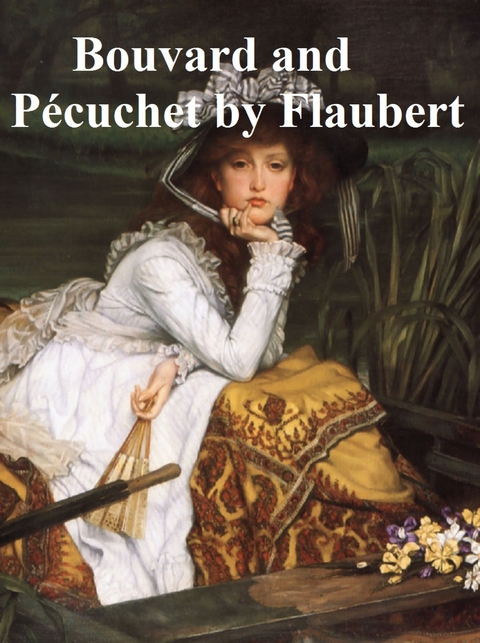
Bouvard and Pecuchet (eBook)
482 Seiten
Seltzer Books (Verlag)
978-1-4553-0867-5 (ISBN)
According to Wikipedia: 'Bouvard et Pécuchet is an unfinished satirical work by Gustave Flaubert, published in 1881 after his death in 1880. Although conceived in 1863 as Les Deux Cloportes ('The Two Woodlice'), and partially inspired by a short story of Barthélemy Maurice (Les Deux Greffiers, 'The Two Court Clerks', which appeared in La Revue des Tribunaux in 1841 and which he may have read in 1858), Flaubert did not begin the work in earnest until 1872, at a time when financial ruin threatened. Over time, the book obsessed him to the degree that he claimed to have read over 1500 books in preparation for writing it-he intended it to be his masterpiece, surpassing all of his other works. He only took a minor break, in order to compose Three Tales in 1875-76. It received lukewarm reviews: critics failed to appreciate both its message and its structural devices.'
According to Wikipedia: "e;Bouvard et Pecuchet is an unfinished satirical work by Gustave Flaubert, published in 1881 after his death in 1880. Although conceived in 1863 as Les Deux Cloportes ("e;The Two Woodlice"e;), and partially inspired by a short story of Barthelemy Maurice (Les Deux Greffiers, "e;The Two Court Clerks"e;, which appeared in La Revue des Tribunaux in 1841 and which he may have read in 1858), Flaubert did not begin the work in earnest until 1872, at a time when financial ruin threatened. Over time, the book obsessed him to the degree that he claimed to have read over 1500 books in preparation for writing it-he intended it to be his masterpiece, surpassing all of his other works. He only took a minor break, in order to compose Three Tales in 1875-76. It received lukewarm reviews: critics failed to appreciate both its message and its structural devices."e;
CHAPTER IV. RESEARCHES IN ARCHÆOLOGY.
Six months later they had become archæologists, and their house was like a museum.
In the vestibule stood an old wooden beam. The staircase was encumbered with the geological specimens, and an enormous chain was stretched on the ground all along the corridor. They had taken off its hinges the door between the two rooms in which they did not sleep, and had condemned the outer door of the second in order to convert both into a single apartment.
As soon as you crossed the threshold, you came in contact with a stone trough (a Gallo-Roman sarcophagus); the ironwork next attracted your attention. Fixed to the opposite wall, a warming-pan looked down on two andirons and a hearthplate representing a monk caressing a shepherdess. On the boards all around, you saw torches, locks, bolts, and nuts of screws. The floor was rendered invisible beneath fragments of red tiles. A table in the centre exhibited curiosities of the rarest description: the shell of a Cauchoise cap, two argil urns, medals, and a phial of opaline glass. An upholstered armchair had at its back a triangle worked with guipure. A piece of a coat of mail adorned the partition to the right, and on the other side sharp spikes sustained in a horizontal position a unique specimen of a halberd.
The second room, into which two steps led down, contained the old books which they had brought with them from Paris, and those which, on their arrival, they had found in a press. The leaves of the folding-doors had been removed hither. They called it the library.
The back of the door was entirely covered by the genealogical tree of the Croixmare family. In the panelling on the return side, a pastel of a lady in the dress of the period of Louis XV. made a companion picture to the portrait of Père Bouvard. The casing of the glass was decorated with a sombrero of black felt, and a monstrous galoche filled with leaves, the remains of a nest.
Two cocoanuts (which had belonged to Pécuchet since his younger days) flanked on the chimney-piece an earthenware cask on which a peasant sat astride. Close by, in a straw basket, was a little coin brought up by a duck.
In front of the bookcase stood a shell chest of drawers trimmed with plush. The cover of it supported a cat with a mouse in its mouth--a petrifaction from St. Allyre; a work-box, also of shell work, and on this box a decanter of brandy contained a Bon Chrétien pear.
But the finest thing was a statue of St. Peter in the embrasure of the window. His right hand, covered with a glove of apple-green colour, was pressing the key of Paradise. His chasuble, ornamented with fleurs-de-luce, was azure blue, and his tiara very yellow, pointed like a pagoda. He had flabby cheeks, big round eyes, a gaping mouth, and a crooked nose shaped like a trumpet. Above him hung a canopy made of an old carpet in which you could distinguish two Cupids in a circle of roses, and at his feet, like a pillar, rose a butter-pot bearing these words in white letters on a chocolate ground: "Executed in the presence of H.R.H. the Duke of Angoulême at Noron, 3rd of October, 1847."
Pécuchet, from his bed, saw all these things in a row, and sometimes he went as far as Bouvard's room to lengthen the perspective.
One spot remained empty, exactly opposite to the coat of arms, that intended for the Renaissance chest. It was not finished; Gorju was still working at it, jointing the panels in the bakehouse, squaring them or undoing them.
At eleven o'clock he took his breakfast, chatted after that with Mélie, and often did not make his appearance again for the rest of the day.
In order to have pieces of furniture in good style, Bouvard and Pécuchet went scouring the country. What they brought back was not suitable; but they had come across a heap of curious things. Their first passion was a taste for articles of _virtù_; then came the love of the Middle Ages.
To begin with, they visited cathedrals; and the lofty naves mirroring themselves in the holy-water fonts, the glass ornaments dazzling as hangings of precious stones, the tombs in the recesses of the chapels, the uncertain light of crypts--everything, even to the coolness of the walls, thrilled them with a shudder of joy, a religious emotion.
They were soon able to distinguish the epochs, and, disdainful of sacristans, they would say: "Ha! a Romanesque apsis!" "That's of the twelfth century!" "Here we are falling back again into the flamboyant!"
They strove to interpret the sculptured symbols on the capitals, such as the two griffins of Marigny pecking at a tree in blossom; Pécuchet read a satire in the singers with grotesque jaws which terminate the mouldings at Feugerolles; and as for the exuberance of the man that covers one of the mullions at Hérouville, that was a proof, according to Bouvard, of our ancestors' love of broad jokes.
They ended by not tolerating the least symptom of decadence. All was decadence, and they deplored vandalism, and thundered against badigeon.
But the style of a monument does not always agree with its supposed date. The semicircular arch of the thirteenth century still holds sway in Provence. The ogive is, perhaps, very ancient; and authors dispute as to the anteriority of the Romanesque to the Gothic. This want of certainty disappointed them.
After the churches they studied fortresses--those of Domfront and Falaise. They admired under the gate the grooves of the portcullis, and, having reached the top, they first saw all the country around them, then the roofs of the houses in the town, the streets intersecting one another, the carts on the square, the women at the washhouse. The wall descended perpendicularly as far as the palisade; and they grew pale as they thought that men had mounted there, hanging to ladders. They would have ventured into the subterranean passages but that Bouvard found an obstacle in his stomach and Pécuchet in his horror of vipers.
They desired to make the acquaintance of the old manor-houses--Curcy, Bully, Fontenay, Lemarmion, Argonge. Sometimes a Carlovingian tower would show itself at the corner of some farm-buildings behind a heap of manure. The kitchen, garnished with stone benches, made them dream of feudal junketings. Others had a forbiddingly fierce aspect with their three enceintes still visible, their loopholes under the staircase, and their high turrets with pointed sides. Then they came to an apartment in which a window of the Valois period, chased so as to resemble ivory, let in the sun, which heated the grains of colza that strewed the floor. Abbeys were used as barns. The inscriptions on tombstones were effaced. In the midst of fields a gable-end remained standing, clad from top to bottom in ivy which trembled in the wind.
A number of things excited in their breasts a longing to possess them--a tin pot, a paste buckle, printed calicoes with large flowerings. The shortness of money restrained them.
By a happy chance, they unearthed at Balleroy in a tinman's house a Gothic church window, and it was big enough to cover, near the armchair, the right side of the casement up to the second pane. The steeple of Chavignolles displayed itself in the distance, producing a magnificent effect. With the lower part of a cupboard Gorju manufactured a prie-dieu to put under the Gothic window, for he humoured their hobby. So pronounced was it that they regretted monuments about which nothing at all is known--such as the villa residence of the bishops of Séez.
"Bayeux," says M. de Caumont, "must have possessed a theatre." They searched for the site of it without success.
The village of Montrecy contained a meadow celebrated for the number of medals which chanced formerly to have been found there. They calculated on making a fine harvest in this place. The caretaker refused to admit them.
They were not more fortunate as to the connection which existed between a cistern at Falaise and the faubourg of Caen. Ducks which had been put in there reappeared at Vaucelles, quacking, "Can, can, can"--whence is derived the name of the town!
No step, no sacrifice, was too great for them.
At the inn of Mesnil-Villement, in 1816, M. Galeron got a breakfast for the sum of four sous. They took the same meal there, and ascertained with surprise that things were altered!
Who was the founder of the abbey of St. Anne? Is there any relationship between Marin Onfroy, who, in the twelfth century, imported a new kind of potato, and Onfroy, governor of Hastings at the period of the Conquest? How were they to procure _L'Astucieuse Pythonisse_, a comedy in verse by one Dutrezor, produced at Bayeux, and just now exceedingly rare? Under Louis XIV., Hérambert Dupaty, or Dupastis Hérambert, composed a work which has never appeared, full of anecdotes about Argentan: the question was how to recover these anecdotes. What have become of the autograph memoirs of Madame Dubois de la Pierre, consulted for the unpublished history of L'Aigle by Louis Dasprès, curate of St. Martin? So many problems, so many curious points, to clear up.
But a slight mark often puts one on the track of an invaluable discovery.
Accordingly, they put on their blouses, in order not to put people on their guard, and, in the guise of hawkers, they presented themselves...
| Erscheint lt. Verlag | 1.3.2018 |
|---|---|
| Sprache | englisch |
| Themenwelt | Literatur ► Anthologien |
| Literatur ► Klassiker / Moderne Klassiker | |
| Literatur ► Romane / Erzählungen | |
| ISBN-10 | 1-4553-0867-6 / 1455308676 |
| ISBN-13 | 978-1-4553-0867-5 / 9781455308675 |
| Informationen gemäß Produktsicherheitsverordnung (GPSR) | |
| Haben Sie eine Frage zum Produkt? |
 EPUB (Adobe DRM)
Größe: 481 KB
Kopierschutz: Adobe-DRM
Adobe-DRM ist ein Kopierschutz, der das eBook vor Mißbrauch schützen soll. Dabei wird das eBook bereits beim Download auf Ihre persönliche Adobe-ID autorisiert. Lesen können Sie das eBook dann nur auf den Geräten, welche ebenfalls auf Ihre Adobe-ID registriert sind.
Details zum Adobe-DRM
Dateiformat: EPUB (Electronic Publication)
EPUB ist ein offener Standard für eBooks und eignet sich besonders zur Darstellung von Belletristik und Sachbüchern. Der Fließtext wird dynamisch an die Display- und Schriftgröße angepasst. Auch für mobile Lesegeräte ist EPUB daher gut geeignet.
Systemvoraussetzungen:
PC/Mac: Mit einem PC oder Mac können Sie dieses eBook lesen. Sie benötigen eine
eReader: Dieses eBook kann mit (fast) allen eBook-Readern gelesen werden. Mit dem amazon-Kindle ist es aber nicht kompatibel.
Smartphone/Tablet: Egal ob Apple oder Android, dieses eBook können Sie lesen. Sie benötigen eine
Geräteliste und zusätzliche Hinweise
Buying eBooks from abroad
For tax law reasons we can sell eBooks just within Germany and Switzerland. Regrettably we cannot fulfill eBook-orders from other countries.
EPUB (Ohne DRM)Digital Rights Management: ohne DRM
Dieses eBook enthält kein DRM oder Kopierschutz. Eine Weitergabe an Dritte ist jedoch rechtlich nicht zulässig, weil Sie beim Kauf nur die Rechte an der persönlichen Nutzung erwerben.
Dateiformat: EPUB (Electronic Publication)
EPUB ist ein offener Standard für eBooks und eignet sich besonders zur Darstellung von Belletristik und Sachbüchern. Der Fließtext wird dynamisch an die Display- und Schriftgröße angepasst. Auch für mobile Lesegeräte ist EPUB daher gut geeignet.
Systemvoraussetzungen:
PC/Mac: Mit einem PC oder Mac können Sie dieses eBook lesen. Sie benötigen dafür die kostenlose Software Adobe Digital Editions.
eReader: Dieses eBook kann mit (fast) allen eBook-Readern gelesen werden. Mit dem amazon-Kindle ist es aber nicht kompatibel.
Smartphone/Tablet: Egal ob Apple oder Android, dieses eBook können Sie lesen. Sie benötigen dafür eine kostenlose App.
Geräteliste und zusätzliche Hinweise
Buying eBooks from abroad
For tax law reasons we can sell eBooks just within Germany and Switzerland. Regrettably we cannot fulfill eBook-orders from other countries.
aus dem Bereich