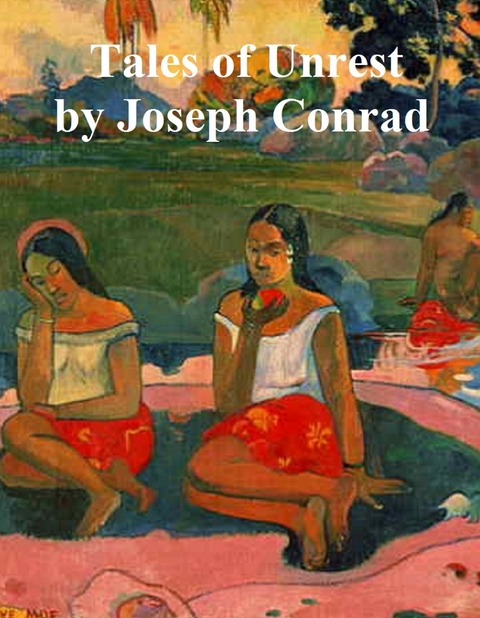
Tales of Unrest (eBook)
406 Seiten
Seltzer Books (Verlag)
978-1-4553-5171-8 (ISBN)

Classic Conrad short stories, including KARAIN: A MEMORY, THE IDIOTS, AN OUTPOST OF PROGRESS, THE RETURN, and THE LAGOON. According to Wikipedia: "e;Joseph Conrad (1857 - 1924) was a Polish-born English novelist. Many critics regard him as one of the greatest novelists in the English language-a fact that is remarkable, as he did not learn to speak English fluently until he was in his twenties (and always with a strong Polish accent). He became a naturalized British subject in 1886. Conrad is recognized as a master prose stylist. Some of his works have a strain of romanticism, but more importantly he is recognized as an important forerunner of modernist literature. His narrative style and anti-heroic characters have influenced many writers, including Ernest Hemingway, D. H. Lawrence, F. Scott Fitzgerald, Graham Greene, William S. Burroughs, Joseph Heller, V.S. Naipaul, Italo Calvino and J. M. Coetzee."e;
THE RETURN
The inner circle train from the City rushed impetuously out of a black hole and pulled up with a discordant, grinding racket in the smirched twilight of a West-End station. A line of doors flew open and a lot of men stepped out headlong. They had high hats, healthy pale faces, dark overcoats and shiny boots; they held in their gloved hands thin umbrellas and hastily folded evening papers that resembled stiff, dirty rags of greenish, pinkish, or whitish colour. Alvan Hervey stepped out with the rest, a smouldering cigar between his teeth. A disregarded little woman in rusty black, with both arms full of parcels, ran along in distress, bolted suddenly into a third-class compartment and the train went on. The slamming of carriage doors burst out sharp and spiteful like a fusillade; an icy draught mingled with acrid fumes swept the whole length of the platform and made a tottering old man, wrapped up to his ears in a woollen comforter, stop short in the moving throng to cough violently over his stick. No one spared him a glance.
Alvan Hervey passed through the ticket gate. Between the bare walls of a sordid staircase men clambered rapidly; their backs appeared alike--almost as if they had been wearing a uniform; their indifferent faces were varied but somehow suggested kinship, like the faces of a band of brothers who through prudence, dignity, disgust, or foresight would resolutely ignore each other; and their eyes, quick or slow; their eyes gazing up the dusty steps; their eyes brown, black, gray, blue, had all the same stare, concentrated and empty, satisfied and unthinking.
Outside the big doorway of the street they scattered in all directions, walking away fast from one another with the hurried air of men fleeing from something compromising; from familiarity or confidences; from something suspected and concealed--like truth or pestilence. Alvan Hervey hesitated, standing alone in the doorway for a moment; then decided to walk home.
He strode firmly. A misty rain settled like silvery dust on clothes, on moustaches; wetted the faces, varnished the flagstones, darkened the walls, dripped from umbrellas. And he moved on in the rain with careless serenity, with the tranquil ease of someone successful and disdainful, very sure of himself--a man with lots of money and friends. He was tall, well set-up, good-looking and healthy; and his clear pale face had under its commonplace refinement that slight tinge of overbearing brutality which is given by the possession of only partly difficult accomplishments; by excelling in games, or in the art of making money; by the easy mastery over animals and over needy men.
He was going home much earlier than usual, straight from the City and without calling at his club. He considered himself well connected, well educated and intelligent. Who doesn't? But his connections, education and intelligence were strictly on a par with those of the men with whom he did business or amused himself. He had married five years ago. At the time all his acquaintances had said he was very much in love; and he had said so himself, frankly, because it is very well understood that every man falls in love once in his life--unless his wife dies, when it may be quite praiseworthy to fall in love again. The girl was healthy, tall, fair, and in his opinion was well connected, well educated and intelligent. She was also intensely bored with her home where, as if packed in a tight box, her individuality-- of which she was very conscious--had no play. She strode like a grenadier, was strong and upright like an obelisk, had a beautiful face, a candid brow, pure eyes, and not a thought of her own in her head. He surrendered quickly to all those charms, and she appeared to him so unquestionably of the right sort that he did not hesitate for a moment to declare himself in love. Under the cover of that sacred and poetical fiction he desired her masterfully, for various reasons; but principally for the satisfaction of having his own way. He was very dull and solemn about it--for no earthly reason, unless to conceal his feelings--which is an eminently proper thing to do. Nobody, however, would have been shocked had he neglected that duty, for the feeling he experienced really was a longing--a longing stronger and a little more complex no doubt, but no more reprehensible in its nature than a hungry man's appetite for his dinner.
After their marriage they busied themselves, with marked success, in enlarging the circle of their acquaintance. Thirty people knew them by sight; twenty more with smiling demonstrations tolerated their occasional presence within hospitable thresholds; at least fifty others became aware of their existence. They moved in their enlarged world amongst perfectly delightful men and women who feared emotion, enthusiasm, or failure, more than fire, war, or mortal disease; who tolerated only the commonest formulas of commonest thoughts, and recognized only profitable facts. It was an extremely charming sphere, the abode of all the virtues, where nothing is realized and where all joys and sorrows are cautiously toned down into pleasures and annoyances. In that serene region, then, where noble sentiments are cultivated in sufficient profusion to conceal the pitiless materialism of thoughts and aspirations Alvan Hervey and his wife spent five years of prudent bliss unclouded by any doubt as to the moral propriety of their existence. She, to give her individuality fair play, took up all manner of philanthropic work and became a member of various rescuing and reforming societies patronized or presided over by ladies of title. He took an active interest in politics; and having met quite by chance a literary man--who nevertheless was related to an earl--he was induced to finance a moribund society paper. It was a semi-political, and wholly scandalous publication, redeemed by excessive dulness; and as it was utterly faithless, as it contained no new thought, as it never by any chance had a flash of wit, satire, or indignation in its pages, he judged it respectable enough, at first sight. Afterwards, when it paid, he promptly perceived that upon the whole it was a virtuous undertaking. It paved the way of his ambition; and he enjoyed also the special kind of importance he derived from this connection with what he imagined to be literature.
This connection still further enlarged their world. Men who wrote or drew prettily for the public came at times to their house, and his editor came very often. He thought him rather an ass because he had such big front teeth (the proper thing is to have small, even teeth) and wore his hair a trifle longer than most men do. However, some dukes wear their hair long, and the fellow indubitably knew his business. The worst was that his gravity, though perfectly portentous, could not be trusted. He sat, elegant and bulky, in the drawing-room, the head of his stick hovering in front of his big teeth, and talked for hours with a thick-lipped smile (he said nothing that could be considered objectionable and not quite the thing) talked in an unusual manner--not obviously irritatingly. His forehead was too lofty--unusually so--and under it there was a straight nose, lost between the hairless cheeks, that in a smooth curve ran into a chin shaped like the end of a snow-shoe. And in this face that resembled the face of a fat and fiendishly knowing baby there glittered a pair of clever, peering, unbelieving black eyes. He wrote verses too. Rather an ass. But the band of men who trailed at the skirts of his monumental frock-coat seemed to perceive wonderful things in what he said. Alvan Hervey put it down to affectation. Those artist chaps, upon the whole, were so affected. Still, all this was highly proper--very useful to him--and his wife seemed to like it--as if she also had derived some distinct and secret advantage from this intellectual connection. She received her mixed and decorous guests with a kind of tall, ponderous grace, peculiarly her own and which awakened in the mind of intimidated strangers incongruous and improper reminiscences of an elephant, a giraffe, a gazelle; of a gothic tower--of an overgrown angel. Her Thursdays were becoming famous in their world; and their world grew steadily, annexing street after street. It included also Somebody's Gardens, a Crescent--a couple of Squares.
Thus Alvan Hervey and his wife for five prosperous years lived by the side of one another. In time they came to know each other sufficiently well for all the practical purposes of such an existence, but they were no more capable of real intimacy than two animals feeding at the same manger, under the same roof, in a luxurious stable. His longing was appeased and became a habit; and she had her desire--the desire to get away from under the paternal roof, to assert her individuality, to move in her own set (so much smarter than the parental one); to have a home of her own, and her own share of the world's respect, envy, and applause. They understood each other warily, tacitly, like a pair of cautious conspirators in a profitable plot; because they were both unable to look at a fact, a sentiment, a principle, or a belief otherwise than in the light of their own dignity, of their own glorification, of their own advantage. They skimmed over the surface of life hand in hand, in a pure and frosty atmosphere--like two skilful skaters cutting figures on thick ice for the admiration of the beholders, and disdainfully ignoring the hidden stream, the stream restless and dark; the stream of life, profound and unfrozen.
Alvan Hervey turned twice to the left, once to the right, walked along two sides of a square, in the middle of which groups of tame-looking trees stood in...
| Erscheint lt. Verlag | 1.3.2018 |
|---|---|
| Sprache | englisch |
| Themenwelt | Literatur ► Anthologien |
| Literatur ► Klassiker / Moderne Klassiker | |
| Literatur ► Romane / Erzählungen | |
| ISBN-10 | 1-4553-5171-7 / 1455351717 |
| ISBN-13 | 978-1-4553-5171-8 / 9781455351718 |
| Informationen gemäß Produktsicherheitsverordnung (GPSR) | |
| Haben Sie eine Frage zum Produkt? |
 EPUB (Adobe DRM)
Größe: 405 KB
Kopierschutz: Adobe-DRM
Adobe-DRM ist ein Kopierschutz, der das eBook vor Mißbrauch schützen soll. Dabei wird das eBook bereits beim Download auf Ihre persönliche Adobe-ID autorisiert. Lesen können Sie das eBook dann nur auf den Geräten, welche ebenfalls auf Ihre Adobe-ID registriert sind.
Details zum Adobe-DRM
Dateiformat: EPUB (Electronic Publication)
EPUB ist ein offener Standard für eBooks und eignet sich besonders zur Darstellung von Belletristik und Sachbüchern. Der Fließtext wird dynamisch an die Display- und Schriftgröße angepasst. Auch für mobile Lesegeräte ist EPUB daher gut geeignet.
Systemvoraussetzungen:
PC/Mac: Mit einem PC oder Mac können Sie dieses eBook lesen. Sie benötigen eine
eReader: Dieses eBook kann mit (fast) allen eBook-Readern gelesen werden. Mit dem amazon-Kindle ist es aber nicht kompatibel.
Smartphone/Tablet: Egal ob Apple oder Android, dieses eBook können Sie lesen. Sie benötigen eine
Geräteliste und zusätzliche Hinweise
Buying eBooks from abroad
For tax law reasons we can sell eBooks just within Germany and Switzerland. Regrettably we cannot fulfill eBook-orders from other countries.
EPUB (Ohne DRM)Digital Rights Management: ohne DRM
Dieses eBook enthält kein DRM oder Kopierschutz. Eine Weitergabe an Dritte ist jedoch rechtlich nicht zulässig, weil Sie beim Kauf nur die Rechte an der persönlichen Nutzung erwerben.
Dateiformat: EPUB (Electronic Publication)
EPUB ist ein offener Standard für eBooks und eignet sich besonders zur Darstellung von Belletristik und Sachbüchern. Der Fließtext wird dynamisch an die Display- und Schriftgröße angepasst. Auch für mobile Lesegeräte ist EPUB daher gut geeignet.
Systemvoraussetzungen:
PC/Mac: Mit einem PC oder Mac können Sie dieses eBook lesen. Sie benötigen dafür die kostenlose Software Adobe Digital Editions.
eReader: Dieses eBook kann mit (fast) allen eBook-Readern gelesen werden. Mit dem amazon-Kindle ist es aber nicht kompatibel.
Smartphone/Tablet: Egal ob Apple oder Android, dieses eBook können Sie lesen. Sie benötigen dafür eine kostenlose App.
Geräteliste und zusätzliche Hinweise
Buying eBooks from abroad
For tax law reasons we can sell eBooks just within Germany and Switzerland. Regrettably we cannot fulfill eBook-orders from other countries.
aus dem Bereich