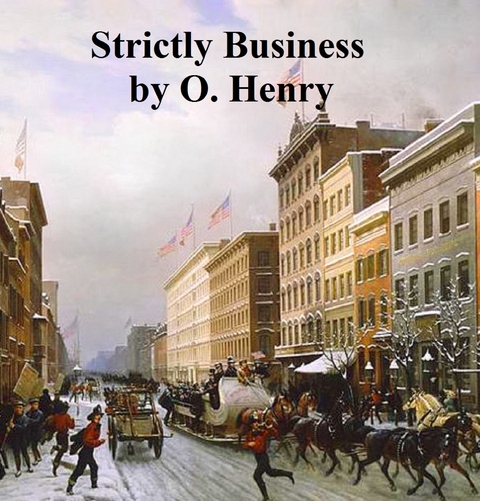
Strictly Business (eBook)
562 Seiten
Seltzer Books (Verlag)
978-1-4553-3351-6 (ISBN)
According to Wikipedia: 'O. Henry was the pen name of American writer William Sydney Porter (September 11, 1862 - June 5, 1910). O. Henry short stories are known for wit, wordplay, warm characterization and clever twist endings.... Most of O. Henry's stories are set in his own time, the early years of the 20th century. Many take place in New York City, and deal for the most part with ordinary people: clerks, policemen, waitresses. Fundamentally a product of his time, O. Henry's work provides one of the best English examples of catching the entire flavor of an age. Whether roaming the cattle-lands of Texas, exploring the art of the 'gentle grafter,' or investigating the tensions of class and wealth in turn-of-the-century New York, O. Henry had an inimitable hand for isolating some element of society and describing it with an incredible economy and grace of language. Some of his best and least-known work resides in the collection Cabbages and Kings, a series of stories which each explore some individual aspect of life in a paralytically sleepy Central American town while each advancing some aspect of the larger plot and relating back one to another in a complex structure which slowly explicates its own background even as it painstakingly erects a town which is one of the most detailed literary creations of the period. The Four Million is another collection of stories. It opens with a reference to Ward McAllister's 'assertion that there were only 'Four Hundred' people in New York City who were really worth noticing. But a wiser man has arisen-the census taker-and his larger estimate of human interest has been preferred in marking out the field of these little stories of the 'Four Million.'' To O. Henry, everyone in New York counted. He had an obvious affection for the city, which he called 'Bagdad-on-the-Subway,'
According to Wikipedia: "e;O. Henry was the pen name of American writer William Sydney Porter (September 11, 1862 - June 5, 1910). O. Henry short stories are known for wit, wordplay, warm characterization and clever twist endings.... Most of O. Henry's stories are set in his own time, the early years of the 20th century. Many take place in New York City, and deal for the most part with ordinary people: clerks, policemen, waitresses. Fundamentally a product of his time, O. Henry's work provides one of the best English examples of catching the entire flavor of an age. Whether roaming the cattle-lands of Texas, exploring the art of the "e;gentle grafter,"e; or investigating the tensions of class and wealth in turn-of-the-century New York, O. Henry had an inimitable hand for isolating some element of society and describing it with an incredible economy and grace of language. Some of his best and least-known work resides in the collection Cabbages and Kings, a series of stories which each explore some individual aspect of life in a paralytically sleepy Central American town while each advancing some aspect of the larger plot and relating back one to another in a complex structure which slowly explicates its own background even as it painstakingly erects a town which is one of the most detailed literary creations of the period. The Four Million is another collection of stories. It opens with a reference to Ward McAllister's "e;assertion that there were only 'Four Hundred' people in New York City who were really worth noticing. But a wiser man has arisen-the census taker-and his larger estimate of human interest has been preferred in marking out the field of these little stories of the 'Four Million.'"e; To O. Henry, everyone in New York counted. He had an obvious affection for the city, which he called "e;Bagdad-on-the-Subway,"e;
"Go to your room for a while," I heard him say. "I will remain and talk with him. His mind? No, I think not--only a portion of the brain. Yes, I am sure he will recover. Go to your room and leave me with him."
The lady disappeared. The man in dark clothes also went outside, still manicuring himself in a thoughtful way. I think he waited in the hall.
"I would like to talk with you a while, Mr. Pinkhammer, if I may," said the gentleman who remained.
"Very well, if you care to," I replied, "and will excuse me if I take it comfortably; I am rather tired." I stretched myself upon a couch by a window and lit a cigar. He drew a chair nearby.
"Let us speak to the point," he said, soothingly. "Your name is not Pinkhammer."
"I know that as well as you do," I said, coolly. "But a man must have a name of some sort. I can assure you that I do not extravagantly admire the name of Pinkhammer. But when one christens one's self suddenly, the fine names do not seem to suggest themselves. But, suppose it had been Scheringhausen or Scroggins! I think I did very well with Pinkhammer."
"Your name," said the other man, seriously, "is Elwyn C. Bellford. You are one of the first lawyers in Denver. You are suffering from an attack of aphasia, which has caused you to forget your identity. The cause of it was over-application to your profession, and, perhaps, a life too bare of natural recreation and pleasures. The lady who has just left the room is your wife."
"She is what I would call a fine-looking woman," I said, after a judicial pause. "I particularly admire the shade of brown in her hair."
"She is a wife to be proud of. Since your disappearance, nearly two weeks ago, she has scarcely closed her eyes. We learned that you were in New York through a telegram sent by Isidore Newman, a traveling man from Denver. He said that he had met you in a hotel here, and that you did not recognize him."
"I think I remember the occasion," I said. "The fellow called me 'Bellford,' if I am not mistaken. But don't you think it about time, now, for you to introduce yourself?"
"I am Robert Volney--Doctor Volney. I have been your close friend for twenty years, and your physician for fifteen. I came with Mrs. Bellford to trace you as soon as we got the telegram. Try, Elwyn, old man--try to remember!"
"What's the use to try?" I asked, with a little frown. "You say you are a physician. Is aphasia curable? When a man loses his memory does it return slowly, or suddenly?"
"Sometimes gradually and imperfectly; sometimes as suddenly as it went."
"Will you undertake the treatment of my case, Doctor Volney?" I asked.
"Old friend," said he, "I'll do everything in my power, and wil have done everything that science can do to cure you."
"Very well," said I. "Then you will consider that I am your patient. Everything is in confidence now--professional confidence."
"Of course," said Doctor Volney.
I got up from the couch. Some one had set a vase of white roses on the centre table--a cluster of white roses, freshly sprinkled and fragrant. I threw them far out of the window, and then laid myself upon the couch again.
"It will be best, Bobby," I said, "to have this cure happen suddenly. I'm rather tired of it all, anyway. You may go now and bring Marian in. But, oh, Doc," I said, with a sigh, as I kicked him on the shin --"good old Doc--it was glorious!"
XIII
A MUNICIPAL REPORT
The cities are full of pride, Challenging each to each-- This from her mountainside, That from her burthened beach.
R. KIPLING.
Fancy a novel about Chicago or Buffalo, let us say, or Nashville, Tennessee! There are justthree big cities in the United States that are "story cities"--New York, of course, New Orleans, and, best of the lot, San Francisco. --FRANK NORRIS.
East is East, and West is San Francisco, according to Californians. Californians are a race of people; they are not merely inhabitants of a State. They are the Southerners of the West. Now, Chicagoans are no less loyal to their city; but when you ask them why, they stammer and speak of lake fish and the new Odd Fellows Building. But Californians go into detail.
Of course they have, in the climate, an argument that is good for half an hour while you are thinking of your coal bills and heavy underwear. But as soon as they come to mistake your silence for conviction, madness comes upon them, and they picture the city of the Golden Gate as the Bagdad of the New World. So far, as a matter of opinion, no refutation is necessary. But, dear cousins all (from Adam and Eve descended), it is a rash one who will lay his finger on the map and say: "In this town there can be no romance--what could happen here?" Yes, it is a bold and a rash deed to challenge in one sentence history, romance, and Rand and McNally.
NASHVILLE--A city, port of delivery, and the capital of the State of Tennessee, is on the Cumberland River and on the N. C. & St. L. and the L. & N. railroads. This city is regarded as the most important educational centre in the South.
I stepped off the train at 8 P.M. Having searched the thesaurus in vain for adjectives, I must, as a substitution, hie me to comparison in the form of a recipe.
Take a London fog 30 parts; malaria 10 parts; gas leaks 20 parts; dewdrops gathered in a brick yard at sunrise, 25 parts; odor of honeysuckle 15 parts. Mix.
The mixture will give you an approximate conception of a Nashville drizzle. It is not so fragrant as a moth-ball nor as thick as pea-soup; but 'tis enough--'twill serve.
I went to a hotel in a tumbril. It required strong self-suppression for me to keep from climbing to the top of it and giving an imitation of Sidney Carton. The vehicle was drawn by beasts of a bygone era and driven by something dark and emancipated.
I was sleepy and tired, so when I got to the hotel I hurriedly paid it the fifty cents it demanded (with approximate lagniappe, I assure you). I knew its habits; and I did not want to hear it prate about its old "marster" or anything that happened "befo' de wah."
The hotel was one of the kind described as 'renovated." That means $20,000 worth of new marble pillars, tiling, electric lights and brass cuspidors in the lobby, and a new L. & N. time table and a lithograph of Lookout Mountain in each one of the great rooms above. The management was without reproach, the attention full of exquisite Southern courtesy, the service as slow as the progress of a snail and as good-humored as Rip Van Winkle. The food was worth traveling a thousand miles for. There is no other hotel in the world where you can get such chicken livers _en brochette_.
At dinner I asked a Negro waiter if there was anything doing in town. He pondered gravely for a minute, and then replied: "Well, boss, I don't really reckon there's anything at all doin' after sundown."
Sundown had been accomplished; it had been drowned in the drizzle long before. So that spectacle was denied me. But I went forth upon the streets in the drizzle to see what might be there.
It is built on undulating grounds; and the streets are lighted by electricity at a cost of $32,470 per annum.
As I left the hotel there was a race riot. Down upon me charged a company of freedmen, or Arabs, or Zulus, armed with--no, I saw with relief that they were not rifles, but whips. And I saw dimly a caravan of black, clumsy vehicles; and at the reassuring shouts, "Kyar you anywhere in the town, boss, fuh fifty cents," I reasoned that I was merely a "fare" instead of a victim.
I walked through long streets, all...
| Erscheint lt. Verlag | 1.3.2018 |
|---|---|
| Sprache | englisch |
| Themenwelt | Literatur ► Anthologien |
| Literatur ► Klassiker / Moderne Klassiker | |
| Literatur ► Romane / Erzählungen | |
| ISBN-10 | 1-4553-3351-4 / 1455333514 |
| ISBN-13 | 978-1-4553-3351-6 / 9781455333516 |
| Informationen gemäß Produktsicherheitsverordnung (GPSR) | |
| Haben Sie eine Frage zum Produkt? |
 EPUB (Adobe DRM)
Größe: 561 KB
Kopierschutz: Adobe-DRM
Adobe-DRM ist ein Kopierschutz, der das eBook vor Mißbrauch schützen soll. Dabei wird das eBook bereits beim Download auf Ihre persönliche Adobe-ID autorisiert. Lesen können Sie das eBook dann nur auf den Geräten, welche ebenfalls auf Ihre Adobe-ID registriert sind.
Details zum Adobe-DRM
Dateiformat: EPUB (Electronic Publication)
EPUB ist ein offener Standard für eBooks und eignet sich besonders zur Darstellung von Belletristik und Sachbüchern. Der Fließtext wird dynamisch an die Display- und Schriftgröße angepasst. Auch für mobile Lesegeräte ist EPUB daher gut geeignet.
Systemvoraussetzungen:
PC/Mac: Mit einem PC oder Mac können Sie dieses eBook lesen. Sie benötigen eine
eReader: Dieses eBook kann mit (fast) allen eBook-Readern gelesen werden. Mit dem amazon-Kindle ist es aber nicht kompatibel.
Smartphone/Tablet: Egal ob Apple oder Android, dieses eBook können Sie lesen. Sie benötigen eine
Geräteliste und zusätzliche Hinweise
Buying eBooks from abroad
For tax law reasons we can sell eBooks just within Germany and Switzerland. Regrettably we cannot fulfill eBook-orders from other countries.
EPUB (Ohne DRM)Digital Rights Management: ohne DRM
Dieses eBook enthält kein DRM oder Kopierschutz. Eine Weitergabe an Dritte ist jedoch rechtlich nicht zulässig, weil Sie beim Kauf nur die Rechte an der persönlichen Nutzung erwerben.
Dateiformat: EPUB (Electronic Publication)
EPUB ist ein offener Standard für eBooks und eignet sich besonders zur Darstellung von Belletristik und Sachbüchern. Der Fließtext wird dynamisch an die Display- und Schriftgröße angepasst. Auch für mobile Lesegeräte ist EPUB daher gut geeignet.
Systemvoraussetzungen:
PC/Mac: Mit einem PC oder Mac können Sie dieses eBook lesen. Sie benötigen dafür die kostenlose Software Adobe Digital Editions.
eReader: Dieses eBook kann mit (fast) allen eBook-Readern gelesen werden. Mit dem amazon-Kindle ist es aber nicht kompatibel.
Smartphone/Tablet: Egal ob Apple oder Android, dieses eBook können Sie lesen. Sie benötigen dafür eine kostenlose App.
Geräteliste und zusätzliche Hinweise
Buying eBooks from abroad
For tax law reasons we can sell eBooks just within Germany and Switzerland. Regrettably we cannot fulfill eBook-orders from other countries.
aus dem Bereich