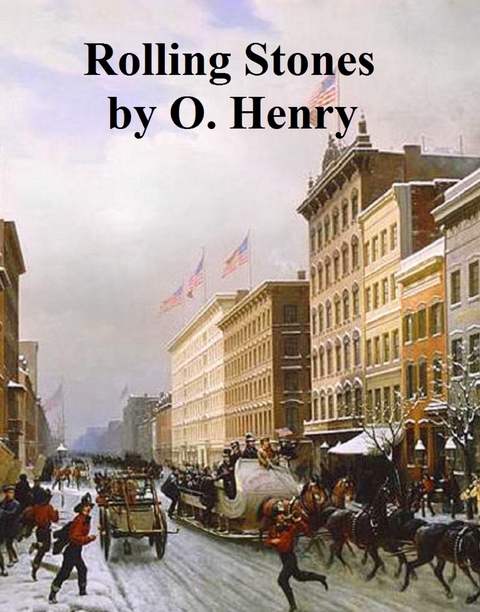
Rolling Stones (eBook)
478 Seiten
Seltzer Books (Verlag)
978-1-4553-3349-3 (ISBN)
According to Wikipedia: "e;O. Henry was the pen name of American writer William Sydney Porter (September 11, 1862 - June 5, 1910). O. Henry short stories are known for wit, wordplay, warm characterization and clever twist endings.... Most of O. Henry's stories are set in his own time, the early years of the 20th century. Many take place in New York City, and deal for the most part with ordinary people: clerks, policemen, waitresses. Fundamentally a product of his time, O. Henry's work provides one of the best English examples of catching the entire flavor of an age. Whether roaming the cattle-lands of Texas, exploring the art of the "e;gentle grafter,"e; or investigating the tensions of class and wealth in turn-of-the-century New York, O. Henry had an inimitable hand for isolating some element of society and describing it with an incredible economy and grace of language. Some of his best and least-known work resides in the collection Cabbages and Kings, a series of stories which each explore some individual aspect of life in a paralytically sleepy Central American town while each advancing some aspect of the larger plot and relating back one to another in a complex structure which slowly explicates its own background even as it painstakingly erects a town which is one of the most detailed literary creations of the period. The Four Million is another collection of stories. It opens with a reference to Ward McAllister's "e;assertion that there were only 'Four Hundred' people in New York City who were really worth noticing. But a wiser man has arisen-the census taker-and his larger estimate of human interest has been preferred in marking out the field of these little stories of the 'Four Million.'"e; To O. Henry, everyone in New York counted. He had an obvious affection for the city, which he called "e;Bagdad-on-the-Subway,"e;
A DINNER AT -------*
[Footnote: See advertising column, "Where to Dine Well," in the daily newspapers.]
[The story referred to in this skit appears in "The Trimmed Lamp" under the same title--"The Badge of Policeman O'Roon."]
The Adventures of an Author With His Own Hero
All that day--in fact from the moment of his creation--Van Sweller had conducted himself fairly well in my eyes. Of course I had had to make many concessions; but in return he had been no less considerate. Once or twice we had had sharp, brief contentions over certain points of behavior; but, prevailingly, give and take had been our rule.
His morning toilet provoked our first tilt. Van Sweller went about it confidently.
"The usual thing, I suppose, old chap," he said, with a smile and a yawn. "I ring for a b. and s., and then I have my tub. I splash a good deal in the water, of course. You are aware that there are two ways in which I can receive Tommy Carmichael when he looks in to have a chat about polo. I can talk to him through the bathroom door, or I can be picking at a grilled bone which my man has brought in. Which would you prefer?"
I smiled with diabolic satisfaction at his coming discomfiture.
"Neither," I said. "You will make your appearance on the scene when a gentleman should--after you are fully dressed, which indubitably private function shall take place behind closed doors. And I will feel indebted to you if, after you do appear, your deportment and manners are such that it will not be necessary to inform the public, in order to appease its apprehension, that you have taken a bath."
Van Sweller slightly elevated his brows. "Oh, very well," he said, a trifle piqued. "I rather imagine it concerns you more than it does me. Cut the 'tub' by all means, if you think best. But it has been the usual thing, you know."
This was my victory; but after Van Sweller emerged from his apartments in the "Beaujolie" I was vanquished in a dozen small but well-contested skirmishes. I allowed him a cigar; but routed him on the question of naming its brand. But he worsted me when I objected to giving him a "coat unmistakably English in its cut." I allowed him to "stroll down Broadway," and even permitted "passers by" (God knows there's nowhere to pass but by) to "turn their heads and gaze with evident admiration at his erect figure." I demeaned myself, and, as a barber, gave him a "smooth, dark face with its keen, frank eye, and firm jaw."
Later on he looked in at the club and saw Freddy Vavasour, polo team captain, dawdling over grilled bone No. 1.
"Dear old boy," began Van Sweller; but in an instant I had seized him by the collar and dragged him aside with the scantiest courtesy.
"For heaven's sake talk like a man," I said, sternly. "Do you think it is manly to use those mushy and inane forms of address? That man is neither dear nor old nor a boy."
To my surprise Van Sweller turned upon me a look of frank pleasure.
"I am glad to hear you say that," he said, heartily. "I used those words because I have been forced to say them so often. They really are contemptible. Thanks for correcting me, dear old boy."
Still I must admit that Van Sweller's conduct in the park that morning was almost without flaw. The courage, the dash, the modesty, the skill, and fidelity that he displayed atoned for everything.
This is the way the story runs. Van Sweller has been a gentleman member of the "Rugged Riders," the company that made a war with a foreign country famous. Among his comrades was Lawrence O'Roon, a man whom Van Sweller liked. A strange thing--and a hazardous one in fiction--was that Van Sweller and O'Roon resembled each other mightily in face, form, and general appearance. After the war Van Sweller pulled wires, and O'Roon was made a mounted policeman.
Now, one night in New York there are commemorations and libations by old comrades, and in the morning, Mounted Policeman O'Roon, unused to potent liquids--another premise hazardous in fiction--finds the earth bucking and bounding like a bronco, with no stirrup into which he may insert foot and save his honor and his badge.
Noblesse oblige? Surely. So out along the driveways and bridle paths trots Hudson Van Sweller in the uniform of his incapacitated comrade, as like unto him as one French pea is unto a petit pois.
It is, of course, jolly larks for Van Sweller, who has wealth and social position enough for him to masquerade safely even as a police commissioner doing his duty, if he wished to do so. But society, not given to scanning the countenances of mounted policemen, sees nothing unusual in the officer on the beat.
And then comes the runaway.
That is a fine scene--the swaying victoria, the impetuous, daft horses plunging through the line of scattering vehicles, the driver stupidly holding his broken reins, and the ivory-white face of Amy Ffolliott, as she clings desperately with each slender hand. Fear has come and gone: it has left her expression pensive and just a little pleading, for life is not so bitter.
And then the clatter and swoop of Mounted Policeman Van Sweller! Oh, it was--but the story has not yet been printed. When it is you shall learn bow he sent his bay like a bullet after the imperilled victoria. A Crichton, a Croesus, and a Centaur in one, he hurls the invincible combination into the chase.
When the story is printed you will admire the breathless scene where Van Sweller checks the headlong team. And then he looks into Amy Ffolliott's eyes and sees two things--the possibilities of a happiness he has long sought, and a nascent promise of it. He is unknown to her; but he stands in her sight illuminated by the hero's potent glory, she his and he hers by all the golden, fond, unreasonable laws of love and light literature.
Ay, that is a rich moment. And it will stir you to find Van Sweller in that fruitful nick of time thinking of his comrade O'Roon, who is cursing his gyrating bed and incapable legs in an unsteady room in a West Side hotel while Van Sweller holds his badge and his honor.
Van Sweller hears Miss Ffolliott's voice thrillingly asking the name of her preserver. If Hudson Van Sweller, in policeman's uniform, has saved the life of palpitating beauty in the park--where is Mounted Policeman O'Roon, in whose territory the deed is done? How quickly by a word can the hero reveal himself, thus discarding his masquerade of ineligibility and doubling the romance! But there is his friend!
Van Sweller touches his cap. "It's nothing, Miss," he says, sturdily; "that's what we are paid for--to do our duty." And away he rides. But the story does not end there.
As I have said, Van Sweller carried off the park scene to my decided satisfaction. Even to me he was a hero when he foreswore, for the sake of his friend, the romantic promise of his adventure. It was later in the day, amongst the more exacting conventions that encompass the society hero, when we had our liveliest disagreement. At noon he went to O'Roon's room and found him far enough recovered to return to his post, which he at once did.
At about six o'clock in the afternoon Van Sweller fingered his watch, and flashed at me a brief look full of such shrewd cunning that I suspected him at once.
"Time to dress for dinner, old man," he said, with exaggerated carelessness.
"Very well," I answered, without giving him a clew to my suspicions; "I will go with you to your rooms and see that you do the thing properly. I suppose that every author must be a valet to his own hero."
He affected cheerful acceptance of my somewhat officious proposal to accompany him. I could see that he was annoyed by it, and that fact fastened deeper in my mind the conviction that he was meditating some act of treachery.
When he had reached his apartments he said to me, with a too patronizing air: "There are, as you perhaps know, quite a number of little distinguishing touches to be had out of the dressing process. Some writers rely almost wholly upon them. I suppose that I am to ring for my man, and that he is to enter noiselessly, with an expressionless countenance."
"He may enter," I said, with decision, "and only enter. Valets do not usually enter a room shouting college songs or with St. Vitus's dance in their faces; so the contrary may be assumed without fatuous or gratuitous asseveration."
"I must ask you to pardon me," continued Van Sweller, gracefully, "for annoying you with questions, but some of your methods are a little new to me. Shall I don a full-dress suit with an immaculate white tie--or is there another tradition to be upset?"
"You will wear," I replied, "evening dress, such as a gentleman wears. If it is full, your tailor should be responsible for its bagginess. And I will leave it to whatever erudition you are supposed to possess whether a white tie is rendered any whiter by being immaculate. And I will leave it to the consciences of you and your man whether a tie...
| Erscheint lt. Verlag | 1.3.2018 |
|---|---|
| Sprache | englisch |
| Themenwelt | Literatur ► Anthologien |
| Literatur ► Klassiker / Moderne Klassiker | |
| Literatur ► Romane / Erzählungen | |
| ISBN-10 | 1-4553-3349-2 / 1455333492 |
| ISBN-13 | 978-1-4553-3349-3 / 9781455333493 |
| Informationen gemäß Produktsicherheitsverordnung (GPSR) | |
| Haben Sie eine Frage zum Produkt? |
 EPUB (Adobe DRM)
Größe: 478 KB
Kopierschutz: Adobe-DRM
Adobe-DRM ist ein Kopierschutz, der das eBook vor Mißbrauch schützen soll. Dabei wird das eBook bereits beim Download auf Ihre persönliche Adobe-ID autorisiert. Lesen können Sie das eBook dann nur auf den Geräten, welche ebenfalls auf Ihre Adobe-ID registriert sind.
Details zum Adobe-DRM
Dateiformat: EPUB (Electronic Publication)
EPUB ist ein offener Standard für eBooks und eignet sich besonders zur Darstellung von Belletristik und Sachbüchern. Der Fließtext wird dynamisch an die Display- und Schriftgröße angepasst. Auch für mobile Lesegeräte ist EPUB daher gut geeignet.
Systemvoraussetzungen:
PC/Mac: Mit einem PC oder Mac können Sie dieses eBook lesen. Sie benötigen eine
eReader: Dieses eBook kann mit (fast) allen eBook-Readern gelesen werden. Mit dem amazon-Kindle ist es aber nicht kompatibel.
Smartphone/Tablet: Egal ob Apple oder Android, dieses eBook können Sie lesen. Sie benötigen eine
Geräteliste und zusätzliche Hinweise
Buying eBooks from abroad
For tax law reasons we can sell eBooks just within Germany and Switzerland. Regrettably we cannot fulfill eBook-orders from other countries.
EPUB (Ohne DRM)Digital Rights Management: ohne DRM
Dieses eBook enthält kein DRM oder Kopierschutz. Eine Weitergabe an Dritte ist jedoch rechtlich nicht zulässig, weil Sie beim Kauf nur die Rechte an der persönlichen Nutzung erwerben.
Dateiformat: EPUB (Electronic Publication)
EPUB ist ein offener Standard für eBooks und eignet sich besonders zur Darstellung von Belletristik und Sachbüchern. Der Fließtext wird dynamisch an die Display- und Schriftgröße angepasst. Auch für mobile Lesegeräte ist EPUB daher gut geeignet.
Systemvoraussetzungen:
PC/Mac: Mit einem PC oder Mac können Sie dieses eBook lesen. Sie benötigen dafür die kostenlose Software Adobe Digital Editions.
eReader: Dieses eBook kann mit (fast) allen eBook-Readern gelesen werden. Mit dem amazon-Kindle ist es aber nicht kompatibel.
Smartphone/Tablet: Egal ob Apple oder Android, dieses eBook können Sie lesen. Sie benötigen dafür eine kostenlose App.
Geräteliste und zusätzliche Hinweise
Buying eBooks from abroad
For tax law reasons we can sell eBooks just within Germany and Switzerland. Regrettably we cannot fulfill eBook-orders from other countries.
aus dem Bereich