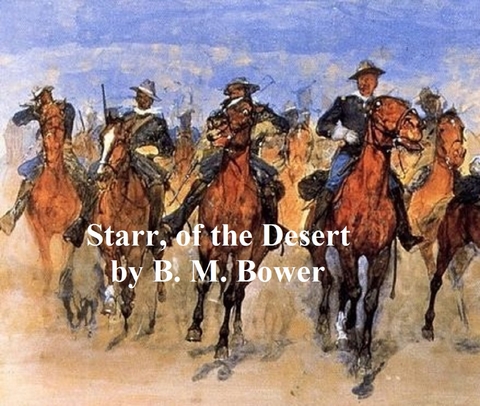
Starr of the Desert (eBook)
510 Seiten
Seltzer Books (Verlag)
978-1-4553-6086-4 (ISBN)
Classic western. "e;A New Mexico ranch story of mystery and adventure."e; According to Wikipedia: "e;Bertha Muzzy Sinclair or Sinclair-Cowan, nee Muzzy (November 15, 1871 - July 23, 1940), best known by her pseudonym B. M. Bower, was an American novelist who wrote fictional stories about the American Old West... She wrote 57 Western novels, several of which were turned into films."e;
CHAPTER THIRTEEN. HELEN MAY SIGHS FOR ROMANCE
Helen May was toiling over the ridgy upland which in New Mexico is called a mesa, when it is not a desert--and sometimes when it is one--taking her turn with the goats while Vic nursed a strained ankle and a grouch under the mesquite tree by the house. With Pat to help, the herding resolved itself into the exercise of human intelligence over the dog's skill. Pat, for instance, would not of his own accord choose the best grazing for his band, but he could drive them to good grazing once it was chosen for him. So, theoretically, Helen May was exercising her human intelligence; actually she was exercising her muscles mostly. And having an abundance of brain energy that refused to lie dormant, she had plenty of time to think her own thoughts while Pat carried out her occasional orders.
For one thing, Helen May was undergoing the transition from a mild satisfaction with her education and mentality, to a shamed consciousness of an appalling ignorance and mental crudity. Holman Sommers was unwittingly the cause of that. There was nothing patronizing or condescending in the attitude of Holman Sommers, even if he did run to long words and scientifically accurate descriptions of the smallest subjects. It was the work he placed before her that held Helen May abashed before his vast knowledge. She could not understand half of what she deciphered and typed for him, and because she could not understand she realized the depth of her benightedness.
She was awed by the breadth and the scope which she sensed more or less vaguely in The Evolution of Sociology. Holman Sommers quoted freely, and discussed boldly and frankly, such abstruse authors as Descartes, Spinoza, Schopenhauer, Comte, Gumplowicz, some of them names she had never heard of and could not even spell without following her copy letter by letter. Holman Sommers seemed to have read all of them and to have weighed all of them and to be able to quote all of them offhand; whereas Schopenhauer was the only name in the lot that sounded in the least familiar to Helen May, and she had a guilty feeling that she had always connected the name with music instead of the sort of things Holman Sommers quoted him as having said or written, she could not make out which.
Helen May, therefore, was suffering from mental growing pains. She struggled with new ideas which she had swallowed whole, without any previous elementary knowledge of the subject. Her brain was hungry, her life was stagnant, and she seized upon these sociological problems which Holman Sommers had placed before her, and worried over them, and wondered where Holman Sommers had learned so much about things she had never heard of. Save his vocabulary, which wearied her, he was the simplest, the kindest of men, though not kind as her Man of the Desert was kind.
Just here in her thoughts Holman Sommers faded, and Starr's lean, whimsical face came out sharply defined before her mental vision. Starr certainly was different! Ordinary, and not educated much beyond the three Rs, she suspected. Just a desert man with a nice voice and a gift for provocative little silences. Two men could not well be farther apart in personality, she thought, and she amused herself by comparing them.
For instance, take the case of Pat. Sommers had told her just why and just how desperately she needed a dog for the goats, and had urged her by all means to get one at the first opportunity. Starr had not said anything about it; he had simply brought the dog. Helen May appreciated the different quality of the kindness that does things.
Privately, she suspected that Starr had stolen that dog, he had seemed so embarrassed while he explained how he came by Pat; especially, she remembered, when she had urged him to take the dog back. She would not, of course, dare hint it even to Vic; and theoretically she was of course shocked at the possibility. But, oh, she was human! That a nice man should swipe a dog for her secretly touched a little, responsive tenderness in Helen May. (She used the word "swipe," which somehow made the suspected deed sound less a crime and more an amusing peccadillo than the word "steal" would have done. Have you ever noticed how adroitly we tone down or magnify certain misdeeds simply by using slang or dictionary words as the case may be?)
Oh, she saw it quite plainly, as she trudged over to the shady side of a rock ridge and sat down where she could keep an eye on Pat and the goats. She told herself that she would ask her Man of the Desert, the next time he happened along, whether he had found out who the dog belonged to. If he acted confused and dodged the issue, then she would know for sure. Just what she would do when she knew for sure, Helen May had not decided.
The goats were browsing docilely upon the slope, eating stuff which only a goat would attempt to eat. Helen May was not afraid of Billy since Pat had taken charge. Pat had a way of keeping Billy cowed and as harmless as the nannies themselves. Just now Pat was standing at a little distance with his tongue slavering down over his white teeth, gazing over the band as a general looks at his army drawn up in review.
He turned his head and glanced at Helen May inquiringly, then trotted over to where she sat in the shade. His tongue still drooped quiveringly over his lower jaw; and now and then he drew it back and licked his lips as though they were dry. Helen May found a rock that was hollowed like a crude saucer, and poured water into the hollow from her canteen. Pat lapped it up thirstily, gave his stubby tail a wag of gratitude, lay down with his front paws on the edge of her skirt with his head dropped down upon them, and took a nap--with one eye opening now and then to see that the goats were all right, and with his ears lifting to catch the meaning of every stray bleat from a garrulous nanny.
Helen May had changed a good deal in the past two or three weeks. Now when she stared away and away over the desert and barren slope and ridges and mountain, she did not feel that she hated them. Instead, she saw that the yellow of the desert, the brown of the slopes, and the black of the distant granite ledges basseting from bleak hills were more beautiful than the tidy little plots of tilled ground she used to think so lovely. There was something hypnotic in these bald distances. She could not read, when she was out like this; she could only look and think and dream.
She wished that she might ride out over it sometime, away over to the mountains, perhaps, as far as she could see. She fell to dreaming of the old days when this was Spanish territory, and the king gave royal grants of land to his favorites: for instance, all the country lying between two mountain ranges, to where a river cut across and formed a natural boundary. Holman Sommers had told her about the old Spanish grants, and how many of the vast estates of Mexican "cattle kings" and "sheep kings" were still preserved almost intact, just as they had been when this was a part of Mexico.
She wished that she might have lived here then, when the dons held sway and when senoritas were all beautiful and when senoras were every one of them imposing in many jewels and in rich mantillas, and when vaqueros wore red sashes and beautiful serapes and big, gold-laced sombreros, and rode prancing steeds that curveted away from jingling, silver-rowelled spurs. Helen May, you must remember, knew her moving-picture romance. She could easily vision these things exactly as they had been presented to her on the screen. That is why she peopled this empty land so gorgeously.
It was different now, of course. All the Mexicans she had seen were like the Mexicans around the old Plaza in Los Angeles. All the senoritas she had met--they had not been many--powdered and painted abominably to the point of their jaws and left their necks dirty. And their petticoats were draggled and their hats looked as though they had been trimmed from the ten-cent counter of a cheap store. All the senoras were smoky looking with snakish eyes, and the dresses under their heavy-fringed black mantillas were more frowsy than those of their daughters. They certainly were not imposing; and if they wore jewelry at all it looked brassy and cheap.
There was no romance, nothing like adventure here nowadays, said Helen May to herself, while she watched the little geysers of dust go dancing like whirling dervishes across the sand. A person lived on canned stuff and kept goats and was abjectly pleased to see any kind of human being. There certainly was no romance left in the country, though it had seemed almost as though there might be, when her Man of the Desert sang and all the little night-sounds hushed to listen, and the moon-trail across the sand of the desert lay like a ribbon of silver. It had seemed then as though there might be romance yet alive in the wide spaces.
So she had swung back again to Starr, just as she was always doing lately. She began to wonder when he would come again, and what he would have to say next time, and whether he had really annexed some poor sheep man's perfectly good dog, just because he knew she needed one. It would never do to let on that she guessed; but all the same, it was mighty nice of him to think of her, even if he did go about it in a queer way. And when Pat, who had seemed to be asleep, lifted his head and looked up into her eyes adoringly, Helen May laid her hand upon his smooth skull and smiled oddly.
No more romance, said Helen May--and here was Starr, a man of...
| Erscheint lt. Verlag | 1.3.2018 |
|---|---|
| Sprache | englisch |
| Themenwelt | Literatur ► Anthologien |
| Literatur ► Klassiker / Moderne Klassiker | |
| Literatur ► Romane / Erzählungen | |
| ISBN-10 | 1-4553-6086-4 / 1455360864 |
| ISBN-13 | 978-1-4553-6086-4 / 9781455360864 |
| Informationen gemäß Produktsicherheitsverordnung (GPSR) | |
| Haben Sie eine Frage zum Produkt? |
 EPUB (Adobe DRM)
Größe: 510 KB
Kopierschutz: Adobe-DRM
Adobe-DRM ist ein Kopierschutz, der das eBook vor Mißbrauch schützen soll. Dabei wird das eBook bereits beim Download auf Ihre persönliche Adobe-ID autorisiert. Lesen können Sie das eBook dann nur auf den Geräten, welche ebenfalls auf Ihre Adobe-ID registriert sind.
Details zum Adobe-DRM
Dateiformat: EPUB (Electronic Publication)
EPUB ist ein offener Standard für eBooks und eignet sich besonders zur Darstellung von Belletristik und Sachbüchern. Der Fließtext wird dynamisch an die Display- und Schriftgröße angepasst. Auch für mobile Lesegeräte ist EPUB daher gut geeignet.
Systemvoraussetzungen:
PC/Mac: Mit einem PC oder Mac können Sie dieses eBook lesen. Sie benötigen eine
eReader: Dieses eBook kann mit (fast) allen eBook-Readern gelesen werden. Mit dem amazon-Kindle ist es aber nicht kompatibel.
Smartphone/Tablet: Egal ob Apple oder Android, dieses eBook können Sie lesen. Sie benötigen eine
Geräteliste und zusätzliche Hinweise
Buying eBooks from abroad
For tax law reasons we can sell eBooks just within Germany and Switzerland. Regrettably we cannot fulfill eBook-orders from other countries.
EPUB (Ohne DRM)Digital Rights Management: ohne DRM
Dieses eBook enthält kein DRM oder Kopierschutz. Eine Weitergabe an Dritte ist jedoch rechtlich nicht zulässig, weil Sie beim Kauf nur die Rechte an der persönlichen Nutzung erwerben.
Dateiformat: EPUB (Electronic Publication)
EPUB ist ein offener Standard für eBooks und eignet sich besonders zur Darstellung von Belletristik und Sachbüchern. Der Fließtext wird dynamisch an die Display- und Schriftgröße angepasst. Auch für mobile Lesegeräte ist EPUB daher gut geeignet.
Systemvoraussetzungen:
PC/Mac: Mit einem PC oder Mac können Sie dieses eBook lesen. Sie benötigen dafür die kostenlose Software Adobe Digital Editions.
eReader: Dieses eBook kann mit (fast) allen eBook-Readern gelesen werden. Mit dem amazon-Kindle ist es aber nicht kompatibel.
Smartphone/Tablet: Egal ob Apple oder Android, dieses eBook können Sie lesen. Sie benötigen dafür eine kostenlose App.
Geräteliste und zusätzliche Hinweise
Buying eBooks from abroad
For tax law reasons we can sell eBooks just within Germany and Switzerland. Regrettably we cannot fulfill eBook-orders from other countries.
aus dem Bereich