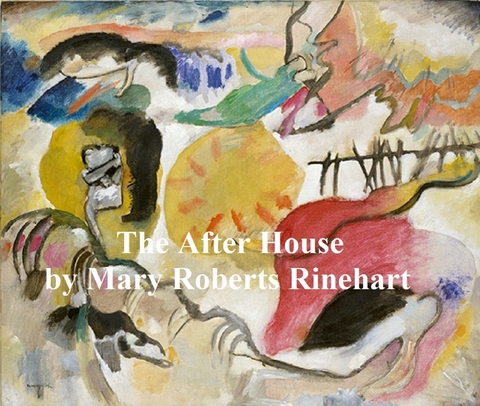
After House (eBook)
556 Seiten
Seltzer Books (Verlag)
978-1-4553-3203-8 (ISBN)
According to Wikipedia: "e;Mary Roberts Rinehart (August 12, 1876-September 22, 1958) was a prolific author often called the American Agatha Christie. She is considered the source of the phrase "e;The butler did it"e;, although she did not actually use the phrase herself, and also considered to have invented the "e;Had-I-But-Known"e; school of mystery writing.... Rinehart wrote hundreds of short stories, poems, travelogues and special articles. Many of her books and plays, such as The Bat (1920) were adapted for movies, such as The Bat (1926), The Bat Whispers (1930), and The Bat (1959). While many of her books were best-sellers, critics were most appreciative of her murder mysteries. Rinehart, in The Circular Staircase (1908), is credited with inventing the "e;Had-I-But-Known"e; school of mystery writing. The Circular Staircase is a novel in which "e;a middle-aged spinster is persuaded by her niece and nephew to rent a country house for the summer. The house they choose belonged to a bank defaulter who had hidden stolen securities in the walls. The gentle, peace-loving trio is plunged into a series of crimes solved with the help of the aunt. This novel is credited with being the first in the "e;Had-I-But-Known"e; school."e;[3] The Had-I-But-Known mystery novel is one where the principal character (frequently female) does less than sensible things in connection with a crime which have the effect of prolonging the action of the novel. Ogden Nash parodied the school in his poem Don't Guess Let Me Tell You: "e;Sometimes the Had I But Known then what I know now I could have saved at least three lives by revealing to the Inspector the conversation I heard through that fortuitous hole in the floor."e; The phrase "e;The butler did it"e;, which has become a cliche, came from Rinehart's novel The Door, in which the butler actually did do it, although that exact phrase does not actually appear in the work."e;
CHAPTER XVII THE AXE IS GONE
My first thought was of the after house. Jones, who had been fond of Burns, was working over him, muttering to himself. I felt his heart, which was beating slowly but regularly, and, convinced that he was not dying, ran down into the after house. The cabin was empty: evidently the guard around the pearl handled revolver had been given up on the false promise of peace. All the lights were going, however, and the heat was suffocating.
I ran to Miss Lee's door, and tried it. It was locked, but almost instantly she spoke from inside:
"What is it?"
"Nothing much. Can you come out?"
She came a moment later, and I asked her to call into each cabin to see if every one was safe. The result was reassuring - no one had been disturbed; and I was put to it to account to Miss Lee for my anxiety without telling her what had happened. I made some sort of excuse, which I have forgotten, except that she evidently did not believe it.
On deck, the men were gathered around Burns. There were ominous faces among them, and mutterings of hatred and revenge; for Burns had been popular - the best-liked man among them all. Jones, wrought to the highest pitch, had even shed a few shamefaced tears, and was obliterating the humiliating memory by an extra brusqueness of manner.
We carried the injured man aft, and with such implements as I had I cleaned and dressed the wound. It needed sewing, and it seemed best to do it before he regained consciousness. Jones and Adams went below to the forecastle, therefore, and brought up my amputating set, which contained, besides its knives, some curved needles and surgical silk, still in good condition.
I opened the case, and before the knives, the long surgeon's knives which were in use before the scalpel superseded them, they fell back, muttering and amazed.
I did not know that Elsa Lee also was watching until, having requested Jones, who had been a sail maker, to thread the needles, his trembling hands refused their duty. I looked up, searching the group for a competent assistant, and saw the girl. She had dressed, and the light from the lantern beside me on the deck threw into relief her white figure among the dark ones. She came forward as my eyes fell on her.
"Let me try," she said; and, kneeling by the lantern, in a moment she held out the threaded needle. Her hand was quite steady. She made an able assistant, wiping clean the oozing edges of the wound so that I could see to clip the bleeding vessels, and working deftly with the silk and needles to keep me supplied. My old case yielded also a roll or so of bandage. By the time Burns was attempting an incoordinate movement or two, the operation was over and the instruments put out of sight.
His condition was good. The men carried him to the tent, where Jones sat beside him, and the other men stood outside, uneasy and watchful, looking in.
The operating-case, with its knives, came in for its share of scrutiny, and I felt that an explanation was due the men. To tell the truth, I had forgotten all about the case. Perhaps I swaggered just a bit as I went over to wash my hands. It was my first opportunity, and I was young, and the Girl was there.
"I see you looking at my case, boys," I said. "Perhaps I'm a little late explaining, but I guess after what you've seen you'll understand. The case belonged to my grandfather, who was a surgeon. He was in the war. That case was at Gettysburg."
"And because of your grandfather you brought it on shipboard!" Clarke said nastily.
"No. I'm a cub doctor myself. I'd been sick, and I needed the sea and a rest."
They were not so impressed as I had expected - or perhaps they had known all along. Sailors are a secretive lot.
"I'm thinking we'll all be getting a rest soon," a voice said. "What are you going to do with them knives?"
I had an inspiration. "I'm going to leave that to you men," I said. "You may throw them overboard, if you wish - but, if you do, take out the needles and the silk; we may need them."
There followed a savage but restrained argument among the men. Jones, from the tent, called out irritably: -
"Don't be fools, you fellows. This happened while Leslie was asleep. I'll swear he never moved after he lay down."
The crew reached a decision shortly after that, and came to me in a body.
"We think," Oleson said, "that we'll lock them in the captain's cabin, with the axe."
"Very well," I said. "Burns has the key around his neck."
Clarke, I think it was, went into the tent, and came out again directly.
"There's no key around his neck," he said gruffly.
"It may have slipped around under his back."
"It isn't there at all."
I ran into the tent, where Jones, having exhausted the resources of the injured man's clothing, was searching among the blankets on which he lay. There was no key. I went out to the men again, bewildered. The dawn had come, a pink and rosy dawn that promised another stifling day. It revealed the disarray of the deck - he basins, the old mahogany amputating-case with its lock plate of bone, the stained and reddened towels; and it showed the brooding and overcast faces of the men.
"Isn't it there?" I asked. "Our agreement was for me to carry the key to Singleton's cabin and Burns the captain's."
Miss Lee, by the rail, came forward slowly, and looked up at me.
"Isn't it possible," she said, "that, knowing where the key was, some one wished to get it, and so -" She indicated the tent and Burns.
I knew then. How dull I had been, and stupid! The men caught her meaning, too, and we tramped heavily forward, the girl and I leading.
The door into the captain's room was open, and the axe was gone from the bunk. The key, with the cord that Burns had worn around his neck, was in the door, the string torn and pulled as if it had been jerked away from the unconscious man. Later on we verified this by finding, on the back of Bums's neck an abraded line two inches or so in length.
It was a strong cord - the kind a sailor pins his faith to, and uses indiscriminately to hold his trousers or his knife.
I ordered a rigid search of the deck, but the axe was gone. Nor was it ever found. It had taken its bloody story many fathoms deep into the old Atlantic, and hidden it, where many crimes have been hidden, in the ooze and slime of the sea-bottom.
That day was memorable for more than the attack on Burns. It marked a complete revolution in my idea of the earlier crimes, and of the criminal.
Two things influenced my change of mental attitude. The attack on Burns was one. I did not believe that Turner had strength enough to fell so vigorous a man, even with the capstan bar which we found lying near by. Nor could he have jerked and broken the amberline. Mrs. Johns I eliminated for the same reason, of course. I could imagine her getting the key by subtlety, wheedling the impressionable young sailor into compliance. But force!
The second reason was the stronger.
Singleton, the mate, had become a tractable and almost amiable prisoner. Like Turner, he was ugly only when he was drinking, and there was not even enough liquor on the Ella to revive poor Burns. He spent his days devising, with bits of wire, a ring puzzle that he intended should make his fortune. And I believe he contrived, finally, a clever enough bit of foolery. He was anxious to talk, and complained bitterly of loneliness, using every excuse to hold Tom, the cook, when he carried him his meals. He had asked for a Bible, too, and read it now and then.
The morning of Bums's injury, I visited Singleton.
The new outrage, coming at a time when they were slowly recovering confidence, had turned the men surly. The loss of the axe, the handle of which I had told them would, under skillful eyes, reveal the murderer as accurately as a photograph, was a serious blow. Again arose the specter of the innocent suffering for the guilty. They went doggedly about their work, and wherever they gathered there was muttered talk of the white figure. There was grumbling, too, over their lack of weapons for defense. The cook was a ringleader of the malcontents. Certain utensils were allowed him; but he was compelled at night to lock them in the galley, after either Burns's inspection or mine, and to turn over the key to one of us.
On the morning after the attack, therefore, Tom, carrying Singleton's breakfast to him, told him at length what had occurred in the night, and dilated on his lack of self-defense should an attack be directed toward him.
Singleton...
| Erscheint lt. Verlag | 1.3.2018 |
|---|---|
| Sprache | englisch |
| Themenwelt | Literatur ► Anthologien |
| Literatur ► Klassiker / Moderne Klassiker | |
| Literatur ► Romane / Erzählungen | |
| ISBN-10 | 1-4553-3203-8 / 1455332038 |
| ISBN-13 | 978-1-4553-3203-8 / 9781455332038 |
| Informationen gemäß Produktsicherheitsverordnung (GPSR) | |
| Haben Sie eine Frage zum Produkt? |
 EPUB (Adobe DRM)
Größe: 555 KB
Kopierschutz: Adobe-DRM
Adobe-DRM ist ein Kopierschutz, der das eBook vor Mißbrauch schützen soll. Dabei wird das eBook bereits beim Download auf Ihre persönliche Adobe-ID autorisiert. Lesen können Sie das eBook dann nur auf den Geräten, welche ebenfalls auf Ihre Adobe-ID registriert sind.
Details zum Adobe-DRM
Dateiformat: EPUB (Electronic Publication)
EPUB ist ein offener Standard für eBooks und eignet sich besonders zur Darstellung von Belletristik und Sachbüchern. Der Fließtext wird dynamisch an die Display- und Schriftgröße angepasst. Auch für mobile Lesegeräte ist EPUB daher gut geeignet.
Systemvoraussetzungen:
PC/Mac: Mit einem PC oder Mac können Sie dieses eBook lesen. Sie benötigen eine
eReader: Dieses eBook kann mit (fast) allen eBook-Readern gelesen werden. Mit dem amazon-Kindle ist es aber nicht kompatibel.
Smartphone/Tablet: Egal ob Apple oder Android, dieses eBook können Sie lesen. Sie benötigen eine
Geräteliste und zusätzliche Hinweise
Buying eBooks from abroad
For tax law reasons we can sell eBooks just within Germany and Switzerland. Regrettably we cannot fulfill eBook-orders from other countries.
EPUB (Ohne DRM)Digital Rights Management: ohne DRM
Dieses eBook enthält kein DRM oder Kopierschutz. Eine Weitergabe an Dritte ist jedoch rechtlich nicht zulässig, weil Sie beim Kauf nur die Rechte an der persönlichen Nutzung erwerben.
Dateiformat: EPUB (Electronic Publication)
EPUB ist ein offener Standard für eBooks und eignet sich besonders zur Darstellung von Belletristik und Sachbüchern. Der Fließtext wird dynamisch an die Display- und Schriftgröße angepasst. Auch für mobile Lesegeräte ist EPUB daher gut geeignet.
Systemvoraussetzungen:
PC/Mac: Mit einem PC oder Mac können Sie dieses eBook lesen. Sie benötigen dafür die kostenlose Software Adobe Digital Editions.
eReader: Dieses eBook kann mit (fast) allen eBook-Readern gelesen werden. Mit dem amazon-Kindle ist es aber nicht kompatibel.
Smartphone/Tablet: Egal ob Apple oder Android, dieses eBook können Sie lesen. Sie benötigen dafür eine kostenlose App.
Geräteliste und zusätzliche Hinweise
Buying eBooks from abroad
For tax law reasons we can sell eBooks just within Germany and Switzerland. Regrettably we cannot fulfill eBook-orders from other countries.
aus dem Bereich