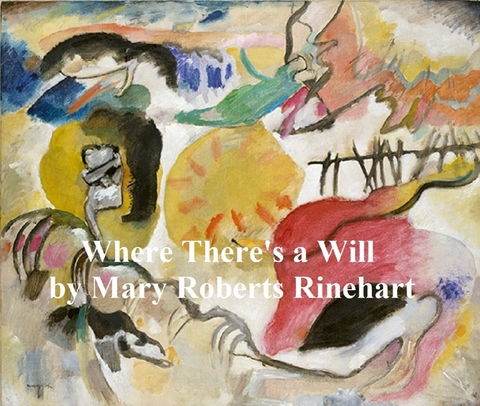
Where There's a Will (eBook)
590 Seiten
Seltzer Books (Verlag)
978-1-4553-3225-0 (ISBN)
According to Wikipedia: "e;Mary Roberts Rinehart (August 12, 1876-September 22, 1958) was a prolific author often called the American Agatha Christie.[1] She is considered the source of the phrase "e;The butler did it"e;, although she did not actually use the phrase herself, and also considered to have invented the "e;Had-I-But-Known"e; school of mystery writing.... Rinehart wrote hundreds of short stories, poems, travelogues and special articles. Many of her books and plays, such as The Bat (1920) were adapted for movies, such as The Bat (1926), The Bat Whispers (1930), and The Bat (1959). While many of her books were best-sellers, critics were most appreciative of her murder mysteries. Rinehart, in The Circular Staircase (1908), is credited with inventing the "e;Had-I-But-Known"e; school of mystery writing. The Circular Staircase is a novel in which "e;a middle-aged spinster is persuaded by her niece and nephew to rent a country house for the summer. The house they choose belonged to a bank defaulter who had hidden stolen securities in the walls. The gentle, peace-loving trio is plunged into a series of crimes solved with the help of the aunt. This novel is credited with being the first in the "e;Had-I-But-Known"e; school."e;[3] The Had-I-But-Known mystery novel is one where the principal character (frequently female) does less than sensible things in connection with a crime which have the effect of prolonging the action of the novel. Ogden Nash parodied the school in his poem Don't Guess Let Me Tell You: "e;Sometimes the Had I But Known then what I know now I could have saved at least three lives by revealing to the Inspector the conversation I heard through that fortuitous hole in the floor."e; The phrase "e;The butler did it"e;, which has become a cliche, came from Rinehart's novel The Door, in which the butler actually did do it, although that exact phrase does not actually appear in the work."e;
Where There's A Will By Mary Roberts Rinehart
published by Samizdat Express, Orange, CT, USA
established in 1974, offering over 14,000 books
Other mysteries by Mary Rinehart:
- The Man in Lower Ten
- The Circular Staircase
- When a Man Marries
- The Case of Jennie Brice
- Street of Seven Stars
- The After House
- K
- Long Live the King!
- The Amazing Interlude
- Dangerous Days
- Love Stories
- A Poor Wise Man
- The Bat
- The Confession
- Sight Unseen
- The Breaking Point
feedback welcome: info@samizdat.com
visit us at samizdat.com
VII MR. PIERCE ACQUIRES A WIFE
VIII AND MR. MOODY INDIGESTION
CHAPTER I I HAVE A WARNING
When it was all over Mr. Sam came out to the spring-house to say good-by to me before he and Mrs. Sam left. I hated to see him go, after all we had been through together, and I suppose he saw it in my face, for he came over close and stood looking down at me, and smiling. "You saved us, Minnie," he said, "and I needn't tell you we're grateful; but do you know what I think?" he asked, pointing his long forefinger at me. "I think you've enjoyed it even when you were suffering most. Red-haired women are born to intrigue, as the sparks fly upward."
"Enjoyed it!" I snapped. "I'm an old woman before my time, Mr. Sam. What with trailing back and forward through the snow to the shelter-house, and not getting to bed at all some nights, and my heart going by fits and starts, as you may say, and half the time my spinal marrow fairly chilled--not to mention putting on my overshoes every morning from force of habit and having to take them off again, I'm about all in."
"It's been the making of you, Minnie," he said, eying me, with his hands in his pockets. "Look at your cheeks! Look at your disposition! I don't believe you'd stab anybody in the back now!"
(Which was a joke, of course; I never stabbed anybody in the back.)
He sauntered over and dropped a quarter into the slot-machine by the door, but the thing was frozen up and refused to work. I've seen the time when Mr. Sam would have kicked it, but he merely looked at it and then at me.
"Turned virtuous, like everything else around the place. Not that I don't approve of virtue, Minnie, but I haven't got used to putting my foot on the brass rail of the bar and ordering a nut sundae. Hook the money out with a hairpin, Minnie, and buy some shredded wheat in remembrance of me."
He opened the door and a blast of February wind rattled the window-frames. Mr. Sam threw out his chest under his sweater and waved me another good-by.
"Well, I'm off, Minnie," he said. "Take care of yourself and don't sit too tight on the job; learn to rise a bit in the saddle."
"Good-by, Mr. Sam!" I called, putting down Miss Patty's doily and following him to the door; "good-by; better have something before you start to keep you warm."
He turned at the corner of the path and grinned back at me.
"All right," he called. "I'll go down to the bar and get a lettuce sandwich!"
Then he was gone, and happy as I was, I knew I would miss him terribly. I got a wire hairpin and went over to the slot- machine, but when I had finally dug out the money I could hardly see it for tears.
It began when the old doctor died. I suppose you have heard of Hope Sanatorium and the mineral spring that made it famous. Perhaps you have seen the blotter we got out, with a flash-light interior of the spring-house on it, and me handing the old doctor a glass of mineral water, and wearing the embroidered linen waist that Miss Patty Jennings gave me that winter. The blotters were a great success. Below the picture it said, "Yours for health," and in the body of the blotter, in red lettering, "Your system absorbs the health-giving drugs in Hope Springs water as this blotter soaks up ink."
The "Yours for health" was my idea.
I have been spring-house girl at Hope Springs Sanatorium for fourteen years. My father had the position before me, but he took rheumatism, and as the old doctor said, it was bad business policy to spend thousands of dollars in advertising that Hope Springs water cured rheumatism, and then have father creaking like a rusty hinge every time he bent over to fill a glass with it.
Father gave me one piece of advice the day he turned the spring- house over to me.
"It's a difficult situation, my girl," he said. "Lots of people think it's simply a matter of filling a glass with water and handing it over the railing. Why, I tell you a barkeeper's a high-priced man mostly, and his job's a snap to this. I'd like to know how a barkeeper would make out if his customers came back only once a year and he had to remember whether they wanted their drinks cold or hot or `chill off'. And another thing: if a chap comes in with a tale of woe, does the barkeeper have to ask him what he's doing for it, and listen while he tells how much weight he lost in a blanket sweat? No, sir; he pushes him a bottle and lets it go at that."
Father passed away the following winter. He'd been a little bit delirious, and his last words were: "Yes, sir; hot, with a pinch of salt, sir?" Poor father! The spring had been his career, you may say, and I like to think that perhaps even now he is sitting by some everlasting spring measuring out water with a golden goblet instead of the old tin dipper. I said that to Mr. Sam once, and he said he felt quite sure that I was right, and that where father was the water would be appreciated. He had heard of father.
Well, for the first year or so I nearly went crazy. Then I found things were coming my way. I've got the kind of mind that never forgets a name or face and can combine them properly, which isn't common. And when folks came back I could call them at once. It would do your heart good to see some politician, coming up to rest his stomach from the free bar in the state house at the capital, enter the spring-house where everybody is playing cards and drinking water and not caring a rap whether he's the man that cleans the windows or the secretary of the navy. If he's been there before, in sixty seconds I have his name on my tongue and a glass of water in his hand, and have asked him about the rheumatism in his right knee and how the children are. And in ten minutes he's sitting in a bridge game and trotting to the spring to have his glass refilled during his dummy hand, as if he'd grown up in the place. The old doctor used to say my memory was an asset to the sanatorium.
He depended on me a good bit--the old doctor...
| Erscheint lt. Verlag | 1.3.2018 |
|---|---|
| Sprache | englisch |
| Themenwelt | Literatur ► Anthologien |
| Literatur ► Klassiker / Moderne Klassiker | |
| Literatur ► Romane / Erzählungen | |
| ISBN-10 | 1-4553-3225-9 / 1455332259 |
| ISBN-13 | 978-1-4553-3225-0 / 9781455332250 |
| Informationen gemäß Produktsicherheitsverordnung (GPSR) | |
| Haben Sie eine Frage zum Produkt? |
 EPUB (Adobe DRM)
Größe: 590 KB
Kopierschutz: Adobe-DRM
Adobe-DRM ist ein Kopierschutz, der das eBook vor Mißbrauch schützen soll. Dabei wird das eBook bereits beim Download auf Ihre persönliche Adobe-ID autorisiert. Lesen können Sie das eBook dann nur auf den Geräten, welche ebenfalls auf Ihre Adobe-ID registriert sind.
Details zum Adobe-DRM
Dateiformat: EPUB (Electronic Publication)
EPUB ist ein offener Standard für eBooks und eignet sich besonders zur Darstellung von Belletristik und Sachbüchern. Der Fließtext wird dynamisch an die Display- und Schriftgröße angepasst. Auch für mobile Lesegeräte ist EPUB daher gut geeignet.
Systemvoraussetzungen:
PC/Mac: Mit einem PC oder Mac können Sie dieses eBook lesen. Sie benötigen eine
eReader: Dieses eBook kann mit (fast) allen eBook-Readern gelesen werden. Mit dem amazon-Kindle ist es aber nicht kompatibel.
Smartphone/Tablet: Egal ob Apple oder Android, dieses eBook können Sie lesen. Sie benötigen eine
Geräteliste und zusätzliche Hinweise
Buying eBooks from abroad
For tax law reasons we can sell eBooks just within Germany and Switzerland. Regrettably we cannot fulfill eBook-orders from other countries.
EPUB (Ohne DRM)Digital Rights Management: ohne DRM
Dieses eBook enthält kein DRM oder Kopierschutz. Eine Weitergabe an Dritte ist jedoch rechtlich nicht zulässig, weil Sie beim Kauf nur die Rechte an der persönlichen Nutzung erwerben.
Dateiformat: EPUB (Electronic Publication)
EPUB ist ein offener Standard für eBooks und eignet sich besonders zur Darstellung von Belletristik und Sachbüchern. Der Fließtext wird dynamisch an die Display- und Schriftgröße angepasst. Auch für mobile Lesegeräte ist EPUB daher gut geeignet.
Systemvoraussetzungen:
PC/Mac: Mit einem PC oder Mac können Sie dieses eBook lesen. Sie benötigen dafür die kostenlose Software Adobe Digital Editions.
eReader: Dieses eBook kann mit (fast) allen eBook-Readern gelesen werden. Mit dem amazon-Kindle ist es aber nicht kompatibel.
Smartphone/Tablet: Egal ob Apple oder Android, dieses eBook können Sie lesen. Sie benötigen dafür eine kostenlose App.
Geräteliste und zusätzliche Hinweise
Buying eBooks from abroad
For tax law reasons we can sell eBooks just within Germany and Switzerland. Regrettably we cannot fulfill eBook-orders from other countries.
aus dem Bereich