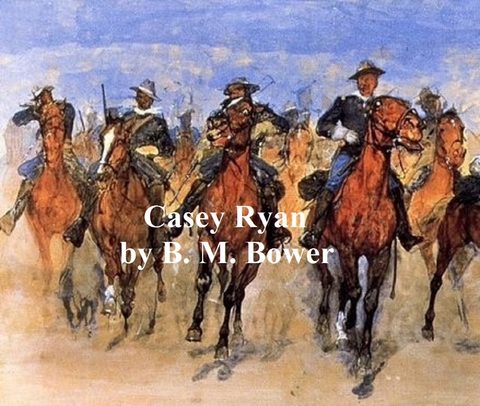
Casey Ryan (eBook)
487 Seiten
Seltzer Books (Verlag)
978-1-4553-6065-9 (ISBN)
Classic western. According to Wikipedia: "e;Bertha Muzzy Sinclair or Sinclair-Cowan, nee Muzzy (November 15, 1871 - July 23, 1940), best known by her pseudonym B. M. Bower, was an American novelist who wrote fictional stories about the American Old West. Born Bertha Muzzy in Cleveland, Minnesota, she was married three times: to Clayton Bower, in 1890; to Bertrand W. Sinclair, in 1912; and to Robert Elsworth Cowan, in 1921. She wrote 57 Western novels, several of which were turned into films."e;
CHAPTER XV. We can all remember
We can all remember certain experiences that fill us with incredulity even while we admit that the facts could be proved before a jury of twelve men. So Casey Ryan, having lost his outfit and come so near to death that he could barely keep his feet under him, walked into a tent and stood there thinking it couldn't be true.
A folding camp chair stood near the opening, and Casey sat down from sheer weakness while he looked about him. The tent was a twelve-by-fourteen, which is a bit larger than one usually carries in a pack outfit. It had a canvas floor soiled in strips where the most walking had been done, but white under table and beds, which proved its newness. Casey was not accustomed to seeing tents floored with canvas, and he stared at it for a full half-minute before his eyes went to other things.
There was a folding camp table of the kind shown in the window display of sporting-goods stores, but which seasoned campers find too wobbly for actual comfort. The varnish still shone on legs and braces, which helped to prove its newness. There was a two-burner oil stove with an enamel-rimmed oven that was distinctly out of place in that country and yet harmonized perfectly with the tent and furnishings. The dishes were white enamel of aluminum, and there were boxes piled upon boxes, the labels proclaiming canned things too expensive for ordinary eating. Two spring cots with new blankets and white-cased pillows stood against the tent wall, and beneath each cot sat two yellow pigskin suitcases with straps and brass buckles. They would have been perfectly natural in a Pullman sleeper, but even in his present stress Casey snorted disdainfully at sight of them here.
Things were tumbled about in the disorder of inexperienced campers, but everything was very new and clean except an array of dishes on the table, which told Casey that one man had eaten at least three meals without washing his dishes or putting away his surplus of food. Casey had eaten nothing at all after that one toasted rabbit which he had choked down on the evening when he gave up hope of finding the burros. He got up and staggered stiffly to the table and picked up a piece of burned biscuit, hard as flint.
While he mumbled a fragment of that he looked into various half-filled cans, setting them one by one in a compact group on the table corner; which was habit rather than conscious thought. Poisonous ptomaine lurked in every one of them, which was a shame, since he had to discard half a can of preserved peaches, half a can of roast beef, half a can of asparagus tips, a can of chicken soup scarcely touched and two thirds of a can of sweet potatoes. He salvaged a can of ripe olives which he thought was good, a can of India relish and a can of sweet gherkins (both of the fifty-seven varieties). You will see what I meant when I spoke of expensive camp food.
There was cold coffee in a nickel percolater, and Casey poured himself a cup, knowing well the risk of eating much just at first. It was while he was unscrewing the top of the glass jar that held the sugar that he first noticed the paper. It was folded and thrust into the sugar jar, and Casey pulled it out and held it crumpled in his hand while he sweetened and drank the coffee, forcing himself to take it slowly. When the cup was empty to the last drop he went over and sat down on the edge of a spring cot and unfolded the note. What he read surprised him a great deal and puzzled him more. I leave it to you to judge why.
"I saw it again last night in a different place. The last horse died yesterday down the canyon. You can have the outfit. I'm going to beat it out of here while the going's good. Fred."
"That's mighty damn funny," Casey muttered thickly. "You can--ask--" He lay back luxuriously, with his head on the white pillow and closed his eyes. The reaction from struggling to live had set in with the assurance of his safety. He slept heavily, refreshingly.
He awoke to the craving for food, and immediately started a small fire outside and boiled coffee in a nice new aluminum pail that held two quarts and had an ornamental cover. The oil stove he dismissed from his mind with a snort of contempt. And because nearly everything he saw was catalogued in his mind as a luxury, he opened cans somewhat extravagantly and dined off strange, delectable foods to which his palate was unaccustomed. He still thought it was mighty queer, but that did not impair his appetite.
Afterwards he went out to look after William, remembering that horses were said to have died in this place. William was almost within kicking distance of the spring, as if he meant to keep an eye upon the water supply even though that involved browsing off brush instead of wandering down to good grass below the camp.
Casey knelt stiffly and drank from the spring, laving his face and head afterward as if he never would get enough of the luxury of being wet and cool. He rose and stood looking at William for a few minutes, then took the lead rope and tied him to a juniper that stood near the spring. The note had said that the last horse died down the canyon, the implication of mystery lying heavy behind the words.
Casey went back to the tent and read the note through again twice, studying each word as if he hoped to twist some added information out of it. It sounded as though the writer had expected his partner back from some trip and had left the note for him, since he had not considered it necessary to explain what it was that he had seen again in a different place. Casey wondered if it might not have been that strange light which he himself had followed. Whatever it was, the fellow had not liked it. His going had all the earmarks of flight.
Well, then, why had the last horse died down the canyon? Casey decided that he would go and see, though he was not hankering for exercise that day. He took a long drink of water, somewhat shamefacedly filled a new canteen that lay on a pile of odds and ends near the tent door, and started down the canyon. It couldn't be far, but he might want a drink before he got back, and Casey had had enough of thirst.
He was not long in finding the horse that had died, and in fact all the horses that had died. There had been four, and the manner of their death was not in the least mysterious. They had been staked out to graze in a luxurious patch of loco weed, which is reason enough why any horse should die.
Of course, no man save an unmitigated tenderfoot would picket a horse on loco, which looks very much like wild peavine and is known the West over as the deadliest weed that grows. A little of it mixed with a diet of grass will drive horses and cattle insane, and there is no authentic case of recovery, that I ever heard, once the infection is complete. A lot of it will kill,--and these poor beasts had actually been staked out to graze upon it, I suppose because it looked nice and green, and the horses liked it.
The performance matched very well the enamel-trimmed oil stove and the tinned dainties and the expensive suitcases. Casey went back to camp feeling as though he had stumbled upon a picnic of feeble-minded persons. He wondered what in hell two men of such a type could be doing out there, a hundred miles and more from an ice-cream soda and a barber's chair. He wondered too how "Fred" had expected to get himself across that hundred miles and more of dry desert country. He must certainly be afoot, and the camp itself showed no sign of an emergency outfit having been assembled from its furnishings.
Casey made sure of that, inspecting first the bedding and food and then the cooking utensils. Everything was complete--lavishly so--for two men who loved comfort. Even their sweaters were there; and Casey knew they must have discovered that the nights can be cool even though the days are hot, in that altitude. And there were two canteens of the size usually carried by hikers.
Casey was so worried that he could not properly enjoy his supper of pate de foi gras and crackers, with pork and beans, plum pudding--eaten as cake--and spiced figs and coffee. That night he turned over on his spring-cot bed as often as if he had been lying on nettles, and when he did sleep he dreamed horribly.
Next morning he set out with William and an emergency camp outfit to trace if he could the missing men. The great outdoors of Nevada is not kind to such as these, and Casey had too lately suffered to think with easy-going optimism that they would manage somehow. They would die if they were left to shift for themselves, and Casey could not pretend that he did not know it.
But there was a difficulty in rescuing them, just as there had been in rescuing the burros. Casey could not find their tracks, and so could not follow them. He and William hunted the canyon from top to bottom and ranged far out on the valley floor without discovering anything that could be called the track of a man. Which was strange, too, in a country where footprints are held for a long, long while by the soil,--as souvenirs of man's passing, perhaps.
So it transpired that Casey at length returned to the new tent just below the spring in the nameless canyon beyond Crazy Woman Lake. Chipmunks had invaded the place and feasted upon an opened package of sweet crackers, but otherwise the tent had been left inviolate. Neither Fred nor his partner had returned. Wherefore Casey opened more cans and "made himself to...
| Erscheint lt. Verlag | 1.3.2018 |
|---|---|
| Sprache | englisch |
| Themenwelt | Literatur ► Anthologien |
| Literatur ► Klassiker / Moderne Klassiker | |
| Literatur ► Romane / Erzählungen | |
| ISBN-10 | 1-4553-6065-1 / 1455360651 |
| ISBN-13 | 978-1-4553-6065-9 / 9781455360659 |
| Informationen gemäß Produktsicherheitsverordnung (GPSR) | |
| Haben Sie eine Frage zum Produkt? |
 EPUB (Adobe DRM)
Größe: 487 KB
Kopierschutz: Adobe-DRM
Adobe-DRM ist ein Kopierschutz, der das eBook vor Mißbrauch schützen soll. Dabei wird das eBook bereits beim Download auf Ihre persönliche Adobe-ID autorisiert. Lesen können Sie das eBook dann nur auf den Geräten, welche ebenfalls auf Ihre Adobe-ID registriert sind.
Details zum Adobe-DRM
Dateiformat: EPUB (Electronic Publication)
EPUB ist ein offener Standard für eBooks und eignet sich besonders zur Darstellung von Belletristik und Sachbüchern. Der Fließtext wird dynamisch an die Display- und Schriftgröße angepasst. Auch für mobile Lesegeräte ist EPUB daher gut geeignet.
Systemvoraussetzungen:
PC/Mac: Mit einem PC oder Mac können Sie dieses eBook lesen. Sie benötigen eine
eReader: Dieses eBook kann mit (fast) allen eBook-Readern gelesen werden. Mit dem amazon-Kindle ist es aber nicht kompatibel.
Smartphone/Tablet: Egal ob Apple oder Android, dieses eBook können Sie lesen. Sie benötigen eine
Geräteliste und zusätzliche Hinweise
Buying eBooks from abroad
For tax law reasons we can sell eBooks just within Germany and Switzerland. Regrettably we cannot fulfill eBook-orders from other countries.
EPUB (Ohne DRM)Digital Rights Management: ohne DRM
Dieses eBook enthält kein DRM oder Kopierschutz. Eine Weitergabe an Dritte ist jedoch rechtlich nicht zulässig, weil Sie beim Kauf nur die Rechte an der persönlichen Nutzung erwerben.
Dateiformat: EPUB (Electronic Publication)
EPUB ist ein offener Standard für eBooks und eignet sich besonders zur Darstellung von Belletristik und Sachbüchern. Der Fließtext wird dynamisch an die Display- und Schriftgröße angepasst. Auch für mobile Lesegeräte ist EPUB daher gut geeignet.
Systemvoraussetzungen:
PC/Mac: Mit einem PC oder Mac können Sie dieses eBook lesen. Sie benötigen dafür die kostenlose Software Adobe Digital Editions.
eReader: Dieses eBook kann mit (fast) allen eBook-Readern gelesen werden. Mit dem amazon-Kindle ist es aber nicht kompatibel.
Smartphone/Tablet: Egal ob Apple oder Android, dieses eBook können Sie lesen. Sie benötigen dafür eine kostenlose App.
Geräteliste und zusätzliche Hinweise
Buying eBooks from abroad
For tax law reasons we can sell eBooks just within Germany and Switzerland. Regrettably we cannot fulfill eBook-orders from other countries.
aus dem Bereich