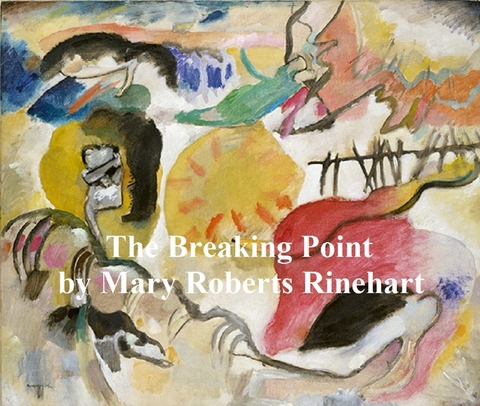
Breaking Point (eBook)
6696 Seiten
Seltzer Books (Verlag)
978-1-4553-3207-6 (ISBN)
According to Wikipedia: "e;Mary Roberts Rinehart (August 12, 1876-September 22, 1958) was a prolific author often called the American Agatha Christie.[1] She is considered the source of the phrase "e;The butler did it"e;, although she did not actually use the phrase herself, and also considered to have invented the "e;Had-I-But-Known"e; school of mystery writing.... Rinehart wrote hundreds of short stories, poems, travelogues and special articles. Many of her books and plays, such as The Bat (1920) were adapted for movies, such as The Bat (1926), The Bat Whispers (1930), and The Bat (1959). While many of her books were best-sellers, critics were most appreciative of her murder mysteries. Rinehart, in The Circular Staircase (1908), is credited with inventing the "e;Had-I-But-Known"e; school of mystery writing. The Circular Staircase is a novel in which "e;a middle-aged spinster is persuaded by her niece and nephew to rent a country house for the summer. The house they choose belonged to a bank defaulter who had hidden stolen securities in the walls. The gentle, peace-loving trio is plunged into a series of crimes solved with the help of the aunt. This novel is credited with being the first in the "e;Had-I-But-Known"e; school."e;[3] The Had-I-But-Known mystery novel is one where the principal character (frequently female) does less than sensible things in connection with a crime which have the effect of prolonging the action of the novel. Ogden Nash parodied the school in his poem Don't Guess Let Me Tell You: "e;Sometimes the Had I But Known then what I know now I could have saved at least three lives by revealing to the Inspector the conversation I heard through that fortuitous hole in the floor."e; The phrase "e;The butler did it"e;, which has become a cliche, came from Rinehart's novel The Door, in which the butler actually did do it, although that exact phrase does not actually appear in the work."e;
XVI
Dick's decision to cut himself off from Elizabeth was born of his certainty that he could not see her and keep his head. He was resolutely determined to keep his head, until he knew what he had to offer her. But he was very unhappy. He worked sturdily all day and slept at night out of sheer fatigue, only to rouse in the early morning to a conviction of something wrong before he was fully awake. Then would come the uncertainty and pain of full consciousness, and he would lie with his arms under his head, gazing unblinkingly at the ceiling and preparing to face another day.
There was no prospect of early relief, although David had not again referred to his going away. David was very feeble. The look of him sometimes sent an almost physical pain through Dick's heart. But there were times when he roused to something like his old spirit, shouted for tobacco, frowned over his diet tray, and fought Harrison Miller when he came in to play cribbage in much his old tumultuous manner.
Then, one afternoon late in May, when for four days Dick had not seen Elizabeth, suddenly he found the decision as to their relation taken out of his hands, and by Elizabeth herself.
He opened the door one afternoon to find her sitting alone in the waiting-room, clearly very frightened and almost inarticulate. He could not speak at all at first, and when he did his voice, to his dismay, was distinctly husky.
"Is anything wrong?" he asked, in a tone which was fairly sepulchral.
"That's what I want to know, Dick."
Suddenly he found himself violently angry. Not at her, of course. At everything.
"Wrong?" he said, savagely. "Yes. Everything is wrong!"
Then he was angry! She went rather pale.
"What have I done, Dick?"
As suddenly as he had been fierce he was abject and ashamed. Startled, too.
"You?" he said. "What have you done? You're the only thing that's right in a wrong world. You - "
He checked himself, put down his bag - he had just come in - and closed the door into the hall. Then he stood at a safe distance from her, and folded his arms in order to be able to keep his head - which shows how strange the English language is.
"Elizabeth," he said gravely. "I've been a self-centered fool. I stayed away because I've been in trouble. I'm still in trouble, for that matter. But it hasn't anything to do with you. Not directly, anyhow."
"Don't you think it's possible that I know what it is?"
"You do know."
He was too absorbed to notice the new maturity in her face, the brooding maternity born of a profound passion. To Elizabeth just then he was not a man, her man, daily deciding matters of life and death, but a worried boy, magnifying a trifle into importance.
"There is always gossip," she said, "and the only thing one can do is to forget it at once. You ought to be too big for that sort of thing."
"But - suppose it is true?"
"What difference would it make?"
He made a quick movement toward her.
"There may be more than that. I don't know, Elizabeth," he said, his eyes on hers. "I have always thought - I can't go to David now."
He was moved to go on. To tell her of his lost youth, of that strange trick by which his mind had shut off those hidden years. But he could not. He had a perfectly human fear of being abnormal in her eyes, precisely but greatly magnified the same instinct which had made him inspect his new tie in daylight for fear it was too brilliant. But greater than that was his new fear that something neither happy nor right lay behind him under lock and key in his memory.
"I want you to know this, Dick," she said. "That nothing, no gossip or anything, can make any difference to me. And I've been terribly hurt. We've been such friends. You - I've been lying awake at night, worrying."
That went to his heart first, and then to his head. This might be all, all he was ever to have. This hour, and this precious and tender child, so brave in her declaration, so simple and direct; all his world in that imitation mahogany chair.
"You're all I've got," he said. "The one real thing in a world that's going to smash. I think I love you more than God."
The same mood, of accepting what he had without question and of refusing to look ahead, actuated him for the next few days. He was incredibly happy.
He went about his work with his customary care and thoroughness, for long practice had made it possible for him to go on as though nothing had happened, to listen to querulous complaints and long lists of symptoms, and to write without error those scrawled prescriptions which were, so hopefully, to cure. Not that Dick himself believed greatly in those empirical doses, but he considered that the expectation of relief was half the battle. But that was the mind of him, which went about clothed in flesh, of course, and did its daily and nightly work, and put up a very fair imitation of Doctor Richard Livingstone. But hidden away was a heart that behaved in a highly unprofessional manner, and sang and dreamed, and jumped at the sight of a certain small figure on the street, and generally played hob with systole and diastole, and the vagus and accelerator nerves. Which are all any doctor really knows about the heart, until he falls in love.
He even began to wonder if he had read into the situation something that was not there, and in this his consciousness of David's essential rectitude helped him. David could not do a wrong thing, or an unworthy one. He wished he were more like David.
The new humility extended to his love for Elizabeth. Sometimes, in his room or shaving before the bathroom mirror, he wondered what she could see in him to care about. He shaved twice a day now, and his face was so sore that he had to put cream on it at night, to his secret humiliation. When he was dressed in the morning he found himself once or twice taking a final survey of the ensemble, and at those times he wished very earnestly that he had some outstanding quality of appearance that she might admire.
He refused to think. He was content for a time simply to feel, to be supremely happy, to live each day as it came and not to look ahead. And the old house seemed to brighten with him. Never had Lucy's window boxes been so bright, or Minnie's bread so light; the sun poured into David's sick room and turned the nurse so dazzling white in her uniform that David declared he was suffering from snow-blindness.
And David himself was improving rapidly. With the passage of each day he felt more secure. The reporter from the Times-Republican -if he were really on the trail of Dick he would have come to see him, would have told him the story. No. That bridge was safely crossed. And Dick was happy. David, lying in his bed, would listen and smile faintly when Dick came whistling into the house or leaped up the stairs two at a time; when he sang in his shower, or tormented the nurse with high-spirited nonsense. The boy was very happy. He would marry Elizabeth Wheeler, and things would be as they should be; there would be the fullness of life, young voices in the house, toys on the lawn. He himself would pass on, in the fullness of time, but Dick -
On Decoration Day they got him out of bed, making a great ceremony of it, and when he was settled by the window in his big chair with a blanket over his knees, Dick came in with a great box. Unwrapping it he disclosed a mass of paper and a small box, and within that still another.
"What fol-de-rol is all this?" David demanded fiercely, with a childish look of expectation in his eyes. "Give me that box. Some more slippers, probably!"
He worked eagerly, and at last he came to the small core of the mass. It was a cigar!
It was somewhat later, when the peace of good tobacco had relaxed him into a sort of benignant drowsiness, and when Dick had started for his late afternoon calls, that Lucy came into the room.
"Elizabeth Wheeler's downstairs," she said. "I told her you wanted to see her. She's brought some chicken jelly, too."
She gathered up the tissue paper that surrounded him, and gave the room a critical survey. She often felt that the nurse was not as tidy as she might be. Then she went over to him and put a hand on his shoulder.
"I don't want to worry you, David. Not now. But if he's going to marry her - "
"Well, why shouldn't he?" he demanded truculently. "A good woman would be one more anchor to windward."
She found that she could not go on. David was always incomprehensible to...
| Erscheint lt. Verlag | 1.3.2018 |
|---|---|
| Sprache | englisch |
| Themenwelt | Literatur ► Anthologien |
| Literatur ► Klassiker / Moderne Klassiker | |
| Literatur ► Romane / Erzählungen | |
| ISBN-10 | 1-4553-3207-0 / 1455332070 |
| ISBN-13 | 978-1-4553-3207-6 / 9781455332076 |
| Informationen gemäß Produktsicherheitsverordnung (GPSR) | |
| Haben Sie eine Frage zum Produkt? |
 EPUB (Adobe DRM)
Größe: 696 KB
Kopierschutz: Adobe-DRM
Adobe-DRM ist ein Kopierschutz, der das eBook vor Mißbrauch schützen soll. Dabei wird das eBook bereits beim Download auf Ihre persönliche Adobe-ID autorisiert. Lesen können Sie das eBook dann nur auf den Geräten, welche ebenfalls auf Ihre Adobe-ID registriert sind.
Details zum Adobe-DRM
Dateiformat: EPUB (Electronic Publication)
EPUB ist ein offener Standard für eBooks und eignet sich besonders zur Darstellung von Belletristik und Sachbüchern. Der Fließtext wird dynamisch an die Display- und Schriftgröße angepasst. Auch für mobile Lesegeräte ist EPUB daher gut geeignet.
Systemvoraussetzungen:
PC/Mac: Mit einem PC oder Mac können Sie dieses eBook lesen. Sie benötigen eine
eReader: Dieses eBook kann mit (fast) allen eBook-Readern gelesen werden. Mit dem amazon-Kindle ist es aber nicht kompatibel.
Smartphone/Tablet: Egal ob Apple oder Android, dieses eBook können Sie lesen. Sie benötigen eine
Geräteliste und zusätzliche Hinweise
Buying eBooks from abroad
For tax law reasons we can sell eBooks just within Germany and Switzerland. Regrettably we cannot fulfill eBook-orders from other countries.
EPUB (Ohne DRM)Digital Rights Management: ohne DRM
Dieses eBook enthält kein DRM oder Kopierschutz. Eine Weitergabe an Dritte ist jedoch rechtlich nicht zulässig, weil Sie beim Kauf nur die Rechte an der persönlichen Nutzung erwerben.
Dateiformat: EPUB (Electronic Publication)
EPUB ist ein offener Standard für eBooks und eignet sich besonders zur Darstellung von Belletristik und Sachbüchern. Der Fließtext wird dynamisch an die Display- und Schriftgröße angepasst. Auch für mobile Lesegeräte ist EPUB daher gut geeignet.
Systemvoraussetzungen:
PC/Mac: Mit einem PC oder Mac können Sie dieses eBook lesen. Sie benötigen dafür die kostenlose Software Adobe Digital Editions.
eReader: Dieses eBook kann mit (fast) allen eBook-Readern gelesen werden. Mit dem amazon-Kindle ist es aber nicht kompatibel.
Smartphone/Tablet: Egal ob Apple oder Android, dieses eBook können Sie lesen. Sie benötigen dafür eine kostenlose App.
Geräteliste und zusätzliche Hinweise
Buying eBooks from abroad
For tax law reasons we can sell eBooks just within Germany and Switzerland. Regrettably we cannot fulfill eBook-orders from other countries.
aus dem Bereich