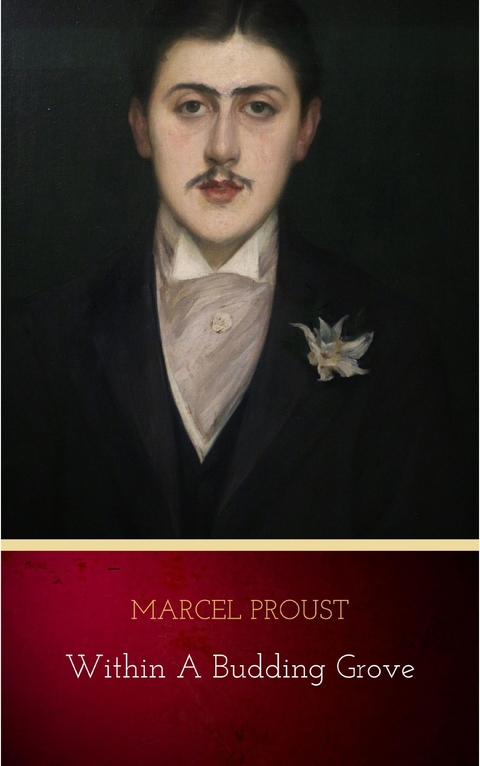
First published in 1919, Within a Budding Grove was awarded the Prix Goncourt, bringing the author immediate fame. In this second volume of In Search of Lost Time, the narrator turns from the childhood reminiscences of Swann's Way to memories of his adolescence. Having gradually become indifferent to Swann's daughter Gilberte, the narrator visits the seaside resort of Balbec with his grandmother and meets a new object of attention-Albertine, 'a girl with brilliant, laughing eyes and plump, matt cheeks.'
For this authoritative English-language edition, D. J. Enright has revised the late Terence Kilmartin's acclaimed reworking of C. K. Scott Moncrieff's translation to take into account the new definitive French editions of Á la recherché du temps perdu (the final volume of these new editions was published by the Bibliothèque de la Pléiade in 1989).
First published in 1919, Within a Budding Grove was awarded the Prix Goncourt, bringing the author immediate fame. In this second volume of In Search of Lost Time, the narrator turns from the childhood reminiscences of Swann's Way to memories of his adolescence. Having gradually become indifferent to Swann's daughter Gilberte, the narrator visits the seaside resort of Balbec with his grandmother and meets a new object of attention-Albertine, "e;a girl with brilliant, laughing eyes and plump, matt cheeks."e;For this authoritative English-language edition, D. J. Enright has revised the late Terence Kilmartin s acclaimed reworking of C. K. Scott Moncrieff s translation to take into account the new definitive French editions of A la recherche du temps perdu (the final volume of these new editions was published by the Bibliotheque de la Pleiade in 1989).
PLACE-NAMES: THE PLACE
The Balbec doctor, who had been called in to cope with a sudden feverish attack, having given the opinion that I ought not to stay out all day on the beach, in the blazing sun, without shelter, and having written out various prescriptions for my use, my grandmother took his prescriptions with a show of respect in which I could at once discern her firm resolve not to have any of them 'made up,' but did pay attention to his advice on the matter of hygiene, and accepted an offer from Mme. de Villeparisis to take us for drives in her carriage. After this I would spend the mornings, until luncheon, going to and fro between my own room and my grandmother's. Hers did not look out directly upon the sea, as mine did, but was lighted from three of its four sides—with views of a strip of the 'front,' of a well inside the building, and of the country inland, and was furnished differently from mine, with armchairs upholstered in a metallic tissue with red flowers from which seemed to emanate the cool and pleasant odour that greeted me when I entered the room. And at that hour when the sun's rays, coming from different aspects and, as it were, from different hours of the day, broke the angles of the wall, thrust in a reflexion of the beach, made of the chest of drawers a festal altar, variegated as a bank of field-flowers, attached to the wall the wings, folded, quivering, warm, of a radiance that would, at any moment, resume its flight, warmed like a bath a square of provincial carpet before the window overlooking the well, which the sun festooned and patterned like a climbing vine, added to the charm and complexity of the room's furniture by seeming to pluck and scatter the petals of the silken flowers on the chairs, and to make their silver threads stand out from the fabric, this room in which I lingered for a moment before going to get ready for our drive suggested a prism in which the colours of the light that shone outside were broken up, or a hive in which the sweet juices of the day which I was about to taste were distilled, scattered, intoxicating, visible, a garden of hope which dissolved in a quivering haze of silver threads and rose leaves. But before all this I had drawn back my own curtains, impatient to know what Sea it was that was playing that morning by the shore, like a Nereid. For none of those Seas ever stayed with us longer than a day. On the morrow there would be another, which sometimes resembled its predecessor. But I never saw the same one twice.
There were some that were of so rare a beauty that my pleasure on catching sight of them was enhanced by surprise. By what privilege, on one morning rather than another, did the window on being uncurtained disclose to my wondering eyes the nymph Glauconome, whose lazy beauty, gently breathing, had the transparence of a vaporous emerald beneath whose surface I could see teeming the ponderable elements that coloured it? She made the sun join in her play, with a smile rendered languorous by an invisible haze which was nought but a space kept vacant about her translucent surface, which, thus curtailed, became more appealing, like those goddesses whom the sculptor carves in relief upon a block of marble, the rest of which he leaves unchiselled. So, in her matchless colour, she invited us out over those rough terrestrial roads, from which, seated beside Mme. de Villeparisis in her barouche, we should see, all day long and without ever reaching it, the coolness of her gentle palpitation.
Mme. de Villeparisis used to order her carriage early, so that we should have time to reach Saint-Mars le Vêtu, or the rocks of Quetteholme, or some other goal which, for a somewhat lumbering vehicle, was far enough off to require the whole day. In my joy at the long drive we were going to take I would be humming some tune that I had heard recently as I strolled up and down until Mme. de Villeparisis was ready. If it was Sunday hers would not be the only carriage drawn up outside the hotel; several hired flies would be waiting there, not only for the people who had been invited to Féterne by Mme. de Cambremer, but for those who, rather than stay at home all day, like children in disgrace, declared that Sunday was always quite impossible at Balbec and started off immediately after luncheon to hide themselves in some neighbouring watering-place or to visit one of the 'sights' of the district. And indeed whenever (which was often) anyone asked Mme. Blandais if she had been to the Cambremers', she would answer peremptorily: "No; we went to the Falls of the Bee," as though that were the sole reason for her not having spent the day at Féteme. And the barrister would be charitable, and say:
"I envy you. I wish I had gone there instead; they must be well worth seeing."
Beside the row of carriages, in front of the porch in which I stood waiting, was planted, like some shrub of a rare species, a young page who attracted the eye no less by the unusual and effective colouring of his hair than by his plant-like epidermis. Inside, in the hall, corresponding to the narthex, or Church of the Catechumens in a primitive basilica, through which persons who were not staying in the hotel were entitled to pass, the comrades of this 'outside' page did not indeed work much harder than he but did at least execute certain drilled movements. It is probable that in the early morning they helped with the cleaning. But in the afternoon they stood there only like a Chorus who, even when there is nothing for them to do, remain upon the stage in order to strengthen the cast. The General Manager, the same who had so terrified me, reckoned on increasing their number considerably next year, for he had 'big ideas.' And this prospect greatly afflicted the manager of the hotel, who found that all these boys about the place only 'created a nuisance,' by which he meant that they got in the visitors' way and were of no use to anyone. But between luncheon and dinner at least, between the exits and entrances of the visitors, they did fill an otherwise empty stage, like those pupils of Mme. de Maintenon who, in the garb of young Israelites, carry on the action whenever Esther or Joad 'goes off.' But the outside page, with his delicate tints, his tall, slender, fragile trunk, in proximity to whom I stood waiting for the Marquise to come downstairs, preserved an immobility into which a certain melancholy entered, for his elder brothers had left the hotel for more brilliant careers elsewhere, and he felt keenly his isolation upon this alien soil. At last Mme. de Villeparisis appeared. To stand by her carriage and to help her into it ought perhaps to have been part of the young page's duties. But he knew on the one hand that a person who brings her own servants to an hotel expects them to wait on her and is not as a rule lavish with her 'tips,' and that generally speaking this was true also of the nobility of the old Faubourg Saint-Germain. Mme. de Villeparisis was included in both these categories. The arborescent page concluded therefore that he need expect nothing from her, and leaving her own maid and footman to pack her and her belongings into the carriage, he continued to dream sadly of the enviable lot of his brothers and preserved his vegetable immobility.
We would start off; some time after rounding the railway station, we came into a country road which soon became as familiar to me as the roads round Combray, from the bend where, like a fish-hook, it was baited with charming orchards, to the turning at which we left it, with tilled fields upon either side. Among these we could see here and there an apple-tree, stripped it was true of its blossom, and bearing no more now than a fringe of pistils, but sufficient even so to enchant me since I could imagine, seeing those inimitable leaves, how their broad expanse, like the ceremonial carpet spread for a wedding that was now over, had been but the other day swept by the white satin train of their blushing flowers.
How often in Paris, during the May of the following year, was I to bring home a branch of apple-blossom from the florist, and to stay all night long before its flowers in which bloomed the same creamy essence that powdered besides and whitened the green unfolding leaves, flowers between whose snowy cups it seemed almost as though it had been the salesman who had, in his generosity towards myself, out of his wealth of invention too and as an effective contrast, added on either side the supplement of a becoming crimson bud: I sat gazing at them, I grouped them in the light of my lamp—for so long that I was often still there when the dawn brought to their whiteness the same flush with which it must at that moment have been tingeing their sisters on the Balbec road—and I sought to carry them back in my imagination to that roadside, to multiply them, to spread them out, so as to fill the frame prepared for them, on the canvas, all ready, of those closes the outline of which I knew by heart, which I so longed to see—which one day I must see again, at the moment when, with the exquisite fervour of genius, spring was covering their canvas with its colours.
Before getting into the carriage I had composed the seascape for which I was going to look out, which I had hoped to see with the 'sun radiant' upon it, and which at Balbec I could distinguish only in too fragmentary a form, broken by so many vulgar intromissions that had no place in my dream, bathers, dressing-boxes, pleasure yachts. But when, Mme. de Ville-parisis's carriage having reached high ground, I caught a glimpse of the sea through the leafy boughs of trees, then no doubt at such a distance those temporal details which had set the sea, as it were, apart from nature and history disappeared, and I could as I looked...
| Erscheint lt. Verlag | 9.3.2018 |
|---|---|
| Sprache | englisch |
| Themenwelt | Literatur ► Anthologien |
| Literatur ► Klassiker / Moderne Klassiker | |
| Literatur ► Romane / Erzählungen | |
| ISBN-10 | 2-37787-859-8 / 2377878598 |
| ISBN-13 | 978-2-37787-859-8 / 9782377878598 |
| Informationen gemäß Produktsicherheitsverordnung (GPSR) | |
| Haben Sie eine Frage zum Produkt? |
 EPUB (Ohne DRM)
Digital Rights Management: ohne DRM
Dieses eBook enthält kein DRM oder Kopierschutz. Eine Weitergabe an Dritte ist jedoch rechtlich nicht zulässig, weil Sie beim Kauf nur die Rechte an der persönlichen Nutzung erwerben.
Dateiformat: EPUB (Electronic Publication)
EPUB ist ein offener Standard für eBooks und eignet sich besonders zur Darstellung von Belletristik und Sachbüchern. Der Fließtext wird dynamisch an die Display- und Schriftgröße angepasst. Auch für mobile Lesegeräte ist EPUB daher gut geeignet.
Systemvoraussetzungen:
PC/Mac: Mit einem PC oder Mac können Sie dieses eBook lesen. Sie benötigen dafür die kostenlose Software Adobe Digital Editions.
eReader: Dieses eBook kann mit (fast) allen eBook-Readern gelesen werden. Mit dem amazon-Kindle ist es aber nicht kompatibel.
Smartphone/Tablet: Egal ob Apple oder Android, dieses eBook können Sie lesen. Sie benötigen dafür eine kostenlose App.
Geräteliste und zusätzliche Hinweise
Buying eBooks from abroad
For tax law reasons we can sell eBooks just within Germany and Switzerland. Regrettably we cannot fulfill eBook-orders from other countries.
aus dem Bereich