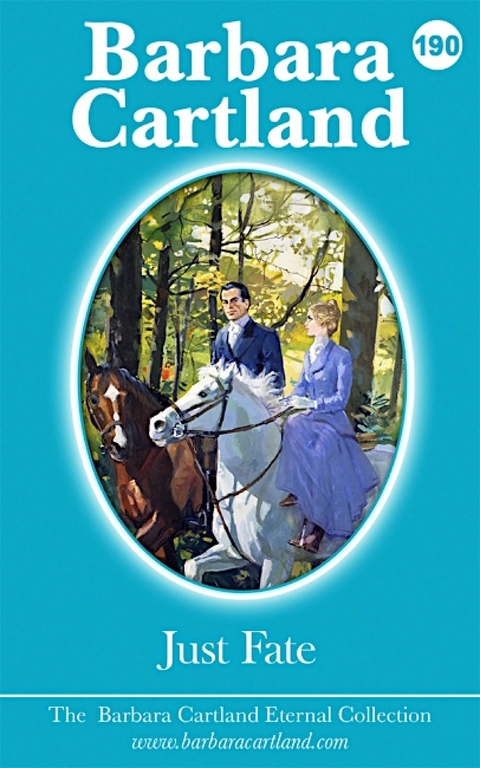
Just Fate (eBook)
298 Seiten
Barbara Cartland eBooks Ltd (Verlag)
9781788670487 (ISBN)
Barbara Cartland was the world's most prolific novelist who wrote an amazing 723 books in her lifetime, of which no less than 644 were romantic novels with worldwide sales of over 1 billion copies and her books were translated into 36 different languages. As well as romantic novels, she wrote historical biographies, 6 autobiographies, theatrical plays and books of advice on life, love, vitamins and cookery. She wrote her first book at the age of 21 and it was called Jigsaw. It became an immediate bestseller and sold 100,000 copies in hardback in England and all over Europe in translation. Between the ages of 77 and 97 she increased her output and wrote an incredible 400 romances as the demand for her romances was so strong all over the world. She wrote her last book at the age of 97 and it was entitled perhaps prophetically The Way to Heaven. Her books have always been immensely popular in the United States where in 1976 her current books were at numbers 1 & 2 in the B. Dalton bestsellers list, a feat never achieved before or since by any author. Barbara Cartland became a legend in her own lifetime and will be best remembered for her wonderful romantic novels so loved by her millions of readers throughout the world, who have always collected her books to read again and again, especially when they feel miserable or depressed. Her books will always be treasured for their moral message, her pure and innocent heroines, her handsome and dashing heroes, her blissful happy endings and above all for her belief that the power of love is more important than anything else in everyone's life.
Widowed Mrs. Mansforde and her younger daughter Philomena (or 'Mena' for short) are pleasantly surprised when elder daughter Lais returns unannounced to the family home.They have not seen her for an age, not even at her father s funeral. And the news she brings is not so pleasant as it seems that she too has been widowed, but already has another wealthy and prestigious husband in her sights, the highly respected Duke of Kernthorpe.The Duke, who is much older than Lais, has invited her to bring her mother to meet him, an invitation that Lais does not extend to young Mena, seeing how beautiful she has become.Mrs. Mansforde insists that Mena goes with her and then it is decided that she will pose as her mother s employed companion.Once at the Duke s Castle Mena goes for a walk in the garden and then sees a stallion and rider galloping towards her. The horse is clearly out of control and throws the rider so Mena rushes over to see if he has been hurt.He is a handsome young man and when he looks up at Mena he thinks, because she is so beautiful, that she must be a Greek Goddess.He is then most impressed when Mena calms the stallion down by talking to him in a quiet gentle voice.At the Duke s Castle love is to take each of the three women, Mena, Lais and their mother, by surprise and brings them ultimate happiness in the form of entirely unexpected suitors.And it seems that Fate has brought them together at the magnificent but mysterious Kerne Castle.
CHAPTER ONE ~ 1874
Philomena walked back through the garden.
She was thinking how attractive it was and that it was such a pity that they could not afford more gardeners.
Since her father’s death she and her mother had had to economise in a great number of ways.
Perhaps the one that she minded most was that they now employed fewer gardeners and grooms in the stable.
Nevertheless the overgrown lawns, the yew hedges that wanted clipping and the flowerbeds, which needed weeding, were still as lovely as ever.
The flowers were a blaze of colour and Philomena thought that there was nothing lovelier than the time when the spring flowers overlapped with the first roses of summer.
It was her mother who had always paid the most attention to the garden.
Her father, who had died early last year, had been completely absorbed in his study of Greece and Philomena sometimes thought that he should be living there rather than in England.
However, if there was one thing her father was really proud of, it was his house and his name.
The Mansfordes were one of the oldest families in Great Britain.
The house, which had always been their family home, had been built in the reign of the great Queen Elizabeth.
Looking at it now ahead of her, Philomena felt that nothing in the whole world could be more beautiful.
The red bricks over the centuries had turned to a soft and most attractive pink.
The strangely shaped high chimneys were silhouetted against the blue sky and the sun shone on the diamond-shaped panes of the casements.
She too loved her home.
Yet she reflected with a little sigh that it was a difficult house to run without a large number of servants.
Since her father’s death she had been in charge of everything.
Her mother, sweet, beautiful and very gentle was sadly quite incapable of organising anything and that included her own life, which had always been managed for her by her husband.
He had been a masterful and in a way dominating man and that was what had attracted him to his wife in the first place.
Because they were the counterparts of each other they had been idyllically happy.
The only sorrow in Lionel Mansforde’s life had been that he had had no son.
He had, however, been delighted with his two daughters and had chosen Greek names for both of them.
Their first daughter had been named ‘Lais’ and their second ‘Philomena’.
It was inevitable, since she was small, fair and at the same time exquisitely lovely, that she should be called ‘Mena’. As her father had told her so often, ‘Philomena’ in Greek meant, ’I am loved’.
“And that, my darling,” he told her firmly, “is what you will always be.”
Equally Mena knew that she had been in fact a disappointment to him.
There were actually four years between her and her sister.
Her mother had thought despairingly that she would have no more children after Lais was born.
Then when Elizabeth Mansforde learnt that she was once again pregnant, she had prayed fervently to God that the baby would be a son.
Instead Philomena had arrived.
However, because she was so exquisite her father had almost forgotten his disappointment that she was not a boy.
“You are like a Goddess from Olympus, my darling,” he had said to her more than once.
“Perhaps that is what I am,” Mena replied laughingly, “and I have come to you now simply because I fit so well into your research into the glory that was Greece.”
When there was any money to spare, Lionel Mansforde spent it on pieces of Greek statuary and Greek vases.
Besides, of course, books of research or poetry written by those who had been privileged to visit the country.
He himself had been there once as a young man and he had never forgotten how thrilled he had been by everything he had seen.
But it was about the Mansforde family and the ancestral house that he talked to his two daughters about.
He described the deeds of heroism wrought by many whose name he bore.
And the part they had played at the battles of Agincourt and of Worcester.
He spoke of the distinguished Mansforde who had become one of the Duke of Marlborough’s Generals.
“It is sad for Papa that he does not have a son to be a hero like the one he was telling us about this morning,” Mena commented to her mother.
“I know, darling,” she replied in her soft voice, “and that is why you must try to make up for what he had missed by giving him as much love and attention as possible.”
Mena had known exactly what her mother meant, but Lais had said,
“I think that Papa should be grateful to have us. After all we are both very pretty!”
She had just become conscious of her beauty because the choirboys stared at her in Church on Sunday mornings.
And when she came into a room, her father and mother’s friends would break off their conversation to stare at her with undisguised admiration.
It was, Mena thought sadly, Lais’s beauty that had taken her away and made her forget all about them.
Mena was very happy and loved being with her mother and yet she sometimes thought that it would be fun to have somebody of her own age to laugh with and enjoy a joke.
Her mother did not find jokes very funny. In fact since her husband’s death she had become listless and not particularly interested in anything.
Mena thought despairingly that it was difficult to think of anything she could do to make her mother happier.
‘She depended so much on Papa,’ she told herself, ‘and misses not only his love and attention but also having a man about the house and knowing that she must make herself look lovely for him.’
At forty-two Elizabeth Mansforde was still a very beautiful woman.
She had been breathtakingly lovely when her husband had married her when she was the same age as Mena was now.
Wherever they went people flattered her and congratulated him.
She had indeed blossomed under their appreciation like a rose coming into bloom.
‘That is exactly what Mama is like,’ Mina thought as she walked towards the house, ‘a flower.’
But it was a flower that was fading simply because Elizabeth Mansforde felt that nobody was interested in her.
‘Now that we are out of mourning,’ Mena thought, ‘perhaps we should give some parties.’
She tried to think of who in the neighbourhood they could ask and there were a great number of married couples.
Yet she could not think of a single man who could balance her mother at luncheons or dinners.
There were just a few young men of her own age.
However, as they had been in deep mourning for a year, there was always the chance that new people had come into the neighbourhood without her being aware of it.
‘I must do something about Mama!’ she thought firmly as she walked into the house.
She walked across the hall, from which rose a fine oak staircase with exquisitely carved newels.
She went into the sitting room and this was one of the loveliest rooms in the house.
It had a low ceiling, two large bow windows and a very fine marble mantelpiece, which had been added later to the original fireplace.
Mrs. Mansforde was sitting in the window on a sofa. It had been drawn forward so that the sun shining through the diamond-paned windows turned her hair to shining gold.
It was the same colour as her daughter’s and so was the pink and white translucence of her skin.
Mena’s eyes were a deeper blue than her mother’s, which now always looked sad and despondent.
She looked up as her daughter approached her.
“Have you enjoyed your walk, Mena?” she enquired.
“I went into the fields and back through the woods,” Mena replied, “and look, Mama, I have brought you some wild orchids. I just knew you would be pleased because they are so lovely.”
Mrs Mansforde took them from her.
“They are very pretty,” she agreed. “We used to grow orchids in the greenhouse when we had enough gardeners to take care of them.”
“Yes, I know, Mama, and I remember how lovely you looked when once you wore them in your hair for a dinner party.”
Unexpectedly her mother laughed.
“I remember that party. The other ladies present wearing their tiaras were furious because the gentlemen were all paying me compliments on my orchids and ignoring their diamonds.”
“You came to say ‘goodnight’ to me,” Mena recalled, “and I thought that you looked like a Fairy Princess.”
“And that was how I felt because your father was with me,” her mother answered.
Now the sadness was back in her eyes.
Mena picked up the wild orchids and added them to one of the vases filled with flowers on a side table.
“I was thinking, Mama,” she said, “that now we are out of mourning we must give some parties here.”
“Parties?” Mrs. Mansforde asked. “Why should we do that?”
“Because it would be pleasant to see our neighbours again,” Mena replied. “I was thinking of all those people like Sir Rupert and Lady Hall who used to come here quite often when Papa was alive.”
Her mother did not say anything and Mena went on,
“Then there is Colonel and Mrs. Strangeways who I am sure would like to see you again.”
“But how can we give a party if your father is not...
| Erscheint lt. Verlag | 1.3.2018 |
|---|---|
| Sprache | englisch |
| Themenwelt | Literatur ► Historische Romane |
| Literatur ► Romane / Erzählungen | |
| ISBN-13 | 9781788670487 / 9781788670487 |
| Informationen gemäß Produktsicherheitsverordnung (GPSR) | |
| Haben Sie eine Frage zum Produkt? |
 EPUB (Adobe DRM)
Kopierschutz: Adobe-DRM
Adobe-DRM ist ein Kopierschutz, der das eBook vor Mißbrauch schützen soll. Dabei wird das eBook bereits beim Download auf Ihre persönliche Adobe-ID autorisiert. Lesen können Sie das eBook dann nur auf den Geräten, welche ebenfalls auf Ihre Adobe-ID registriert sind.
Details zum Adobe-DRM
Dateiformat: EPUB (Electronic Publication)
EPUB ist ein offener Standard für eBooks und eignet sich besonders zur Darstellung von Belletristik und Sachbüchern. Der Fließtext wird dynamisch an die Display- und Schriftgröße angepasst. Auch für mobile Lesegeräte ist EPUB daher gut geeignet.
Systemvoraussetzungen:
PC/Mac: Mit einem PC oder Mac können Sie dieses eBook lesen. Sie benötigen eine
eReader: Dieses eBook kann mit (fast) allen eBook-Readern gelesen werden. Mit dem amazon-Kindle ist es aber nicht kompatibel.
Smartphone/Tablet: Egal ob Apple oder Android, dieses eBook können Sie lesen. Sie benötigen eine
Geräteliste und zusätzliche Hinweise
Buying eBooks from abroad
For tax law reasons we can sell eBooks just within Germany and Switzerland. Regrettably we cannot fulfill eBook-orders from other countries.
aus dem Bereich