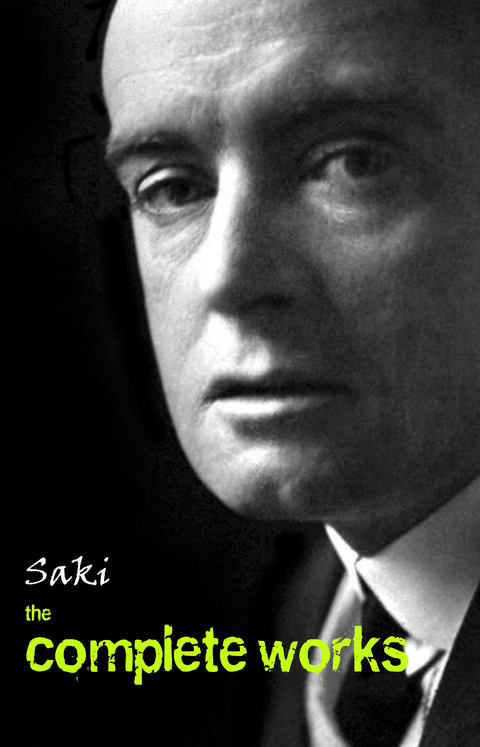
Saki: The Complete Works (eBook)
1204 Seiten
Pandora's Box (Verlag)
978-989-778-562-7 (ISBN)
This ebook contains Saki's complete works. This edition has been professionally formatted and contains several tables of contents. The first table of contents (at the very beginning of the ebook) lists the titles of all novels included in this volume. By clicking on one of those titles you will be redirected to the beginning of that work, where you'll find a new TOC that lists all the chapters and sub-chapters of that specific work.
Reginald in Russia
and Other Sketches
by
SAKI
Methuen & Co. Ltd., London
1910
russia
Reginald in Russia
The Reticence of Lady Anne
The Lost Sanjak
The Sex that Doesn’t Shop
The Blood-Feud of Toad-Water A West-Country Epic
A Young Turkish Catastrophe in Two Scenes
Judkin of the Parcels
Gabriel-Ernest
The Saint and the Goblin
The Soul of Laploshka
The Bag
The Strategist
Cross Currents
The Baker’s Dozen
The Mouse
[The text follows the 1910
Methuen & Co. edition.]
TO
M. V. P.
“The Baker’s Dozen” originally appeared in ‘The Journal of the Leinster Regiment.The other sketches have appeared from time to time in the “Westminster Gazette.” To the Editors of these publications I am indebted for courteous permission to reproduce the stories in their present form.
REGINALD IN RUSSIA
REGINALD sat in a corner of the Princess’s salon and tried to forgive the furniture, which started out with an obvious intention of being Louis Quinze, but relapsed at frequent intervals into Wilhelm II.
He classified the Princess with that distinct type of woman that looks as if it habitually went out to feed hens in the rain.
Her name was Olga; she kept what she hoped and believed to be a fox-terrier, and professed what she thought were Socialist opinions. It is not necessary to be called Olga if you are a Russian Princess; in fact, Reginald knew quite a number who were called Vera; but the fox-terrier and the Socialism are essential.
“The Countess Lomshen keeps a bull-dog,” said the Princess suddenly. “In England is it more chic to have a bull-dog than a fox-terrier?”
Reginald threw his mind back over the canine fashions of the last ten years and gave an evasive answer.
“Do you think her handsome, the Countess Lomshen?” asked the Princess.
Reginald thought the Countess’s complexion suggested an exclusive diet of macaroons and pale sherry. He said so.
“But that cannot be possible,” said the Princess triumphantly; “I’ve seen her eating fish-soup at Donon’s.”
The Princess always defended a friend’s complexion if it was really bad. With her, as with a great many of her sex, charity began at homeliness and did not generally progress much farther.
Reginald withdrew his macaroon and sherry theory, and became interested in a case of miniatures.
“That?” said the Princess; “that is the old Princess Lorikoff. She lived in Millionaya Street, near the Winter Palace, and was one of the Court ladies of the old Russian school. Her knowledge of people and events was extremely limited; but she used to patronise every one who came in contact with her. There was a story that when she died and left the Millionaya for Heaven she addressed St. Peter in her formal staccato French: ‘Je suis la Princesse Lor-i-koff. Il me donne grand plaisir à faire votre connaissance. Je vous en prie me présenter au Bon Dieu.’ St. Peter made the desired introduction, and the Princess addressed le Bon Dieu: ‘Je suis la Princesse Lor-i-koff. Il me donne grand plaisir à faire votre connaissance. On a souvent parlé de vous à l’église de la rue Million.’”
“Only the old and the clergy of Established churches know how to be flippant gracefully,” commented Reginald; “which reminds me that in the Anglican Church in a certain foreign capital, which shall be nameless, I was present the other day when one of the junior chaplains was preaching in aid of distressed somethings or other, and he brought a really eloquent passage to a close with the remark, ‘The tears of the afflicted, to what shall I liken them—to diamonds?’ The other junior chaplain, who had been dozing out of professional jealousy, awoke with a start and asked hurriedly, ‘Shall I play to diamonds, partner?’ It didn’t improve matters when the senior chaplain remarked dreamily but with painful distinctness, ‘Double diamonds.’ Every one looked at the preacher, half expecting him to redouble, but he contented himself with scoring what points he could under the circumstances.”
“You English are always so frivolous,” said the Princess. “In Russia we have too many troubles to permit of our being light-hearted.”
Reginald gave a delicate shiver, such as an Italian greyhound might give in contemplating the approach of an ice age of which he personally disapproved, and resigned himself to the inevitable political discussion.
“Nothing that you hear about us in England is true,” was the Princess’s hopeful beginning.
“I always refused to learn Russian geography at school,” observed Reginald; “I was certain some of the names must be wrong.”
“Everything is wrong with our system of government,” continued the Princess placidly. “The Bureaucrats think only of their pockets, and the people are exploited and plundered in every direction, and everything is mismanaged.”
“With us,” said Reginald, “a Cabinet usually gets the credit of being depraved and worthless beyond the bounds of human conception by the time it has been in office about four years.”
“But if it is a bad Government you can turn it out at the elections,” argued the Princess.
“As far as I remember, we generally do,” said Reginald.
“But here it is dreadful, every one goes to such extremes. In England you never go to extremes.”
“We go to the Albert Hall,” explained Reginald.
“There is always a see-saw with us between repression and violence,” continued the Princess; “and the pity of it is the people are really not in the least inclined to be anything but peaceable. Nowhere will you find people more good-natured, or family circles where there is more affection.”
“There I agree with you,” said Reginald. “I know a boy who lives somewhere on the French Quay who is a case in point. His hair curls naturally, especially on Sundays, and he plays bridge well, even for a Russian, which is saying much. I don’t think he has any other accomplishments, but his family affection is really of a very high order. When his maternal grandmother died he didn’t go as far as to give up bridge altogether, but he declared on nothing but black suits for the next three months. That, I think, was really beautiful.”
The Princess was not impressed.
“I think you must be very self-indulgent and live only for amusement,” she said, “a life of pleasure-seeking and card-playing and dissipation brings only dissatisfaction. You will find that out some day.”
“Oh, I know it turns out that way sometimes,” assented Reginald. “Forbidden fizz is often the sweetest.”
But the remark was wasted on the Princess, who preferred champagne that had at least a suggestion of dissolved barley-sugar.
“I hope you will come and see me again,” she said, in a tone that prevented the hope from becoming too infectious; adding as a happy afterthought, “you must come to stay with us in the country.”
Her particular part of the country was a few hundred versts the other side of Tamboff, with some fifteen miles of agrarian disturbance between her and the nearest neighbour. Reginald felt that there is some privacy which should be sacred from intrusion.
THE RETICENCE OF LADY ANNE
EGBERT came into the large, dimly lit drawing-room with the air of a man who is not certain whether he is entering a dovecote or a bomb factory, and is prepared for either eventuality. The little domestic quarrel over the luncheon-table had not been fought to a definite finish, and the question was how far Lady Anne was in a mood to renew or forgo hostilities. Her pose in the arm-chair by the tea-table was rather elaborately rigid; in the gloom of a December afternoon Egbert’s pince-nez did not materially help him to discern the expression of her face.
By way of breaking whatever ice might be floating on the surface he made a remark about a dim religious light. He or Lady Anne were accustomed to make that remark between 4.30 and 6 on winter and late autumn evenings; it was a part of their married life. There was no recognised rejoinder to it, and Lady Anne made none.
Don Tarquinio lay astretch on the Persian rug, basking in the firelight with superb indifference to the possible ill-humour of Lady Anne. His pedigree was as flawlessly Persian as the rug, and his ruff was coming into the glory of its second winter. The page-boy, who had Renaissance tendencies, had christened him Don Tarquinio. Left to themselves, Egbert and Lady Anne would unfailingly have called him Fluff, but they were not obstinate.
Egbert poured himself out some tea. As the silence gave no sign of breaking on Lady Anne’s initiative, he braced himself for another Yermak effort.
“My remark at lunch had a purely...
| Erscheint lt. Verlag | 6.12.2019 |
|---|---|
| Sprache | englisch |
| Themenwelt | Literatur ► Anthologien |
| Literatur ► Romane / Erzählungen | |
| ISBN-10 | 989-778-562-0 / 9897785620 |
| ISBN-13 | 978-989-778-562-7 / 9789897785627 |
| Informationen gemäß Produktsicherheitsverordnung (GPSR) | |
| Haben Sie eine Frage zum Produkt? |
 EPUB (Adobe DRM)
Kopierschutz: Adobe-DRM
Adobe-DRM ist ein Kopierschutz, der das eBook vor Mißbrauch schützen soll. Dabei wird das eBook bereits beim Download auf Ihre persönliche Adobe-ID autorisiert. Lesen können Sie das eBook dann nur auf den Geräten, welche ebenfalls auf Ihre Adobe-ID registriert sind.
Details zum Adobe-DRM
Dateiformat: EPUB (Electronic Publication)
EPUB ist ein offener Standard für eBooks und eignet sich besonders zur Darstellung von Belletristik und Sachbüchern. Der Fließtext wird dynamisch an die Display- und Schriftgröße angepasst. Auch für mobile Lesegeräte ist EPUB daher gut geeignet.
Systemvoraussetzungen:
PC/Mac: Mit einem PC oder Mac können Sie dieses eBook lesen. Sie benötigen eine
eReader: Dieses eBook kann mit (fast) allen eBook-Readern gelesen werden. Mit dem amazon-Kindle ist es aber nicht kompatibel.
Smartphone/Tablet: Egal ob Apple oder Android, dieses eBook können Sie lesen. Sie benötigen eine
Geräteliste und zusätzliche Hinweise
Buying eBooks from abroad
For tax law reasons we can sell eBooks just within Germany and Switzerland. Regrettably we cannot fulfill eBook-orders from other countries.
aus dem Bereich