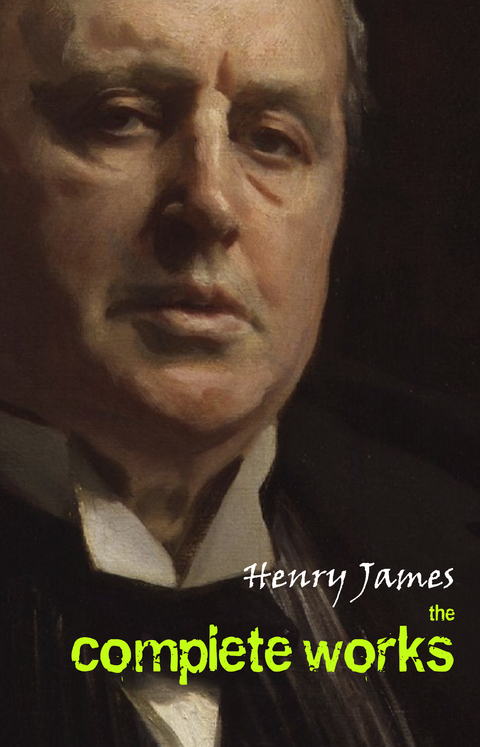
Henry James: The Complete Works (eBook)
21828 Seiten
Pandora's Box (Verlag)
978-989-778-551-1 (ISBN)
This ebook contains Henry James' complete works. This edition has been professionally formatted and contains several tables of contents. The first table of contents (at the very beginning of the ebook) lists the titles of all novels included in this volume. By clicking on one of those titles you will be redirected to the beginning of that work, where you'll find a new TOC that lists all the chapters and sub-chapters of that specific work.
VI
Roger had assured his cousin that he meant to return home, and indeed, after Nora’s departure, he spent a fortnight in the country. But finding he had no patience left for solitude, he again came to town and established himself for the winter. A restless need of getting rid of time caused him to resume his earlier social habits. It began to be said of him that now he had disposed of that queer little girl whom he had picked up heaven knew where (whom it was certainly very good-natured of Mrs. Keith to take off his hands), he was going to look about him for a young person whom he might take to his home in earnest. Roger felt as if he were now establishing himself in society in behalf of that larger personality into which his narrow singleness was destined to expand. He was paving the way for Nora. It seemed to him that she might find it an easy way to tread. He compared her attentively with every young girl he met; many were prettier, some possessed in larger degree the air of “brightness”; but none revealed that deep-shrined natural force, lurking in the shadow of modesty like a statue in a recess, which you hardly know whether to denominate humility or pride.
One evening, at a large party, Roger found himself approached by an elderly lady who had known him from his boyhood and for whom he had a vague traditional regard, but with whom of late years he had relaxed his intercourse, from a feeling that, being a very worldly old woman, her influence on Nora might be pernicious. She had never smiled on the episode of which Nora was the heroine, and she hailed Roger’s reappearance as a sign that this episode was at an end, and that he meant to begin to live as a man of taste. She was somewhat cynical in her shrewdness, and, so far as she might, she handled matters without gloves.
“I’m glad to see you have found your wits again,” she said, “and that that forlorn little orphan—Dora, Flora, what’s her name?—hasn’t altogether made a fool of you. You want to marry; come, don’t deny it. You can no more remain unmarried than I can remain standing here. Go ask that little man for his chair. With your means and your disposition and all the rest of it, you ought by this time to be setting a good example. But it’s never too late to mend. J’ai votre affaire. Have you been introduced to Miss Sandys? Who is Miss Sandys? There you are to the life! Miss Sandys is Miss Sandys, the young lady in whose honor we are here convened. She is staying with my sister. You must have heard of her. New York, but good New York; so pretty that she might be as silly as you please, yet as clever and good as if she were as plain as I. She’s everything a man can want. If you’ve not seen her it’s providential. Come; don’t protest for the sake of protesting. I have thought it all out. Allow me! in this matter I have a real sixth sense. I know at a glance what will do and what won’t. You’re made for each other. Come and be presented. You have just time to settle down to it before supper.”
Then came into Roger’s honest visage a sort of Mephistophelian glee,—the momentary intoxication of duplicity. “Well, well,” he said, “let us see all that’s to be seen.” And he thought of his Peruvian Teresa. Miss Sandys, however, proved no Teresa, and Roger’s friend had not overstated her merits. Her beauty was remarkable; and strangely, in spite of her blooming maturity, something in her expression, her smile, reminded him forcibly of Nora. So Nora might look after ten or twelve years of evening parties. There was a hint, just a hint, of customary triumph in the poise of her head, an air of serene success in her carriage; but it was her especial charm that she seemed to melt downward and condescend from this altitude of loveliness with a benignant and considerate grace; to drop, as it were, from the zenith of her favor, with a little shake of invitation, the silken cable of a long-drawn smile. Roger felt that there was so little to be feared from her that he actually enjoyed the mere surface glow of his admiration; the sense of floating unmelted in the genial zone of her presence, like a polar ice-block in a summer sea. The more he observed her, the more she seemed to foreshadow his prospective Nora; so that at last, borrowing confidence from this phantasmal identity, he addressed her with unaffected friendliness. Miss Sandys, who was a woman of perceptions, seeing an obviously modest man swimming, as it were, in this mystical calm, became interested. She divined in Roger’s manner an unwonted force of admiration. She had feasted her fill on uttered flattery; but here was a good man whose appreciation left compliments far behind. At the end of ten minutes Roger frankly proclaimed that she reminded him singularly of a young girl he knew. “A young girl, forsooth,” thought Miss Sandys. “Is he coming to his fadaises, like the rest of them?”
“You’re older than she,” Roger added, “but I expect her to look like you some time hence.”
“I gladly bequeath her my youth, as I come to give it up.”
“You can never have been plain,” said Roger. “My friend, just now, is no beauty. But I assure you, you encourage me.”
“Tell me about this young lady,” his companion rejoined. “It’s interesting to hear about people one looks like.”
“I should like to tell you,” said Roger, “but you would laugh at me.”
“You do me injustice. Evidently this is a matter of sentiment. A bit of genuine sentiment is the best thing in the world; and when I catch myself laughing at a mortal who confesses to one, I submit to being told that I have grown old only to grow silly.”
Roger smiled approval. “I can only say,” he answered, “that this young friend of mine is, to me, the most interesting object in the world.”
“In other words, you’re engaged to her.”
“Not a bit of it.”
“Why, then, she is a deaf-mute whom you have rendered vocal, or a pretty heathen whom you have brought to Sunday school.”
Roger laughed exuberantly. “You’ve hit it,” he said; “a deaf-mute whom I have taught to speak. Add to that, that she was a little blind, and that now she recognizes me with spectacles, and you’ll admit that I have reason to be proud of my work.” Then after a pause he pursued, seriously: “If anything were to happen to her—”
“If she were to lose her faculties—”
“I should be in despair; but I know what I should do. I should come to you.”
“O, I should be a poor substitute!”
“I should make love to you,” Roger went on.
“You would be in despair indeed. But you must bring me some supper.”
Half an hour later, as the ladies were cloaking themselves, Mrs. Middleton, who had undertaken Roger’s case, asked Miss Sandys for her impressions. These seemed to have been highly propitious. “He is not a shining light perhaps,” the young lady said, “but he has the real moral heat that one so seldom meets. He’s in earnest; after what I have been through, that’s very pleasant. And by the way, what is this little deaf and dumb girl in whom he is interested?”
Mrs. Middleton stared. “I never heard she was deaf and dumb. Very likely. He adopted her and brought her up. He has sent her abroad—to learn the languages!”
Miss Sandys mused as they descended the stairs. “He’s a good man,” she said. “I like him.”
It was in consequence, doubtless, of this last remark that Roger, the next morning, received a note from his friend. “You have made a hit; I shall never forgive you, if you don’t follow it up. You have only to be decently civil and then propose. Come and dine with me on Wednesday. I shall have only one guest. You know I always take a nap after dinner.”
The same post that brought Mrs. Middleton’s note brought him a letter from Nora. It was dated from Rome, and ran as follows:—
“I hardly know, dearest Roger, whether to begin with an apology or a scolding. We have each something to forgive, but you have certainly least. I have before me your two poor little notes, which I have been reading over for the twentieth time; trying, in this city of miracles, to work upon them the miracle of the loaves and fishes. But the miracle won’t come; they remain only two very much bethumbed epistles. Dear Roger, I have been extremely vexed and uneasy. I have fancied you were ill, or, worse,—that out of sight is out of mind. It’s not with me, I assure you. I have written you twelve little letters. They have been short only cause I have been horribly busy. To-day I declined an invitation to drive on the Campagna, on purpose to write to you. The Campagna,—do you hear? I can hardly believe that, five months ago, I was watching the ripe apples drop in the orchard at C——. We are always on our second floor on the Pincian, with plenty of sun, which you know is the great necessity here. Close at hand are the great steps of the Piazza di Spagna, where the beggars and models sit at the receipt of custom. Some of them are so handsome, sunning themselves there in their picturesqueness, that I can’t help wishing I knew how to paint or draw. I wish I had been a good girl three years ago and done as you wished, and taken drawing-lessons in earnest. Dear Roger, I never neglected your advice but to my cost. Mrs. Keith is extremely kind and determined I shall have not come abroad to ‘mope,’ as she says. She doesn’t care much for sight-seeing, having done it all before; though she keeps pretty well au courant of the various church festivals. She very often talks of you and is very fond of you. She is full of good points, but that is her best one....
| Erscheint lt. Verlag | 6.12.2019 |
|---|---|
| Sprache | englisch |
| Themenwelt | Literatur ► Anthologien |
| Literatur ► Romane / Erzählungen | |
| ISBN-10 | 989-778-551-5 / 9897785515 |
| ISBN-13 | 978-989-778-551-1 / 9789897785511 |
| Informationen gemäß Produktsicherheitsverordnung (GPSR) | |
| Haben Sie eine Frage zum Produkt? |
 EPUB (Adobe DRM)
Kopierschutz: Adobe-DRM
Adobe-DRM ist ein Kopierschutz, der das eBook vor Mißbrauch schützen soll. Dabei wird das eBook bereits beim Download auf Ihre persönliche Adobe-ID autorisiert. Lesen können Sie das eBook dann nur auf den Geräten, welche ebenfalls auf Ihre Adobe-ID registriert sind.
Details zum Adobe-DRM
Dateiformat: EPUB (Electronic Publication)
EPUB ist ein offener Standard für eBooks und eignet sich besonders zur Darstellung von Belletristik und Sachbüchern. Der Fließtext wird dynamisch an die Display- und Schriftgröße angepasst. Auch für mobile Lesegeräte ist EPUB daher gut geeignet.
Systemvoraussetzungen:
PC/Mac: Mit einem PC oder Mac können Sie dieses eBook lesen. Sie benötigen eine
eReader: Dieses eBook kann mit (fast) allen eBook-Readern gelesen werden. Mit dem amazon-Kindle ist es aber nicht kompatibel.
Smartphone/Tablet: Egal ob Apple oder Android, dieses eBook können Sie lesen. Sie benötigen eine
Geräteliste und zusätzliche Hinweise
Buying eBooks from abroad
For tax law reasons we can sell eBooks just within Germany and Switzerland. Regrettably we cannot fulfill eBook-orders from other countries.
aus dem Bereich