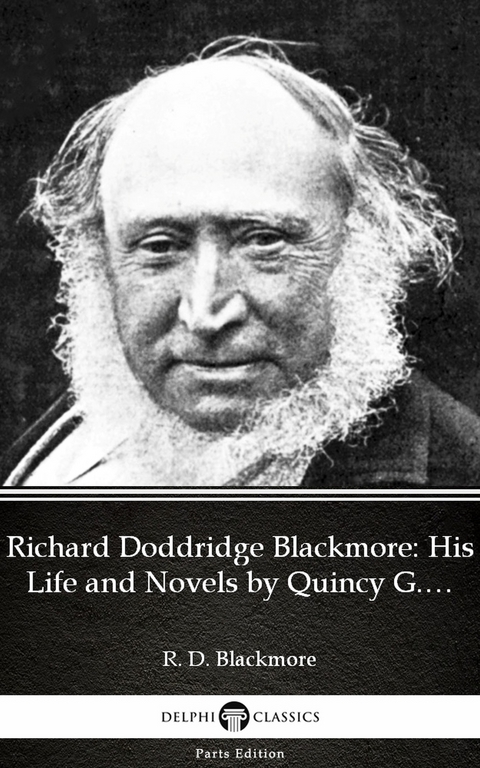
Richard Doddridge Blackmore His Life and Novels by Quincy G. Burris - Delphi Classics (Illustrated) (eBook)
197 Seiten
Delphi Classics (Parts Edition) (Verlag)
978-1-78877-929-6 (ISBN)
Having established their name as the leading publisher of classic literature and art, Delphi Classics produce publications that are individually crafted with superior formatting, while introducing many rare texts for the first time in digital print. The Delphi Classics edition of Blackmore includes original annotations and illustrations relating to the life and works of the author, as well as individual tables of contents, allowing you to navigate eBooks quickly and easily.
eBook features:* The complete unabridged text of 'Richard Doddridge Blackmore His Life and Novels by Quincy G. Burris by R. D. Blackmore - Delphi Classics (Illustrated)'
* Beautifully illustrated with images related to Blackmore's works
* Individual contents table, allowing easy navigation around the eBook
* Excellent formatting of the textPlease visit www.delphiclassics.com to learn more about our wide range of titles
This eBook features the unabridged text of 'Richard Doddridge Blackmore His Life and Novels by Quincy G. Burris by R. D. Blackmore - Delphi Classics (Illustrated)' from the bestselling edition of 'The Complete Works of R. D. Blackmore'. Having established their name as the leading publisher of classic literature and art, Delphi Classics produce publications that are individually crafted with superior formatting, while introducing many rare texts for the first time in digital print. The Delphi Classics edition of Blackmore includes original annotations and illustrations relating to the life and works of the author, as well as individual tables of contents, allowing you to navigate eBooks quickly and easily.eBook features:* The complete unabridged text of 'Richard Doddridge Blackmore His Life and Novels by Quincy G. Burris by R. D. Blackmore - Delphi Classics (Illustrated)'* Beautifully illustrated with images related to Blackmore's works* Individual contents table, allowing easy navigation around the eBook* Excellent formatting of the textPlease visit www.delphiclassics.com to learn more about our wide range of titles
CHAPTER I. THE LIFE AND CHARACTER OF BLACKMORE
WHAT MANNER OF men were the fathers of Richard Doddridge Blackmore we can only guess, for our actual knowledge of them is very slender. We know that on his father’s side they were yeomen farmers, owning and farming the land down to the time of his grandfather. Among his maternal sires, the Church had been for generations the great end and devotion. Now his paternal grandfather, John Blackmore, gave up the soil for the Church, and the stock, for so long owners and tillers of the soil, became permanently clerical. There is nothing hostile in this background to the character of Blackmore as we know it, meagrely enough, at the present time. There is no inexplicable difference between him and his fathers. Though he never considered the Church as a vocation, he was always a devout man; and to the calling of his earlier ancestors, to loving and careful toil with his hands, he returned with all the affection and patient devotion which they had spent upon their glebes.
Although by the accident of birth, Blackmore was a native of Longworth, Berkshire, he was, in his long residence, and in his sympathies a West-country man. His stock, if we may believe the fragmentary information we have about it, came from Devon; and the Exmoor of which he wrote with such feeling embraces both that county and the county of Somerset. His family had long been associated with Parracombe, a village upon the moors of Devon. In 1640 a Richard Blackmore, resident at Parracombe, married a Margaret Wichehalse, and in 1641 a Richard and a John Blackmore were in Parracombe. Of the exact connection between Margaret Wichehalse and John Blackmore we cannot be certain; but we may be certain that from this John Blackmore, the succession of the family is clear and unbroken. From him, through a series of John Blackmores who carried on the family through the eighteenth century, was descended the John Blackmore (1764-1842) who was Richard’s grandfather. Parracombe parish is still the residence of some of the descendants, and a portion of the land they once owned is in the possession of the novelist’s kin.
The grandfather of Richard went to Blundell’s School at Tiverton and attended Exeter College, Oxford. Later he was ordained the curate of High Bray. He did not return to the pursuits of his ancestors, but in him there had appeared that love of learning which characterized the Blackmores after him. He bought the advowson of Charles, near South Molton, with the intention of living there whenever the incumbent should vacate the post. In the meantime he assumed the oversight of the parish as curate in charge, in 1799. The advowson, however, did not fall vacant until many years later. In the interim of waiting, he became rector of Oare in 1809, and of Combe Martin in 1833, both of which he kept until his death. He occupied his leisure with literary and antiquarian studies, among them the collection of notes for a history of the neighborhood, the copying of the parish registers, and curiously enough, the occasional interpolation among these latter of Latin verses. At some time in the 1790’s he married, and the issue of this union was two sons, both born at High Bray. They were, in the order of their birth, John Blackmore (1794-1858), the father of the novelist; and Richard, his uncle (1798-1880).
When the curacy of Charles fell finally vacant, the father of these two, who were now come to manhood, for some strange reason passed over John, the elder son, and gave it to Richard, the younger. There is said to be a legend in the family that the parsonage at Charles was haunted by the repentant spirit of the father, weeping that he had not given the curacy as he should have given it.
John Blackmore, like his father, and like his son after him, went to Blundell’s School, and afterward became a fellow of Exeter College, Oxford, in 1816. Whatever the slight his father put upon him, John Blackmore turned out a good and pious man, of high classical attainments and great force of character. In 1822 he married Anne Basset, the eldest daughter of the Reverend J. Knight, the Vicar of Tewkesbury, who was descended from Sir John Knight, the elder (1612-1683), twice mayor of Bristol, merchant, persecutor of nonconformists and Roman Catholics. Her mother, Mercy, was the grand-daughter of Philip Doddridge, the non-conformist divine and hymn-writer of the eighteenth century. Blackmore was later to write to Sir Herbert Warren of one of his ancestor’s hymns which he had in manuscript, and to say to another acquaintance that he had the ivory and silver tobacco stopper which the divine had owned. The novelist was fond of remembering this family connection, for the character of the eighteenth century Doddridge was attractive to him. Dr. Doddridge was by no means strait-laced, or severe, either in his youth or his age. There are some rumors of his having been sportive and vivacious, of his having married the smartest young lady in his congregation, and of his conducting a training college with such hospitality that his students lived too well for their studies. From this jovial divine, whose lines, “Live while you live,” Dr. Johnson pronounced one of the finest epigrams in the language, Richard got his middle name.
His maternal uncle, the Reverend H. Hey Knight, was Curate of Newton Nottage, Glamorganshire.
To John Blackmore, between the years of 1822 and 1825, two sons and a daughter were borne by his wife Anne. The elder brother was something of an eccentric with scientific leanings, not always considered quite compos mentis. He changed his name from Henry John Blackmore to Henry John Turberville, for what reason I do not know, and died in 1875, at Barnstaple. The younger brother was Richard, the novelist, born June 7, 1825. At the time of his birth his father was a coach for Oxford pupils. About three months after the birth of Richard, an outburst of typhus fever ravaged his father’s house and family, sweeping away wife, daughter, the family physician, and all the servants. From Longworth, Berks, where his family died, John Blackmore fled heart-broken to Culmstock, near Barnstaple, where he held the curacy, and whence, a little later, he went to Ashford, no great distance, to become curate there. After some years he remarried. This second marriage is probably the explanation of young Richard’s spending much of his time with his grandfather and uncle at Charles Rectory and at Newton Nottage.
Over his early boyhood there hangs a cloud of uncertainty, out of which one can discern only a few facts. We learn that he was a very precocious lad, if we may judge from the anecdote which relates that at five years of age, wanting to read in bed, he took The Edinburgh Review with him for that purpose. But books were not all that this boy conned. There was a glebe farm attached to the Rectory at Charles, which his uncle Richard farmed with some success. There in the rough brakes and lone silences of this remote place, Richard must have absorbed much of his fondness for nature, and for quiet simplicity. In Charles Bottom, about a mile from the Rectory, there was a great menhir stone, lying flat beside the road, where the young Blackmore spent a deal of his time musing. He was a dreamy boy, who, his uncle doubted, was not sharp enough for the law, for which he was intended.
He went to grammar school at Bruton, in Somerset. It must have been this period of his childhood to which he referred in the preface to Tales from the Telling House, in the following words:
Sometimes of a night, when the spirit of a dream flits away for a waltz with the shadow of a pen, over dreary moors, and dark waters, I behold an old man, with a keen profile, under a parson’s shovel hat, riding a tall chestnut horse up the western slope of Exmoor, followed by his little grandson upon a shaggy and stuggy pony.
This gives us but a fugitive glimpse of his boyhood, and the reminiscences which follow only serve to confuse the reader. In some of them, however, we can recognize suggestions of the scenes and activities which surrounded him at Charles. He mentions his grandfather’s sheep, and the West-country garrulity and prevarication of John Fry, who has lost two sheep, gifts from Richard’s uncle to the boy, and marked with ‘R.D.B.’ Young Richard is much concerned over their loss, for he has promised his school-fellows a gala occasion upon the money which the sheep would have brought; and he fears to return without the money. What school it was we cannot know from what Blackmore has written in this preface, though he refers to himself as the little grandson of the old man described.
Whatever may have been his education up to this time, he entered Blundell’s School at Tiverton at the age of twelve, on August 12, 1837; even as had his father and grandfather, and according to his own statement, as had his uncles. At Blundell’s he was a shy, retiring boy, an easy mark for the bullying of his older fellows. The business of fagging was never a gentle one, and its evil effect upon a boy of sensitive nature might well work enduring injury. Blackmore, we are told, was early subject to epileptic seizures. How early we do not know. The injurious effects of fagging, however, must have been considerable in his own case, for the epilepsy from which he suffered was, if not caused, certainly made worse by the severity of his treatment at school. It is possible to bring about such seizures by blows and brutal treatment. Waiving, however, the cause and the initial appearance of the affliction, there is no doubt about the brutality. Certainly...
| Erscheint lt. Verlag | 17.7.2017 |
|---|---|
| Reihe/Serie | Delphi Parts Edition (R. D. Blackmore) | Delphi Parts Edition (R. D. Blackmore) |
| Sprache | englisch |
| Themenwelt | Literatur ► Anthologien |
| Literatur ► Klassiker / Moderne Klassiker | |
| Literatur ► Romane / Erzählungen | |
| Schlagworte | Dariel • Doone • Hardy • lorna • Perlycross • Stevenson • Trollope |
| ISBN-10 | 1-78877-929-0 / 1788779290 |
| ISBN-13 | 978-1-78877-929-6 / 9781788779296 |
| Informationen gemäß Produktsicherheitsverordnung (GPSR) | |
| Haben Sie eine Frage zum Produkt? |
 EPUB (Adobe DRM)
Größe: 1,0 MB
Kopierschutz: Adobe-DRM
Adobe-DRM ist ein Kopierschutz, der das eBook vor Mißbrauch schützen soll. Dabei wird das eBook bereits beim Download auf Ihre persönliche Adobe-ID autorisiert. Lesen können Sie das eBook dann nur auf den Geräten, welche ebenfalls auf Ihre Adobe-ID registriert sind.
Details zum Adobe-DRM
Dateiformat: EPUB (Electronic Publication)
EPUB ist ein offener Standard für eBooks und eignet sich besonders zur Darstellung von Belletristik und Sachbüchern. Der Fließtext wird dynamisch an die Display- und Schriftgröße angepasst. Auch für mobile Lesegeräte ist EPUB daher gut geeignet.
Systemvoraussetzungen:
PC/Mac: Mit einem PC oder Mac können Sie dieses eBook lesen. Sie benötigen eine
eReader: Dieses eBook kann mit (fast) allen eBook-Readern gelesen werden. Mit dem amazon-Kindle ist es aber nicht kompatibel.
Smartphone/Tablet: Egal ob Apple oder Android, dieses eBook können Sie lesen. Sie benötigen eine
Geräteliste und zusätzliche Hinweise
Buying eBooks from abroad
For tax law reasons we can sell eBooks just within Germany and Switzerland. Regrettably we cannot fulfill eBook-orders from other countries.
EPUB (Ohne DRM)Digital Rights Management: ohne DRM
Dieses eBook enthält kein DRM oder Kopierschutz. Eine Weitergabe an Dritte ist jedoch rechtlich nicht zulässig, weil Sie beim Kauf nur die Rechte an der persönlichen Nutzung erwerben.
Dateiformat: EPUB (Electronic Publication)
EPUB ist ein offener Standard für eBooks und eignet sich besonders zur Darstellung von Belletristik und Sachbüchern. Der Fließtext wird dynamisch an die Display- und Schriftgröße angepasst. Auch für mobile Lesegeräte ist EPUB daher gut geeignet.
Systemvoraussetzungen:
PC/Mac: Mit einem PC oder Mac können Sie dieses eBook lesen. Sie benötigen dafür die kostenlose Software Adobe Digital Editions.
eReader: Dieses eBook kann mit (fast) allen eBook-Readern gelesen werden. Mit dem amazon-Kindle ist es aber nicht kompatibel.
Smartphone/Tablet: Egal ob Apple oder Android, dieses eBook können Sie lesen. Sie benötigen dafür eine kostenlose App.
Geräteliste und zusätzliche Hinweise
Buying eBooks from abroad
For tax law reasons we can sell eBooks just within Germany and Switzerland. Regrettably we cannot fulfill eBook-orders from other countries.
aus dem Bereich