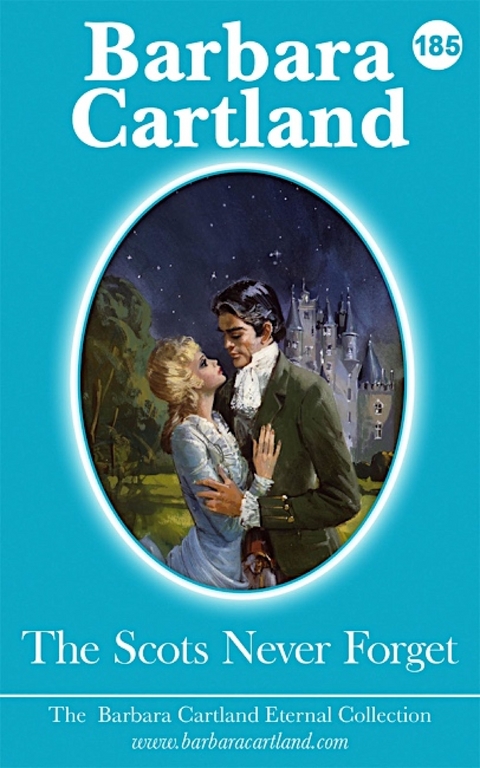
Scots Never Forget (eBook)
320 Seiten
Barbara Cartland eBooks Ltd (Verlag)
9781788670258 (ISBN)
Barbara Cartland was the world's most prolific novelist who wrote an amazing 723 books in her lifetime, of which no less than 644 were romantic novels with worldwide sales of over 1 billion copies and her books were translated into 36 different languages. As well as romantic novels, she wrote historical biographies, 6 autobiographies, theatrical plays and books of advice on life, love, vitamins and cookery. She wrote her first book at the age of 21 and it was called Jigsaw. It became an immediate bestseller and sold 100,000 copies in hardback in England and all over Europe in translation. Between the ages of 77 and 97 she increased her output and wrote an incredible 400 romances as the demand for her romances was so strong all over the world. She wrote her last book at the age of 97 and it was entitled perhaps prophetically The Way to Heaven. Her books have always been immensely popular in the United States where in 1976 her current books were at numbers 1 & 2 in the B. Dalton bestsellers list, a feat never achieved before or since by any author. Barbara Cartland became a legend in her own lifetime and will be best remembered for her wonderful romantic novels so loved by her millions of readers throughout the world, who have always collected her books to read again and again, especially when they feel miserable or depressed. Her books will always be treasured for their moral message, her pure and innocent heroines, her handsome and dashing heroes, her blissful happy endings and above all for her belief that the power of love is more important than anything else in everyone's life.
When her sister, Denise, seven years her senior, and her husband Alistair drowned in a storm at sea, the beautiful nineteen-year-old Pepita Linford is left alone to cope with the care of their young children, Rory and Jeanie, as well as Alistair's huge amount of debts.Exiled from his Scottish Clan for ever by his father, the Duke of Strathnairn, because he dared to marry an Englishwoman against his wishes they then settled in Hertfordshire. Alistair had been deprived of his allowance from his father and had lived on a fast-dwindling legacy from his mother.Virtually destitute Pepita has no choice but to travel to Scotland to throw herself and the children on the mercy of the Duke of Strathnairn.But sadly His Grace, consumed with hatred for the English, is not in the slightest pleased to see them, but grudgingly agrees that they can stay at his imposing Castle for a short while.Pepita is at once aware of the hostility and dislike of the Duchess of Strathnairn, who does everything she can to make life unpleasant for her and Rory and Jeanie.Save for the children Pepita finds herself on her own in a hostile country until she finds warmth, kindness and sympathy in the handsome and charming Torquil McNairn, Alistair s cousin.Soon that warmth becomes an all-encompassing and consuming love for both Pepita and Torquil.But surely it is a passion doomed.Pepita is determined that she must never inflict Alistair s fate on Torquil to be an outcast for no other reason than that he loved a Sassenach from England!
Chapter One ~ 1884
Pepita Linford walked into the sitting room and looked at the packing cases in the centre of the room, the rolled-up carpet and the paintings that had been taken down and stacked against the walls.
There was something so depressing about it that, almost as if she winced away from what she was seeing and thinking, she walked to the window to look out at the garden.
There was still a good display of roses, dahlias and gladioli despite the fact that it was the beginning of September.
Beyond the garden was rolling empty land and beyond that was the sea.
She could see the blue of the Atlantic, almost as vivid as that of the Mediterranean, and knew that the waves would be crashing beneath the cliffs as if they sought to destroy them.
The thought of the sea made her remember all too vividly what it had taken from her and she fought back the tears with what was a valiant effort at self-control.
As she did so, she heard a knock on the front door and went across the small hall to open it.
As she expected, a grey-haired, short, neatly dressed man was standing outside and he smiled at the sight of her.
“Good afternoon, Miss Linford.”
“I was expecting you, Mr. Clarence,” she answered. “Will you please come in? I am afraid that the only chairs we have to sit on are those in the dining room.”
He followed her into the small square room facing the front of the house that Lord Alistair McNairn and his wife had used as a dining room.
Like the sitting room it had now been dismantled and only a few upright leather-seated chairs remained unpacked.
Pepita sat down on one of them and, as Mr. Clarence took another she looked at him with large eyes wide and apprehensive, as if she knew already what he was going to tell her.
He moved another chair close to his, put on it a leather briefcase he had been carrying in his hand and opened it.
“I am afraid, Miss Linford,” he said as he did so, “that I do not have good news for you.”
“I expected that, Mr. Clarence.”
Mr. Clarence drew from his case a sheet of foolscap paper.
He stared at it for some moments as if either what he read surprised him or he was thinking how he could explain to the girl waiting.
Then he cleared his throat and, as if he forced himself to begin, he said,
“I have received the sum of three hundred and twenty-two pounds from the purchasers of the horses and the furniture.”
Pepita gave a little gasp.
“Is that all?”
“It was the very best I could get, Miss Linford, and I promise you I tried in every possible way to make it more.”
“You have been very kind, Mr. Clarence, and I am exceedingly grateful, but as you know three hundred and twenty-two pounds will not cover my brother-in-law’s debts!”
“I am aware of that, Miss Linford,” Mr. Clarence replied, “but I am hoping that we shall receive a little more from the sale of the three paintings that I have sent to Christie’s in London.”
Pepita was silent, feeling that, although Mr. Clarence sounded optimistic, it was very unlikely that the paintings her brother-in-law had bought because he liked the subject rather than the artist were likely to bring a large sum at auction.
At the same time she told herself that every little bit helped.
There were, however, the children to think of and for the moment she felt as if she was swimming in a rough sea and it was hard to keep her head above water.
As if he realised what she was feeling, Mr. Clarence said in a gentle tone,
“I have arranged with Mr. Healey, the purchaser of the furniture, that he will not move the beds until Friday at the earliest. By that time I know that you will have decided where you and the children will go.”
Pepita took a deep breath.
“There is nowhere we can possibly go, Mr. Clarence, except to Scotland!”
For a moment it seemed as if she had taken Mr. Clarence’s breath away.
He stared at her in astonishment before, after a perceptible pause, he said,
“Scotland? I had not thought that – ”
“As you looked after my brother-in-law’s affairs since he came here, you must be aware that when he married my sister, his father, the Duke, not only cut him off with the proverbial shilling but also expelled him from his Clan.”
“Lord Alistair himself told me that,” Mr. Clarence murmured.
“It was cruel and unjust and, although I myself am not Scottish, I know how much the Clan meant to my brother- in-law and how deeply he was hurt by his father’s action.”
Pepita’s voice died away.
She was thinking how only a hard, cruel and unbending Scot could have behaved to his son as the Duke had done.
It seemed strange after all these years to look back and realise that, because Lord Alistair McNairn had fallen in love with her sister, everything else that mattered to him had been taken away.
He had been punished fiercely and relentlessly for marrying for love rather than convenience.
It was a romantic story that Mr. Clarence knew without Pepita telling him what had happened.
The Duke of Strathnairn, who was sometimes spoken of as ‘the King of Scotland’ and who certainly behaved as if he was, had a burning hatred for the English.
They had fired the fury of many Scotsmen since the Battle of Culloden and, as Lord Alistair had often said,
“Scotsmen like elephants never forget!”
It had been arranged for the Duke’s eldest son to marry the daughter of the Chief of the McDonavan Clan, whose boundaries marched with his and with whom they had been at war for centuries.
United by their mutual hatred of the English the Duke had agreed that his son, Euan, the Marquis, should marry Janet McDonavan and the Clans would celebrate their marriage by a vast rally of the McNairns and the McDonavans, who would come from all over Scotland to attend.
But soon after the engagement was announced the Marquis was killed in a shooting accident and, hardly waiting for the conventional short period of mourning, the Duke told his second son, Alistair, that he must take his brother’s place.
“When I die you will be Chieftain of the Clan,” he asserted, “and now you must shoulder the responsibilities of your position as your brother was ready to do and marry Janet McDonavan.”
Lord Alistair was appalled at the idea.
Never for one moment had he envisaged succeeding his father as Chieftain and he had actually spent a great deal more time in the South than his brother had.
He thought that his father’s hatred of the English was out-of-date in a modern world in which there was a Queen on the throne and the traditional feuds and bitterness between the Clans had largely subsided.
However, the Duke pressed his son hard and Alistair was torn between his own personal inclinations and his loyalty to his father.
Then quite unexpectedly he fell in love.
Looking back, even though she was very young at the time, Pepita could remember seeing the two of them look at each other for the first time and, as their eyes met, they had seemed to be joined by some magical spell that linked them indivisibly.
She and her sister, Denise, had been living with their father, who had retired from his position at the Foreign Office to write a book on the strange countries he had journeyed to during his years as a Diplomat.
They had settled in a small village to the North of London in Hertfordshire.
*
The two girls were sitting in their garden one sunny day when there was the sound of a crash in the roadway outside and they had sprung to their feet and run to the gate to see what had occurred.
A smart phaeton drawn by two horses had collided with a village cart that had come out of a side turning without any warning because the yokel driving it was half-asleep.
It was only by a superb piece of driving, Pepita realised later, that the horses had not been badly injured, although they were plunging between the shafts and frightened by the impact.
One of the wheels from the phaeton was lying on the road and the vehicle itself was half-submerged in the ditch.
The village cart being of sturdy material was not badly damaged, but the boy who had been driving it was yelling noisily.
Only as a smartly dressed, extremely handsome young man rose from the wreckage of the phaeton was some semblance of order restored.
The horses had been brought into Sir Robert Linford’s stables and Pepita and her sister, Denise, had taken the gentleman driving them into the house where their father had offered him a glass of wine and he had introduced himself.
“I am Alistair McNairn and I am extremely humiliated, as you can imagine, that I should not have anticipated that country folk expect every road that they travel on to be empty of any other traffic.”
“That is true and may I ask if you are any relation to the Duke of Strathnairn,” Sir Robert replied.
“I am his son,” Lord Alistair answered, “and actually I am supposed to be returning home tomorrow. This is the last time I shall be in the South for a long time.”
He spoke as if he regretted it and, as his eyes were on Denise’s face, Pepita thought that, whatever reasons he had had before for not wishing to leave the South, her sister had added another most compelling one.
It was not surprising that Lord Alistair should have fallen in love with Denise for she was exceedingly beautiful and, although the two sisters resembled each other in many ways, Denise was the more spectacular.
Her hair was the gold of ripened corn, but her eyes, because their mother had French blood, were...
| Erscheint lt. Verlag | 1.1.2018 |
|---|---|
| Sprache | englisch |
| Themenwelt | Literatur ► Historische Romane |
| ISBN-13 | 9781788670258 / 9781788670258 |
| Informationen gemäß Produktsicherheitsverordnung (GPSR) | |
| Haben Sie eine Frage zum Produkt? |
 EPUB (Adobe DRM)
Kopierschutz: Adobe-DRM
Adobe-DRM ist ein Kopierschutz, der das eBook vor Mißbrauch schützen soll. Dabei wird das eBook bereits beim Download auf Ihre persönliche Adobe-ID autorisiert. Lesen können Sie das eBook dann nur auf den Geräten, welche ebenfalls auf Ihre Adobe-ID registriert sind.
Details zum Adobe-DRM
Dateiformat: EPUB (Electronic Publication)
EPUB ist ein offener Standard für eBooks und eignet sich besonders zur Darstellung von Belletristik und Sachbüchern. Der Fließtext wird dynamisch an die Display- und Schriftgröße angepasst. Auch für mobile Lesegeräte ist EPUB daher gut geeignet.
Systemvoraussetzungen:
PC/Mac: Mit einem PC oder Mac können Sie dieses eBook lesen. Sie benötigen eine
eReader: Dieses eBook kann mit (fast) allen eBook-Readern gelesen werden. Mit dem amazon-Kindle ist es aber nicht kompatibel.
Smartphone/Tablet: Egal ob Apple oder Android, dieses eBook können Sie lesen. Sie benötigen eine
Geräteliste und zusätzliche Hinweise
Buying eBooks from abroad
For tax law reasons we can sell eBooks just within Germany and Switzerland. Regrettably we cannot fulfill eBook-orders from other countries.
aus dem Bereich