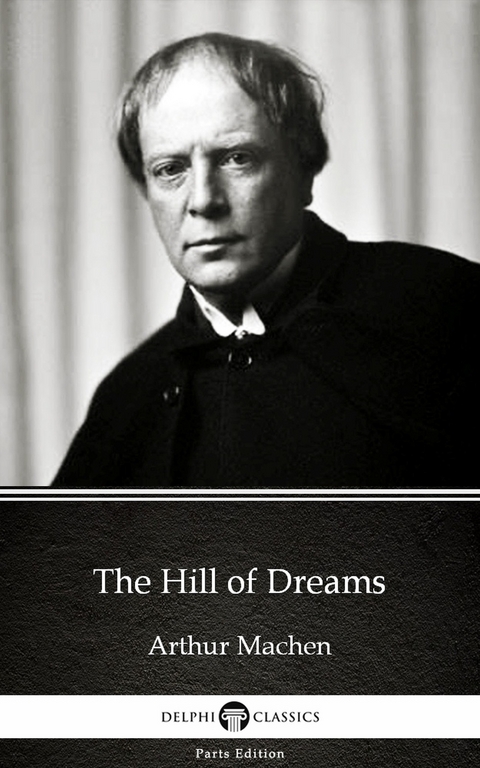
Hill of Dreams by Arthur Machen - Delphi Classics (Illustrated) (eBook)
172 Seiten
Delphi Classics (Parts Edition) (Verlag)
978-1-78877-907-4 (ISBN)
This eBook features the unabridged text of 'The Hill of Dreams by Arthur Machen - Delphi Classics (Illustrated)' from the bestselling edition of 'The Complete Works of Arthur Machen'.
Having established their name as the leading publisher of classic literature and art, Delphi Classics produce publications that are individually crafted with superior formatting, while introducing many rare texts for the first time in digital print. The Delphi Classics edition of Machen includes original annotations and illustrations relating to the life and works of the author, as well as individual tables of contents, allowing you to navigate eBooks quickly and easily.
eBook features:
* The complete unabridged text of 'The Hill of Dreams by Arthur Machen - Delphi Classics (Illustrated)'
* Beautifully illustrated with images related to Machen's works
* Individual contents table, allowing easy navigation around the eBook
* Excellent formatting of the textPlease visit www.delphiclassics.com to learn more about our wide range of titles
This eBook features the unabridged text of 'The Hill of Dreams by Arthur Machen - Delphi Classics (Illustrated)' from the bestselling edition of 'The Complete Works of Arthur Machen'. Having established their name as the leading publisher of classic literature and art, Delphi Classics produce publications that are individually crafted with superior formatting, while introducing many rare texts for the first time in digital print. The Delphi Classics edition of Machen includes original annotations and illustrations relating to the life and works of the author, as well as individual tables of contents, allowing you to navigate eBooks quickly and easily.eBook features:* The complete unabridged text of The Hill of Dreams by Arthur Machen - Delphi Classics (Illustrated) * Beautifully illustrated with images related to Machen s works* Individual contents table, allowing easy navigation around the eBook* Excellent formatting of the textPlease visit www.delphiclassics.com to learn more about our wide range of titles
II
LUCIAN WAS GROWING really anxious about his manuscript. He had gained enough experience at twenty-three to know that editors and publishers must not be hurried; but his book had been lying at Messrs Beit’s office for more than three months. For six weeks he had not dared to expect an answer, but afterwards life had become agonizing. Every morning, at post-time, the poor wretch nearly choked with anxiety to know whether his sentence had arrived, and the rest of the day was racked with alternate pangs of hope and despair. Now and then he was almost assured of success; conning over these painful and eager pages in memory, he found parts that were admirable, while again, his inexperience reproached him, and he feared he had written a raw and awkward book, wholly unfit for print. Then he would compare what he remembered of it with notable magazine articles and books praised by reviewers, and fancy that after all there might be good points in the thing; he could not help liking the first chapter for instance. Perhaps the letter might come tomorrow. So it went on; week after week of sick torture made more exquisite by such gleams of hope; it was as if he were stretched in anguish on the rack, and the pain relaxed and kind words spoken now and again by the tormentors, and then once more the grinding pang and burning agony. At last he could bear suspense no longer, and he wrote to Messrs Beit, inquiring in a humble manner whether the manuscript had arrived in safety. The firm replied in a very polite letter, expressing regret that their reader had been suffering from a cold in the head, and had therefore been unable to send in his report. A final decision was promised in a week’s time, and the letter ended with apologies for the delay and a hope that he had suffered no inconvenience. Of course the “final decision” did not come at the end of the week, but the book was returned at the end of three weeks, with a circular thanking the author for his kindness in submitting the manuscript, and regretting that the firm did not see their way to producing it. He felt relieved; the operation that he had dreaded and deprecated for so long was at last over, and he would no longer grow sick of mornings when the letters were brought in. He took his parcel to the sunny corner of the garden, where the old wooden seat stood sheltered from the biting March winds. Messrs Beit had put in with the circular one of their short lists, a neat booklet, headed: Messrs Beit & Co.’s Recent Publications.
He settled himself comfortably on the seat, lit his pipe, and began to read: “A Bad Un to Beat: a Novel of Sporting Life, by the Honorable Mrs. Scudamore Runnymede, author of Yoicks, With the Mudshire Pack, The Sportleigh Stables, etc., etc., 3 vols. At all Libraries.” The Press, it seemed, pronounced this to be a “charming book. Mrs. Runnymede has wit and humor enough to furnish forth half-a-dozen ordinary sporting novels.” “Told with the sparkle and vivacity of a past-mistress in the art of novel writing,” said the Review; while Miranda, of Smart Society, positively bubbled with enthusiasm. “You must forgive me, Aminta,” wrote this young person, “if I have not sent the description I promised of Madame Lulu’s new creations and others of that ilk. I must a tale unfold; Tom came in yesterday and began to rave about the Honorable Mrs. Scudamore Runnymede’s last novel, A Bad Un to Beat. He says all the Smart Set are talking of it, and it seems the police have to regulate the crowd at Mudie’s. You know I read everything Mrs. Runnymede writes, so I set out Miggs directly to beg, borrow or steal a copy, and I confess I burnt the midnight oil before I laid it down. Now, mind you get it, you will find it so awfully chic.” Nearly all the novelists on Messrs Beit’s list were ladies, their works all ran to three volumes, and all of them pleased the Press, the Review, and Miranda of Smart Society. One of these books, Millicent’s Marriage, by Sarah Pocklington Sanders, was pronounced fit to lie on the school-room table, on the drawing-room bookshelf, or beneath the pillow of the most gently nurtured of our daughters. “This,” the reviewer went on, “is high praise, especially in these days when we are deafened by the loud-voiced clamor of self-styled ‘artists.’ We would warn the young men who prate so persistently of style and literature, construction and prose harmonies, that we believe the English reading public will have none of them. Harmless amusement, a gentle flow of domestic interest, a faithful reproduction of the open and manly life of the hunting field, pictures of innocent and healthy English girlhood such as Miss Sanders here affords us; these are the topics that will always find a welcome in our homes, which remain bolted and barred against the abandoned artist and the scrofulous stylist.”
He turned over the pages of the little book and chuckled in high relish; he discovered an honest enthusiasm, a determination to strike a blow for the good and true that refreshed and exhilarated. A beaming face, spectacled and whiskered probably, an expansive waistcoat, and a tender heart, seemed to shine through the words which Messrs Beit had quoted; and the alliteration of the final sentence; that was good too; there was style for you if you wanted it. The champion of the blushing cheek and the gushing eye showed that he too could handle the weapons of the enemy if he cared to trouble himself with such things. Lucian leant back and roared with indecent laughter till the tabby tom-cat who had succeeded to the poor dead beasts looked up reproachfully from his sunny corner, with a face like the reviewer’s, innocent and round and whiskered. At last he turned to his parcel and drew out some half-dozen sheets of manuscript, and began to read in a rather desponding spirit; it was pretty obvious, he thought, that the stuff was poor and beneath the standard of publication. The book had taken a year and a half in the making; it was a pious attempt to translate into English prose the form and mystery of the domed hills, the magic of occult valleys, the sound of the red swollen brook swirling through leafless woods. Day-dreams and toil at nights had gone into the eager pages, he had labored hard to do his very best, writing and rewriting, weighing his cadences, beginning over and over again, grudging no patience, no trouble if only it might be pretty good; good enough to print and sell to a reading public which had become critical. He glanced through the manuscript in his hand, and to his astonishment, he could not help thinking that in its measure it was decent work. After three months his prose seemed fresh and strange as if it had been wrought by another man, and in spite of himself he found charming things, and impressions that were not commonplace. He knew how weak it all was compared with his own conceptions; he had seen an enchanted city, awful, glorious, with flame smitten about its battlements, like the cities of the Sangraal, and he had molded his copy in such poor clay as came to his hand; yet, in spite of the gulf that yawned between the idea and the work, he knew as he read that the thing accomplished was very far from a failure. He put back the leaves carefully, and glanced again at Messrs Beit’s list. It had escaped his notice that A Bad Un to Beat was in its third three-volume edition. It was a great thing, at all events, to know in what direction to aim, if he wished to succeed. If he worked hard, he thought, he might some day win the approval of the coy and retiring Miranda of Smart Society; that modest maiden might in his praise interrupt her task of disinterested advertisement, her philanthropic counsels to “go to Jumper’s, and mind you ask for Mr. C. Jumper, who will show you the lovely blue paper with the yellow spots at ten shillings the piece.” He put down the pamphlet, and laughed again at the books and the reviewers: so that he might not weep. This then was English fiction, this was English criticism, and farce, after all, was but an ill-played tragedy.
The rejected manuscript was hidden away, and his father quoted Horace’s maxim as to the benefit of keeping literary works for some time “in the wood.” There was nothing to grumble at, though Lucian was inclined to think the duration of the reader’s catarrh a little exaggerated. But this was a trifle; he did not arrogate to himself the position of a small commercial traveler, who expects prompt civility as a matter of course, and not at all as a favor. He simply forgot his old book, and resolved that he would make a better one if he could. With the hot fit of resolution, the determination not to be snuffed out by one refusal upon him, he began to beat about in his mind for some new scheme. At first it seemed that he had hit upon a promising subject; he began to plot out chapters and scribble hints for the curious story that had entered his mind, arranging his circumstances and noting the effects to be produced with all the enthusiasm of the artist. But after the first breath the aspect of the work changed; page after page was tossed aside as hopeless, the beautiful sentences he had dreamed of refused to be written, and his puppets remained stiff and wooden, devoid of life or motion. Then all the old despairs came back, the agonies of the artificer who strives and perseveres in vain; the scheme that seemed of amorous fire turned to cold hard ice in his hands. He let the pen...
| Erscheint lt. Verlag | 17.7.2017 |
|---|---|
| Reihe/Serie | Delphi Parts Edition (Arthur Machen) | Delphi Parts Edition (Arthur Machen) |
| Sprache | englisch |
| Themenwelt | Literatur ► Anthologien |
| Literatur ► Klassiker / Moderne Klassiker | |
| Literatur ► Romane / Erzählungen | |
| Schlagworte | Hill • House • impostors • Lovecraft • Pan • Stories • Tales |
| ISBN-10 | 1-78877-907-X / 178877907X |
| ISBN-13 | 978-1-78877-907-4 / 9781788779074 |
| Informationen gemäß Produktsicherheitsverordnung (GPSR) | |
| Haben Sie eine Frage zum Produkt? |
 EPUB (Adobe DRM)
Größe: 1,2 MB
Kopierschutz: Adobe-DRM
Adobe-DRM ist ein Kopierschutz, der das eBook vor Mißbrauch schützen soll. Dabei wird das eBook bereits beim Download auf Ihre persönliche Adobe-ID autorisiert. Lesen können Sie das eBook dann nur auf den Geräten, welche ebenfalls auf Ihre Adobe-ID registriert sind.
Details zum Adobe-DRM
Dateiformat: EPUB (Electronic Publication)
EPUB ist ein offener Standard für eBooks und eignet sich besonders zur Darstellung von Belletristik und Sachbüchern. Der Fließtext wird dynamisch an die Display- und Schriftgröße angepasst. Auch für mobile Lesegeräte ist EPUB daher gut geeignet.
Systemvoraussetzungen:
PC/Mac: Mit einem PC oder Mac können Sie dieses eBook lesen. Sie benötigen eine
eReader: Dieses eBook kann mit (fast) allen eBook-Readern gelesen werden. Mit dem amazon-Kindle ist es aber nicht kompatibel.
Smartphone/Tablet: Egal ob Apple oder Android, dieses eBook können Sie lesen. Sie benötigen eine
Geräteliste und zusätzliche Hinweise
Buying eBooks from abroad
For tax law reasons we can sell eBooks just within Germany and Switzerland. Regrettably we cannot fulfill eBook-orders from other countries.
EPUB (Ohne DRM)Digital Rights Management: ohne DRM
Dieses eBook enthält kein DRM oder Kopierschutz. Eine Weitergabe an Dritte ist jedoch rechtlich nicht zulässig, weil Sie beim Kauf nur die Rechte an der persönlichen Nutzung erwerben.
Dateiformat: EPUB (Electronic Publication)
EPUB ist ein offener Standard für eBooks und eignet sich besonders zur Darstellung von Belletristik und Sachbüchern. Der Fließtext wird dynamisch an die Display- und Schriftgröße angepasst. Auch für mobile Lesegeräte ist EPUB daher gut geeignet.
Systemvoraussetzungen:
PC/Mac: Mit einem PC oder Mac können Sie dieses eBook lesen. Sie benötigen dafür die kostenlose Software Adobe Digital Editions.
eReader: Dieses eBook kann mit (fast) allen eBook-Readern gelesen werden. Mit dem amazon-Kindle ist es aber nicht kompatibel.
Smartphone/Tablet: Egal ob Apple oder Android, dieses eBook können Sie lesen. Sie benötigen dafür eine kostenlose App.
Geräteliste und zusätzliche Hinweise
Buying eBooks from abroad
For tax law reasons we can sell eBooks just within Germany and Switzerland. Regrettably we cannot fulfill eBook-orders from other countries.
aus dem Bereich