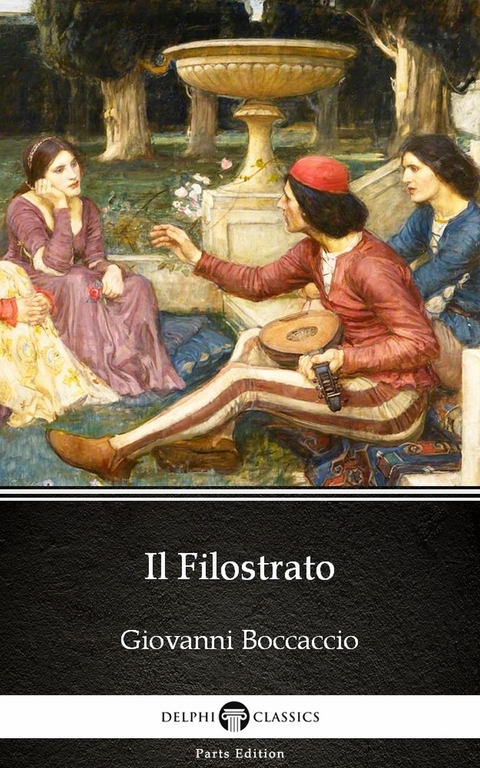
Il Filostrato by Giovanni Boccaccio - Delphi Classics (Illustrated) (eBook)
491 Seiten
Delphi Classics (Parts Edition) (Verlag)
978-1-78877-903-6 (ISBN)
This eBook features the unabridged text of 'Il Filostrato by Giovanni Boccaccio - Delphi Classics (Illustrated)' from the bestselling edition of 'The Collected Works of Giovanni Boccaccio'.
Having established their name as the leading publisher of classic literature and art, Delphi Classics produce publications that are individually crafted with superior formatting, while introducing many rare texts for the first time in digital print. The Delphi Classics edition of Boccaccio includes original annotations and illustrations relating to the life and works of the author, as well as individual tables of contents, allowing you to navigate eBooks quickly and easily.
eBook features:
* The complete unabridged text of 'Il Filostrato by Giovanni Boccaccio - Delphi Classics (Illustrated)'
* Beautifully illustrated with images related to Boccaccio's works
* Individual contents table, allowing easy navigation around the eBook
* Excellent formatting of the textPlease visit www.delphiclassics.com to learn more about our wide range of titles
This eBook features the unabridged text of 'Il Filostrato by Giovanni Boccaccio - Delphi Classics (Illustrated)' from the bestselling edition of 'The Collected Works of Giovanni Boccaccio'. Having established their name as the leading publisher of classic literature and art, Delphi Classics produce publications that are individually crafted with superior formatting, while introducing many rare texts for the first time in digital print. The Delphi Classics edition of Boccaccio includes original annotations and illustrations relating to the life and works of the author, as well as individual tables of contents, allowing you to navigate eBooks quickly and easily.eBook features:* The complete unabridged text of Il Filostrato by Giovanni Boccaccio - Delphi Classics (Illustrated) * Beautifully illustrated with images related to Boccaccio s works* Individual contents table, allowing easy navigation around the eBook* Excellent formatting of the textPlease visit www.delphiclassics.com to learn more about our wide range of titles
PREFACE
THIS TRANSLATION OF Boccaccio’s Filostrato has not been prepared with a purpose primarily of adding to the rich storehouse of English poetry. To add further ornament to English literature would at any time be most difficult; but to seek to add at a point where Chaucer has already made the supreme contribution in his Troilus and Criseyde would be the height of temerity. In that poem, more than five hundred years ago, appeared the best gift that the Filostrato, its chief source, could hope to make to lovers of story in English verse.
Yet my work upon the translation of the old Italian narrative poem on which Chaucer’s tale of the unhappy love of Troilus is founded, and upon a translation of it into English verse, has not been without purpose. Two of “the all Etruscan Three” of whom Byron, reviewing the history of the great men of Florence, sings in Childe Harold’s Pilgrimage,
Dante, and Petrarch, and, scarce less than they,
The Bard of Prose, creative spirit! he
Of the Hundred Tales of love.
are familiar figures in English Literature. He who lists may read Dante and Petrarch from their own lips speaking in English poetry. But it is not so with the “Bard of Prose.” He seldom speaks to us in the language of English verse. We have been introduced to him in poetry, to be sure, by Chaucer in The Clerk’s Tale, by Longfellow in his story of The Falcon of Ser Federigo in the Tales from a Wayside Inn, and by Tennyson in his little poetic drama, The Falcon; but there after all, however charming the English verses that have introduced Boccaccio, we have met him only as the “Bard of Prose,” the author of the Decamerone. And it may be believed that Chaucer thought, as he maintained, that he was introducing to us only the work of
Fraunceys Petrark, the lauréat poete when he wrote the Clerk’s tale of the patient Griselde. As a “Bard of Verse” — translated English verse for Italian verse — we have then met Boccaccio the poet only in a few modest and little known sonnet translations by Dante Gabriel Rossetti. It has been largely the hope of this present translation that it might introduce him anew to English readers as a poet. For the fact that Boccaccio is best known, and should be best known in English as the airy and graceful narrator of the famous novelle should not debar him from the privilege of being known more largely to us in our own language in that capacity. The author of the Decamerone, the first great student and critic of Dante, the friend and intimate of Petrarch, the writer of an ardent defense of poetry in one of the books of his De Genealogiis Deorum — and so an ancestor in criticism of Sir Philip Sidney and Percy Bysshe Shelley, Boccaccio has, it seems to me, for his very achievements’ sake deserved a ranking among the poets. May it be the good fortune of this text of the Filostrato to bring him a little nearer to that place in the English language!
But my work has had, too, a more practical and less ambitious purpose. I have wished to make it possible for students of Chaucer more readily to compare Troilus and Criseyde with the story of Troilo, as Boccaccio told it, that they more properly may appraise the merits of both narratives, the English and the Italian. There has been a tendency toward belief that Chaucer’s is a preeminently superior work, more realistic in action and character portrayal, richer in humour, and more mature in wisdom. That such is not invincibly the case I hope may be revealed here. Boccaccio’s work is not sheer romance. The Filoslrato may deserve the name of metrical romance which is frequently given to it, and it may be written in ottava rima, but it is, for all those facts, a poem that is written with the clearest psychological truth to human character and one that exhibits many a sly touch of satire and worldly wisdom. At times, too, it has a piquancy that even Chaucer’s geniality does not entirely transcend. It is different in manner from ‘Troilus and Criseyde rather than distinctly inferior in quality.
Considered independently, II Filoslrato is a simple forthright narrative of a disappointment in love. It is without intricacy in plot and is devoid of affectation in style. Unlike La Teseide, in time of composition Boccaccio’s next poetic work, it makes no effort to be either epic or pseudo-epic. The beautiful Homeric similes with which the poet ornaments that latter poem are lacking in the story of Troilo. The magic, the supernaturalism, and the glamour of high adventure with which contemporary metrical romance was everywhere replete have no part in it. It is an unadorned story of love and pain. To produce genuine and poignant passion it relies only on simplicity; for although it is in poetry, its style possesses much of the naïveté of the prose of the Decamerone, and so is never unworthy of the master narrator of the “Hundred Tales of love.”
Of the four chief characters that appear in Il Filostrato much might be said. But a little mention, here, of Troilo, Griseida, Pandaro, and Diomede will suffice.
Troilo is but a genuine manifestation of youth — youth of Romeo’s cast. Ironic, arrogant, defiant in the presence of love in the beginning though he is, his impressionability leads him, as it has a habit of leading youth, to a very sudden fall. He succumbs to the charms of Griseida and to love, and he succumbs wholly. Thereafter he is alternately gay or despondent lover. His joy has all the exaltation of youth for a time, and the pain that follows has all the intensity of the first genuine bitterness that comes with the first complete disillusionment of youth. When presently he fears his Griseida has been taken from him, his bliss removed, he draws his dagger on himself; as, figuratively at least, youth is ever prone to wield its weapon when its first mental agony makes death appear its only possible relief. But, if he represents the weakness of youth, he represents, too, its valour and its constancy. After his mistress has been sent away from Troy to the Greeks, he loves loyally and he fights valiantly. When final conviction of Griseida’s infidelity comes upon him, his cup of bitterness is filled. There is nothing to do but like a man to seek revenge on Diomede and to court death bravely on the field of battle. And both these things he does with a will.
Griseida (changed in the text of the translation to Criseis) is but womanhood, fair and frail — or, as Boccaccio usually conceives it to be, frail whether it be fair or otherwise. She is a lovely creature, frightened at first by the ardent advances of Troilo, later delighted with his adoration, supremely happy in her hours of dalliance with him, prostrated with grief when she learns that they must part, confident that she can win her way back to her lover from the tents of the Greeks, and serene in her belief in her own impeccable constancy. But presently she fails Troilo and gives her love to Diomede. That is all her story as Boccaccio sees it.
Pandaro portrays at once the charms and the insufficiencies of boon companionship. He is a graceful figure, witty, fond of pleasure, possessed of an indulgent and unscrupulous eye for the follies and the vices of youth, full of raillery, and when all goes well, full of invention. He can turn every trick in a successful lover’s favour. But, when misery comes on, when Griseida must leave Troy, and when finally she abandons Troilo for the love of another, Pandaro, like every boon companion, is helpless. He can, it is true, wrest a knife away from a despairing lover and keep him from taking his own life; but he can offer him no true and efficacious comfort. He can only look on impotently and pathetically at Troilo’s suffering.
Diomede, of whom we see little and who is abruptly, if not crudely, introduced by Boccaccio, is a combination of charm and dare-deviltry. He might be painted very black, but the poet does not really deal with him in that colour. When first he sees Griseida and, with true and immediate insight, perceives that she is in love with Troilo, he sighs to think that so fair a woman should already be in love, and doubts regretfully his own ability to make a conquest of her with that disadvantage to overcome. But with Diomede a woman is a woman, and a game is a game: the more obstacles the better sport! With a zest he enters into the hazard of the venture, and with grace and clever speech he wins. For his robbing of Troilo justice and honour cannot commend him; but for his winning of the game the young Greek cannot be utterly despised.
About the translation itself a few words must be said.
It has been made stanza for stanza in English ottava rima, but with one notable variation. The last line of the stanza (which is usually made, like all the other seven, one of iambic pentameter) has here been regularly converted into an alexandrine, like the last verse of a Spenserian stanza. The assuming of this liberty has made somewhat easier the task of translating stanza for stanza, rhyme scheme for rhyme scheme; and it has not unpleasantly altered the iambic rhythm.
A few further liberties have been taken, too, in the language used. Archaism is sometimes resorted to in such terms as ruth, hent, pent,...
| Erscheint lt. Verlag | 17.7.2017 |
|---|---|
| Reihe/Serie | Delphi Parts Edition (Giovanni Boccaccio) | Delphi Parts Edition (Giovanni Boccaccio) |
| Sprache | englisch |
| Themenwelt | Literatur ► Anthologien |
| Literatur ► Klassiker / Moderne Klassiker | |
| Literatur ► Romane / Erzählungen | |
| Schlagworte | Canterbury • Chaucer • Dante • Decameron • petrarch • Poetry • Shakespeare |
| ISBN-10 | 1-78877-903-7 / 1788779037 |
| ISBN-13 | 978-1-78877-903-6 / 9781788779036 |
| Informationen gemäß Produktsicherheitsverordnung (GPSR) | |
| Haben Sie eine Frage zum Produkt? |
 EPUB (Adobe DRM)
Größe: 5,0 MB
Kopierschutz: Adobe-DRM
Adobe-DRM ist ein Kopierschutz, der das eBook vor Mißbrauch schützen soll. Dabei wird das eBook bereits beim Download auf Ihre persönliche Adobe-ID autorisiert. Lesen können Sie das eBook dann nur auf den Geräten, welche ebenfalls auf Ihre Adobe-ID registriert sind.
Details zum Adobe-DRM
Dateiformat: EPUB (Electronic Publication)
EPUB ist ein offener Standard für eBooks und eignet sich besonders zur Darstellung von Belletristik und Sachbüchern. Der Fließtext wird dynamisch an die Display- und Schriftgröße angepasst. Auch für mobile Lesegeräte ist EPUB daher gut geeignet.
Systemvoraussetzungen:
PC/Mac: Mit einem PC oder Mac können Sie dieses eBook lesen. Sie benötigen eine
eReader: Dieses eBook kann mit (fast) allen eBook-Readern gelesen werden. Mit dem amazon-Kindle ist es aber nicht kompatibel.
Smartphone/Tablet: Egal ob Apple oder Android, dieses eBook können Sie lesen. Sie benötigen eine
Geräteliste und zusätzliche Hinweise
Buying eBooks from abroad
For tax law reasons we can sell eBooks just within Germany and Switzerland. Regrettably we cannot fulfill eBook-orders from other countries.
EPUB (Ohne DRM)Digital Rights Management: ohne DRM
Dieses eBook enthält kein DRM oder Kopierschutz. Eine Weitergabe an Dritte ist jedoch rechtlich nicht zulässig, weil Sie beim Kauf nur die Rechte an der persönlichen Nutzung erwerben.
Dateiformat: EPUB (Electronic Publication)
EPUB ist ein offener Standard für eBooks und eignet sich besonders zur Darstellung von Belletristik und Sachbüchern. Der Fließtext wird dynamisch an die Display- und Schriftgröße angepasst. Auch für mobile Lesegeräte ist EPUB daher gut geeignet.
Systemvoraussetzungen:
PC/Mac: Mit einem PC oder Mac können Sie dieses eBook lesen. Sie benötigen dafür die kostenlose Software Adobe Digital Editions.
eReader: Dieses eBook kann mit (fast) allen eBook-Readern gelesen werden. Mit dem amazon-Kindle ist es aber nicht kompatibel.
Smartphone/Tablet: Egal ob Apple oder Android, dieses eBook können Sie lesen. Sie benötigen dafür eine kostenlose App.
Geräteliste und zusätzliche Hinweise
Buying eBooks from abroad
For tax law reasons we can sell eBooks just within Germany and Switzerland. Regrettably we cannot fulfill eBook-orders from other countries.
aus dem Bereich