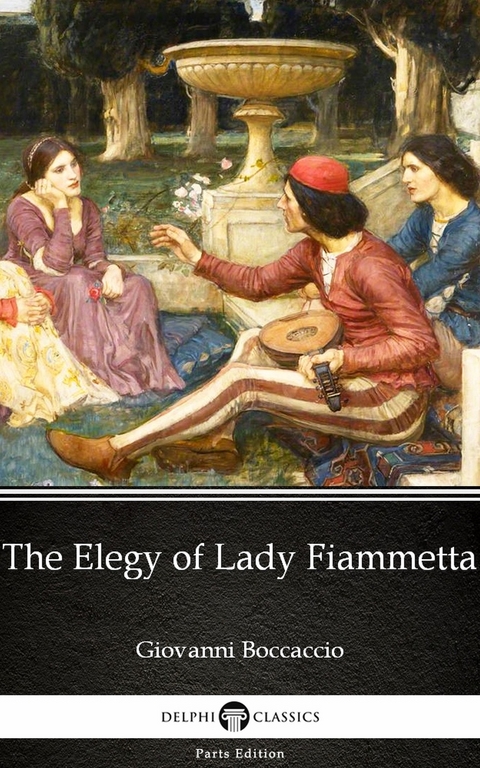
Elegy of Lady Fiammetta by Giovanni Boccaccio - Delphi Classics (Illustrated) (eBook)
217 Seiten
Delphi Classics (Parts Edition) (Verlag)
978-1-78877-902-9 (ISBN)
This eBook features the unabridged text of 'The Elegy of Lady Fiammetta by Giovanni Boccaccio - Delphi Classics (Illustrated)' from the bestselling edition of 'The Collected Works of Giovanni Boccaccio'.
Having established their name as the leading publisher of classic literature and art, Delphi Classics produce publications that are individually crafted with superior formatting, while introducing many rare texts for the first time in digital print. The Delphi Classics edition of Boccaccio includes original annotations and illustrations relating to the life and works of the author, as well as individual tables of contents, allowing you to navigate eBooks quickly and easily.
eBook features:
* The complete unabridged text of 'The Elegy of Lady Fiammetta by Giovanni Boccaccio - Delphi Classics (Illustrated)'
* Beautifully illustrated with images related to Boccaccio's works
* Individual contents table, allowing easy navigation around the eBook
* Excellent formatting of the textPlease visit www.delphiclassics.com to learn more about our wide range of titles
This eBook features the unabridged text of 'The Elegy of Lady Fiammetta by Giovanni Boccaccio - Delphi Classics (Illustrated)' from the bestselling edition of 'The Collected Works of Giovanni Boccaccio'. Having established their name as the leading publisher of classic literature and art, Delphi Classics produce publications that are individually crafted with superior formatting, while introducing many rare texts for the first time in digital print. The Delphi Classics edition of Boccaccio includes original annotations and illustrations relating to the life and works of the author, as well as individual tables of contents, allowing you to navigate eBooks quickly and easily.eBook features:* The complete unabridged text of The Elegy of Lady Fiammetta by Giovanni Boccaccio - Delphi Classics (Illustrated) * Beautifully illustrated with images related to Boccaccio s works* Individual contents table, allowing easy navigation around the eBook* Excellent formatting of the textPlease visit www.delphiclassics.com to learn more about our wide range of titles
THE SECOND BOOK OF BOCCACE HIS FIAMMETTA
WHILST THAT, O dearest Ladies, I spent my merry days in so pleasant and jocund a life, as is above written, never thinking of future chances, cruel fortune did secretly prepare her malicious poison for me, and with continual courage (myself not suspecting anything) did at an inch pursue my joyful life. And thinking that (in making me become a vassal to love, and in my chiefest time of joy and liberty), she was not well appaid, but perceiving how this my sweet servitude did yield me great delight, she endeavoured with a more stinging nettle to torment and prick my poor and silly soul. And her appointed time being now come, she tempered (as after you shall perceive) her bitter galls and wormwood for my unwilling and feeble stomach: which (maugre my teeth) compelling me to drink, turned my present mirth into sudden sadness, and my wonted laughter into woeful lamentations: which things not only enduring, but yet thinking it my duty in writing them, to show them to some others, I took such compassion of myself, that taking almost all my force from me, and bringing infinite tears to mine eyes, it did hardly permit me anything effectually to execute my purpose herein: which, albeit I may very ill do, yet will I forcibly go about to perform the same.
After that he and I (the weather falling out very cold and rainy) were in my Chamber together, reposing and solacing ourselves upon a sumptuous and sweet bed, and Lady Citherea wearied, nay almost overcome, the dark and silent night with her long tariance favourably granted to our pleasant and desired sports fit opportunity of time and place. And a great light hanging in the midst of the Chamber glutted his eyes and mine (viewing each other’s beauty) with exceeding joy: of which, while I recreated my mind in gazing and discoursing of his, mine eyes did drink a superfluous kind of sweetness, which making their lights inebriated (as it were) with the same, with deceitful sleep (I know not how) a little while oppressed, and my words (interrupted also in the midst) remained locked up close in their lids.
Which pleasant and sweet slumber, passing so mildly away from me, as it came, my ears by chance heard certain doleful mutterings and sorrowful bewailings uttered forth by my best beloved. Wherefore suddenly troubled in mind, and my thoughts, at war within themselves for his welfare, made me almost interrupt him with these words Sweet heart, what dost thou ail?” But countermanded by new counsel I kept them in, and with a sharp eye and subtle ears, secretly beholding him turned now on the other side of the bed, I listened a good while to his sorrowful and silent words, but mine ears did not apprehend any of them, albeit I might perceive him molested with great store of lamentable sobs and sighs, that he cast forth, and by seeing also his breast bedewed all with tears.
What words (alas) can sufficiently express with how many cares my poor soul all this while (being ignorant of the cause) was afflicted? A thousand thoughts in one moment did violently run up and down in my doubtful mind, meeting all at the last, and concluding in one thing, which was, that he, loving some other Woman, remained with me here, and in this sort against his will.
My words were very often at the brink of my mouth, to examine the cause of his grief, but doubting lest he lamenting in this sort, and being suddenly espied and interrupted of me, he might not be greatly abashed thereat, they retired back, and went down again: and oftentimes likewise I turned away mine eyes from beholding him, because lest the hot tears distilling from them, and falling upon him, might have given him occasion and matter to know that I perceived his woeful plight. Oh, how many impatient means did I imagine to practise, because that he (awaking me) might conjecture that I had neither heard his sighs, nor seen his tears: and yet agreed to none at all.
But overcome at the last with eager desire to know the occasion of his complaint, because he should turn him towards me, as those who, in their deepest sleep, terrified by dreaming of some great fall, wild beast, or of some ghastly thing, give a sudden start, and in most fearful wise rouse up themselves, affrighted out of their sleep and wits at once, even so with a sudden and timorous voice I shrieked, and lifting up myself, I violently cast one of my arms over his shoulders. And truly my deceit deceived me not, because (closely wiping away his tears) with infinite (though counterfeit) joy he quickly turned towards me again, and with a pitiful voice said:
“My fairest and sweetest soul, of what wert thou afraid?” Whom without delay I answered thus: “My Love, I thought I had lost thee.” My words (alas) I know not by what spirit uttered forth, were most true presagers and foretellers of my future loss, as now too true I find it.
But he replied:— “O dearest dear, not hateful death, nor any adverse chance of unstable Fortune whatsoever, can work such operations in my firm breast, that thou (my only joy) shalt leese me for ever.” And incontinently a great and profound sigh followed these pitiful words, the cause of which not so soon demanded of me (who was also most desirous to know the offspring of his first lamentations) but suddenly two streams of tears from both his eyes (as from two fountains) began to gush out amain, and in great abundance to drench his sorrowful breast, not yet thoroughly dried up by his former weeping. And holding me, poor soul (plunged in a gulf of griefs, and overcome with floods of brinish tears), a long time in a doleful and doubtful suspense, before (even so did the violence of his sobs and sighs stop the passage of his words) he could answer anything to my demands again.
But after that he felt the tempest of his outrageous passion somewhat calmed, with a sorrowful voice, yet still interrupted with many heavy sighs, he said thus again: “O dearest Lady and sole Mistress of my afflicted heart, and only beloved of me above all other women in the world, as these extraordinary effects are true records of the same: if my plaints deserve any credit at all, thou mayst then believe, that my eyes not without a grievous occasion shed erst such plenty of bitter tears, whensoever that is objected to my memory, which (remaining now with thee in great joy) doth cruelly torment my heart to think of, that is when I remember with myself that thou mayest not (alas, fain would I that thou couldest) make two Panphilowes of me, because remaining here, and being also there, whither urgent and necessary affairs do perforce compel me (most unwillingly) to retire, I might at one time fulfil the laws of love, and my pitiful, natural and dutiful devoyre: O my aged and loving father. Being therefore not able to suffer any more, my pensive heart, with remembrance of it, is continually with great affliction galled more and more, as one whom, pity drawing on the one side, is taken out of thy arms, and on the other side with great force of love is still retained in them.”
These words pierced my miserable heart with such extreme bitterness as I never felt before. And although my dusked wits did not well understand them, notwithstanding (as much as my ears and senses attentive to their harms did receive and conceive of them) by so much more, the very same, converted into tears, issued out of my eyes, leaving behind them their cruel and malicious effects in my heart. This was therefore (good Ladies) the first hour in the which I felt such grudging griefs envious of my pleasures: this was the hour which made me pour forth innumerable tears, the like never spent of me before, whose course and main streams not any of his comforts and consolatory words could stop and stanch one whit. But after I had a long time together remained in woeful wailings, enfolding him lovingly between my arms, I prayed him (as much as I could) to tell me more clearly what pity, and what due piety that was, that did draw him out of my arms, and threaten me his absence; whereupon, not ceasing to lament, he said thus unto me:
“Inevitable death, the final end of all things, of many other sons hath left me sole to survive with my aged and reverend father, who burdened with many years, and living without the sweet company of his deceased wife, and loving brothers, who might in his old years carefully comfort him, and remaining now without any hope of any more issue, being determined not to marry, doth recall me home to see him, as the chiefest part of his consolation, whom he hath not seen these many years past. For shifting of which journey (because I would not, sweet Fiammetta, leave thee) there are not a few months past, when first by divers means I began to frame some just and reasonable excuse. But he in fine, not accepting of any, did not cease to conjure me, by the essence which I had by him, and by my impotent childhood tenderly brought up, and nurtured in his lap, by that love, which continually he had borne me, and by the duty and that love, which I should bear him again, and by that requisite obedience which every child should bear unto his father, and by all other things that he thought most effectual and persuasive, did like a familiar friend (whose part is rather to command) pray me, that, to commiserate his aged and declining years, and to tender his welfare, I would with speed return to visit him. And besides this, with solemn oaths, and serious observations, he caused all his friends, and agents in these parts, and with most earnest entreaties provoked them incessantly, to prick me on in this behalf, saying, that if he did not see me shortly with him, his miserable soul would utterly forsake his old and comfortless body. But (alas) how strong and...
| Erscheint lt. Verlag | 17.7.2017 |
|---|---|
| Reihe/Serie | Delphi Parts Edition (Giovanni Boccaccio) | Delphi Parts Edition (Giovanni Boccaccio) |
| Sprache | englisch |
| Themenwelt | Literatur ► Anthologien |
| Literatur ► Klassiker / Moderne Klassiker | |
| Literatur ► Romane / Erzählungen | |
| Schlagworte | Canterbury • Chaucer • Dante • Decameron • petrarch • Poetry • Shakespeare |
| ISBN-10 | 1-78877-902-9 / 1788779029 |
| ISBN-13 | 978-1-78877-902-9 / 9781788779029 |
| Informationen gemäß Produktsicherheitsverordnung (GPSR) | |
| Haben Sie eine Frage zum Produkt? |
 EPUB (Adobe DRM)
Größe: 4,4 MB
Kopierschutz: Adobe-DRM
Adobe-DRM ist ein Kopierschutz, der das eBook vor Mißbrauch schützen soll. Dabei wird das eBook bereits beim Download auf Ihre persönliche Adobe-ID autorisiert. Lesen können Sie das eBook dann nur auf den Geräten, welche ebenfalls auf Ihre Adobe-ID registriert sind.
Details zum Adobe-DRM
Dateiformat: EPUB (Electronic Publication)
EPUB ist ein offener Standard für eBooks und eignet sich besonders zur Darstellung von Belletristik und Sachbüchern. Der Fließtext wird dynamisch an die Display- und Schriftgröße angepasst. Auch für mobile Lesegeräte ist EPUB daher gut geeignet.
Systemvoraussetzungen:
PC/Mac: Mit einem PC oder Mac können Sie dieses eBook lesen. Sie benötigen eine
eReader: Dieses eBook kann mit (fast) allen eBook-Readern gelesen werden. Mit dem amazon-Kindle ist es aber nicht kompatibel.
Smartphone/Tablet: Egal ob Apple oder Android, dieses eBook können Sie lesen. Sie benötigen eine
Geräteliste und zusätzliche Hinweise
Buying eBooks from abroad
For tax law reasons we can sell eBooks just within Germany and Switzerland. Regrettably we cannot fulfill eBook-orders from other countries.
EPUB (Ohne DRM)Digital Rights Management: ohne DRM
Dieses eBook enthält kein DRM oder Kopierschutz. Eine Weitergabe an Dritte ist jedoch rechtlich nicht zulässig, weil Sie beim Kauf nur die Rechte an der persönlichen Nutzung erwerben.
Dateiformat: EPUB (Electronic Publication)
EPUB ist ein offener Standard für eBooks und eignet sich besonders zur Darstellung von Belletristik und Sachbüchern. Der Fließtext wird dynamisch an die Display- und Schriftgröße angepasst. Auch für mobile Lesegeräte ist EPUB daher gut geeignet.
Systemvoraussetzungen:
PC/Mac: Mit einem PC oder Mac können Sie dieses eBook lesen. Sie benötigen dafür die kostenlose Software Adobe Digital Editions.
eReader: Dieses eBook kann mit (fast) allen eBook-Readern gelesen werden. Mit dem amazon-Kindle ist es aber nicht kompatibel.
Smartphone/Tablet: Egal ob Apple oder Android, dieses eBook können Sie lesen. Sie benötigen dafür eine kostenlose App.
Geräteliste und zusätzliche Hinweise
Buying eBooks from abroad
For tax law reasons we can sell eBooks just within Germany and Switzerland. Regrettably we cannot fulfill eBook-orders from other countries.
aus dem Bereich