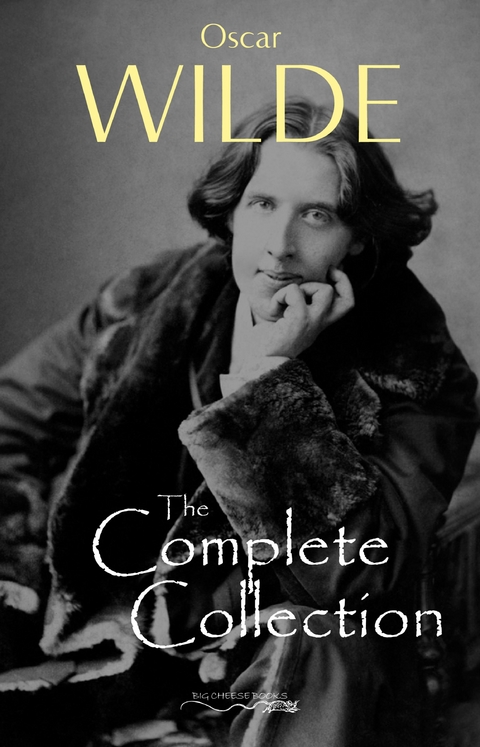
Oscar Wilde: The Complete Collection (eBook)
2898 Seiten
Pandora's Box (Verlag)
978-989-778-126-1 (ISBN)
This ebook contains all of Oscar Wilde's plays (including the fragments), his only novel, his fairy tales and short stories, the poems, all of his essays, lectures, reviews, and other newspaper articles, based on the 1909 edition of his works. For easier navigation, there are tables of contents for each section and one for the whole volume. At the end of each text there are links bringing you back to the respective contents tables. I have also added an alphabetical index for the poems and a combined one for all the essays, lectures, articles, and reviews. Contents:THE PLAYS. Vera or the Nihilists, The Duchess of Padua, Lady Windermere's Fan, A Woman of No Importance, An Ideal Husband, The Importance of Being Earnest, Salom (the French original and Bosie's translation, and the fragments of La Sainte Courtisane and A Florentine Tragedy. THE NOVEL. The Picture of Dorian Gray. THE STORIES. All the stories and tales from The Happy Prince and Other Tales, Lord Arthur Savile's Crime and Other Stories (incl. The Portrait of Mr. W.H.), and A House of Pomegranates. THE POEMS. The Collected Poems of O.W. THE ESSAYS etc. The four essays from 'Intentions', The Soul of Man under Socialism, De Profundis (the unabridged version!), The Rise of Historical Criticism, the lectures (The English Renaissance in Art, House Decoration, Art and the Handicraftsman, Lecture to Art Students)
The
Duchess of
Padua.
by
Oscar Wilde
Privately printed as manuscript, 1883;
premiered January 26th, 1891
at the Broadway Theatre, New York
[The text follows the
1909 Methuen & Co. edition.]
to
MISS ADELA SCHUSTER
madam,
A few months before his death Mr. Oscar Wilde expressed to me a regret that he had never dedicated any of his works to one from whom he had received such infinite kindness and to whom he was under obligations no flattering dedication could repay. With not very great sincerity, because I knew he was a dying man, I suggested he might still write a play or book which you would accept. He answered with truth, ‘There is nothing but The Duchess of Padua and it is unworthy of her and unworthy of me.’ With all his egoism and self-complacency you will know, perhaps as well as I do, that he never regarded his works as an adequate expression of his extraordinary genius and his magnificent intellectual endowment; many people hardly believe that in his last years he was the severest critic of his own achievements. In the pages of De Profundis there are many references to yourself, and I think I am carrying out my dear friend’s wishes in asking your acceptance of a play which was the prelude to a singularly brilliant and, if the last five years are omitted, a very happy life.
robert ross
Christmas 1906.
the persons of the play.
Simone Gesso, Duke of Padua
Beatrice, his Wife
Andreas Pollajuolo, Cardinal of Padua
Maffio Petrucci,
Jeppo Vitellozzo,
Taddeo Bardi, Gentlemen of the Duke’s Household
Guido Ferranti, a Young Man
Ascanio Cristofano, his Friend
Count Moranzone, an Old Man
Bernardo Cavalcanti, Lord Justice of Padua
Hugo, the Headsman
Lucy, a Tire woman
Servants, Citizens, Soldiers, Monks, Falconers with their hawks and dogs, etc.
Place: Padua.
Time: The latter half of Sixteenth Century.
the scenes of the play.
Act I: The Market Place of Padua (25 minutes).
Act II: Room in the Duke’s Palace (36 minutes).
Act III: Corridor in the Duke’s Palace (29 minutes).
Act IV: The Hall of Justice (31 minutes).
Act V: The Dungeon (25 minutes).
Style of Architecture: Italian, Gothic and Romanesque
Act I.
Scene—The Market Place of Padua at noon; in the background is the great Cathedral of Padua; the architecture is Romanesque, and wrought in black and white marbles; a flight of marble steps leads up to the Cathedral door; at the foot of the steps are two large stone lions; the houses on each side of the stage have coloured awnings from their windows, and are flanked by stone arcades; on the right of the stage is the public fountain, with a triton in green bronze blowing from a conch; around the fountain is a stone seat; the bell of the Cathedral is ringing, and the citizens, men, women and children, are passing into the Cathedral.
[Enter Guido Ferranti and Ascanio Cristofano.]
Ascanio. Now by my life, Guido, I will go no farther; for if I walk another step I will have no life left to swear by; this wild-goose errand of yours! [Sits down on the steps of the fountain.]
Guido. I think it must be here. [Goes up to passer-by and doffs his cap.] Pray, sir, is this the market place, and that the church of Santa Croce? [Citizen bows.] I thank you, sir.
Ascanio. Well?
Guido. Ay! it is here.
Ascanio. I would it were somewhere else, for I see no wine-shop.
Guido. [Taking a letter from his pocket and reading it.] ‘The hour noon; the city, Padua; the place, the market; and the day, Saint Philip’s Day.’
Ascanio. And what of the man, how shall we know him?
Guido. [reading still] ‘I will wear a violet cloak with a silver falcon broidered on the shoulder.’ A brave attire, Ascanio.
Ascanio. I’d sooner have my leathern jerkin. And you think he will tell you of your father?
Guido. Why, yes! It is a month ago now, you remember; I was in the vineyard, just at the corner nearest the road, where the goats used to get in, a man rode up and asked me was my name Guido, and gave me this letter, signed ‘Your Father’s Friend,’ bidding me be here to-day if I would know the secret of my birth, and telling me how to recognise the writer! I had always thought old Pedro was my uncle, but he told me that he was not, but that I had been left a child in his charge by some one he had never since seen.
Ascanio. And you don’t know who your father is?
Guido. No.
Ascanio. No recollection of him even?
Guido. None, Ascanio, none.
Ascanio. [laughing] Then he could never have boxed your ears so often as my father did mine.
Guido. [smiling] I am sure you never deserved it.
Ascanio. Never; and that made it worse. I hadn’t the consciousness of guilt to buoy me up. What hour did you say he fixed?
Guido. Noon. [Clock in the Cathedral strikes.]
Ascanio. It is that now, and your man has not come. I don’t believe in him, Guido. I think it is some wench who has set her eye at you; and, as I have followed you from Perugia to Padua, I swear you shall follow me to the nearest tavern. [Rises.] By the great gods of eating, Guido, I am as hungry as a widow is for a husband, as tired as a young maid is of good advice, and as dry as a monk’s sermon. Come, Guido, you stand there looking at nothing, like the fool who tried to look into his own mind; your man will not come.
Guido. Well, I suppose you are right. Ah! [Just as he is leaving the stage with Ascanio, enter Lord Moranzone in a violet cloak, with a silver falcon broidered on the shoulder; he passes across to the Cathedral, and just as he is going in Guido runs up and touches him.]
Moranzone. Guido Ferranti, thou hast come in time.
Guido. What! Does my father live?
Moranzone. Ay! lives in thee.
Thou art the same in mould and lineament,
Carriage and form, and outward semblances;
I trust thou art in noble mind the same.
Guido. Oh, tell me of my father; I have lived
But for this moment.
Moranzone. We must be alone.
Guido. This is my dearest friend, who out of love
Has followed me to Padua; as two brothers,
There is no secret which we do not share.
Moranzone. There is one secret which ye shall not share;
Bid him go hence.
Guido. [to Ascanio] Come back within the hour.
He does not know that nothing in this world
Can dim the perfect mirror of our love.
Within the hour come.
Ascanio. Speak not to him,
There is a dreadful terror in his look.
Guido. [laughing]
Nay, nay, I doubt not that he has come to tell
That I am some great Lord of Italy,
And we will have long days of joy together.
Within the hour, dear Ascanio.
[Exit Ascanio.]
Now tell me of my father? [Sits down on a stone seat.] Stood he tall?
I warrant he looked tall upon his horse.
His hair was black? or perhaps a reddish gold,
Like a red fire of gold? Was his voice low?
The very bravest men have voices sometimes
Full of low music; or a clarion was it
That brake with terror all his enemies?
Did he ride singly? or with many squires
And valiant gentlemen to serve his state?
For oftentimes methinks I feel my veins
Beat with the blood of kings. Was he a king?
Moranzone. Ay, of all men he was the kingliest.
Guido. [proudly] Then when you saw my noble father last
He was set high above the heads of men?
Moranzone. Ay, he was high above the heads of men,
[Walks over to Guido and puts his hand upon his shoulder.]
On a red scaffold, with a butcher’s block
Set for his neck.
Guido. [leaping up]
What dreadful man art thou,
That like a raven, or the midnight owl,
Com’st with this awful message from the grave?
Moranzone. I am known here as the Count Moranzone,
...| Erscheint lt. Verlag | 28.11.2019 |
|---|---|
| Sprache | englisch |
| Themenwelt | Literatur ► Anthologien |
| Literatur ► Romane / Erzählungen | |
| ISBN-10 | 989-778-126-9 / 9897781269 |
| ISBN-13 | 978-989-778-126-1 / 9789897781261 |
| Informationen gemäß Produktsicherheitsverordnung (GPSR) | |
| Haben Sie eine Frage zum Produkt? |
 EPUB (Adobe DRM)
Kopierschutz: Adobe-DRM
Adobe-DRM ist ein Kopierschutz, der das eBook vor Mißbrauch schützen soll. Dabei wird das eBook bereits beim Download auf Ihre persönliche Adobe-ID autorisiert. Lesen können Sie das eBook dann nur auf den Geräten, welche ebenfalls auf Ihre Adobe-ID registriert sind.
Details zum Adobe-DRM
Dateiformat: EPUB (Electronic Publication)
EPUB ist ein offener Standard für eBooks und eignet sich besonders zur Darstellung von Belletristik und Sachbüchern. Der Fließtext wird dynamisch an die Display- und Schriftgröße angepasst. Auch für mobile Lesegeräte ist EPUB daher gut geeignet.
Systemvoraussetzungen:
PC/Mac: Mit einem PC oder Mac können Sie dieses eBook lesen. Sie benötigen eine
eReader: Dieses eBook kann mit (fast) allen eBook-Readern gelesen werden. Mit dem amazon-Kindle ist es aber nicht kompatibel.
Smartphone/Tablet: Egal ob Apple oder Android, dieses eBook können Sie lesen. Sie benötigen eine
Geräteliste und zusätzliche Hinweise
Buying eBooks from abroad
For tax law reasons we can sell eBooks just within Germany and Switzerland. Regrettably we cannot fulfill eBook-orders from other countries.
aus dem Bereich