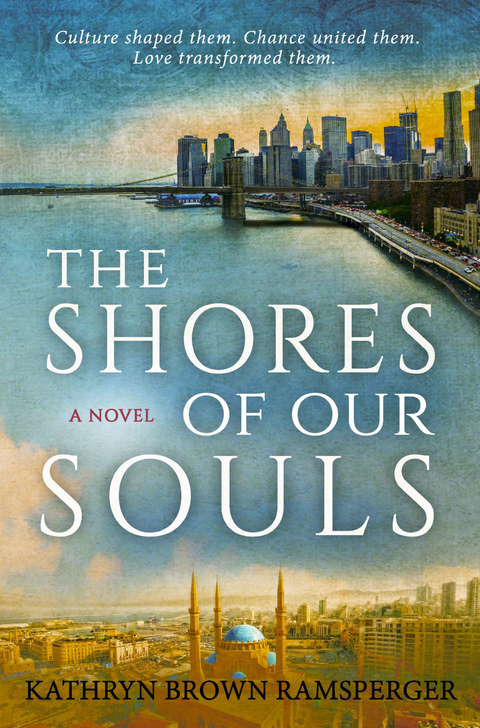
The Shores of Our Souls (eBook)
306 Seiten
Touchpoint Press (Verlag)
978-0-00-003911-8 (ISBN)
Qasim, an Arab Muslim U.N. official fleeing family obligations in 1980s war-torn Lebanon meets Dianna, escaping her rural Southern roots to become a researcher at the Metropolitan Museum of Art. Will their love be enough in this war-torn, conflict-weary world? Ramsperger's debut novel gives an entirely new perspective on the controversial conflicts in our hearts and in our history.
CHAPTER ONE
CIVIL WAR
April 13, 1975, Beirut
Gunmen kill four Christians during an assassination attempt on Lebanese Maronite leader Pierre Gemayel. Believing assassins to be Palestinian, the Christians attack a bus of Palestinian passengers, killing at least twenty-six. Civil War begins.
“Qasim, where are you, my son?”
I rifle through my papers, trying to complete my thoughts before my mother discovers me. I am wrestling with some legal details before sending paperwork to our attorney. This side of business has always been an anathema to me, and I have delayed dealing with it for far too long. I have spent alJuma’a, our holy day, working on my master’s thesis in secret. I spent all evening looking over my shoulder. Had my mother discovered me working when I should have been praying, she would have given me, a grown man, a good thrashing.
“Qasim!” My mother swings the double doors open and stands in the doorway, sunlight filtering over her like a fluorescent bubble, hand on her left hip, head tipped to the opposite side. “Qasim, did you not hear me call your name? I was afraid I had missed you. The streets are explosive today. I heard reports of gunfire over by one of the camps. You didn’t pass by it, did you?”
“No, Mama,” I reply and reach to massage the scar that outlines my throbbing cheek. I ignore her reference to the camp. “I’m trying to complete something here.”
“Work, work, work. That is all you boys ever do any more. Just like your father.” She perches on the edge of the upholstery, her fingers tapping on her lap.
“That is what men do,” I remind her.
“My youngest, all grown up,” she says, half to herself. My mother is too shrewd for the boring details that occupy my days. I would be surprised if she spent most of her day plotting for all her sons, rearranging our future. Thus far, she has certainly met with success, leaving only a few skeletons in her wake. .
Yet the conflict in the region has diverted even her attention outward. What happens outside our home is now of more importance than what happens within it. Still, one must keep up appearances.
These days, I am happy to forget my own assortment of skeletons. I forget my mother’s face over mine in the hospital, willing me to live. I forget the shame that covered my father’s entire countenance once I finally could breathe on my own. I forget my brothers’ hasty comings and goings. I forget the imam’s warnings; I already have known a kind of death; why should I fear nothingness? Most of all, I forget—I will myself to forget my wedding day. It is a haze, as is my life. I have money, prestige, my work. One day I will have a mistress, I suppose. For a time, I will hibernate in my fog. I hide any wreckage well, even from myself. Who has time for one more irksome female? I laugh, I joke, I am my old charming self. I am there but not there. Work has been my salvation.
I hear a rustling in the hallway. I walk to the doorway, thinking it is a colleague coming to get me, tired of waiting for me at the offices. Instead, Rasha sways on the bottom step, hovering above the landing, in her flowing white chiffon. “Qasim?” she says, her voice a blend of croak and whisper. She looks every bit a ghost.
“What is the matter, Rasha?” I ask. I am irritated at all the attention I am expected to bestow on females when they know I should be at my office.
“Qasim?” She repeats the question and sways some more. Her eyes seem glazed, and so I sigh, mount the staircase, and guide her by the elbow back to her bedroom. “I am not feeling well,” she says.
“You rest,” I tell her. “Rest is what you need.”
She suppresses a whimper. “I should not bother you with this…”
“Perhaps I will send for your sister when I go to town?” I reassure her. “That would do you good.” I dread having her sister in our home. Perhaps she will be gone by the time I return. I will work late.
She pulls her elbow from my grasp and flops down onto the coverlet. “Yes, that would do me good,” she replies. “Thank you, Qasim. Shukran.”
“Qasim!”
“Yes, Mama?” I am truly irritated. Will I never be able to attend to important matters?
“Qasim, I need you to take care of that spent ammunition today.” My mother is in the hallway, holding a slim cigarette in a hand that trembles just enough for me to notice.
The ammunition was a curiosity at first. Tariq dragged it home one morning. It was evening, and Rasha yelled for me to go outside to see what he was bringing home. I leaned over the balcony first, as she is prone to fits of needless anxiety. Tariq’s body, brown as a coconut, was bent over, walking backwards, towing it along, a cloud of dust making him sputter. He had broken a strap of one of his sandals, so he was limping, too. His dark, soulful eyes lit up with wonder. How I love that boy!
At first, I was merely bemused. He reminded me of a peddler who couldn’t get his donkey to obey. I couldn’t imagine what he was dragging that nearly matched his weight. When I realized his claimed treasure was weaponry, I became as agitated as Rasha. When I learned he had picked it from a gutter lining rue Omar ad-Daouk, as innocently as he would have plucked a flower from a bush, I was frightened.
We had not thought things were so far gone that we needed to warn him about unexploded ammo. What would be next, landmines disguised as toys? Our Tariq would not need the excuse of disguise to investigate. His natural curiosity always gets the best of him. Sadly, artillery dots every neighborhood, begging for investigation from curious children. Tariq has never known this country at a time of relative peace. Weapons are more familiar to him than to me, his father. Perhaps not commonplace because we keep our war well hidden, but familiar, as familiar as the tooth he lost last month.
I brought the shell around to the courtyard immediately wondering whom to call to rid ourselves of it. Tariq cried bitterly that he could not keep it. We brought our neighbor, old Ahmed, a veteran of prior wars, over to inspect it. He bent and rose, bent and rose, as though he were praying, as he pored over the still strange object. Finally, he pushed the glasses off the tip of his nose and squinted toward me. “Harmless,” he pronounced. “A dud.” With that, he turned and collapsed on the courtyard bench, fanning himself. He ensured us it would not explode in Tariq’s hands should he not heed our warnings to look, not touch.
“What is it?” I asked. “What sort of weapon is this? I have never seen such a curious weapon.”
“They’re using some kind of ancient weaponry. Looks as old as the last World War. Must be some little-funded faction that launched it. If it hasn’t exploded in thirty-five years, it’s not going to go off in your garden.” He laughed from his throat, and then his eyes drifted and glazed. He was back in his own world again.
The monstrosity sat in the courtyard for a few days while I searched for someone in the government who would retrieve it. They wanted nothing to do with it. There it sat: ugly metal, covered with soil and rust, a visible reminder of the war raging round us, while we went about our everyday business. Tariq treated it almost as a playmate or a pet. He actually talked to it but minded us and never touched it again. A shower washed some of the mud away, revealing tiny scratches in the metal, like mosaic patterns, and when the sun glinted from the right direction, one could almost look on it as sculpture. It had a protuberance near the top creating a depth of field on its shiny, cylindrical surface that refracted light and shadow just so. I had once seen a water tower rising out of the desert sand in the middle of nowhere that produced a similar effect. I began to look on the cylinder as, at the very least, a part of our lives, and at most, a work of art. Our lives continued around it, at least until we found someone willing to take it away.
Oh yes, every now and then we overhear a burst of gunfire, syncopated with shouts of injury. Yet largely our lives are about money exchanging hands at my office, listening to Tariq recite his prayers and lessons, running the household, alternating weekend visits to our families, and winding our way down to the beach, filled with young starlets sporting bikinis rather than burkas, a recent, modern trend. Beirut moves forward even as the bullets fly, and so must I.
Long after evening prayer, I arrive home with news. Tariq lies on his belly under the same table I once used as a hiding place, reading.
“What is that, son?” I ask, and he grunts an answer. More than likely it is a book of riddles or a puzzle book. I wish he would read as I did. His dusty feet thump on the tile floor, and his straight hair sticks up at the crown like a rooster.
Rebuffed, I climb the stairs to my room. It is a day of heat, inexplicably stifling in this Mediterranean climate. My shirt sticks to me, the sweat entwined on every hair lining my chest. My tie, normally as comfortable to me as the neck it encircles, chokes me. I go upstairs, lay my jacket carefully on the back...
| Erscheint lt. Verlag | 16.11.2017 |
|---|---|
| Sprache | englisch |
| Themenwelt | Literatur ► Romane / Erzählungen |
| ISBN-10 | 0-00-003911-X / 000003911X |
| ISBN-13 | 978-0-00-003911-8 / 9780000039118 |
| Informationen gemäß Produktsicherheitsverordnung (GPSR) | |
| Haben Sie eine Frage zum Produkt? |
 EPUB (Adobe DRM)
Größe: 708 KB
Kopierschutz: Adobe-DRM
Adobe-DRM ist ein Kopierschutz, der das eBook vor Mißbrauch schützen soll. Dabei wird das eBook bereits beim Download auf Ihre persönliche Adobe-ID autorisiert. Lesen können Sie das eBook dann nur auf den Geräten, welche ebenfalls auf Ihre Adobe-ID registriert sind.
Details zum Adobe-DRM
Dateiformat: EPUB (Electronic Publication)
EPUB ist ein offener Standard für eBooks und eignet sich besonders zur Darstellung von Belletristik und Sachbüchern. Der Fließtext wird dynamisch an die Display- und Schriftgröße angepasst. Auch für mobile Lesegeräte ist EPUB daher gut geeignet.
Systemvoraussetzungen:
PC/Mac: Mit einem PC oder Mac können Sie dieses eBook lesen. Sie benötigen eine
eReader: Dieses eBook kann mit (fast) allen eBook-Readern gelesen werden. Mit dem amazon-Kindle ist es aber nicht kompatibel.
Smartphone/Tablet: Egal ob Apple oder Android, dieses eBook können Sie lesen. Sie benötigen eine
Geräteliste und zusätzliche Hinweise
Buying eBooks from abroad
For tax law reasons we can sell eBooks just within Germany and Switzerland. Regrettably we cannot fulfill eBook-orders from other countries.
aus dem Bereich