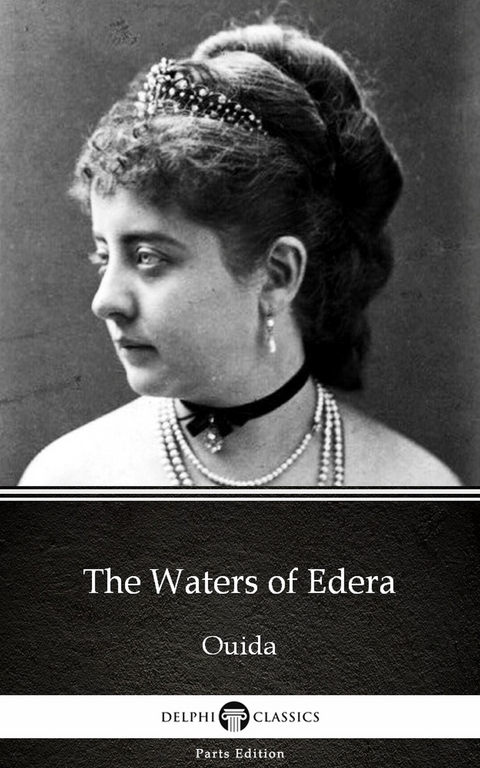
Waters of Edera by Ouida - Delphi Classics (Illustrated) (eBook)
207 Seiten
Delphi Classics (Parts Edition) (Verlag)
978-1-78877-886-2 (ISBN)
Having established their name as the leading publisher of classic literature and art, Delphi Classics produce publications that are individually crafted with superior formatting, while introducing many rare texts for the first time in digital print. The Delphi Classics edition of Ouida includes original annotations and illustrations relating to the life and works of the author, as well as individual tables of contents, allowing you to navigate eBooks quickly and easily.
eBook features:* The complete unabridged text of 'The Waters of Edera by Ouida - Delphi Classics (Illustrated)'
* Beautifully illustrated with images related to Ouida's works
* Individual contents table, allowing easy navigation around the eBook
* Excellent formatting of the textPlease visit www.delphiclassics.com to learn more about our wide range of titles
This eBook features the unabridged text of 'The Waters of Edera by Ouida - Delphi Classics (Illustrated)' from the bestselling edition of 'The Collected Works of Ouida'. Having established their name as the leading publisher of classic literature and art, Delphi Classics produce publications that are individually crafted with superior formatting, while introducing many rare texts for the first time in digital print. The Delphi Classics edition of Ouida includes original annotations and illustrations relating to the life and works of the author, as well as individual tables of contents, allowing you to navigate eBooks quickly and easily.eBook features:* The complete unabridged text of 'The Waters of Edera by Ouida - Delphi Classics (Illustrated)'* Beautifully illustrated with images related to Ouida's works* Individual contents table, allowing easy navigation around the eBook* Excellent formatting of the textPlease visit www.delphiclassics.com to learn more about our wide range of titles
II
The large square fresh-water fishing-net had sunk under the surface, the canes which framed it were out of sight; only the great central pole, which sustained the whole, and was planted in the ground of the river-bank, remained visible as it bent and swayed but did not yield or break. Such nets as this had been washed by the clear green waters of the pools and torrents of the Edera ever since the days of Etruscan gods and Latin augurs; religions had changed, but the river, and the ways of the men of the river, had not altered.
Adone did not touch it, for it was well where it was; he seated himself on the bank ready to seize and hold it if its pole showed any sign of yielding and giving way and heeling over into the stream. He sat thus amongst the bulrushes for many an hour, on many a spring day and summer night. Although fish were not numerous he never tired of his vigil, lulled by the sound of the current as it splashed among the stones and rippled through the rushes; a deeper music coming from its higher reaches, where it fell over a ledge of rock and leapt like a live thing into the air. And, indeed, what thing could be more living than this fresh, pure, untroubled water, glad as a child, swift as a swallow, singing for sport, as a happy boy sings, as it ran down on its way from the hills?
To the young man sitting now on its bank amidst the bulrushes it was as living as himself, his playmate, friend, and master, all in one. First of all things which he could remember were the brightness and the coolness of it as it had laved his limbs in his childhood on mid-summer noons, his mother’s hands holding him safely as he waded with rosy feet and uncertain steps along its pebbly bottom! How many mornings, when he had grown to boyhood and to manhood, had he escaped from the rays of the vertical sun into its acacia-shadowed pools; how many moonlit, balmy nights had he bathed in its still reaches, the liquid silver of its surface breaking up like molten metal as he dived! How many hours of peace had he passed, as he was spending this, waiting for the fish to float into his great net, whilst the air and the water were alike so still that he could hear the little voles stealing in and out amongst the reeds, and the water-thrush pushing the pebbles on its sands in search for insects, though beast and bird were both unseen by him! How many a time upon the dawn of a holy-day had he washed and swam in its waters whilst the bells of the old church in the village above had tolled in the softness of dusk!
He thought of none of these memories distinctly, for he was young and contented, and those who are satisfied with their lot live in their present; but they all drifted vaguely through his mind as he sat by the side of the river, as the memories of friends dear from infancy drift through our waking dreams.
He was in every way a son of the Edera, for he had been born almost in the water itself; his mother had been washing linen with other women at the ford when she had been taken with the pains of labour two months before her time. Her companions had had no time or thought to do more than to stretch her on the wet sand, with some hempen sheets, which had not yet been thrown in the water, between her and the ground; and the cries of her in her travail had echoed over the stream and had startled the kingfishers in the osiers, and the wild ducks in the marshes, and the tawny owls asleep in the belfry tower of the village. But her pains had been brief though sharp, and her son had first seen the light beside the water; a strong and healthy child, none the worse for his too early advent, and the rough river-women had dipped him in the shallows, where their linen and their wooden beaters were, and had wrapped him up in a soiled woollen shirt, and had laid him down with his face on his mother’s young breast, opening his shut unconscious mouth with their rough fingers, and crying in his deaf ear, “Suck! and grow to be a man!”
Clelia Alba was now a woman of forty-one years old, and he, her only son, was twenty-four; they had named him Adone; the beautiful Greek Adonais having passed into the number of the saints of the Latin Church, by a transition so frequent in hagiology that its strangeness is not remembered save by a scholar here and there. When he had been born she had been a young creature of seventeen, with the wild grace of a forest doe; with that nobility of beauty, that purity of outline, and that harmony of structure, which still exist in those Italians in whom the pure Italiote blood is undefiled by Jew or Gentile. Now her abundant hair was white, and her features were bronzed and lined by open-air work, and her hands of beautiful shape were hard as horn through working in the fields. She looked an old woman, and was thought so by others, and thought herself so: for youth is soon over in these parts, and there is no half-way house between youth and age for the peasant.
Clelia Alba, moreover, had lost her youth earlier even than others: lost it for ever when her husband at five-and-twenty years of age had been killed by falling from an olive-tree of which the branch sustaining him had cracked and broken under his weight. His neck had been broken in the fall. She had been dancing and shouting with her two-year-old child on the grassland not far off, romping and playing ball with some dropped chestnuts; and when their play was over she had lifted her boy on to her shoulder and run with him to find his father. Under one of the great, gnarled, wide-spreading olives she had seen him, lying asleep as she thought.
“Oh, lazy one, awake! The sun is only two hours old!” she had cried merrily, and the child on her shoulder had cooed and shouted in imitation, “Wake — wake — wake!” and she, laughing, had cast a chestnut she had carried in her hand upon the motionless figure. Then, as the prostrate form did not stir, a sudden terror had seized her, and she had set the baby down upon the grass and run to the olive-tree. There she had seen that this was death, for when she had raised him his head had dropped, and seemed to hang like a poppy broken in a blast of wind, and his eyes had no sight, and his mouth had no breath.
From that dread hour Clelia Alba had never laughed again. Her hair grew white, and her youth went away from her for ever.
She lived for the sake of her son, but she and joy had parted company for ever.
His death had made her sole ruler of the Terra Vergine; she had both the knowledge and the strength necessary for culture of the land, and she taught her boy to value and respect the soil.
“As you treat the ground ill or well, so will your ground treat you,” she said to him.
She always wore the costume of the province, which was similar to that of the Abruzzo villages, and suited her cast of features and her strong and haughty carriage. On feast-days she wore three strings of fine pearls round her throat, and bracelets of massive gold and of fine workmanship, so many in number that her arms were stiff with them; they had been her mother’s and grandmother’s and great-grandmother’s, and had been in her dower. To sell or pawn them under stress of need, had such occurred, would never have seemed to any of her race to be possible. It would have seemed as sacrilegious as to take the chalice off the church altar, and melt its silver and jewels in the fire. When she should go to her grave these ornaments would pass to Adone as heirlooms; none of her family were living.
“Never talk of death, mother,” he said, whenever she spoke of these things. “Death is always listening; and if he hear his name he taps the talker on the shoulder, just to show that he is there and must be reckoned with.”
“Not so, my son!” replied Clelia Alba, with a sigh. “He has every soul of us written down in his books from the time we are born; we all have our hour to go and none of us can alter it.”
“I do not believe that,” said Adone. “We kill ourselves oftentimes; or we hasten our end, as drunkards do.”
“Did your father hasten his end?” said his mother. “Did not some one break that olive branch? It was not the tree itself, though the Ruscino folks would have it cut down because they called it a felon.”
“Was it not the devil?” said Adone.
He believed in the devil, of course, as he had been taught to do; and had he not as a child met the infernal effigy everywhere — in marble, in stone, in wood, in colour, in the church and outside it, on water-spout and lamp-iron, and even on the leaves of his primer? But it seemed to him that the devil had “troppo braccia” given him, was allowed too long a tether, too free a hand; if indeed he it were that made everything go wrong, and Adone did not see who else it could be. Here, in the vale of Edera, all the world believed in Satan as in holy water, or in daily bread.
Clelia Alba crossed herself hastily, for she was a pious woman.
“We are talking blasphemy, my son,” she said gravely. “Of course there is the good God who orders the number of our days for each of us, and is over us all.”
Adone was silent. To him it seemed doubtful. Did the good God kill the pretty little children as the butcher in a city killed his lambs? But he never contradicted or vexed his mother; he loved her with a great and tender affection. He was less ignorant than she was, and saw many things she could not see; he was, as it were, on a hilltop and she down in a valley, but he had a profound respect for her; he obeyed her implicitly, as if he were still a child, and he thought the world held no woman equal to her.
When he...
| Erscheint lt. Verlag | 17.7.2017 |
|---|---|
| Reihe/Serie | Delphi Parts Edition (Ouida) | Delphi Parts Edition (Ouida) |
| Sprache | englisch |
| Themenwelt | Literatur ► Anthologien |
| Literatur ► Klassiker / Moderne Klassiker | |
| Literatur ► Romane / Erzählungen | |
| Schlagworte | Bronte • Dickens • Doyle • Moths • Novels • Under • wilkie |
| ISBN-10 | 1-78877-886-3 / 1788778863 |
| ISBN-13 | 978-1-78877-886-2 / 9781788778862 |
| Informationen gemäß Produktsicherheitsverordnung (GPSR) | |
| Haben Sie eine Frage zum Produkt? |
 EPUB (Adobe DRM)
Größe: 827 KB
Kopierschutz: Adobe-DRM
Adobe-DRM ist ein Kopierschutz, der das eBook vor Mißbrauch schützen soll. Dabei wird das eBook bereits beim Download auf Ihre persönliche Adobe-ID autorisiert. Lesen können Sie das eBook dann nur auf den Geräten, welche ebenfalls auf Ihre Adobe-ID registriert sind.
Details zum Adobe-DRM
Dateiformat: EPUB (Electronic Publication)
EPUB ist ein offener Standard für eBooks und eignet sich besonders zur Darstellung von Belletristik und Sachbüchern. Der Fließtext wird dynamisch an die Display- und Schriftgröße angepasst. Auch für mobile Lesegeräte ist EPUB daher gut geeignet.
Systemvoraussetzungen:
PC/Mac: Mit einem PC oder Mac können Sie dieses eBook lesen. Sie benötigen eine
eReader: Dieses eBook kann mit (fast) allen eBook-Readern gelesen werden. Mit dem amazon-Kindle ist es aber nicht kompatibel.
Smartphone/Tablet: Egal ob Apple oder Android, dieses eBook können Sie lesen. Sie benötigen eine
Geräteliste und zusätzliche Hinweise
Buying eBooks from abroad
For tax law reasons we can sell eBooks just within Germany and Switzerland. Regrettably we cannot fulfill eBook-orders from other countries.
EPUB (Ohne DRM)Digital Rights Management: ohne DRM
Dieses eBook enthält kein DRM oder Kopierschutz. Eine Weitergabe an Dritte ist jedoch rechtlich nicht zulässig, weil Sie beim Kauf nur die Rechte an der persönlichen Nutzung erwerben.
Dateiformat: EPUB (Electronic Publication)
EPUB ist ein offener Standard für eBooks und eignet sich besonders zur Darstellung von Belletristik und Sachbüchern. Der Fließtext wird dynamisch an die Display- und Schriftgröße angepasst. Auch für mobile Lesegeräte ist EPUB daher gut geeignet.
Systemvoraussetzungen:
PC/Mac: Mit einem PC oder Mac können Sie dieses eBook lesen. Sie benötigen dafür die kostenlose Software Adobe Digital Editions.
eReader: Dieses eBook kann mit (fast) allen eBook-Readern gelesen werden. Mit dem amazon-Kindle ist es aber nicht kompatibel.
Smartphone/Tablet: Egal ob Apple oder Android, dieses eBook können Sie lesen. Sie benötigen dafür eine kostenlose App.
Geräteliste und zusätzliche Hinweise
Buying eBooks from abroad
For tax law reasons we can sell eBooks just within Germany and Switzerland. Regrettably we cannot fulfill eBook-orders from other countries.
aus dem Bereich