
Homicide Justified (eBook)
University of Georgia Press (Verlag)
978-0-8203-5111-7 (ISBN)
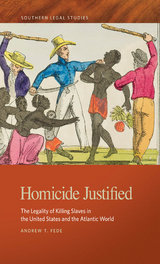
This comparative study looks at the laws concerning the murder of slaves by their masters and at how these laws were implemented. Andrew T. Fede cites a wide range of cases—across time, place, and circumstance—to illuminate legal, judicial, and other complexities surrounding this regrettably common occurrence. These laws had evolved to limit in different ways the masters’ rights to severely punish and even kill their slaves while protecting valuable enslaved people, understood as “property,” from wanton destruction by hirers, overseers, and poor whites who did not own slaves.
To explore the conflicts of masters’ rights with state and colonial laws, Fede shows how slave homicide law evolved and was enforced not only in the United States but also in ancient Roman, Visigoth, Spanish, Portuguese, French, and British jurisdictions. His comparative approach reveals how legal reforms regarding slave homicide in antebellum times, like past reforms dictated by emperors and kings, were the products of changing perceptions of the interests of the public; of the individual slave owners; and of the slave owners’ families, heirs, and creditors.
Although some slave murders came to be regarded as capital offenses, the laws consistently reinforced the second-class status of slaves. This influence, Fede concludes, flowed over into the application of law to free African Americans and would even make itself felt in the legal attitudes that underlay the Jim Crow era.
ANDREW T. FEDE is of counsel to the law firm Archer & Greiner, P.C., based in New Jersey, and, since 1986, has been an adjunct professor teaching law courses at Montclair State University. He is the author of Homicide Justified: The Legality of Killing Slaves in the United States and the Atlantic World, Roadblocks to Freedom: Slavery and Manumission in the United States South, and People without Rights: An Interpretation of the Fundamentals of the Law of Slavery in the U.S. South.
| Erscheint lt. Verlag | 30.7.2017 |
|---|---|
| Reihe/Serie | Southern Legal Studies |
| Southern Legal Studies Ser. | Southern Legal Studies Ser. |
| Verlagsort | Athens |
| Sprache | englisch |
| Themenwelt | Literatur ► Klassiker / Moderne Klassiker |
| Sachbuch/Ratgeber ► Beruf / Finanzen / Recht / Wirtschaft | |
| Geschichte ► Allgemeine Geschichte ► Neuzeit (bis 1918) | |
| Geisteswissenschaften ► Geschichte ► Regional- / Ländergeschichte | |
| Geschichte ► Teilgebiete der Geschichte ► Militärgeschichte | |
| Recht / Steuern ► EU / Internationales Recht | |
| Recht / Steuern ► Öffentliches Recht | |
| Recht / Steuern ► Rechtsgeschichte | |
| Sozialwissenschaften ► Soziologie ► Makrosoziologie | |
| Schlagworte | Amelioration • American Colonies • Antebellum • Common Law of slavery • comparative law • Crime • Decriminalization • Georgia • John Hoover • law of homicide • North Carolina • Slave homicide • slave owners’ rights • Slavery • slavery law • slave societies • slave violence • South Carolina • Southern law • Southern studies • Tennessee • Virginia |
| ISBN-10 | 0-8203-5111-3 / 0820351113 |
| ISBN-13 | 978-0-8203-5111-7 / 9780820351117 |
| Informationen gemäß Produktsicherheitsverordnung (GPSR) | |
| Haben Sie eine Frage zum Produkt? |
 EPUB (Adobe DRM)
Kopierschutz: Adobe-DRM
Adobe-DRM ist ein Kopierschutz, der das eBook vor Mißbrauch schützen soll. Dabei wird das eBook bereits beim Download auf Ihre persönliche Adobe-ID autorisiert. Lesen können Sie das eBook dann nur auf den Geräten, welche ebenfalls auf Ihre Adobe-ID registriert sind.
Details zum Adobe-DRM
Dateiformat: EPUB (Electronic Publication)
EPUB ist ein offener Standard für eBooks und eignet sich besonders zur Darstellung von Belletristik und Sachbüchern. Der Fließtext wird dynamisch an die Display- und Schriftgröße angepasst. Auch für mobile Lesegeräte ist EPUB daher gut geeignet.
Systemvoraussetzungen:
PC/Mac: Mit einem PC oder Mac können Sie dieses eBook lesen. Sie benötigen eine
eReader: Dieses eBook kann mit (fast) allen eBook-Readern gelesen werden. Mit dem amazon-Kindle ist es aber nicht kompatibel.
Smartphone/Tablet: Egal ob Apple oder Android, dieses eBook können Sie lesen. Sie benötigen eine
Geräteliste und zusätzliche Hinweise
Buying eBooks from abroad
For tax law reasons we can sell eBooks just within Germany and Switzerland. Regrettably we cannot fulfill eBook-orders from other countries.
aus dem Bereich