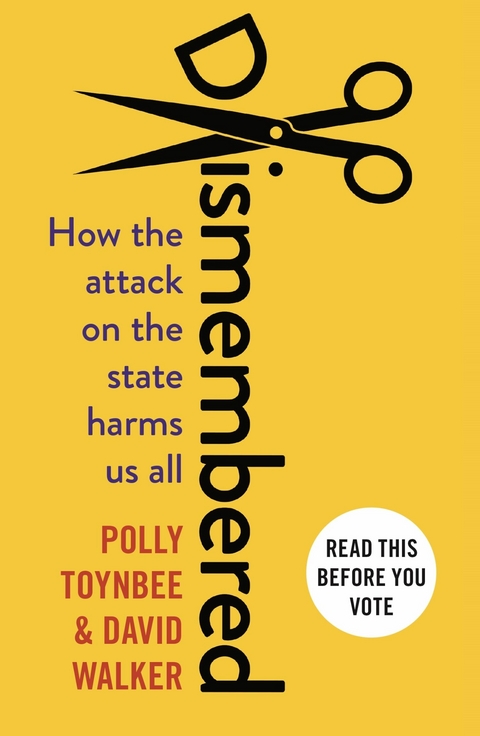
Dismembered (eBook)
336 Seiten
Guardian Faber Publishing (Verlag)
978-1-78335-122-0 (ISBN)
Polly Toynbee and David Walker have co-authored Dogma and Disarray: Cameron at Half-Time, Unjust Rewards: Exposing Greed and Inequality in Britain Today, The Verdict: Did Labour Change Britain? and Better or Worse: Did Labour Deliver? Polly Toynbee is a columnist for the Guardian. David Walker is a contributing editor to the Guardian Public and former director of public reporting at the Audit Commission.
What is the state? And what's it ever done for you?More than you think. The state houses us, educates us, employs us, protects us on the street and in the wider world. It is the country we created together, and a part of our national identity. However, in recent years there has been a systematic and covert attack on the state that has turned us all against it - the government have depleted funding and resources, and mounted an ideological assault on the public sector through the media. Toynbee and Walker travelled around Great Britain gathering the voices of the people who make up the state: nurses and patients, teachers and parents, policemen and civilians. This book is your chance to hear their side of the story. The story they tell is one of dismemberment across our nation state: a fragmented NHS, a reduced police force, divided schools and a vulnerable military. In Dismembered, it becomes clear that this attack on the state is an attack on each and every one of us, for our peace and productivity as a country depend upon a strong state. DISMEMBERED lays bare the deliberate dismantling of the public sector and its consequences. Our post-Brexit well-being and prosperity are now at stake.
Polly Toynbee and David Walker have co-authored Dogma and Disarray: Cameron at Half-Time, Unjust Rewards: Exposing Greed and Inequality in Britain Today, The Verdict: Did Labour Change Britain? and Better or Worse: Did Labour Deliver? Polly Toynbee is a columnist for the Guardian. David Walker is a contributing editor to the Guardian Public and former director of public reporting at the Audit Commission.
They care for stroke victims, guard the borders, patrol children’s crossings, rescue people from fires (and stop them breaking out), teach English in further education colleges, check restaurants are clean and weights and measures accurate, monitor brimming river levels and perform a thousand other unsung but indispensible tasks. They are essential if we are to hold together as a society and thrive. This book is a paean of praise to these people, to public service and, behind them, the state.
Pen-pushers and bean counters may be the butt of the tabloids and the trolls, but they too are equally essential, along with tax inspectors, regulators and enforcers and the operators of surveillance CCTV and speed cameras. Unseen and vital are the monitors who ensure that Wessex Water (aka the private company YTL Power International of Kuala Lumpur) flushes the sewers as it is supposed to and that transport giant First Group’s 15 per cent operating profit has not been puffed up by axing buses, cancelling trains or colluding on prices.
Public service is about prevention and assurance. Without the protection of public service, we come to harm – take, for instance, the Financial Conduct Authority without which we would pay over the odds for mortgages or even not be able to get them at all. Free enterprise only thrives within a strong public realm.
For the state is our security. When their credit ran out and their financial nakedness was exposed, the bankers in the Canary Wharf skyscrapers turned automatically to the government; they were ungrateful then and since, perhaps because they were witnessing a fundamental truth, that private profitmaking depends on public power. It’s the backstop when Tata threatens to pull out of Port Talbot and the steel mills in Hartlepool go cold.
The ‘it’ is what the Romans called res publica, the space within which collective decisions were made and implemented, armies sent to march, taxes levied and bridges built. Theirs was an empire. Over the centuries, its shape has largely settled on the nation state, within which is preserved much of our sense of who we are, certainly far more than any identity offered by global companies or giant internet corporations, however bloated their marketing budgets.
In our case, Britishness, the national fabric, is woven from interlinked identities. With increasing devolution the UK state has become harder to decipher as commitments, values and spending levels diverge across Scotland, Wales and Northern Ireland – though all are subject to the Tory austerity drive. Visit the permanent secretary of the Welsh government at Cathays Park in Cardiff and the campus around her feels like the headquarters of a small state. The relative size of government in Northern Ireland has been maintained, while its counterpart in England has continued to shrink. And Nicola Sturgeon’s Scottish Nationalist government has talked a fine game on growing public services – although so far it has not dared raise taxes in order to support its greater spending than England.
For all that, we can’t tell ourselves much about our common past or what faces us tomorrow without also narrating government. Who are ‘we’, in these times of confused identity, exposed in the Brexit vote? Public services used to define who we are, from the NHS to the British Army, National Grid and elemental water and energy services. Some have been sold, bought by foreign companies and run for private profit. Others have been broken up into competing units, defying common understanding of who does what in whose name. ‘Public spirit’ is evaporating.
In Theresa May’s Cabinet the communities secretary, Sajid Javid, dislikes government, wants to shrink spending and reduce regulation; his bedtime novels are said to be the libertarian fantasies of Ayn Rand. As business secretary he famously banned the phrase ‘industrial policy’, declaring it oxymoronic. But confronted with questions about integration and values in modern Britain, his response is to turn to … the state. In order to tighten citizenship requirements, to administer oaths: who else is going to define ‘Britishness’? What he has to accept is that Britishness and the health of the British state are codetermined; to dismember the latter is to diminish exactly what he says he wants to extol. Charities have the potential to bind people in a sense of national common endeavour but they too are in crisis, overloaded, underfunded and, now, under political and regulatory attack; the Big Society is a failed fantasy of an already half-forgotten prime minister.
It’s not too late; cuts and dislocation have not yet inflicted permanent damage. We can say that because the ‘public thing’ is in large measure the people who work for it and for us and their spirit has not been extinguished: dimmed and guttering the flame may be but it still burns. You will meet some of them in the pages of this book: NHS podiatrists, trading standards enforcers, police officers, water regulators, council chief executives, people at work within government agencies, local authorities, Whitehall departments. Of course they are not all moral heroes; some may even be knaves. But together, they embody an ethos built around the idea of the common good: the frustrations they express almost always concern cuts and obstacles to doing their job as well as they otherwise could.
They would rarely use such hifalutin terms as ‘ethos’ and that is because they are usually highly focused. They define themselves by a specific job: border control, community programmes, running a Whitehall department, managing a sexual health clinic. Citizens also tell pollsters they value specifics – their children’s teacher, their GP, local police officers and home carers. Nurses top the polls for public respect, with an array of public servants close behind in esteem;1 but what happens when the same question is posed of the NHS or the local council or other public body as a whole? The institutions themselves seem to find it harder to command the citizens’ respect. We moan about service. We swap tales of shortcomings. Yet the engine of state is greater than the sum of its working parts and extends beyond the immediate here and now, stretching across the decades, to pay our and our children’s pensions. Without reminders and encouragement to take pride, citizens themselves may end up undermining the wider thing that binds us in common purpose.
Dismembered
It’s not just the recent cuts. The UK state has been pulled apart, partially rebuilt, then deconstructed time and again during the past 30 years. Few of these ‘reforms’ have been backed by evidence of organisational effectiveness; most have been based on dogma, hunch or the discovery by newly arrived ministers that, far easier than changing society or economy, they could just pull a lever and reconfigure the machinery of state. The result has been confusion and public mistrust.
In the Thatcher and Major era, the Tories sold the family silver and privatised the state’s capacity to contribute directly to the economy in energy and the utilities, transport and communications. They straitjacketed councils but also created ramshackle executive agencies as part of a programme to bring business into the heart of government. But Tory ministers were not themselves prepared to be businesslike. In 1995, Home Secretary Michael Howard said he wanted the prisons run as if they were freestanding companies, then sacked the chief executive of the prisons agency, Derek Lewis, because he was behaving like an executive manager.
After 1997, a jungle of zones and semi-autonomous bodies sprang from a welter of well-intentioned Blair government initiatives. Ministers wanted to do things, but their enthusiasm produced overlap and befuddlement. Under the New Deal for Communities, local boards took on substantial sums of public money for estate regeneration and jobs. But when we chronicled one such project in Clapham Park for our book The Verdict we could see how puzzling the structures were. The project wasn’t run by Lambeth Council, nor the (confusingly named) Office of the Deputy Prime Minister; the initiative was part voluntary, part enforced. As blocks were refurbished and training schemes started, great potential benefits were proffered to residents, but they were unlabelled. Money was spent, there was some physical and some social renewal, but no one was claiming agency over it; the government certainly got no credit.
From 2010, the cuts were accompanied by tinkering; austerity with administrative anarchy. (Chaos is deliberate, said the Tory ideologue Oliver Letwin; if public staff are disorientated, they will be easier to get rid of.) Cameron swung about like a mad axeman, lopping off regional development agencies and sundry commissions whose usefulness he hadn’t bothered to ask about. He also redisorganised health and education, creating hundreds of new quangos and ‘trusts’.
In the Cameron coalition and afterwards, Tory ministers let rip. Civil servants were ‘enemies of enterprise’, echoing dark Thatcherite invocations of the ‘enemy within’.2 Liam Fox attacked ‘pen-pushers’; Andrew Lansley disparaged the very managers whom he was asking to make his incomprehensible health scheme work. In the case of education, Michael Gove’s apparatchik Dominic Cummings and special advisers around Theresa May at the Home Office (now with her in...
| Erscheint lt. Verlag | 16.5.2017 |
|---|---|
| Verlagsort | London |
| Sprache | englisch |
| Themenwelt | Literatur ► Essays / Feuilleton |
| Sozialwissenschaften ► Pädagogik ► Sozialpädagogik | |
| Sozialwissenschaften ► Politik / Verwaltung ► Staat / Verwaltung | |
| Sozialwissenschaften ► Soziologie | |
| Schlagworte | austerity Britain • cameron's coup • James Meek • Jeremy Corbyn • NHS book • Owen Jones • Polly Toynbee |
| ISBN-10 | 1-78335-122-5 / 1783351225 |
| ISBN-13 | 978-1-78335-122-0 / 9781783351220 |
| Informationen gemäß Produktsicherheitsverordnung (GPSR) | |
| Haben Sie eine Frage zum Produkt? |
 EPUB (Adobe DRM)
Kopierschutz: Adobe-DRM
Adobe-DRM ist ein Kopierschutz, der das eBook vor Mißbrauch schützen soll. Dabei wird das eBook bereits beim Download auf Ihre persönliche Adobe-ID autorisiert. Lesen können Sie das eBook dann nur auf den Geräten, welche ebenfalls auf Ihre Adobe-ID registriert sind.
Details zum Adobe-DRM
Dateiformat: EPUB (Electronic Publication)
EPUB ist ein offener Standard für eBooks und eignet sich besonders zur Darstellung von Belletristik und Sachbüchern. Der Fließtext wird dynamisch an die Display- und Schriftgröße angepasst. Auch für mobile Lesegeräte ist EPUB daher gut geeignet.
Systemvoraussetzungen:
PC/Mac: Mit einem PC oder Mac können Sie dieses eBook lesen. Sie benötigen eine
eReader: Dieses eBook kann mit (fast) allen eBook-Readern gelesen werden. Mit dem amazon-Kindle ist es aber nicht kompatibel.
Smartphone/Tablet: Egal ob Apple oder Android, dieses eBook können Sie lesen. Sie benötigen eine
Geräteliste und zusätzliche Hinweise
Buying eBooks from abroad
For tax law reasons we can sell eBooks just within Germany and Switzerland. Regrettably we cannot fulfill eBook-orders from other countries.
aus dem Bereich