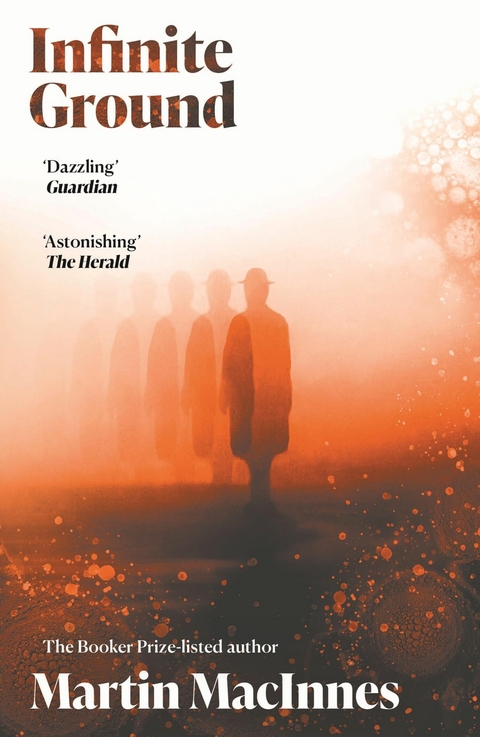
Infinite Ground (eBook)
272 Seiten
Atlantic Books (Verlag)
978-1-78239-948-3 (ISBN)
Martin MacInnes is the best-selling and multi-award-winning author of three novels, most recently In Ascension (2023), which was long-listed for the Booker Prize and has been optioned for film. He has been published in 11 languages, and lives in Edinburgh, Scotland.
Martin MacInnes lives in Edinburgh, Scotland. His debut novel, Infinite Ground (2016), won the Somerset Maugham Award. His second novel, Gathering Evidence (2020), led to his inclusion in The National Centre for Writing/British Council's list of ten writers shaping the UK's future. His third novel, In Ascension (2023), was longlisted for the Booker Prize and has been optioned for film. He is published in 10 languages, and is the winner of a Manchester Fiction Prize and a Scottish Book Trust New Writers Award.
I
Walking is something perfected by children, the people who learn it and who have nowhere else to go. Walking is a special pleasure of children and they see it springing up in others. They learn it quite similarly, watching each other move. Children are the ones who learn to move for the first time, and not simply by growing but by moving themselves. Children don’t need to tell themselves to continue moving, once it’s all started, and adults are grateful for this process having been enabled. Once it’s been established, walking commands the community area as people move around and pick up pieces and drop them elsewhere. In addition to transporting body-weight and facilitating social interaction, walking maintains air-diversity in trailing multiple breaths across and over each other, and this in turn supports the growth of vegetable, fungal and animal life.
TRIBES OF THE SOUTHERN INTERIOR, p. 17
He got the call in the night, for some reason. His help would be appreciated going over a case. How recent was unusual – the man had been gone only three weeks. He was to put everything aside and concentrate, for a spell, exclusively on this. Resources would be made available. He would be given all the support they could provide.
He explained his doubts and received the necessary assurances: he would have authority and resources; he could work independently or in league; though he had officially retired, to all intents and purposes it would be just as if he remained a senior investigating officer.
Carlos, the missing person, was twenty-nine years old, single, and lived in a small apartment under an informal rent agreement that afforded him little security. He had joined his workplace – a financial institution in the process of a large and complex merger, leaving it for the moment without a name – six years ago, straight from college. He was devoted to his job, known to forego holidays.
He had recently moved into his own office, with a personal secretary: a considerable forward step. His work demands were said to have increased three-fold, but remained nothing out of the ordinary. Reception records showed he was arriving earlier and leaving later every day.
Carlos took a metro and two buses to and from his work. To enter the corporation building he would wait for a vehicle to approach the basement parking lot entrance and jog or walk briskly in behind before the barriers closed. He phoned his mother, Maria, every second Sunday. Maria had been planning the meal at La Cueva for some time. It took around thirty-five minutes, after Carlos had got up from the table, for the party to establish that something had gone wrong. His cousin, Gabriela, had insisted they continue their meal, the price of which meant it was considered a treat.
Maria first reported her son missing the following morning, but he couldn’t be registered as such for another thirty-two hours. By this stage not only had all possibly significant forensic information been dispersed from the restaurant, but Carlos’s flat had also been reoccupied, his possessions, among which was either a telescope or a microscope, dumped in two black refuse sacks left out on the street.
The original investigating officers monitored his phone records, bank accounts and email addresses; all activity had ceased on the 24th. They interviewed his family, reconstructed the night in question, and promised they would do all they could to find him. Most likely, one officer had said, your son left of his own volition, and he will walk back in through this door just any day now.
The inspector found it a little confusing to begin with, going over his questions with the people concerned – family, friends, the staff at La Cueva, adjacent diners on the evening Carlos disappeared – as their answers seemed laboured, artificial. People responded to his enquiries without any evidence of thinking. They spoke, almost to a person, in the manner of a performance. Of course they did – they had been through all this before, he realized, several times at least. He was not the first to put these questions to them. And now, bringing them back, all he was doing was dredging up remembered, polished versions of the things they’d said some time before.
‘It is just,’ she said, ‘that I haven’t been back here since. Maybe none of it happened. Is that possible, Inspector? Is that ourselves, there, at the table?’
‘Just tell me, Maria, exactly what you remember.’
‘Well we hadn’t all been together like that in years. A reunion of sorts, and it was all my doing. I sent the invitations, made the phone calls, the reservation. The thing about the meal – it wasn’t to celebrate a particular occasion like a birthday or an anniversary or something, it was simply for the good of us all seeing each other. Many years, I’m ashamed to say. It was a beautiful night – because of the atmosphere, the light. The storm had cleared; it had just stopped raining.
‘As you know, my son Carlos pushed back his chair, excused himself from the table and went to visit the bathroom. We had eaten our starters and we were enjoying our main courses. It is a little surprising Carlos got up while we were eating. He is normally such an attentive and thoughtful man, though I imagine you never believe a mother when she says these things, and why would you? And he had already gone earlier – I assume that that was where he went, the bathroom – which is also unusual, because he had not drunk more than three glasses of wine.
‘Should I really carry on with these details? I’d thought they were only important to me, because of what happened later, what was about to happen, in the restaurant I mean. I wish I could remember everything. It was remiss of me not to have started from the very start and recorded everything my child did, moment by moment, so I could always have it – of course I never expected him to go, to experience losing him, which is unnatural, a mother having to confront this in the case of her child. Not that I am giving up hope, either. For one thing I have brought you here, to the scene.
‘I began making lists. I’ve been doing so ever since he disappeared. There is so much I don’t know of his life and I wouldn’t even want to speculate, it’s his own private area, it’s not a mother’s business, but at least at the start, when he was small, I had complete knowledge of things such as where he slept, and so I have begun making lists of my impressions from his early years. Here, I will show you one.’
The inspector scanned the pages, the locations written in brief descriptions as items numbered from the margin: ‘folds of assistant midwife’s lower arms’; ‘sand on cove’; ‘forest-patterned blankets’. The list went on. He nodded for her to continue.
‘Well, we recorded significant moments like birthdays and his first day at school, we have an album of photographs of those sorts of things, but it is all the uncountable, absent pictures between them that are difficult now. I’m not saying it’s possible to record everything, I know it’s not, but we could have done more, we could have held on to more of these details.
‘He pushed his chair back a little, careful not to let it screech on the tiled floor, and he smiled at his cousin Gabriela sitting to his left in a beautiful soft yellow gown that might have been thought too much for a routine family gathering, only this wasn’t routine at all, as I’ve explained, and I’m sure we would all have remembered it even if Carlos hadn’t disappeared. As he was pushing the chair back several inches in order to give himself room to stand, he stopped, aware just in time of the waiter about to pass between our table and the next; and it is just like Carlos to notice in time, he is very observant, and considerate, kind. He paused for a count of two, dragging out the motion, before finally standing up and walking to the bathroom. And that is the last I saw of him.’
She looked nervous. He thought she was waiting quite anxiously for his reaction. She looked away, then sharply back at him, as if trying to catch him out.
‘I have a confession, Inspector. In reality, I didn’t see him stand up from the table. I was aware of him doing it, from the corner of my eye. I didn’t pay attention, but others later told me he had gone to visit the bathroom. This is merely how I have chosen to remember it, with more of the detail it deserves.
‘I spend a lot of time imagining him pushing back his chair. I spend days doing only this, Inspector. I could speak about this for as long as you have to listen, which I know you will advise me is contrary to the interests of my health, but still, it helps, in some way.’
The heat obstructed him. It slowed down everything. Action took a little longer in this weather. Getting dressed, preparing food, going up and down a flight of stairs. You had to walk slowly as a caution against ruining clothes. He was late for appointments, yet frustrated when the other party arrived later still.
Transport suffered, one public strike after another. Walking wasn’t much better: in dense pedestrian areas you could actually feel, live, the substance sloughing off the population. At the same time other life quickened. By afternoon there was the odour everywhere of product turned to pulp. The bins, even at a distance, appeared unstable, as if you could see the fruit inside expiring, liquefying and vanishing. It was getting worse. He longed for the inhalation of cold, fresh air, all but floored by the momentary consideration of standing on a dawn coastline, the sound of a...
| Erscheint lt. Verlag | 4.8.2016 |
|---|---|
| Verlagsort | London |
| Sprache | englisch |
| Themenwelt | Literatur ► Krimi / Thriller / Horror ► Krimi / Thriller |
| Literatur ► Romane / Erzählungen | |
| Schlagworte | Alienation • Apocalypse Now • charles lispector • china meiville • Claire-Louise Bennet • crying of lot 49 • detective • Franz Kafka • Gabriel Garcia Marquez • Heart of Darkness • His Bloody Project • Horror • Hot Milk • hunters and collectors • In Ascension • investigation • Isabella Hamad • Jeff VanderMeer • Jungle • literary fiction • messing person • Milkman • naked lunch • Neo Noir • Neo-Noir • New York Trilogy • paranioa • Paul Auster • Paul Harding • Paul Lynch • postmodern • Prophet Song • psychological horror • Rainforest • Raymond Chandler • remainder • Sarah Bernstein • Science • Science novels • scottish author • Scottish authors • solar bones • South America • Study for Obedience • surreal • The Booker Prize • Thomas Pynchon • tom mccarthy • william s burroughs |
| ISBN-10 | 1-78239-948-8 / 1782399488 |
| ISBN-13 | 978-1-78239-948-3 / 9781782399483 |
| Informationen gemäß Produktsicherheitsverordnung (GPSR) | |
| Haben Sie eine Frage zum Produkt? |
 EPUB (Wasserzeichen)
DRM: Digitales Wasserzeichen
Dieses eBook enthält ein digitales Wasserzeichen und ist damit für Sie personalisiert. Bei einer missbräuchlichen Weitergabe des eBooks an Dritte ist eine Rückverfolgung an die Quelle möglich.
Dateiformat: EPUB (Electronic Publication)
EPUB ist ein offener Standard für eBooks und eignet sich besonders zur Darstellung von Belletristik und Sachbüchern. Der Fließtext wird dynamisch an die Display- und Schriftgröße angepasst. Auch für mobile Lesegeräte ist EPUB daher gut geeignet.
Systemvoraussetzungen:
PC/Mac: Mit einem PC oder Mac können Sie dieses eBook lesen. Sie benötigen dafür die kostenlose Software Adobe Digital Editions.
eReader: Dieses eBook kann mit (fast) allen eBook-Readern gelesen werden. Mit dem amazon-Kindle ist es aber nicht kompatibel.
Smartphone/Tablet: Egal ob Apple oder Android, dieses eBook können Sie lesen. Sie benötigen dafür eine kostenlose App.
Geräteliste und zusätzliche Hinweise
Buying eBooks from abroad
For tax law reasons we can sell eBooks just within Germany and Switzerland. Regrettably we cannot fulfill eBook-orders from other countries.
aus dem Bereich