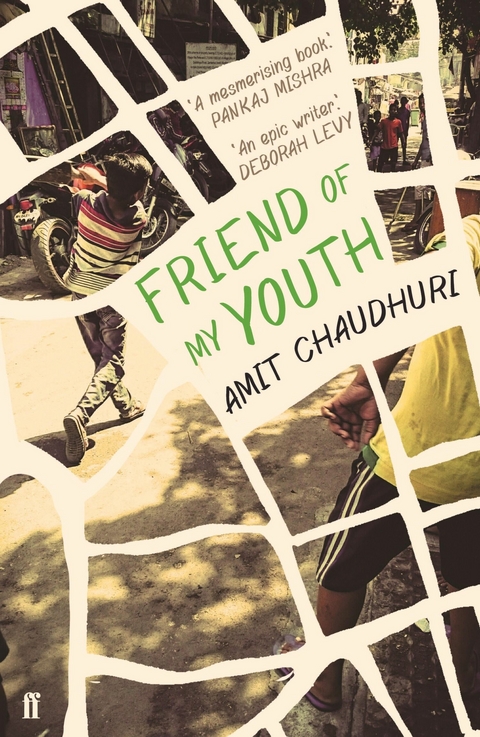
Friend of My Youth (eBook)
272 Seiten
Faber & Faber (Verlag)
9780571337613 (ISBN)
Amit Chaudhuri is the acclaimed author of six novels, including Odysseus Abroad and A Strange and Sublime Address, and two books of essays. He has been awarded the Commonwealth Literature Prize, the Betty Trask Award, the Encore Award, the LA Times Book Prize and the Sahitya Akademi Award, among other accolades. He is a Fellow of the Royal Society of Literature, a Fellow of the English Association, and was a judge of the Man Booker International Prize. Currently he is Professor of Contemporary Literature at the University of East Anglia.
In Friend of My Youth, a novelist named Amit Chaudhuri visits his childhood home of Bombay. The city, reeling from the impact of the 2008 terrorist attacks, weighs heavily on Amit's mind, as does the unexpected absence of his childhood friend Ramu, a drifting, opaque figure who is Amit's last remaining connection to the city he once called home.
‘We have long forgotten the ritual by which the house of our life was erected. But when it is under assault and enemy bombs are already taking their toll, what enervated, perverse antiquities do they not lay bare in the foundations! What things were interred and sacrificed amid magic incantations, what horrible cabinet of curiosities lies there below, where the deepest shafts are reserved for what is most commonplace? In a night of despair I dreamed I was with my first friend from my schooldays, whom I had not seen for decades and had scarcely ever remembered in that time, tempestuously renewing our friendship and brotherhood. But when I awoke it became clear that what despair had brought to light like a detonation was the corpse of that boy, who had been immured as a warning: that whoever one day lives here may in no respect resemble him.’
*
I think of Ramu when I read these lines. It’s of him I think when I reread them. I have no idea why. For one thing, Ramu isn’t ‘my first friend from my schooldays’ – though he’s the only surviving school friend I’ll see when I visit Bombay. Bombay: the city I grew up in. The city I grew up in but knew very little. That is, a pretty limited number of roads; specific clusters of buildings.
I feel a deep sadness reading these lines – I can’t say why.
*
When I arrive into Bombay, I make phone calls. This is in the taxi, or the car that’s come to receive me from the airport and reach me to wherever it is I’m staying: club or hotel. All the while, I’m registering the unfamiliar: the new flyovers; the disappearance of certain things which weren’t quite landmarks but which helped you orient yourself – furniture showrooms; fisherfolk’s settlements. I would be surprised – maybe even disappointed – if these large-scale changes did not occur. On the right-hand side at the end of the road from the airport towards Mahim is, I know, the mosque with loudspeakers, hemmed in by traffic; on the left, further up, past the brief stink of the sea, will be the church where I once went to attend an NA meeting. I was keeping Ramu company. These aren’t parts in which I grew up – but my childhood is coming back to me: the terror – the bewilderment and impatience. The contempt for others. For the city. The magical sense of superiority – like an armour – nurtured inadvertently by your parents: hard to regain.
*
This is a new route. It’s very grandiose.
A bridge suspended over water. I’ve been on it twice before. It is still. In the monsoons, its cables look immovable against the sheets of rain. Suddenly there’s an island, low and humped, with irregular houses and a temple, which you never saw on the old route (that route’s roughly parallel to this one, which is seaborne). Fisherfolk. No slum. The original islanders – you can’t but romanticize them when granted such a glimpse. They were invisible – for perhaps more than a century – from the Mahim side. Maybe they preferred it that way. Maybe they never realized they were invisible. Maybe they don’t know they’re visible. Of course, they’d have noticed the bridge come up over the years. Children would have grown up and left in the time. Do they leave? It doesn’t look like a place to go away from. The houses have a light wash – pale yellow, or pink, or white.
*
The bridge doesn’t last long – it’s meant to cut the duration of the journey. When you’re on it, you want it – the straight lines, the geometry, the inviolable sterility – to last longer. There are no pedestrians. Everything you claim to miss – human noise, congestion – you cease to miss when you’re on the bridge. Death in life. The other end dumps the cars into Worli. The wrong side of Worli. The car needs to make a U-turn round the potholes. In place of the old sea-facing bungalows, the high buildings for the new rich flank the left. The sea on the right is desolate, though it isn’t by the Marine Drive or before the Gateway or even in Juhu. Your first taste of the sea: contained, menacing. Contrary to your desires, you’ve been deposited in the middle of nowhere – which is what Worli was, and is. Still, the signal has come back – you can make calls again.
*
Instead, I send out a smarmy text to two acquaintances. ‘I’ll be doing a reading on the 5th at 6.30 p.m. at … And performing on the 6th at 8 p.m. Do come if you’re free.’ This silly message, bound for people I hardly know, flies out of my mobile as the car turns right towards Haji Ali. I detest messaging. Experiencing any kind of need leads to unease. But I mustn’t take the audience for granted.
‘Aaj kal mausam kaisa hai?’ I ask the driver – the weather’s the best subject when you’ve just released a text and are about to get bored.
At my request, he’s turned down the volume of his CD player, which has been broadcasting lushly arranged covers of film songs by a mediocre singer – why covers rather than the originals I don’t know, because the latter are easier to procure. Could, maybe, the singer be him? People believe in multitasking in Bombay. It’s a word used frequently here.
‘Garmi shuru ho gayi hai,’ he says, sombre, matter-of-fact. It’s March; no vestiges of coolness. Anyway, Bombay has no winter. Everyone knows that, but I get a sense that he thinks I might not know. He’s a true-blue ‘Mumbaikar’; I’m a tourist – he tests my knowledge by gently asking me my route preferences. He has no idea I grew up here – I, a man collected from the airport – that this city was long ago my life. I’m tempted to share this information, but have no opportunity. Instead, every time the car stops at a light, I stare at the vendors of pirated books who magically appear, who assess you with a piercing gaze as they brandish Jhumpa Lahiri; and the dark girls selling unblemished mogra flowers. White bracelets. ‘Bisnes pe aya?’ he asks me. I suppose writing is a business. Yes, I’m here on business. But I don’t tell him what kind, because I presume he won’t understand. What am I up to? If I made millions and entertained millions, there would be a justification; but … Nevertheless, I am here, and people, oddly, accept me for what I do. Even the driver would probably be OK with it. Now, the word ‘business’ – it has such a malleability in the language. ‘The business of writing a poem.’
*
I feel a sense of purposelessness – is it the ennui of the book tour or book-related visit? Not entirely. No, it pertains to Bombay, to being returned to a city where one performed a function, reluctantly. Reluctance is fundamental. You don’t plunge into growing up; it happens in spite of you. Then, one day, it’s done: you’re ‘grown up’. You go away. Back now in the city of my growing up, there’s nothing more that can happen to me. I embrace a false busyness. I suppose I’m living life. Without necessarily meaning to. It doesn’t occur to me that the visit is part of my life. I believe I’ll resume life after it’s done.
Ramu. Now, I don’t spectate on him as I do on the city: as a relic of my boyhood. My oldest surviving friend in Bombay. That makes it sound like the other friends are dead. But you know what I mean. We argue a lot: it’s not unequivocal affection. He’s irritating. I have delusions of grandeur. But we’re both reliable.
*
Ramu isn’t in Bombay. He’s in rehab in Alibag. It sounds like a punitive regime: you can’t talk to him on the phone. He cannot leave. His sister gives me his news: not that there’s any news. She says he went in voluntarily. The regime will cure him once and for all of – what was it? It used to be ‘brown sugar’; is that still the fix? The stuff has become ‘shit’, Ramu once told me, horribly impure. He’s been in Alibag for a year; he’ll be in there for another. Unbelievable! But prevarication was possible no more. He’d come close to death (I was here at the time) on his first and only overdose (he’s a chronic but doubtful user; he flirts with but doesn’t revel in danger; he’s timid). He lived, courtesy of the kindness of an extraordinary policeman. And a doctor called Shailendra. He lived; he was convinced he’d had some sense knocked into him. He had a certain look on his face for a year. Like a hare that’s felt the velocity of a bullet passing a centimetre from its ear. Then, slowly, he became himself. ‘How do I look? How do I look?’ he asked, narrowing his eyes – he’s always keen to know how others see him. And he’s also completely indifferent to opinion – a curious paradox. ‘You’re looking yourself again,’ I lied. He had aged, lost some hair, and put on weight. Epitome of middle-class anonymity; he even wore terecot trousers, not jeans. But the self-absorbed expression was back. I was relieved as well as concerned. After a year, he ‘slipped’ again. He disappeared to rehab without telling me; I didn’t know when. I call him very occasionally, when seized by duty or a faint nostalgia. We have nothing really to say to each other, except the usual – his health, drugs, life, Bombay, what he might achieve if he were gainfully employed, masturbation, the girls we knew in...
| Erscheint lt. Verlag | 22.8.2017 |
|---|---|
| Verlagsort | London |
| Sprache | englisch |
| Themenwelt | Literatur ► Romane / Erzählungen |
| ISBN-13 | 9780571337613 / 9780571337613 |
| Informationen gemäß Produktsicherheitsverordnung (GPSR) | |
| Haben Sie eine Frage zum Produkt? |
 EPUB (Adobe DRM)
Kopierschutz: Adobe-DRM
Adobe-DRM ist ein Kopierschutz, der das eBook vor Mißbrauch schützen soll. Dabei wird das eBook bereits beim Download auf Ihre persönliche Adobe-ID autorisiert. Lesen können Sie das eBook dann nur auf den Geräten, welche ebenfalls auf Ihre Adobe-ID registriert sind.
Details zum Adobe-DRM
Dateiformat: EPUB (Electronic Publication)
EPUB ist ein offener Standard für eBooks und eignet sich besonders zur Darstellung von Belletristik und Sachbüchern. Der Fließtext wird dynamisch an die Display- und Schriftgröße angepasst. Auch für mobile Lesegeräte ist EPUB daher gut geeignet.
Systemvoraussetzungen:
PC/Mac: Mit einem PC oder Mac können Sie dieses eBook lesen. Sie benötigen eine
eReader: Dieses eBook kann mit (fast) allen eBook-Readern gelesen werden. Mit dem amazon-Kindle ist es aber nicht kompatibel.
Smartphone/Tablet: Egal ob Apple oder Android, dieses eBook können Sie lesen. Sie benötigen eine
Geräteliste und zusätzliche Hinweise
Buying eBooks from abroad
For tax law reasons we can sell eBooks just within Germany and Switzerland. Regrettably we cannot fulfill eBook-orders from other countries.
aus dem Bereich