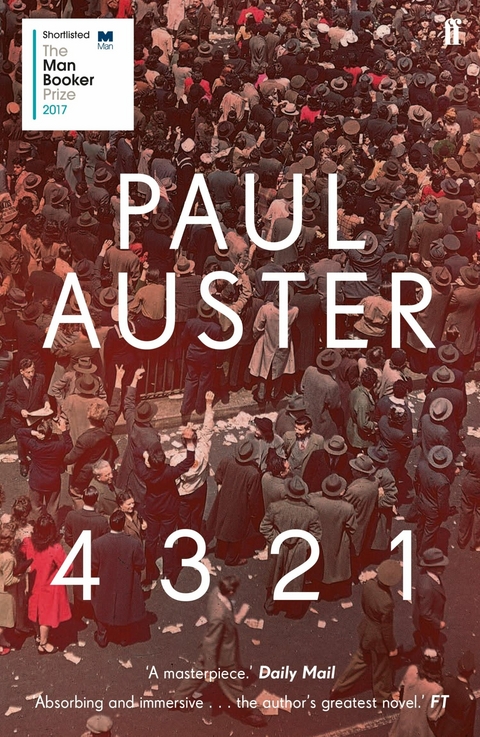
4 3 2 1 (eBook)
880 Seiten
Faber & Faber (Verlag)
9780571324668 (ISBN)
Paul Auster was the bestselling author of 4 3 2 1, Sunset Park, The Book of Illusions, Moon Palace and The New York Trilogy. He and Spencer Ostrander collaborated on Bloodbath Nation. In 2006, he was awarded the Prince of Asturias Prize for Literature. His other honours include the Prix Medicis Étranger for Leviathan, the Independent Spirit Award for the Screenplay of Smoke, the Los Angeles Times Book Prize for Burning Boy, and the Carlos Fuentes Prize for his body of work. His novel 4 3 2 1 was shortlisted for the 2017 Man Booker Prize. He was a member of the American Academy of Arts and Letters, and was a Commandeur de l'Ordre des Arts et des Lettres. His work was translated into more than forty languages. His final novel, Baumgartner, was published in November 2023. He died on 30 April 2024.
Auster's Booker Prize-shortlisted epic from the author of contemporary classic The New York Trilogy: 'a literary voice for the ages' (Guardian)'A masterpiece.' Daily Mail'Absorbing and immersive . . . the author's greatest novel.' FTSHORTLISTED FOR THE MAN BOOKER PRIZE 2017On March 3rd, 1947, Archibald Isaac Ferguson, the only child of Rose and Stanley Ferguson, is born. From that single beginning, Ferguson's life will take four simultaneous but entirely different paths. Family fortunes diverge. Loves and friendships and passions contrast. Each version of Ferguson's story rushes across the fractured terrain of mid-twentieth century America, in this sweeping story of birthright and possibility, of love and the fullness of life itself. 'Remarkable . . . A novel that contains multitudes.' New York Times'A vast portrait of the turbulent mid-20th century . . . wonderfully, vividly conveyed.' New Statesman
lt;p>Paul Auster is the best-selling author of Winter Journal, Sunset Park, Man in the Dark, The Brooklyn Follies, The Book of Illusions, The New York Trilogy, among many other works. In 2006 he was awarded the Prince of Asturias Prize for Literature and inducted into the American Academy of Arts and Letters.
Among his other honours are the Independent Spirit Award for the screenplay of Smoke and the Prix Medicis Etranger forLeviathan. He has also been short-listed for both the International IMPAC Dublin Literary Award (The Book of Illusions) and the PEN/Faulkner Award for Fiction (The Music of Chance). His work has been translated into more than thirty languages.
He lives in Brooklyn, New York.
HIS MOTHER’S NAME WAS ROSE, AND WHEN HE WAS BIG ENOUGH to tie his shoes and stop wetting the bed, he was going to marry her. Ferguson knew that Rose was already married to his father, but his father was an old man, and it wouldn’t be long now before he was dead. Once that happened, Ferguson would marry his mother, and from then on her husband’s name would be Archie, not Stanley. He would be sad when his father died, but not too sad, not sad enough to shed any tears. Tears were for babies, and he wasn’t a baby anymore. There were moments when tears still came out of him, of course, but only when he fell down and hurt himself, and hurting yourself didn’t count.
The best things in the world were vanilla ice cream and jumping up and down on his parents’ bed. The worst things in the world were stomach aches and fevers.
He knew now that sourballs were dangerous. No matter how much he liked them, he understood that he mustn’t put them in his mouth anymore. They were too slippery, and he couldn’t help swallowing them, and because they were too big to go all the way down, they would get stuck in his windpipe and make it hard to breathe. He would never forget how bad it felt the day he started to choke, but then his mother rushed into the room, lifted him off the ground, turned him upside down, and with one hand holding him by the feet, pounded him on the back with the other hand until the sourball popped out of his mouth and clattered onto the floor. His mother said: No more sourballs, Archie. They’re too dangerous. After that, she asked him to help her carry the bowl of sourballs into the kitchen, and one by one they took turns dropping the red, yellow, and green candies into the garbage. Then his mother said: Adios, sourballs. Such a funny word: adios.
That happened in Newark, in the long-ago days when they lived in the apartment on the third floor. Now they lived in a house in a place called Montclair. The house was bigger than the apartment, but the truth was that he had trouble remembering much about the apartment anymore. Except for the sourballs. Except for the venetian blinds in his room, which rattled whenever the window was open. Except for the day when his mother folded up his crib and he slept alone in a bed for the first time.
His father left the house early in the morning, often before Ferguson was awake. Sometimes his father would come home for dinner, and sometimes he wouldn’t come home until after Ferguson had been put to bed. His father worked. That was what grown men did. They left the house every day and worked, and because they worked they made money, and because they made money they could buy things for their wives and children. That was how his mother explained it to him one morning as he watched his father’s blue car drive away from the house. It seemed to be a good arrangement, Ferguson thought, but the money part was a little confusing. Money was so small and dirty, and how could those small, dirty pieces of paper get you something as big as a car or a house?
His parents had two cars, his father’s blue DeSoto and his mother’s green Chevrolet, but Ferguson had thirty-six cars, and on gloomy days when it was too wet to go outside, he would take them out of their box and line up his miniature fleet on the living room floor. There were two-door cars and four-door cars, convertibles and dump trucks, police cars and ambulances, taxis and buses, fire trucks and cement mixers, delivery trucks and station wagons, Fords and Chryslers, Pontiacs and Studebakers, Buicks and Nash Ramblers, each one different from the others, no two even remotely alike, and whenever Ferguson began to push one of them across the floor, he would bend down and look inside at the empty driver’s seat, and because every car needed a driver in order to move, he would imagine he was the person sitting behind the wheel, a tiny person, a man so tiny he was no bigger than the top joint of his thumb.
His mother smoked cigarettes, but his father smoked nothing, not even a pipe or cigars. Old Golds. Such a good-sounding name, Ferguson thought, and how hard he laughed when his mother blew smoke rings for him. Sometimes his father would say to her, Rose, you smoke too much, and his mother would nod her head and agree with him, but still she went on smoking as much as before. Whenever he and his mother climbed into the green car to go out on errands, they would stop for lunch in a little restaurant called Al’s Diner, and as soon as he finished his chocolate milk and grilled-cheese sandwich, his mother would hand him a quarter and ask him to buy her a pack of Old Golds from the cigarette machine. It made him feel like a big person to be given that quarter, which was about the best feeling there was, and off he would march to the back of the diner where the machine stood against the wall between the two restrooms. Once there, he would reach up on his toes to put the coin in the slot, pull the knob under the pillar of stacked-up Old Golds, and then listen to the sound of the pack as it tumbled out of the bulky machine and landed in the silver trough below the knobs. In those days, cigarettes didn’t cost twenty-five cents but twenty-three cents, and each pack came with two freshly minted copper pennies tucked inside the cellophane wrapper. Ferguson’s mother always let him keep those two pennies, and as she smoked her post-lunch cigarette and finished her coffee, he would hold them in his open palm and study the embossed profile of the man on the face of the two coins. Abraham Lincoln. Or, as his mother sometimes said: Honest Abe.
Beyond the little family of Ferguson and his parents, there were two other families to think about, his father’s family and his mother’s family, the New Jersey Fergusons and the New York Adlers, the big family with two aunts, two uncles, and five cousins and the small family with his grandparents and Aunt Mildred, which sometimes included his Great-aunt Pearl and his grown-up twin cousins, Betty and Charlotte. Uncle Lew had a thin mustache and wore wire-rimmed glasses, Uncle Arnold smoked Camels and had reddish hair, Aunt Joan was short and round, Aunt Millie was a little taller but very thin, and the cousins mostly ignored him because he was so much younger than they were, except for Francie, who sometimes babysat for him when his parents went to the movies or to someone’s house for a party. Francie was far and away his favorite person in the New Jersey family. She made beautiful, complicated drawings of castles and knights on horses for him, let him eat as much vanilla ice cream as he wanted, told funny jokes, and was ever so pretty to look at, with long hair that seemed both brown and red at the same time. Aunt Mildred was pretty as well, but her hair was blond, unlike his mother’s hair, which was dark brown, and even though his mother kept telling him that Mildred was her sister, he sometimes forgot because the two of them looked so different. He called his grandfather Papa and his grandmother Nana. Papa smoked Chesterfields and had lost most of his hair. Nana was on the fat side and laughed in the most interesting way, as if there were birds trapped inside her throat. It was better to visit the Adler apartment in New York than the Ferguson houses in Union and Maplewood, not least because the drive through the Holland Tunnel was something he relished, the curious sensation of traveling through an underwater tube lined with millions of identical square tiles, and each time he made that subaquatic journey, he would marvel at how neatly the tiles fit together and wonder how many men it had taken to finish such a colossal task. The apartment was smaller than the houses in New Jersey, but it had the advantage of being high up, on the sixth floor of the building, and Ferguson never tired of looking out the window in the living room and watching the traffic move around Columbus Circle, and then, on Thanksgiving, there was the further advantage of being able to watch the annual parade pass in front of that window, with the gigantic balloon of Mickey Mouse almost smack against his face. Another good thing about going to New York was that there were always presents when he arrived, boxed candies from his grandmother, books and records from Aunt Mildred, and all kinds of special things from his grandfather: balsa-wood airplanes, a game called Parcheesi (another excellent word), decks of playing cards, magic tricks, a red cowboy hat, and a pair of six-shooters in genuine leather holsters. The New Jersey houses offered no such bounties, and therefore Ferguson decided that New York was the place to be. When he asked his mother why they couldn’t live there all the time, she broke into a big smile and said: Ask your father. When he asked his father, his father said: Ask your mother. Apparently, there were some questions that had no answer.
He wanted a brother, preferably an older brother, but since that wasn’t possible anymore, he would settle for a younger brother, and if he couldn’t have a brother, he would make do with a sister, even a younger sister. It was often lonely having no one to play with or talk to, and experience had taught him that every child had a brother or a sister, or several brothers and sisters, and as far as he could tell, he was the only exception to that rule anywhere in the world. Francie had Jack and Ruth, Andrew and Alice had each other, his friend Bobby down the street had a brother and two sisters, and even his own parents had spent their childhoods in the company of other children, two brothers for his father and one...
| Erscheint lt. Verlag | 31.1.2017 |
|---|---|
| Verlagsort | London |
| Sprache | englisch |
| Themenwelt | Literatur ► Historische Romane |
| Literatur ► Klassiker / Moderne Klassiker | |
| Literatur ► Märchen / Sagen | |
| Literatur ► Romane / Erzählungen | |
| Schlagworte | Great American Novel • Jonathan Franzen • Jonathan Lethem • New York Trilogy • Paul Auster • Postmodernism • twentieth century America |
| ISBN-13 | 9780571324668 / 9780571324668 |
| Informationen gemäß Produktsicherheitsverordnung (GPSR) | |
| Haben Sie eine Frage zum Produkt? |
 EPUB (Adobe DRM)
Kopierschutz: Adobe-DRM
Adobe-DRM ist ein Kopierschutz, der das eBook vor Mißbrauch schützen soll. Dabei wird das eBook bereits beim Download auf Ihre persönliche Adobe-ID autorisiert. Lesen können Sie das eBook dann nur auf den Geräten, welche ebenfalls auf Ihre Adobe-ID registriert sind.
Details zum Adobe-DRM
Dateiformat: EPUB (Electronic Publication)
EPUB ist ein offener Standard für eBooks und eignet sich besonders zur Darstellung von Belletristik und Sachbüchern. Der Fließtext wird dynamisch an die Display- und Schriftgröße angepasst. Auch für mobile Lesegeräte ist EPUB daher gut geeignet.
Systemvoraussetzungen:
PC/Mac: Mit einem PC oder Mac können Sie dieses eBook lesen. Sie benötigen eine
eReader: Dieses eBook kann mit (fast) allen eBook-Readern gelesen werden. Mit dem amazon-Kindle ist es aber nicht kompatibel.
Smartphone/Tablet: Egal ob Apple oder Android, dieses eBook können Sie lesen. Sie benötigen eine
Geräteliste und zusätzliche Hinweise
Buying eBooks from abroad
For tax law reasons we can sell eBooks just within Germany and Switzerland. Regrettably we cannot fulfill eBook-orders from other countries.
aus dem Bereich