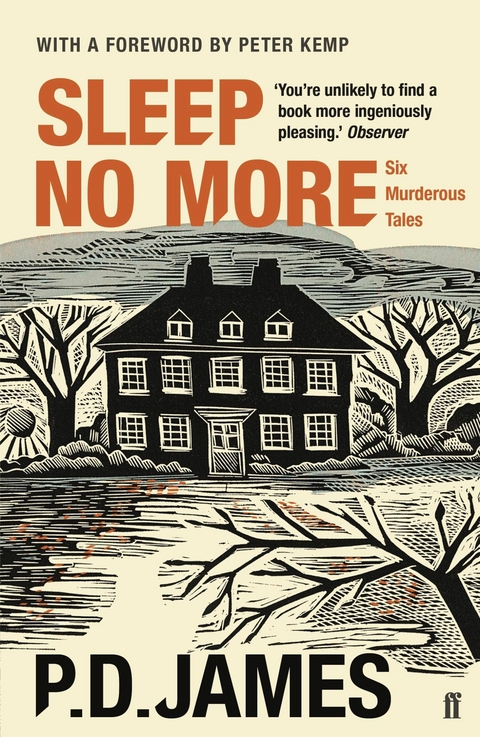
Sleep No More (eBook)
200 Seiten
Faber & Faber (Verlag)
978-0-571-33989-1 (ISBN)
P. D. James (1920-2014) was a bestselling and internationally acclaimed crime writer best known for her books starring poet-detective Adam Dalgliesh. She wrote nineteen novels as well as several short story collections and works of non-fiction. Her work has been translated into thirty-six languages, and has sold millions of copies worldwide. Among many international prizes, awards and honours, she received the highest honours in both British and American crime writing: the CWA Diamond Dagger for a lifetime contribution to the genre, and the Mystery Writers of America Grandmaster Award. She was inducted into the Crime Writing Hall of Fame in 2008. Beyond her writing, she worked in the National Health Service and then in the Home Office for over thirty years, first in the Police Department and later in the Criminal Policy Department, and made use of all this experience in her novels. She served as president of the Society of Authors for sixteen years, and was a Fellow of both the Royal Society of Literature and of the Royal Society of Arts. In 1983 she was awarded an OBE, and she was made a life peer in 1991. She died in 2014.
The acknowledged 'Queen of Crime', P. D. James, was a past master of the short story, weaving together motifs of the Golden Age of crime-writing with deep psychological insight to create gripping, suspenseful tales. The Mistletoe Murder and Other Stories contained four of these perfectly formed stories, and this companion volume contains a further six, published here together for the first time. As the six murderous tales unfold, the dark motive of revenge is revealed at the heart of each. Bullying schoolmasters receive their comeuppance, unhappy marriages and childhoods are avenged, a murder in the small hours of Christmas Day puts an end to the vicious new lord of the manor, and, from the safety of his nursing home, an octogenarian exerts exquisite retribution. The punishments inflicted on the guilty are fittingly severe, but here they are meted out by the unseen forces of natural justice rather than the institutions of the law. Once again, P. D. James shows her expert control of the short-story form, conjuring motives and scenarios with complete conviction, and each with a satisfying twist in the tail.
P. D. James (1920-2014) was born in Oxford and educated at Cambridge High School for Girls. From 1949 to 1968 she worked in the National Health Service and subsequently in the Home Office, first in the Police Department and later in the Criminal Policy Department. All that experience was used in her novels. She was a Fellow of the Royal Society of Literature and of the Royal Society of Arts and served as a Governor of the BBC, a member of the Arts Council, where she was Chairman of the Literary Advisory Panel, on the Board of the British Council and as a magistrate in Middlesex and London. She was an Honorary Bencher of the Honourable Society of the Inner Temple. She won awards for crime writing in Britain, America, Italy and Scandinavia, including the Mystery Writers of America Grandmaster Award and The National Arts Club Medal of Honor for Literature (US). She received honorary degrees from seven British universities, was awarded an OBE in 1983 and was created a life peer in 1991. In 1997 she was elected President of the Society of Authors, stepping down from the post in August 2013.
You know Princess Ilsa Mancelli, of course. I mean by that that you must have seen her on the cinema screen; on television; pictured in newspapers arriving at airports with her latest husband; relaxing on their yacht; bejewelled at first nights, gala nights, at any night and in any place where it is obligatory for the rich and successful to show themselves. Even if, like me, you have nothing but bored contempt for what I believe is called the international jet set, you can hardly live in the modern world and not know Ilsa Mancelli. And you can’t fail to have picked up some scraps about her past. The brief and not particularly successful screen career, when even her heart-stopping beauty couldn’t quite compensate for the paucity of talent; the succession of marriages – first to the producer who made her first film and who broke a twenty-year-old marriage to get her; then to a Texan millionaire; lastly to a prince. About two months ago I saw a nauseatingly sentimental picture of her with her two-day-old son in a Rome nursing home. So it looks as if this marriage, sanctified as it is by wealth, a title and maternity, may be intended as her final adventure.
The husband before the film producer is, I notice, no longer mentioned. Perhaps her publicity agent fears that a violent death in the family, particularly an unsolved violent death, might tarnish her bright image. Blood and beauty. In the early stages of her career they hadn’t been able to resist that cheap, vicarious thrill. But not now. Nowadays her early history, before she married the film producer, has become a little obscure, although there is a suggestion of poor but decent parentage and early struggles suitably rewarded. I am the most obscure part of that obscurity. Whatever you know, or think you know, of Ilsa Mancelli, you won’t have heard about me. The publicity machine has decreed that I be nameless, faceless, unremembered, that I no longer exist. Ironically, the machine is right; in any real sense, I don’t.
I married her when she was Elsie Bowman aged seventeen. I was assistant librarian at our local branch library and fifteen years older, a thirty-two-year-old virgin, a scholar manqué, thin-faced, a little stooping, my meagre hair already thinning. She worked on the cosmetic counter of our High Street store. She was beautiful then, but with a delicate, tentative, unsophisticated loveliness which gave little promise of the polished mature beauty which is hers today. Our story was very ordinary. She returned a book to the library one evening when I was on counter duty. We chatted. She asked my advice about novels for her mother. I spent as long as I dared finding suitable romances for her on the shelves. I tried to interest her in the books I liked. I asked her about herself, her life, her ambitions. She was the only woman I had been able to talk to. I was enchanted by her, totally and completely besotted.
I used to take my lunch early and make surreptitious visits to the store, watching her from the shadow of a neighbouring pillar. There is one picture which even now seems to stop my heart. She had dabbed her wrist with scent and was holding out a bare arm over the counter so that a prospective customer could smell the perfume. She was entirely absorbed, her young face gravely preoccupied. I watched her, silently, and felt the tears smarting my eyes.
It was a miracle when she agreed to marry me. Her mother (she had no father) was reconciled if not enthusiastic about the match. She didn’t, as she made it abundantly plain, consider me much of a catch. But I had a good job with prospects; I was educated; I was steady and reliable; I spoke with a grammar-school accent which, while she affected to deride it, raised my status in her eyes. Besides, any marriage for Elsie was better than none. I was dimly aware when I bothered to think about Elsie in relation to anyone but myself that she and her mother didn’t get on.
Mrs Bowman made, as she described it, a splash. There was a full choir and a peal of bells. The church hall was hired and a sit-down meal, ostentatiously unsuitable and badly cooked, was served to eighty guests. Between the pangs of nervousness and indigestion I was conscious of smirking waiters in short white jackets, a couple of giggling bridesmaids from the store, their freckled arms bulging from pink taffeta sleeves, hearty male relatives, red-faced and with buttonholes of carnation and waving fern, who made indelicate jokes and clapped me painfully between the shoulders. There were speeches and warm champagne. And, in the middle of it all, Elsie, my Elsie, like a white rose.
I suppose that it was stupid of me to imagine that I could hold her. The mere sight of our morning faces, smiling at each other’s reflection in the bedroom mirror, should have warned me that it couldn’t last. But, poor deluded fool, I never dreamed that I might lose her except by death. Her death I dared not contemplate, and I was afraid for the first time of my own. Happiness had made a coward of me. We moved into a new bungalow, chosen by Elsie, sat in new chairs chosen by Elsie, slept in a befrilled bed chosen by Elsie. I was so happy that it was like passing into a new phase of existence, breathing a different air, seeing the most ordinary things as if they were newly created. One isn’t necessarily humble when greatly in love. Is it so unreasonable to recognise the value of a love like mine, to believe that the beloved is equally sustained and transformed by it?
She said that she wasn’t ready to start a baby and, without her job, she was easily bored. She took a brief training in shorthand and typing at our local technical college and found herself a position as shorthand typist at the firm of Collingford and Major. That, at least, was how the job started. Shorthand typist, then secretary to Mr Rodney Collingford, then personal secretary, then confidential personal secretary; in my bemused state of uxorious bliss I only half-registered her progress from occasionally taking his dictation when his then secretary was absent to flaunting his gifts of jewellery and sharing his bed.
He was everything I wasn’t. Rich (his father had made a fortune from plastics shortly after the war and had left the factory to his only son), coarsely handsome in a swarthy fashion, big-muscled, confident, attractive to women. He prided himself on taking what he wanted. Elsie must have been one of his easiest pickings.
Why, I still wonder, did he want to marry her? I thought at the time that he couldn’t resist depriving a pathetic, underprivileged, unattractive husband of a prize which neither looks nor talent had qualified him to deserve. I’ve noticed that about the rich and successful. They can’t bear to see the undeserving prosper. I thought that half the satisfaction for him was in taking her away from me. That was partly why I knew that I had to kill him. But now I’m not so sure. I may have done him an injustice. It may have been both simpler and more complicated than that. She was, you see – she still is – so very beautiful.
I understand her better now. She was capable of kindness, good humour, generosity even, provided she was getting what she wanted. At the time we married, and perhaps eighteen months afterwards, she wanted me. Neither her egoism nor her curiosity had been able to resist such a flattering, overwhelming love. But, for her, marriage wasn’t permanency. It was the first and necessary step towards the kind of life she dreamt of and meant to have. She was kind to me, in bed and out, while I was what she wanted. But when she wanted someone else, then my need of her, my jealousy, my bitterness, she saw as a cruel and wilful denial of her basic right – the right to have what she wanted. After all, I’d had her for nearly three years. It was two years more than I had any right to expect. She thought so. Her darling Rodney thought so. When my acquaintances at the library learnt of the divorce I could see in their eyes that they thought so too. And she couldn’t see what I was so bitter about. Rodney was perfectly happy to be the guilty party; they weren’t, she pointed out caustically, expecting me to behave like a gentleman. I wouldn’t have to pay for the divorce. Rodney would see to that. I wasn’t being asked to provide her with alimony. Rodney had more than enough. At one point she came close to bribing me with Rodney’s money to let her go without fuss. And yet – was it really as simple as that? She had loved me, or at least needed me, for a time. Had she perhaps seen in me the father that she had lost at five years old?
During the divorce, through which I was, as it were, gently processed by highly paid legal experts as if I were an embarrassing but expendable nuisance to be got rid of with decent speed, I was only able to keep sane by the knowledge that I was going to kill Collingford. I knew that I couldn’t go on living in a world where he breathed the same air. My mind fed voraciously on the thought of his death, savoured it, began systematically and with dreadful pleasure to plan it.
A successful murder depends on knowing your victim, his character, his daily routine, his weaknesses, those unalterable and betraying habits which make up the core of personality. I knew quite a lot about Rodney Collingford. I knew facts which Elsie had let fall in her first weeks with the firm, typing-pool...
| Erscheint lt. Verlag | 3.10.2017 |
|---|---|
| Verlagsort | London |
| Sprache | englisch |
| Themenwelt | Literatur ► Krimi / Thriller / Horror ► Krimi / Thriller |
| Literatur ► Romane / Erzählungen | |
| Schlagworte | Agatha Christie • christmas crime • Classic Crime • detective • Hercule Poirot • Miss Marple • Whodunnit |
| ISBN-10 | 0-571-33989-1 / 0571339891 |
| ISBN-13 | 978-0-571-33989-1 / 9780571339891 |
| Informationen gemäß Produktsicherheitsverordnung (GPSR) | |
| Haben Sie eine Frage zum Produkt? |
 EPUB (Adobe DRM)
Kopierschutz: Adobe-DRM
Adobe-DRM ist ein Kopierschutz, der das eBook vor Mißbrauch schützen soll. Dabei wird das eBook bereits beim Download auf Ihre persönliche Adobe-ID autorisiert. Lesen können Sie das eBook dann nur auf den Geräten, welche ebenfalls auf Ihre Adobe-ID registriert sind.
Details zum Adobe-DRM
Dateiformat: EPUB (Electronic Publication)
EPUB ist ein offener Standard für eBooks und eignet sich besonders zur Darstellung von Belletristik und Sachbüchern. Der Fließtext wird dynamisch an die Display- und Schriftgröße angepasst. Auch für mobile Lesegeräte ist EPUB daher gut geeignet.
Systemvoraussetzungen:
PC/Mac: Mit einem PC oder Mac können Sie dieses eBook lesen. Sie benötigen eine
eReader: Dieses eBook kann mit (fast) allen eBook-Readern gelesen werden. Mit dem amazon-Kindle ist es aber nicht kompatibel.
Smartphone/Tablet: Egal ob Apple oder Android, dieses eBook können Sie lesen. Sie benötigen eine
Geräteliste und zusätzliche Hinweise
Buying eBooks from abroad
For tax law reasons we can sell eBooks just within Germany and Switzerland. Regrettably we cannot fulfill eBook-orders from other countries.
aus dem Bereich