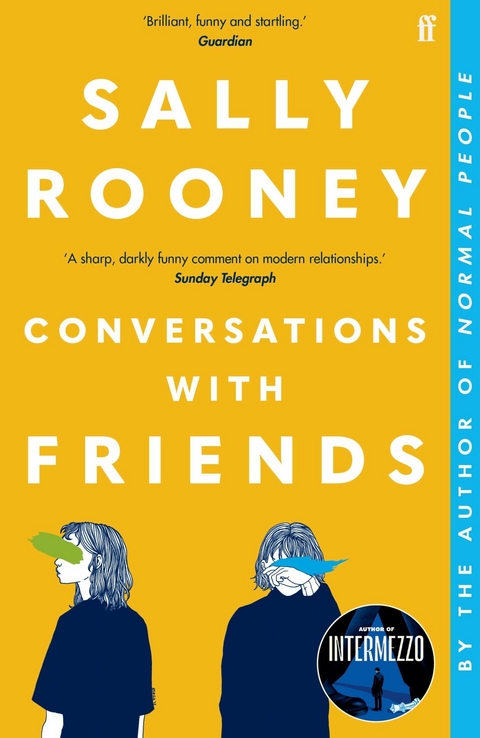
Conversations with Friends (eBook)
272 Seiten
Faber & Faber (Verlag)
978-0-571-33314-1 (ISBN)
Sally Rooney is an Irish novelist. She is the author of Conversations with Friends, Normal People and Beautiful World, Where Are You.
'A nuanced, page-turning portrait.' Zadie Smith'Brilliant.' Marian Keyes'A sharp, darkly funny comment on modern relationships.' Sunday TelegraphThe critically-acclaimed debut novel from the globally bestselling author of Normal People and Beautiful World, Where Are You. A SUNDAY TIMES TOP 25 NOVEL OF THE TWENTY-FIRST CENTURYFrances is twenty-one years old, cool-headed and observant. At night she performs spoken word with her best friend Bobbi, who used to be her girlfriend. When they are befriended by Melissa, a well-known journalist who is married to Nick, an actor, they enter a world of beautiful houses, raucous dinner parties and holidays in Provence, beginning a complex menage-a-quatre. But when Frances and Nick get unexpectedly closer, Frances is forced to honestly confront her own vulnerabilities for the first time. Readers love Conversations with Friends:????? 'Completely engulfs you. I missed it when I finished reading.'????? 'Sucked me in and didn't let me go until the very end.'????? 'Portrays love and obsession and friendship and anxiety in such accurate detail, I feel like I've lived it.'????? 'Rooney's writing is completely addictive.'????? 'I wish I could read it for the first time all over again.'
Sally Rooney is the author of the novels Conversations with Friends and Normal People. Her writing has appeared in the New Yorker, the New York Times, the London Review of Books and elsewhere. Conversations with Friends was shortlisted for both the Dylan Thomas Prize and the Rathbones Folio Prize, and longlisted for the Desmond Elliott Prize. Rooney was also shortlisted for the Sunday Times EFG Short Story Award for 'Mr Salary' and was the winner of the Sunday Times/PFD Young Writer of the Year Award. Normal People was the Waterstones Book of the Year 2019 and won the Costa Novel of the Year in 2018. It was longlisted for the Man Booker Prize in 2018, as well as the Women's Prize for Fiction and the Rathbones Folio Prize in 2019. Sally Rooney co-wrote the television adaptation of Normal People which was broadcast on the BBC in 2020, and for which she was nominated for an Emmy award.
Bobbi and I first met Melissa at a poetry night in town, where we were performing together. Melissa took our photograph outside, with Bobbi smoking and me self-consciously holding my left wrist in my right hand, as if I was afraid the wrist was going to get away from me. Melissa used a big professional camera and kept lots of different lenses in a special camera pouch. She chatted and smoked while taking the pictures. She talked about our performance and we talked about her work, which we’d come across on the internet. Around midnight the bar closed. It was starting to rain then, and Melissa told us we were welcome to come back to her house for a drink.
We all got into the back of a taxi together and started fixing up our seat belts. Bobbi sat in the middle, with her head turned to speak to Melissa, so I could see the back of her neck and her little spoon-like ear. Melissa gave the driver an address in Monkstown and I turned to look out the window. A voice came on the radio to say the words: eighties … pop … classics. Then a jingle played. I felt excited, ready for the challenge of visiting a stranger’s home, already preparing compliments and certain facial expressions to make myself seem charming.
The house was a semi-detached red-brick, with a sycamore tree outside. Under the streetlight the leaves looked orange and artificial. I was a big fan of seeing the insides of other people’s houses, especially people who were slightly famous like Melissa. Right away I decided to remember everything about her home, so I could describe it to our other friends later and Bobbi could agree.
When Melissa let us in, a little red spaniel came racing up the hall and started barking at us. The hallway was warm and the lights were on. Next to the door was a low table where someone had left a stack of change, a hairbrush and an open tube of lipstick. There was a Modigliani print hanging over the staircase, a nude woman reclining. I thought: this is a whole house. A family could live here.
We have guests, Melissa called down the corridor.
No one appeared so we followed her into the kitchen. I remember seeing a dark wooden bowl filled with ripe fruit, and noticing the glass conservatory. Rich people, I thought. I was always thinking about rich people then. The dog had followed us to the kitchen and was snuffling around at our feet, but Melissa didn’t mention the dog so neither did we.
Wine? Melissa said. White or red?
She poured huge, bowl-sized glasses and we all sat around a low table. Melissa asked us how we’d started out performing spoken word poetry together. We had both just finished our third year of university at the time, but we’d been performing together since we were in school. Exams were over by then. It was late May.
Melissa had her camera on the table and occasionally lifted it to take a photograph, laughing self-deprecatingly about being a ‘work addict’. She lit a cigarette and tipped the ash into a kitschy-looking glass ashtray. The house didn’t smell of smoke at all and I wondered if she usually smoked in there or not.
I made some new friends, she said.
Her husband was in the kitchen doorway. He held up his hand to acknowledge us and the dog started yelping and whining and running around in circles.
This is Frances, said Melissa. And this is Bobbi. They’re poets.
He took a bottle of beer out of the fridge and opened it on the countertop.
Come and sit with us, Melissa said.
Yeah, I’d love to, he said, but I should try and get some sleep before this flight.
The dog jumped up on a kitchen chair near where he was standing and he reached out absently to touch its head. He asked Melissa if she had fed the dog, she said no. He lifted the dog into his arms and let the dog lick his neck and jaw. He said he would feed her, and he went back out the kitchen door again.
Nick’s filming tomorrow morning in Cardiff, said Melissa.
We already knew that the husband was an actor. He and Melissa were frequently photographed together at events, and we had friends of friends who had met them. He had a big, handsome face and looked like he could comfortably pick Melissa up under one arm and fend off interlopers with the other.
He’s very tall, Bobbi said.
Melissa smiled as if ‘tall’ was a euphemism for something, but not necessarily something flattering. The conversation moved on. We got into a short discussion about the government and the Catholic Church. Melissa asked us if we were religious and we said no. She said she found religious occasions, like funerals or weddings, ‘comforting in a kind of sedative way’. They’re communal, she said. There’s something nice about that for the neurotic individualist. And I went to a convent school so I still know most of the prayers.
We went to a convent school, said Bobbi. It posed issues.
Melissa grinned and said: like what?
Well, I’m gay, said Bobbi. And Frances is a communist.
I also don’t think I remember any of the prayers, I said.
We sat there talking and drinking for a long time. I remember that we talked about the poet Patricia Lockwood, who we admired, and also about what Bobbi disparagingly called ‘pay gap feminism’. I started to get tired and a little drunk. I couldn’t think of anything witty to say and it was hard to arrange my face in a way that would convey my sense of humour. I think I laughed and nodded a lot. Melissa told us she was working on a new book of essays. Bobbi had read her first one, but I hadn’t.
It’s not very good, Melissa told me. Wait till the next one comes out.
At about three o’clock, she showed us to the spare room and told us how great it was to meet us and how glad she was that we were staying. When we got into bed I stared up at the ceiling and felt very drunk. The room was spinning repetitively in short, consecutive spins. Once I adjusted my eyes to one rotation, another would begin immediately. I asked Bobbi if she was also having a problem with that but she said no.
She’s amazing, isn’t she? said Bobbi. Melissa.
I like her, I said.
We could hear her voice in the corridor and her footsteps taking her from room to room. Once when the dog barked we could hear her yell something, and then her husband’s voice. But after that we fell asleep. We didn’t hear him leave.
*
Bobbi and I had first met in secondary school. Back then Bobbi was very opinionated and frequently spent time in detention for a behavioural offence our school called ‘disrupting teaching and learning’. When we were sixteen she got her nose pierced and took up smoking. Nobody liked her. She got temporarily suspended once for writing ‘fuck the patriarchy’ on the wall beside a plaster cast of the crucifixion. There was no feeling of solidarity around this incident. Bobbi was considered a show-off. Even I had to admit that teaching and learning went a lot more smoothly during the week she was gone.
When we were seventeen we had to attend a fundraising dance in the school assembly hall, with a partially broken disco ball casting lights on the ceiling and the barred-up windows. Bobbi wore a flimsy summer dress and looked like she hadn’t brushed her hair. She was radiantly attractive, which meant everyone had to work hard not to pay her any attention. I told her I liked her dress. She gave me some of the vodka she was drinking from a Coke bottle and asked if the rest of the school was locked up. We checked the door up to the back staircase and found it was open. All the lights were off and no one else was up there. We could hear the music buzzing through the floorboards, like a ringtone belonging to someone else. Bobbi gave me some more of her vodka and asked me if I liked girls. It was very easy to act unfazed around her. I just said: sure.
I wasn’t betraying anyone’s loyalties by being Bobbi’s girlfriend. I didn’t have close friends and at lunchtime I read textbooks alone in the school library. I liked the other girls, I let them copy my homework, but I was lonely and felt unworthy of real friendship. I made lists of the things I had to improve about myself. After Bobbi and I started seeing each other, everything changed. No one asked for my homework any more. At lunchtime we walked along the car park holding hands and people looked away from us maliciously. It was fun, the first real fun I’d ever had.
After school we used to lie in her room listening to music and talking about why we liked each other. These were long and intense conversations, and felt so momentous to me that I secretly transcribed parts of them from memory in the evenings. When Bobbi talked about me it felt like seeing myself in a mirror for the first time. I also looked in actual mirrors more often. I started taking a close interest in my face and body, which I’d never done before. I asked Bobbi questions like: do I have long legs? Or short?
At our school graduation ceremony we performed a spoken word piece together. Some of the parents cried, but our classmates just looked out the assembly-room windows or talked quietly amongst themselves. Several months later, after more than a year together, Bobbi and I broke up.
*
Melissa wanted to write a...
| Erscheint lt. Verlag | 25.5.2017 |
|---|---|
| Verlagsort | London |
| Sprache | englisch |
| Themenwelt | Literatur ► Romane / Erzählungen |
| Schlagworte | Anuk Arudpragasam A Passage North • A Slow Fire Burning Paula Hawkins • Assembly • assembly natasha brown • BBC • Bernadine Evaristo • bernardine evaristo • Candice Carty-Williams • Colin Barrett • conversations with friends • daisy edgar jones • Daisy Jones and the Six • Dublin • eleanor oliphant • Feminism • fleabag • Girl Woman Other • love marriage • luster • Normal People • Open Water • Phoebe Waller Bridge • Queenie • Salinger • Sara Baume • Sorrow and Bliss • the Maid • To Paradise |
| ISBN-10 | 0-571-33314-1 / 0571333141 |
| ISBN-13 | 978-0-571-33314-1 / 9780571333141 |
| Informationen gemäß Produktsicherheitsverordnung (GPSR) | |
| Haben Sie eine Frage zum Produkt? |
 EPUB (Adobe DRM)
Kopierschutz: Adobe-DRM
Adobe-DRM ist ein Kopierschutz, der das eBook vor Mißbrauch schützen soll. Dabei wird das eBook bereits beim Download auf Ihre persönliche Adobe-ID autorisiert. Lesen können Sie das eBook dann nur auf den Geräten, welche ebenfalls auf Ihre Adobe-ID registriert sind.
Details zum Adobe-DRM
Dateiformat: EPUB (Electronic Publication)
EPUB ist ein offener Standard für eBooks und eignet sich besonders zur Darstellung von Belletristik und Sachbüchern. Der Fließtext wird dynamisch an die Display- und Schriftgröße angepasst. Auch für mobile Lesegeräte ist EPUB daher gut geeignet.
Systemvoraussetzungen:
PC/Mac: Mit einem PC oder Mac können Sie dieses eBook lesen. Sie benötigen eine
eReader: Dieses eBook kann mit (fast) allen eBook-Readern gelesen werden. Mit dem amazon-Kindle ist es aber nicht kompatibel.
Smartphone/Tablet: Egal ob Apple oder Android, dieses eBook können Sie lesen. Sie benötigen eine
Geräteliste und zusätzliche Hinweise
Buying eBooks from abroad
For tax law reasons we can sell eBooks just within Germany and Switzerland. Regrettably we cannot fulfill eBook-orders from other countries.
aus dem Bereich