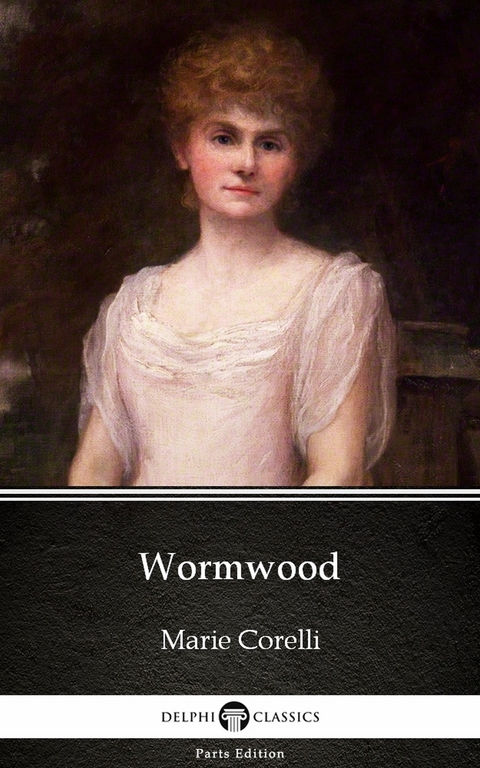
Wormwood by Marie Corelli - Delphi Classics (Illustrated) (eBook)
338 Seiten
Publishdrive (Verlag)
978-1-78877-878-7 (ISBN)
Having established their name as the leading publisher of classic literature and art, Delphi Classics produce publications that are individually crafted with superior formatting, while introducing many rare texts for the first time in digital print. The Delphi Classics edition of Corelli includes original annotations and illustrations relating to the life and works of the author, as well as individual tables of contents, allowing you to navigate eBooks quickly and easily.
eBook features:* The complete unabridged text of 'Wormwood by Marie Corelli - Delphi Classics (Illustrated)'
* Beautifully illustrated with images related to Corelli's works
* Individual contents table, allowing easy navigation around the eBook
* Excellent formatting of the textPlease visit www.delphiclassics.com to learn more about our wide range of titles
This eBook features the unabridged text of 'Wormwood by Marie Corelli - Delphi Classics (Illustrated)' from the bestselling edition of 'The Complete Works of Marie Corelli'. Having established their name as the leading publisher of classic literature and art, Delphi Classics produce publications that are individually crafted with superior formatting, while introducing many rare texts for the first time in digital print. The Delphi Classics edition of Corelli includes original annotations and illustrations relating to the life and works of the author, as well as individual tables of contents, allowing you to navigate eBooks quickly and easily.eBook features:* The complete unabridged text of 'Wormwood by Marie Corelli - Delphi Classics (Illustrated)'* Beautifully illustrated with images related to Corelli's works* Individual contents table, allowing easy navigation around the eBook* Excellent formatting of the textPlease visit www.delphiclassics.com to learn more about our wide range of titles
I.
SILENCE, — silence! It is the hour of the deepest hush of night; the invisible intangible clouds of sleep brood over the brilliant city. Sleep! What is it? Forgetfulness? A sweet unconsciousness of dreamless rest? Aye! it must be so, if I remember rightly; but I cannot be quite sure, for it seems a century since I slept well. But what of that? Does any one sleep well nowadays, save children and hard-worked diggers of the soil? We who think — oh, the entanglements and perplexities of this perpetual Thought! — we have no space or time wherein to slumber; between the small hours of midnight and morning we rest on our pillows for mere form’s sake, and doze and dream, — but we do not sleep.
Stay! let me consider. What am I doing here so late? why am I not at home? Why do I stand alone on this bridge, gazing down into the cold sparkling water of the Seine — water that, to my mind, resembles a glittering glass screen, through which I see faces peering up at me, white and aghast with a frozen wonder! How they stare, how they smile, all those drowned women and men! Some are beautiful; all are mournful. I am not sorry for them, no! but I am sure they must have died with half their griefs un-spoken, to look so wildly even in death. Is it my fancy, or do they want something of me? I feel impelled towards them — they draw me downwards by a deadly fascination, I must go on, or else —
With a violent effort I tear myself away, and, leaving the bridge, I wander slowly homeward.
The city sleeps, did I say? Oh no! Paris is not so clean of conscience or so pure of heart that its inhabitants should compose themselves to rest simply because it is midnight. There are hosts of people about and stirring; rich aristocrats for instance, whose names are blazoned on the lists of honour and la haute noblesse, can be met at every turn, stalking abroad like beasts in search of prey; there are the painted and bedizened outcasts who draw their silken skirts scornfully aside from any chance of contact with the soiled and ragged garments worn by the wretched and starving members of the same deplorable sisterhood; and every now and again the flashing of lamps in a passing carriage containing some redoubtable princess of the demi-monde, assures the beholder of the fact that, however soundly virtue may slumber, vice is awake and rampant. But what am I that I should talk of vice or virtue? What business has a wreck cast on the shores of ruin to concern itself with the distant sailing of the gaudy ships bound for the same disastrous end!
How my brain reels! The hot pavements scorch my tired feet, and the round white moon looks at me from the sky like the foolish ghost of herself in a dream. Street after street I pass, scarcely conscious of sight or sense; I hardly know whither I am bound, and it is by mere mechanical instinct alone that I finally reach my destination.
Home at last! I recognize the dim and dirty alley, the tumbledown miserable lodging-house in which, of all the wretched rooms it holds, the wretchedest is the garret I call mine. That gaunt cat is always on the doorstep, — always tearing some horrible offal she has found, with claws and teeth — yet savage as hunger has made her she is afraid of me, and bounds stealthily aside and away as I cross the threshold. Two men, my drunken landlord and his no less drunken brother, are quarrelling furiously in the passage; I shrink past them unobserved and make my way up the dark foul-smelling staircase to my narrow den, where, on entering, I jealously lock myself in, eager to be alone. Alone, alone — always alone! I approach the window and fling it wide open; I rest my arms on the sill and look out drearily at the vast deep star-besprinkled heaven.
They were cruel to me to-night at the café, particularly that young curly-haired student. Who is he, and what is he? I hate him, I know not why! except that he reminds me of one who is dead. “Do not drink that,” he said gravely, touching the glass I held. “It will drive you mad some day!” Drive me mad! Good, very good! That is what a great many people have told me, — croakers all! Who is mad, and who is sane? It is not easy to decide. The world has various ways of defining insanity in different individuals. The genius who has grand ideas, and fancies he can realize them is “mad;” the priest who, like Saint Damien, sacrifices himself for others is “mad,” the hero who, like the English Gordon, perishes at his post instead of running away to save his own skin, is “mad,” and only the comfortable tradesman or financier who amasses millions by systematically cheating his fellows, is “sane.” Excellent! Let me be mad, then, by all means! mad with the madness of Absinthe, the wildest, most luxurious madness in the world! Vive la folie! Vive l’amour! Vive l’animalism!
Vive le Diable! Live everybody, and everything that can live without a conscience, for conscience is at a discount in this age, and honesty cannot keep pace with our modern progress. The times are as we make them, and we have made ours those of realism; the old idyllic days of faith and sentiment are past.
Those cold and quiet stars! What innumerable multitudes of them there are! Why were they created? Through countless centuries bewildered mankind has gazed at them and asked the same question, — a question never to be answered, — a problem never to be solved. The mind soon grows fatigued with pondering. It is better not to think. Yet one good thing has lately come out of the subtle and incessant workings of intellect, and that is that we need not trouble ourselves about God any more. Nothing in all the vast mechanism of the universe can actually prove a Deity to be existent; and no one is called upon to believe in what cannot be proved. I am glad of this, very glad; for if I thought there were a God in heaven — a Supreme Justice enthroned in some far-off sphere of life unseen yet eternal, I think — I do not know, but I think — I should be afraid! Afraid of the day, afraid of the night, afraid of the glassy river, with its thousands of drowned eyes below; afraid, perchance, of my own hovering shadow; and still more darkly dimly afraid of creatures that might await me in lands invisible beyond the grave — phantom creatures that I have wronged as much and haply more than they in their time wronged me!
Yet, after all, I am no coward; and why should I fear God, supposing a God should, notwithstanding our denial of Him, positively exist? If He is the Author of Creation, He is answerable for every atom within it, even for me. I have done evil. What then? Am I the only one? If I have sinned more, I have also suffered more; and plenty of scientists and physiologists could be found to prove that my faults are those of temperament and brain-construction, and that I cannot help them if I would. Ah, how consoling are these advanced doctrines! No criminal ought, in strict justice, to be punished at all, seeing that it is his inborn nature to commit crime, and that he cannot alter that nature even if he tried! Only a canting priest would dare to ask him to try; and, in France at least, we have done with priestcraft.
Well, we live in a great and wonderful era, and we have great and wonderful needs — needs which must be supplied! One of our chief requirements is that we should know everything — even things that used for honour and decency’s sake to be concealed. Wise and pure and beautiful things we have had enough of. They belong to the old classic days of Greece and Rome, the ages of idyll and allegory; and we find them on the whole rather ennuyant. We have developed different tastes. We want the ugly truths of life, not the pretty fables. We like ugly truths. We find them piquant and palatable, like the hot sauce poured on fish to give it a flavour. For example, the story of “Paul et Virginie” is very charming, but also very tame and foolish. It suited the literary spirit of the time in which it was written; but to us in the present day there is something far more entrainant in a novel which faithfully describes the love-making of Jeanne the washer-woman with Jacques the rag-picker. We prefer their coarse amours to Virginie s tearful sentiment — autres temps, autres mœurs. I thought of this yesterday, when, strolling aimlessly across the Pont Neuf, I glanced at the various titles of the books for sale on the open-air counters and saw Realism represented to the last dregs of reality. And then I began to consider what the story of my life would look like when written, and what people would think of it if they read it. This idea has haunted me all last night and to-day. I have turned it over and over again in my mind with a certain savage amusement. Dear old world! dear Society! will you believe me if I tell you what I am? No, I am sure you will not! You will shudder a little, perhaps; but it is far more likely that you will scoff and sneer. It is so easy to make light of a fellow-creature’s downfall. Moreover, your critics will assure you that the whole narrative is a tissue of absurd improbabilities, that such and such events never could and never would happen under any sort of circumstances whatever, and that a disordered imagination alone has to do with the weaving of a drama as wild as mine!
But, think what you will, say what you choose, I am resolved you shall know me. It is well you should learn what manner of man is in your midst: a man as...
| Erscheint lt. Verlag | 17.7.2017 |
|---|---|
| Reihe/Serie | Delphi Parts Edition (Marie Corelli) | Delphi Parts Edition (Marie Corelli) |
| Sprache | englisch |
| Themenwelt | Literatur ► Anthologien |
| Literatur ► Klassiker / Moderne Klassiker | |
| Literatur ► Romane / Erzählungen | |
| Schlagworte | ouida • Romance • Satan • Soul • Stoker • Wells • wilkie |
| ISBN-10 | 1-78877-878-2 / 1788778782 |
| ISBN-13 | 978-1-78877-878-7 / 9781788778787 |
| Informationen gemäß Produktsicherheitsverordnung (GPSR) | |
| Haben Sie eine Frage zum Produkt? |
 EPUB (Adobe DRM)
Größe: 1,6 MB
Kopierschutz: Adobe-DRM
Adobe-DRM ist ein Kopierschutz, der das eBook vor Mißbrauch schützen soll. Dabei wird das eBook bereits beim Download auf Ihre persönliche Adobe-ID autorisiert. Lesen können Sie das eBook dann nur auf den Geräten, welche ebenfalls auf Ihre Adobe-ID registriert sind.
Details zum Adobe-DRM
Dateiformat: EPUB (Electronic Publication)
EPUB ist ein offener Standard für eBooks und eignet sich besonders zur Darstellung von Belletristik und Sachbüchern. Der Fließtext wird dynamisch an die Display- und Schriftgröße angepasst. Auch für mobile Lesegeräte ist EPUB daher gut geeignet.
Systemvoraussetzungen:
PC/Mac: Mit einem PC oder Mac können Sie dieses eBook lesen. Sie benötigen eine
eReader: Dieses eBook kann mit (fast) allen eBook-Readern gelesen werden. Mit dem amazon-Kindle ist es aber nicht kompatibel.
Smartphone/Tablet: Egal ob Apple oder Android, dieses eBook können Sie lesen. Sie benötigen eine
Geräteliste und zusätzliche Hinweise
Buying eBooks from abroad
For tax law reasons we can sell eBooks just within Germany and Switzerland. Regrettably we cannot fulfill eBook-orders from other countries.
EPUB (Ohne DRM)Digital Rights Management: ohne DRM
Dieses eBook enthält kein DRM oder Kopierschutz. Eine Weitergabe an Dritte ist jedoch rechtlich nicht zulässig, weil Sie beim Kauf nur die Rechte an der persönlichen Nutzung erwerben.
Dateiformat: EPUB (Electronic Publication)
EPUB ist ein offener Standard für eBooks und eignet sich besonders zur Darstellung von Belletristik und Sachbüchern. Der Fließtext wird dynamisch an die Display- und Schriftgröße angepasst. Auch für mobile Lesegeräte ist EPUB daher gut geeignet.
Systemvoraussetzungen:
PC/Mac: Mit einem PC oder Mac können Sie dieses eBook lesen. Sie benötigen dafür die kostenlose Software Adobe Digital Editions.
eReader: Dieses eBook kann mit (fast) allen eBook-Readern gelesen werden. Mit dem amazon-Kindle ist es aber nicht kompatibel.
Smartphone/Tablet: Egal ob Apple oder Android, dieses eBook können Sie lesen. Sie benötigen dafür eine kostenlose App.
Geräteliste und zusätzliche Hinweise
Buying eBooks from abroad
For tax law reasons we can sell eBooks just within Germany and Switzerland. Regrettably we cannot fulfill eBook-orders from other countries.
aus dem Bereich