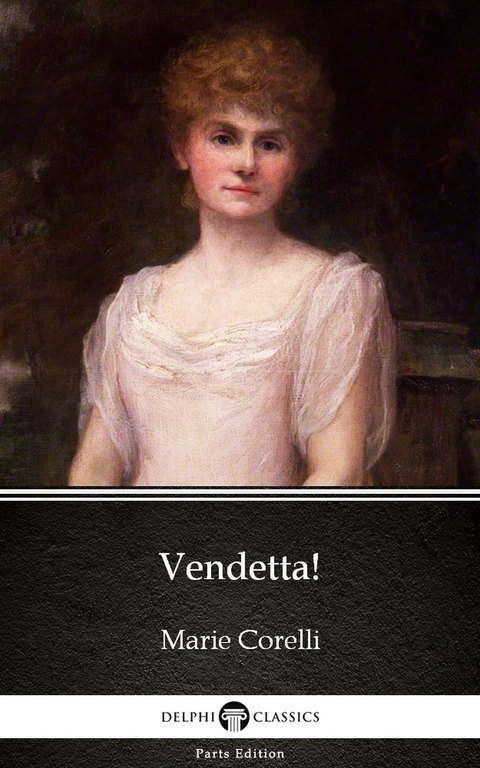
Vendetta! by Marie Corelli - Delphi Classics (Illustrated) (eBook)
371 Seiten
Publishdrive (Verlag)
978-1-78877-877-0 (ISBN)
Having established their name as the leading publisher of classic literature and art, Delphi Classics produce publications that are individually crafted with superior formatting, while introducing many rare texts for the first time in digital print. The Delphi Classics edition of Corelli includes original annotations and illustrations relating to the life and works of the author, as well as individual tables of contents, allowing you to navigate eBooks quickly and easily.
eBook features:* The complete unabridged text of 'Vendetta! by Marie Corelli - Delphi Classics (Illustrated)'
* Beautifully illustrated with images related to Corelli's works
* Individual contents table, allowing easy navigation around the eBook
* Excellent formatting of the textPlease visit www.delphiclassics.com to learn more about our wide range of titles
This eBook features the unabridged text of 'Vendetta! by Marie Corelli - Delphi Classics (Illustrated)' from the bestselling edition of 'The Complete Works of Marie Corelli'. Having established their name as the leading publisher of classic literature and art, Delphi Classics produce publications that are individually crafted with superior formatting, while introducing many rare texts for the first time in digital print. The Delphi Classics edition of Corelli includes original annotations and illustrations relating to the life and works of the author, as well as individual tables of contents, allowing you to navigate eBooks quickly and easily.eBook features:* The complete unabridged text of 'Vendetta! by Marie Corelli - Delphi Classics (Illustrated)'* Beautifully illustrated with images related to Corelli's works* Individual contents table, allowing easy navigation around the eBook* Excellent formatting of the textPlease visit www.delphiclassics.com to learn more about our wide range of titles
CHAPTER I.
I, who write this, am a dead man. Dead legally — dead by absolute proofs — dead and buried! Ask for me in my native city and they will tell you I was one of the victims of the cholera that ravaged Naples in 1884, and that my mortal remains lie moldering in the funeral vault of my ancestors. Yet — I live! I feel the warm blood coursing through my veins — the blood of thirty summers — the prime of early manhood invigorates me, and makes these eyes of mine keen and bright — these muscles strong as iron — this hand powerful of grip — this well-knit form erect and proud of bearing. Yes! — I am alive, though declared to be dead; alive in the fullness of manly force — and even sorrow has left few distinguishing marks upon me, save one. My hair, once ebony-black, is white as a wreath of Alpine snow, though its clustering curls are thick as ever.
“A constitutional inheritance?” asks one physician, observing my frosted locks.
“A sudden shock?” suggests another.
“Exposure to intense heat?” hints a third.
I answer none of them. I did so once. I told my story to a man I met by chance — one renowned for medical skill and kindliness. He heard me to the end in evident incredulity and alarm, and hinted at the possibility of madness. Since then I have never spoken.
But now I write. I am far from all persecution — I can set down the truth fearlessly. I can dip the pen in my own blood if I choose, and none shall gainsay me! For the green silence of a vast South American forest encompasses me — the grand and stately silence of a virginal nature, almost unbroken by the ruthless step of man’s civilization — a haven of perfect calm, delicately disturbed by the fluttering wings and soft voices of birds, and the gentle or stormy murmur of the freeborn winds of heaven. Within this charmed circle of rest I dwell — here I lift up my overburdened heart like a brimming chalice, and empty it on the ground, to the last drop of gall contained therein. The world shall know my history.
Dead, and yet living! How can that be? — you ask. Ah, my friends! If you seek to be rid of your dead relations for a certainty, you should have their bodies cremated. Otherwise there is no knowing what may happen! Cremation is the best way — the only way. It is clean, and safe. Why should there be any prejudice against it? Surely it is better to give the remains of what we loved (or pretended to love) to cleansing fire and pure air than to lay them in a cold vault of stone, or down, down in the wet and clinging earth. For loathly things are hidden deep in the mold — things, foul and all unnameable — long worms — slimy creatures with blind eyes and useless wings — abortions and deformities of the insect tribe born of poisonous vapor — creatures the very sight of which would drive you, oh, delicate woman, into a fit of hysteria, and would provoke even you, oh, strong man, to a shudder of repulsion! But there is a worse thing than these merely physical horrors which come of so-called Christian burial — that is, the terrible uncertainty. What, if after we have lowered the narrow strong box containing our dear deceased relation into its vault or hollow in the ground — what, if after we have worn a seemly garb of woe, and tortured our faces into the fitting expression of gentle and patient melancholy — what, I say, if after all the reasonable precautions taken to insure safety, they should actually prove insufficient? What — if the prison to which we have consigned the deeply regretted one should not have such close doors as we fondly imagined? What, if the stout coffin should be wrenched apart by fierce and frenzied fingers — what, if our late dear friend should not be dead, but should, like Lazarus of old, come forth to challenge our affection anew? Should we not grieve sorely that we had failed to avail ourselves of the secure and classical method of cremation? Especially if we had benefited by worldly goods or money left to us by the so deservedly lamented! For we are self-deceiving hypocrites — few of us are really sorry for the dead — few of us remember them with any real tenderness or affection. And yet God knows! they may need more pity than we dream of!
But let me to my task. I, Fabio Romani, lately deceased, am about to chronicle the events of one short year — a year in which was compressed the agony of a long and tortured life-time! One little year! — one sharp thrust from the dagger of Time! It pierced my heart — the wound still gapes and bleeds, and every drop of blood is tainted as it falls!
One suffering, common to many, I have never known — that is — poverty. I was born rich. When my father, Count Filippo Romani, died, leaving me, then a lad of seventeen, sole heir to his enormous possessions — sole head of his powerful house — there were many candid friends who, with their usual kindness, prophesied the worst things of my future. Nay, there were even some who looked forward to my physical and mental destruction with a certain degree of malignant expectation — and they were estimable persons too. They were respectably connected — their words carried weight — and for a time I was an object of their maliciously pious fears. I was destined, according to their calculations, to be a gambler, a spendthrift, a drunkard, an incurable roue of the most abandoned character. Yet, strange to say, I became none of these things. Though a Neapolitan, with all the fiery passions and hot blood of my race, I had an innate scorn for the contemptible vices and low desires of the unthinking vulgar. Gambling seemed to me a delirious folly — drink, a destroyer of health and reason — and licentious extravagance an outrage on the poor. I chose my own way of life — a middle course between simplicity and luxury — a judicious mingling of home-like peace with the gayety of sympathetic social intercourse — an even tenor of intelligent existence which neither exhausted the mind nor injured the body.
I dwelt in my father’s villa — a miniature palace of white marble, situated on a wooded height overlooking the Bay of Naples. My pleasure-grounds were fringed with fragrant groves of orange and myrtle, where hundreds of full-voiced nightingales warbled their love-melodies to the golden moon. Sparkling fountains rose and fell in huge stone basins carved with many a quaint design, and their cool murmurous splash refreshed the burning silence of the hottest summer air. In this retreat I lived at peace for some happy years, surrounded by books and pictures, and visited frequently by friends — young men whose tastes were more or less like my own, and who were capable of equally appreciating the merits of an antique volume, or the flavor of a rare vintage.
Of women I saw little or nothing. Truth to tell, I instinctively avoided them. Parents with marriageable daughters invited me frequently to their houses, but these invitations I generally refused. My best books warned me against feminine society — and I believed and accepted the warning. This tendency of mine exposed me to the ridicule of those among my companions who were amorously inclined, but their gay jests at what they termed my “weakness” never affected me. I trusted in friendship rather than love, and I had a friend — one for whom at that time I would gladly have laid down my life — one who inspired me with the most profound attachment. He, Guido Ferrari, also joined occasionally with others in the good-natured mockery I brought down upon myself by my shrinking dislike of women.
“Fie on thee, Fabio!” he would cry. “Thou wilt not taste life till thou hast sipped the nectar from a pair of rose-red lips — thou shalt not guess the riddle of the stars till thou hast gazed deep down into the fathomless glory of a maiden’s eyes — thou canst not know delight till thou hast clasped eager arms round a coy waist and heard the beating of a passionate heart against thine own! A truce to thy musty volumes! Believe it, those ancient and sorrowful philosophers had no manhood in them — their blood was water — and their slanders against women were but the pettish utterances of their own deserved disappointments. Those who miss the chief prize of life would fain persuade others that it is not worth having. What, man! Thou, with a ready wit, a glancing eye, a gay smile, a supple form, thou wilt not enter the lists of love? What says Voltaire of the blind god?
“‘Qui que tu sois voilà ton maitre,
Il fut — il est — ou il doit être!’”
When my friend spoke thus I smiled, but answered nothing. His arguments failed to convince me. Yet I loved to hear him talk — his voice was mellow as the note of a thrush, and his eyes had an eloquence greater than all speech. I loved him — God knows! unselfishly, sincerely — with that rare tenderness sometimes felt by schoolboys for one another, but seldom experienced by grown men. I was happy in his society, as he, indeed, appeared to be in mine. We passed most of our time together, he, like myself, having been bereaved of his parents in early youth, and therefore left to shape out his own course of life as suited his particular fancy. He chose art as a profession, and, though a fairly successful painter, was as poor as I was rich. I remedied this neglect of fortune for him in various ways with due forethought and delicacy — and gave him as many commissions as I possibly...
| Erscheint lt. Verlag | 17.7.2017 |
|---|---|
| Reihe/Serie | Delphi Parts Edition (Marie Corelli) | Delphi Parts Edition (Marie Corelli) |
| Sprache | englisch |
| Themenwelt | Literatur ► Anthologien |
| Literatur ► Klassiker / Moderne Klassiker | |
| Literatur ► Romane / Erzählungen | |
| Schlagworte | ouida • Romance • Satan • Soul • Stoker • Wells • wilkie |
| ISBN-10 | 1-78877-877-4 / 1788778774 |
| ISBN-13 | 978-1-78877-877-0 / 9781788778770 |
| Informationen gemäß Produktsicherheitsverordnung (GPSR) | |
| Haben Sie eine Frage zum Produkt? |
 EPUB (Adobe DRM)
Größe: 1,9 MB
Kopierschutz: Adobe-DRM
Adobe-DRM ist ein Kopierschutz, der das eBook vor Mißbrauch schützen soll. Dabei wird das eBook bereits beim Download auf Ihre persönliche Adobe-ID autorisiert. Lesen können Sie das eBook dann nur auf den Geräten, welche ebenfalls auf Ihre Adobe-ID registriert sind.
Details zum Adobe-DRM
Dateiformat: EPUB (Electronic Publication)
EPUB ist ein offener Standard für eBooks und eignet sich besonders zur Darstellung von Belletristik und Sachbüchern. Der Fließtext wird dynamisch an die Display- und Schriftgröße angepasst. Auch für mobile Lesegeräte ist EPUB daher gut geeignet.
Systemvoraussetzungen:
PC/Mac: Mit einem PC oder Mac können Sie dieses eBook lesen. Sie benötigen eine
eReader: Dieses eBook kann mit (fast) allen eBook-Readern gelesen werden. Mit dem amazon-Kindle ist es aber nicht kompatibel.
Smartphone/Tablet: Egal ob Apple oder Android, dieses eBook können Sie lesen. Sie benötigen eine
Geräteliste und zusätzliche Hinweise
Buying eBooks from abroad
For tax law reasons we can sell eBooks just within Germany and Switzerland. Regrettably we cannot fulfill eBook-orders from other countries.
EPUB (Ohne DRM)Digital Rights Management: ohne DRM
Dieses eBook enthält kein DRM oder Kopierschutz. Eine Weitergabe an Dritte ist jedoch rechtlich nicht zulässig, weil Sie beim Kauf nur die Rechte an der persönlichen Nutzung erwerben.
Dateiformat: EPUB (Electronic Publication)
EPUB ist ein offener Standard für eBooks und eignet sich besonders zur Darstellung von Belletristik und Sachbüchern. Der Fließtext wird dynamisch an die Display- und Schriftgröße angepasst. Auch für mobile Lesegeräte ist EPUB daher gut geeignet.
Systemvoraussetzungen:
PC/Mac: Mit einem PC oder Mac können Sie dieses eBook lesen. Sie benötigen dafür die kostenlose Software Adobe Digital Editions.
eReader: Dieses eBook kann mit (fast) allen eBook-Readern gelesen werden. Mit dem amazon-Kindle ist es aber nicht kompatibel.
Smartphone/Tablet: Egal ob Apple oder Android, dieses eBook können Sie lesen. Sie benötigen dafür eine kostenlose App.
Geräteliste und zusätzliche Hinweise
Buying eBooks from abroad
For tax law reasons we can sell eBooks just within Germany and Switzerland. Regrettably we cannot fulfill eBook-orders from other countries.
aus dem Bereich