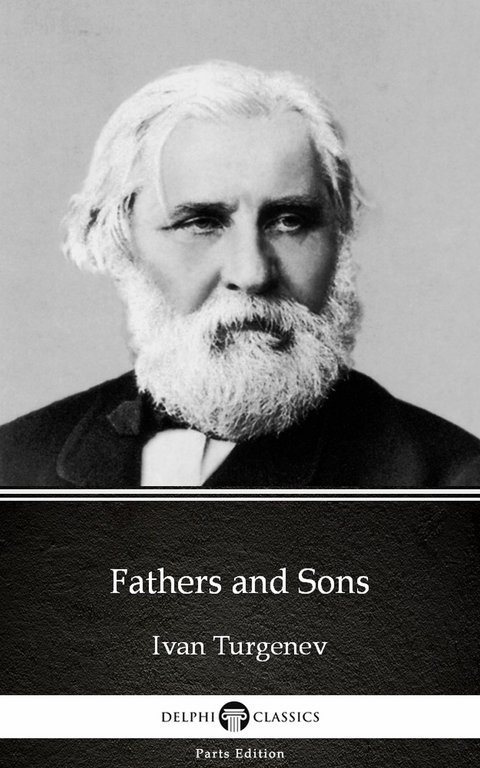
Fathers and Sons by Ivan Turgenev - Delphi Classics (Illustrated) (eBook)
163 Seiten
Publishdrive (Verlag)
978-1-78877-032-3 (ISBN)
Having established their name as the leading publisher of classic literature and art, Delphi Classics produce publications that are individually crafted with superior formatting, while introducing many rare texts for the first time in digital print. The Delphi Classics edition of Turgenev includes original annotations and illustrations relating to the life and works of the author, as well as individual tables of contents, allowing you to navigate eBooks quickly and easily.
eBook features:* The complete unabridged text of 'Fathers and Sons by Ivan Turgenev - Delphi Classics (Illustrated)'
* Beautifully illustrated with images related to Turgenev's works
* Individual contents table, allowing easy navigation around the eBook
* Excellent formatting of the textPlease visit www.delphiclassics.com to learn more about our wide range of titles
This eBook features the unabridged text of 'Fathers and Sons by Ivan Turgenev - Delphi Classics (Illustrated)' from the bestselling edition of 'The Collected Works of Ivan Turgenev'. Having established their name as the leading publisher of classic literature and art, Delphi Classics produce publications that are individually crafted with superior formatting, while introducing many rare texts for the first time in digital print. The Delphi Classics edition of Turgenev includes original annotations and illustrations relating to the life and works of the author, as well as individual tables of contents, allowing you to navigate eBooks quickly and easily.eBook features:* The complete unabridged text of 'Fathers and Sons by Ivan Turgenev - Delphi Classics (Illustrated)'* Beautifully illustrated with images related to Turgenev's works* Individual contents table, allowing easy navigation around the eBook* Excellent formatting of the textPlease visit www.delphiclassics.com to learn more about our wide range of titles
CHAPTER III
‘So here you are, a graduate at last, and come home again,’ said Nikolai Petrovitch, touching Arkady now on the shoulder, now on the knee. ‘At last!’
‘And how is uncle? quite well?’ asked Arkady, who, in spite of the genuine, almost childish delight filling his heart, wanted as soon as possible to turn the conversation from the emotional into a commonplace channel.
‘Quite well. He was thinking of coming with me to meet you, but for some reason or other he gave up the idea.’
‘And how long have you been waiting for me?’ inquired Arkady.
‘Oh, about five hours.’
‘Dear old dad!’
Arkady turned round quickly to his father, and gave him a sounding kiss on the cheek. Nikolai Petrovitch gave vent to a low chuckle.
‘I have got such a capital horse for you!’ he began. ‘You will see. And your room has been fresh papered.’
‘And is there a room for Bazarov?’
‘We will find one for him too.’
‘Please, dad, make much of him. I can’t tell you how I prize his friendship.’
‘Have you made friends with him lately?’
‘Yes, quite lately.’
‘Ah, that’s how it is I did not see him last winter. What does he study?’
‘His chief subject is natural science. But he knows everything. Next year he wants to take his doctor’s degree.’
‘Ah! he’s in the medical faculty,’ observed Nikolai Petrovitch, and he was silent for a little. ‘Piotr,’ he went on, stretching out his hand, ‘aren’t those our peasants driving along?’
Piotr looked where his master was pointing. Some carts harnessed with unbridled horses were moving rapidly along a narrow by - road. In each cart there were one or two peasants in sheepskin coats, unbuttoned.
‘Yes, sir,’ replied Piotr.
‘Where are they going, — to the town?’
‘To the town, I suppose. To the gin - shop,’ he added contemptuously, turning slightly towards the coachman, as though he would appeal to him. But the latter did not stir a muscle; he was a man of the old stamp, and did not share the modern views of the younger generation.
‘I have had a lot of bother with the peasants this year,’ pursued Nikolai Petrovitch, turning to his son. ‘They won’t pay their rent. What is one to do?’
‘But do you like your hired labourers?’
‘Yes,’ said Nikolai Petrovitch between his teeth. ‘They’re being set against me, that’s the mischief; and they don’t do their best. They spoil the tools. But they have tilled the land pretty fairly. When things have settled down a bit, it will be all right. Do you take an interest in farming now?’
‘You’ve no shade; that’s a pity,’ remarked Arkady, without answering the last question.
‘I have had a great awning put up on the north side over the balcony,’ observed Nikolai Petrovitch; ‘now we can have dinner even in the open air.’
‘It’ll be rather too like a summer villa.... Still, that’s all nonsense. What air though here! How delicious it smells! Really I fancy there’s nowhere such fragrance in the world as in the meadows here! And the sky too.’
Arkady suddenly stopped short, cast a stealthy look behind him, and said no more.
‘Of course,’ observed Nikolai Petrovitch, ‘you were born here, and so everything is bound to strike you in a special — —’
‘Come, dad, that makes no difference where a man is born.’
‘Still — —’
‘No; it makes absolutely no difference.’
Nikolai Petrovitch gave a sidelong glance at his son, and the carriage went on a half - a - mile further before the conversation was renewed between them.
‘I don’t recollect whether I wrote to you,’ began Nikolai Petrovitch, ‘your old nurse, Yegorovna, is dead.’
‘Really? Poor thing! Is Prokofitch still living?’
‘Yes, and not a bit changed. As grumbling as ever. In fact, you won’t find many changes at Maryino.’
‘Have you still the same bailiff?’
‘Well, to be sure there is a change there. I decided not to keep about me any freed serfs, who have been house servants, or, at least, not to intrust them with duties of any responsibility.’ (Arkady glanced towards Piotr.) ‘Il est libre, en effet,’ observed Nikolai Petrovitch in an undertone; ‘but, you see, he’s only a valet. Now I have a bailiff, a townsman; he seems a practical fellow. I pay him two hundred and fifty roubles a year. But,’ added Nikolai Petrovitch, rubbing his forehead and eyebrows with his hand, which was always an indication with him of inward embarrassment, ‘I told you just now that you would not find changes at Maryino.... That’s not quite correct. I think it my duty to prepare you, though....’
He hesitated for an instant, and then went on in French.
‘A severe moralist would regard my openness, as improper; but, in the first place, it can’t be concealed, and secondly, you are aware I have always had peculiar ideas as regards the relation of father and son. Though, of course, you would be right in blaming me. At my age.... In short ... that ... that girl, about whom you have probably heard already ...’
‘Fenitchka?’ asked Arkady easily.
Nikolai Petrovitch blushed. ‘Don’t mention her name aloud, please.... Well ... she is living with me now. I have installed her in the house ... there were two little rooms there. But that can all be changed.’
‘Goodness, daddy, what for?’
‘Your friend is going to stay with us ... it would be awkward ...’
‘Please don’t be uneasy on Bazarov’s account. He’s above all that.’
‘Well, but you too,’ added Nikolai Petrovitch. ‘The little lodge is so horrid — that’s the worst of it.’
‘Goodness, dad,’ interposed Arkady, ‘it’s as if you were apologising; I wonder you’re not ashamed.’
‘Of course, I ought to be ashamed,’ answered Nikolai Petrovitch, flushing more and more.
‘Nonsense, dad, nonsense; please don’t!’ Arkady smiled affectionately. ‘What a thing to apologise for!’ he thought to himself, and his heart was filled with a feeling of condescending tenderness for his kind, soft - hearted father, mixed with a sense of secret superiority. ‘Please, stop,’ he repeated once more, instinctively revelling in a consciousness of his own advanced and emancipated condition.
Nikolai Petrovitch glanced at him from under the fingers of the hand with which he was still rubbing his forehead, and there was a pang in his heart.... But at once he blamed himself for it.
‘Here are our meadows at last,’ he said after a long silence.
‘And that in front is our forest, isn’t it?’ asked Arkady.
‘Yes. Only I have sold the timber. This year they will cut it down.’
‘Why did you sell it?’
‘The money was needed; besides, that land is to go to the peasants.’
‘Who don’t pay you their rent?’
‘That’s their affair; besides, they will pay it some day.’
‘I am sorry about the forest,’ observed Arkady, and he began to look about him.
The country through which they were driving could not be called picturesque. Fields upon fields stretched all along to the very horizon, now sloping gently upwards, then dropping down again; in some places woods were to be seen, and winding ravines, planted with low, scanty bushes, recalling vividly the representation of them on the old - fashioned maps of the times of Catherine. They came upon little streams too with hollow banks; and tiny lakes with narrow dykes; and little villages, with low hovels under dark and often tumble - down roofs, and slanting barns with walls woven of brushwood and gaping doorways beside neglected threshing - floors; and churches, some brick - built, with stucco peeling off in patches, others wooden, with crosses fallen askew, and overgrown grave - yards. Slowly Arkady’s heart sunk. To complete the picture, the peasants they met were all in tatters and on the sorriest little nags; the willows, with their trunks stripped of bark, and broken branches, stood like ragged beggars along the roadside; cows lean and shaggy and looking pinched up by hunger, were greedily tearing at the grass along the ditches. They looked as though they had just been snatched out of the murderous clutches of some threatening monster; and the piteous state of the weak, starved beasts in the midst of the lovely spring day, called up, like a white phantom, the endless, comfortless winter with its storms, and frosts, and snows.... ‘No,’ thought Arkady, ‘this is not a rich country; it does not impress one by plenty or industry; it can’t, it can’t go on like this, reforms are absolutely necessary ... but how is one to carry them out, how is one to begin?’
Such were Arkady’s reflections; ... but even as he reflected, the spring regained its sway. All around was golden green, all — trees, bushes, grass — shone and stirred gently in wide waves under the soft breath of the...
| Erscheint lt. Verlag | 17.7.2017 |
|---|---|
| Reihe/Serie | Delphi Parts Edition (Ivan Turgenev) | Delphi Parts Edition (Ivan Turgenev) |
| Sprache | englisch |
| Themenwelt | Literatur ► Anthologien |
| Literatur ► Klassiker / Moderne Klassiker | |
| Literatur ► Romane / Erzählungen | |
| Schlagworte | Dostoyevsky • Fathers • House • Rudin • smoke • Tolstoy • virgin |
| ISBN-10 | 1-78877-032-3 / 1788770323 |
| ISBN-13 | 978-1-78877-032-3 / 9781788770323 |
| Informationen gemäß Produktsicherheitsverordnung (GPSR) | |
| Haben Sie eine Frage zum Produkt? |
 EPUB (Adobe DRM)
Größe: 1,3 MB
Kopierschutz: Adobe-DRM
Adobe-DRM ist ein Kopierschutz, der das eBook vor Mißbrauch schützen soll. Dabei wird das eBook bereits beim Download auf Ihre persönliche Adobe-ID autorisiert. Lesen können Sie das eBook dann nur auf den Geräten, welche ebenfalls auf Ihre Adobe-ID registriert sind.
Details zum Adobe-DRM
Dateiformat: EPUB (Electronic Publication)
EPUB ist ein offener Standard für eBooks und eignet sich besonders zur Darstellung von Belletristik und Sachbüchern. Der Fließtext wird dynamisch an die Display- und Schriftgröße angepasst. Auch für mobile Lesegeräte ist EPUB daher gut geeignet.
Systemvoraussetzungen:
PC/Mac: Mit einem PC oder Mac können Sie dieses eBook lesen. Sie benötigen eine
eReader: Dieses eBook kann mit (fast) allen eBook-Readern gelesen werden. Mit dem amazon-Kindle ist es aber nicht kompatibel.
Smartphone/Tablet: Egal ob Apple oder Android, dieses eBook können Sie lesen. Sie benötigen eine
Geräteliste und zusätzliche Hinweise
Buying eBooks from abroad
For tax law reasons we can sell eBooks just within Germany and Switzerland. Regrettably we cannot fulfill eBook-orders from other countries.
EPUB (Ohne DRM)Digital Rights Management: ohne DRM
Dieses eBook enthält kein DRM oder Kopierschutz. Eine Weitergabe an Dritte ist jedoch rechtlich nicht zulässig, weil Sie beim Kauf nur die Rechte an der persönlichen Nutzung erwerben.
Dateiformat: EPUB (Electronic Publication)
EPUB ist ein offener Standard für eBooks und eignet sich besonders zur Darstellung von Belletristik und Sachbüchern. Der Fließtext wird dynamisch an die Display- und Schriftgröße angepasst. Auch für mobile Lesegeräte ist EPUB daher gut geeignet.
Systemvoraussetzungen:
PC/Mac: Mit einem PC oder Mac können Sie dieses eBook lesen. Sie benötigen dafür die kostenlose Software Adobe Digital Editions.
eReader: Dieses eBook kann mit (fast) allen eBook-Readern gelesen werden. Mit dem amazon-Kindle ist es aber nicht kompatibel.
Smartphone/Tablet: Egal ob Apple oder Android, dieses eBook können Sie lesen. Sie benötigen dafür eine kostenlose App.
Geräteliste und zusätzliche Hinweise
Buying eBooks from abroad
For tax law reasons we can sell eBooks just within Germany and Switzerland. Regrettably we cannot fulfill eBook-orders from other countries.
aus dem Bereich