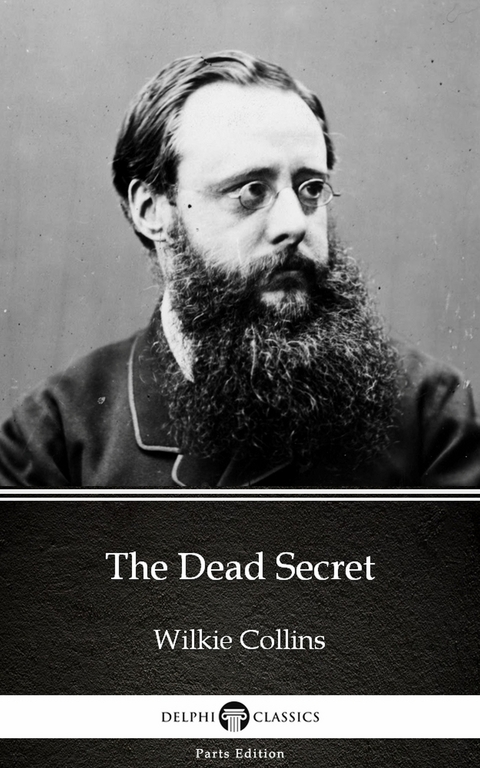
Dead Secret by Wilkie Collins - Delphi Classics (Illustrated) (eBook)
262 Seiten
Publishdrive (Verlag)
978-1-78877-065-1 (ISBN)

Having established their name as the leading publisher of classic literature and art, Delphi Classics produce publications that are individually crafted with superior formatting, while introducing many rare texts for the first time in digital print. The Delphi Classics edition of Collins includes original annotations and illustrations relating to the life and works of the author, as well as individual tables of contents, allowing you to navigate eBooks quickly and easily.
eBook features:* The complete unabridged text of 'The Dead Secret by Wilkie Collins - Delphi Classics (Illustrated)'
* Beautifully illustrated with images related to Collins's works
* Individual contents table, allowing easy navigation around the eBook
* Excellent formatting of the textPlease visit www.delphiclassics.com to learn more about our wide range of titles
This eBook features the unabridged text of 'The Dead Secret by Wilkie Collins - Delphi Classics (Illustrated)' from the bestselling edition of 'The Complete Works of Wilkie Collins'. Having established their name as the leading publisher of classic literature and art, Delphi Classics produce publications that are individually crafted with superior formatting, while introducing many rare texts for the first time in digital print. The Delphi Classics edition of Collins includes original annotations and illustrations relating to the life and works of the author, as well as individual tables of contents, allowing you to navigate eBooks quickly and easily.eBook features:* The complete unabridged text of 'The Dead Secret by Wilkie Collins - Delphi Classics (Illustrated)'* Beautifully illustrated with images related to Collins's works* Individual contents table, allowing easy navigation around the eBook* Excellent formatting of the textPlease visit www.delphiclassics.com to learn more about our wide range of titles
CHAPTER II.
THE CHILD.
The instant Sarah Leeson had turned the key of her bedroom door, she took the sheet of note-paper from its place of concealment in her bosom — shuddering, when she drew it out, as if the mere contact of it hurt her — placed it open on her little dressing-table, and fixed her eyes eagerly on the lines which the note contained. At first they swam and mingled together before her. She pressed her hands over her eyes, for a few minutes, and then looked at the writing again.
The characters were clear now — vividly clear, and, as she fancied, unnaturally large and near to view. There was the address: “To my Husband;” there the first blotted line beneath, in her dead mistress’s handwriting; there the lines that followed, traced by her own pen, with the signature at the end — Mrs. Treverton’s first, and then her own. The whole amounted to but very few sentences, written on one perishable fragment of paper, which the flame of a candle would have consumed in a moment. Yet there she sat, reading, reading, reading, over and over again; never touching the note, except when it was absolutely necessary to turn over the first page; never moving, never speaking, never raising her eyes from the paper. As a condemned prisoner might read his death-warrant, so did Sarah Leeson now read the few lines which she and her mistress had written together not half an hour since.
The secret of the paralyzing effect of that writing on her mind lay, not only in itself, but in the circumstances which had attended the act of its production.
The oath which had been proposed by Mrs. Treverton under no more serious influence than the last caprice of her disordered faculties, stimulated by confused remembrances of stage words and stage situations, had been accepted by Sarah Leeson as the most sacred and inviolable engagement to which she could bind herself. The threat of enforcing obedience to her last commands from beyond the grave, which the mistress had uttered in mocking experiment on the superstitious fears of the maid, now hung darkly over the weak mind of Sarah, as a judgment which might descend on her, visibly and inexorably, at any moment of her future life. When she roused herself at last, and pushed away the paper and rose to her feet, she stood quite still for an instant, before she ventured to look behind her. When she did look, it was with an effort and a start, with a searching distrust of the empty dimness in the remoter corners of the room.
Her old habit of talking to herself began to resume its influence, as she now walked rapidly backward and forward, sometimes along the room and sometimes across it. She repeated incessantly such broken phrases as these: “How can I give him the letter? — Such a good master; so kind to us all. — Why did she die, and leave it all to me? — I can’t bear it alone; it’s too much for me.” While reiterating these sentences, she vacantly occupied herself in putting things about the room in order, which were set in perfect order already. All her looks, all her actions, betrayed the vain struggle of a weak mind to sustain itself under the weight of a heavy responsibility. She arranged and re-arranged the cheap china ornaments on her chimney-piece a dozen times over — put her pin-cushion first on the looking-glass, then on the table in front of it — changed the position of the little porcelain dish and tray on her wash-hand-stand, now to one side of the basin, and now to the other. Throughout all these trifling actions the natural grace, delicacy, and prim neat-handedness of the woman still waited mechanically on the most useless and aimless of her occupations of the moment. She knocked nothing down, she put nothing awry; her footsteps at the fastest made no sound — the very skirts of her dress were kept as properly and prudishly composed as if it was broad daylight and the eyes of all her neighbors were looking at her.
From time to time the sense of the words she was murmuring confusedly to herself changed. Sometimes they disjointedly expressed bolder and more self-reliant thoughts. Once they seemed to urge her again to the dressing-table and the open letter on it, against her own will. She read aloud the address, “To my Husband,” and caught the letter up sharply, and spoke in firmer tones. “Why give it to him at all? Why not let the secret die with her and die with me, as it ought? Why should he know it? He shall not know it!”
Saying those last words, she desperately held the letter within an inch of the flame of the candle. At the same moment the white curtain over the window before her stirred a little, as the freshening air found its way through the old-fashioned, ill-fitting sashes. Her eye caught sight of it, as it waved gently backward and forward. She clasped the letter suddenly to her breast with both hands, and shrank back against the wall of the room, her eyes still fastened on the curtain with the same blank look of horror which they had exhibited when Mrs. Treverton had threatened to claim her servant’s obedience from the other world.
“Something moves,” she gasped to herself, in a breathless whisper. “Something moves in the room.”
The curtain waved slowly to and fro for the second time. Still fixedly looking at it over her shoulder, she crept along the wall to the door.
“Do you come to me already?” she said, her eyes riveted on the curtain while her hand groped over the lock for the key. “Before your grave is dug? Before your coffin is made? Before your body is cold?”
She opened the door and glided into the passage; stopped there for a moment, and looked back into the room.
“Rest!” she said. “Rest, mistress — he shall have the letter.”
The staircase-lamp guided her out of the passage. Descending hurriedly, as if she feared to give herself time to think, she reached Captain Treverton’s study, on the ground-floor, in a minute or two. The door was wide open, and the room was empty.
After reflecting a little, she lighted one of the chamber-candles standing on the hall-table, at the lamp in the study, and ascended the stairs again to her master’s bedroom. After repeatedly knocking at the door and obtaining no answer, she ventured to go in. The bed had not been disturbed, the candles had not been lit — to all appearance the room had not even been entered during the night.
There was but one other place to seek him — the chamber in which his wife lay dead. Could she summon the courage to give him the letter there? She hesitated a little — then whispered, “I must! I must!”
The direction she now compelled herself to take led her a little way down the stairs again. She descended very slowly this time, holding cautiously by the banisters, and pausing to take breath almost at every step. The door of what had been Mrs. Treverton’s bedroom was opened, when she ventured to knock at it, by the nurse, who inquired, roughly and suspiciously, what she wanted there.
“I want to speak to my master.”
“Look for him somewhere else. He was here half an hour ago. He is gone now.”
“Do you know where he has gone?”
“No. I don’t pry into other people’s goings and comings. I mind my own business.”
With that discourteous answer, the nurse closed the door again. Just as Sarah turned away from it she looked toward the inner end of the passage. The door of the nursery was situated there. It was ajar, and a dim gleam of candle-light was flickering through it.
She went in immediately, and saw that the candle-light came from an inner room, usually occupied, as she well knew, by the nursery-maid and by the only child of the house of Treverton — a little girl named Rosamond, aged, at that time, nearly five years.
“Can he be there? — in that room, of all the rooms in the house!”
Quickly as the thought arose in her mind, Sarah raised the letter (which she had hitherto carried in her hand) to the bosom of her dress, and hid it for the second time, exactly as she had hidden it on leaving her mistress’s bedside.
She then stole across the nursery on tiptoe toward the inner room. The entrance to it, to please some caprice of the child’s, had been arched, and framed with trellis-work, gayly colored, so as to resemble the entrance to a summer-house. Two pretty chintz curtains, hanging inside the trellis-work, formed the only barrier between the day-room and the bedroom. One of these was looped up, and toward the opening thus made Sarah now advanced, after cautiously leaving her candle in the passage outside.
The first object that attracted her attention in the child’s bedroom was the figure of the nurse-maid, leaning back, fast asleep, in an easy-chair by the window. Venturing, after this discovery, to look more boldly into the room, she next saw her master sitting with his back toward her, by the side of the child’s crib. Little Rosamond was awake, and was standing up in bed with her arms round her father’s neck. One of her hands held over his shoulder the doll that she had taken to bed with her, the other was twined gently in his hair. The child had been crying bitterly, and had now exhausted herself, so that she was only moaning a little from time to time, with her head laid wearily on her father’s bosom.
The tears stood thick in Sarah’s eyes as they looked on her master and on the little hands that lay round his neck. She lingered by the raised curtain,...
| Erscheint lt. Verlag | 17.7.2017 |
|---|---|
| Reihe/Serie | Delphi Parts Edition (Wilkie Collins) | Delphi Parts Edition (Wilkie Collins) |
| Sprache | englisch |
| Themenwelt | Literatur ► Anthologien |
| Literatur ► Klassiker / Moderne Klassiker | |
| Literatur ► Romane / Erzählungen | |
| Schlagworte | Armadale • Dickens • Hide • leaves • Moonstone • Name • Stories • Woman |
| ISBN-10 | 1-78877-065-X / 178877065X |
| ISBN-13 | 978-1-78877-065-1 / 9781788770651 |
| Informationen gemäß Produktsicherheitsverordnung (GPSR) | |
| Haben Sie eine Frage zum Produkt? |
 EPUB (Adobe DRM)
Größe: 1,3 MB
Kopierschutz: Adobe-DRM
Adobe-DRM ist ein Kopierschutz, der das eBook vor Mißbrauch schützen soll. Dabei wird das eBook bereits beim Download auf Ihre persönliche Adobe-ID autorisiert. Lesen können Sie das eBook dann nur auf den Geräten, welche ebenfalls auf Ihre Adobe-ID registriert sind.
Details zum Adobe-DRM
Dateiformat: EPUB (Electronic Publication)
EPUB ist ein offener Standard für eBooks und eignet sich besonders zur Darstellung von Belletristik und Sachbüchern. Der Fließtext wird dynamisch an die Display- und Schriftgröße angepasst. Auch für mobile Lesegeräte ist EPUB daher gut geeignet.
Systemvoraussetzungen:
PC/Mac: Mit einem PC oder Mac können Sie dieses eBook lesen. Sie benötigen eine
eReader: Dieses eBook kann mit (fast) allen eBook-Readern gelesen werden. Mit dem amazon-Kindle ist es aber nicht kompatibel.
Smartphone/Tablet: Egal ob Apple oder Android, dieses eBook können Sie lesen. Sie benötigen eine
Geräteliste und zusätzliche Hinweise
Buying eBooks from abroad
For tax law reasons we can sell eBooks just within Germany and Switzerland. Regrettably we cannot fulfill eBook-orders from other countries.
EPUB (Ohne DRM)Digital Rights Management: ohne DRM
Dieses eBook enthält kein DRM oder Kopierschutz. Eine Weitergabe an Dritte ist jedoch rechtlich nicht zulässig, weil Sie beim Kauf nur die Rechte an der persönlichen Nutzung erwerben.
Dateiformat: EPUB (Electronic Publication)
EPUB ist ein offener Standard für eBooks und eignet sich besonders zur Darstellung von Belletristik und Sachbüchern. Der Fließtext wird dynamisch an die Display- und Schriftgröße angepasst. Auch für mobile Lesegeräte ist EPUB daher gut geeignet.
Systemvoraussetzungen:
PC/Mac: Mit einem PC oder Mac können Sie dieses eBook lesen. Sie benötigen dafür die kostenlose Software Adobe Digital Editions.
eReader: Dieses eBook kann mit (fast) allen eBook-Readern gelesen werden. Mit dem amazon-Kindle ist es aber nicht kompatibel.
Smartphone/Tablet: Egal ob Apple oder Android, dieses eBook können Sie lesen. Sie benötigen dafür eine kostenlose App.
Geräteliste und zusätzliche Hinweise
Buying eBooks from abroad
For tax law reasons we can sell eBooks just within Germany and Switzerland. Regrettably we cannot fulfill eBook-orders from other countries.
aus dem Bereich