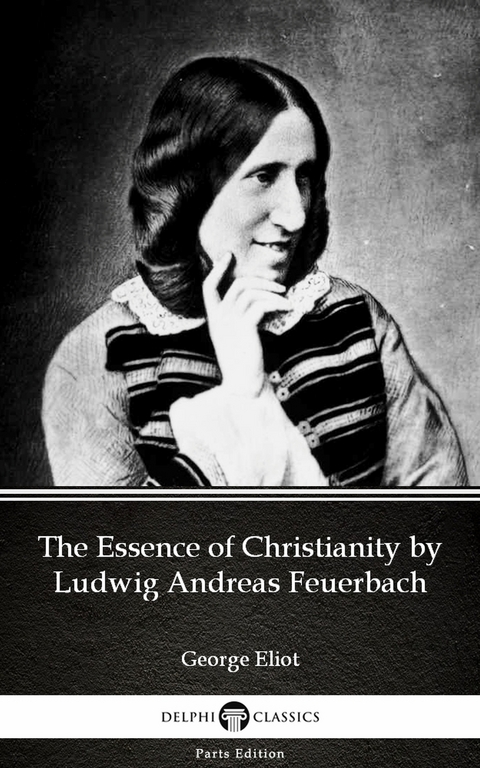
Essence of Christianity by Ludwig Andreas Feuerbach by George Eliot - Delphi Classics (Illustrated) (eBook)
196 Seiten
Publishdrive (Verlag)
978-1-78877-012-5 (ISBN)
Having established their name as the leading publisher of classic literature and art, Delphi Classics produce publications that are individually crafted with superior formatting, while introducing many rare texts for the first time in digital print. The Delphi Classics edition of Eliot includes original annotations and illustrations relating to the life and works of the author, as well as individual tables of contents, allowing you to navigate eBooks quickly and easily.
eBook features:* The complete unabridged text of 'The Essence of Christianity by Ludwig Andreas Feuerbach by George Eliot - Delphi Classics (Illustrated)'
* Beautifully illustrated with images related to Eliot's works
* Individual contents table, allowing easy navigation around the eBook
* Excellent formatting of the textPlease visit www.delphiclassics.com to learn more about our wide range of titles
This eBook features the unabridged text of 'The Essence of Christianity by Ludwig Andreas Feuerbach by George Eliot - Delphi Classics (Illustrated)' from the bestselling edition of 'The Complete Works of George Eliot'. Having established their name as the leading publisher of classic literature and art, Delphi Classics produce publications that are individually crafted with superior formatting, while introducing many rare texts for the first time in digital print. The Delphi Classics edition of Eliot includes original annotations and illustrations relating to the life and works of the author, as well as individual tables of contents, allowing you to navigate eBooks quickly and easily.eBook features:* The complete unabridged text of 'The Essence of Christianity by Ludwig Andreas Feuerbach by George Eliot - Delphi Classics (Illustrated)'* Beautifully illustrated with images related to Eliot's works* Individual contents table, allowing easy navigation around the eBook* Excellent formatting of the textPlease visit www.delphiclassics.com to learn more about our wide range of titles
CHAPTER II.
GOD AS A BEING OF THE UNDERSTANDING.
Religion is the disuniting of man from himself: he sets God before him as the antithesis of himself. God is not what man is — man is not what God is. God is the infinite, man the finite being; God is perfect, man imperfect; God eternal, man temporal; God almighty, man weak; God holy, man sinful. God and man are extremes: God is the absolutely positive, the sum of all realities; man the absolutely negative, comprehending all negations.
But in religion man contemplates his own latent nature. Hence it must be shown that this antithesis, this differencing of God and man, with which religion begins, is a differencing of man with his own nature.
The inherent necessity of this proof is at once apparent from this, — that if the divine nature, which is the object of religion, were really different from the nature of man, a division, a disunion could not take place. If God is really a different being from myself, why should his perfection trouble me? Disunion exists only between beings who are at variance, but who ought to be one, who can be one, and who consequently in nature, in truth, are one. On this general ground, then, the nature with which man feels himself in disunion, must be inborn, immanent in himself, but at the same time it must be of a different character from that nature or power which gives him the feeling, the consciousness of reconciliation, of union with God, or, what is the same thing, with himself.
This nature is nothing else than the intelligence — the reason or the understanding. God as the antithesis of man, as a being not human, i.e., not personally human, is the objective nature of the understanding. The pure, perfect divine nature is the self-consciousness of the understanding, the consciousness which the understanding has of its own perfection. The understanding knows nothing of the sufferings of the heart; it has no desires, no passions, no wants, and for that reason, no deficiencies and weaknesses, as the heart has. Men in whom the intellect predominates, who with one-sided but all the more characteristic definiteness, embody and personify for us the nature of the understanding, are free from the anguish of the heart, from the passions, the excesses of the man who has strong emotions; they are not passionately interested in any finite, i.e., particular object; they do not give themselves in pledge; they are free. “To want nothing, and by this freedom from wants to become like the immortal Gods;”—”not to subject ourselves to things but things to us;”—”all is vanity;” — these and similar sayings are the mottoes of the men who are governed by abstract understanding. The understanding is that part of our nature which is neutral, impassible, not to be bribed, not subject to illusions — the pure, passionless light of the intelligence. It is the categorical, impartial consciousness of the fact as fact, because it is itself of an objective nature. It is the consciousness of the uncontradictory, because it is itself the uncontradictory unity, the source of logical identity. It is the consciousness of law, necessity, rule, measure, because it is itself the activity of law, the necessity of the nature of things under the form of spontaneous activity, the rule of rules, the absolute measure, the measure of measures. Only by the understanding can man judge and act in contradiction with his dearest human, that is, personal feelings, when the God of the understanding, — law, necessity, right, — commands it. The father who as a judge condemns his own son to death because he knows him to be guilty, can do this only as a rational not as an emotional being. The understanding shews us the faults and weaknesses even of our beloved ones; it shews us even our own. It is for this reason that it so often throws us into painful collision with ourselves, with our own hearts. We do not like to give reason the upper hand: we are too tender to ourselves to carry out the true, but hard, relentless verdict of the understanding. The understanding is the power which has relation to species: the heart represents particular circumstances, individuals, — the understanding, general circumstances, universals; it is the superhuman, i.e., the impersonal power in man. Only by and in the understanding has man the power of abstraction from himself, from his subjective being, — of exalting himself to general ideas and relations, of distinguishing the object from the impressions which it produces on his feelings, of regarding it in and by itself without reference to human personality. Philosophy, mathematics, astronomy, physics, in short, science in general, is the practical proof, because it is the product, of this truly infinite and divine activity. Religious anthropomorphisms, therefore, are in contradiction with the understanding; it repudiates their application to God; it denies them. But this God, free from anthropomorphisms, impartial, passionless, is nothing else than the nature of the understanding itself regarded as objective.
God as God, that is, as a being not finite, not human, not materially conditioned, not phenomenal, is only an object of thought. He is the incorporeal, formless, incomprehensible — the abstract, negative being: he is known, i.e., becomes an object, only by abstraction and negation (via negationis). Why? Because he is nothing but the objective nature of the thinking power, or in general, of the power or activity, name it what you will, whereby man is conscious of reason, of mind, of intelligence. There is no other spirit, that is, (for the idea of spirit is simply the idea of thought, of intelligence, of understanding, every other spirit being a spectre of the imagination,) no other intelligence which man can believe in or conceive, than that intelligence which enlightens him, which is active in him. He can do nothing more than separate the intelligence from the limitations of his own individuality. The “infinite spirit,” in distinction from the finite, is therefore nothing else than the intelligence disengaged from the limits of individuality and corporeality, — for individuality and corporeality are inseparable, — intelligence posited in and by itself. God, said the schoolmen, the Christian fathers, and long before them the heathen philosophers, — God is immaterial essence, intelligence, spirit, pure understanding. Of God as God, no image can be made; but canst thou frame an image of mind? Has mind a form? Is not its activity the most inexplicable, the most incapable of representation? God is incomprehensible; but knowest thou the nature of the intelligence? Hast thou searched out the mysterious operation of thought, the hidden nature of self-consciousness? Is not self-consciousness the enigma of enigmas? Did not the old mystics, schoolmen, and fathers, long ago compare the incomprehensibility of the divine nature with that of the human intelligence, and thus, in truth, identify the nature of God with the nature of man? God as God — as a purely thinkable being, an object of the intellect, — is thus nothing else than the reason in its utmost intensification become objective to itself. It is asked what is the understanding or the reason? The answer is found in the idea of God. Everything must express itself, reveal itself, make itself objective, affirm itself. God is the reason expressing, affirming itself as the highest existence. To the imagination, the reason is the revelation of God; but to the reason, God is the revelation of the reason; since what reason is, what it can do, is first made objective in God. God is a need of the intelligence, a necessary thought — the highest degree of the thinking power. “The reason cannot rest in sensuous things;” it can find contentment only when it penetrates to the highest, first, necessary being, which can be an object to the reason alone. Why? Because with the conception of this being it first completes itself, because only in the idea of the highest nature is the highest nature of reason existent, the highest step of the thinking power attained; and it is a general truth, that we feel a blank, a void, a want in ourselves, and are consequently unhappy and unsatisfied, so long as we have not come to the last degree of a power, to that quo nihil majus cogitari potest, — so long as we cannot bring our inborn capacity for this or that art, this or that science, to the utmost proficiency. For only in the highest proficiency is art truly art; only in its highest degree is thought truly thought, reason. Only when thy thought is God, dost thou truly think, rigorously speaking; for only God is the realized, consummate, exhausted thinking power. Thus in conceiving God, man first conceives reason as it truly is, though by means of the imagination he conceives this divine nature as distinct from reason, because as a being affected by external things he is accustomed always to distinguish the object from the conception of it. And here he applies the same process to the conception of the reason, thus, for an existence in reason, in thought, substituting an existence in space and time, from which he had, nevertheless, previously abstracted it. God, as a metaphysical being, is the intelligence satisfied in itself, or rather, conversely, the intelligence satisfied in itself, thinking itself as the absolute being, is God as a metaphysical being. Hence all metaphysical predicates of God are real predicates only when they are recognised as belonging to thought, to intelligence, to the understanding.
The understanding is that which conditionates and co-ordinates all things, that which places all...
| Erscheint lt. Verlag | 17.7.2017 |
|---|---|
| Reihe/Serie | Delphi Parts Edition (George Eliot) | Delphi Parts Edition (George Eliot) |
| Sprache | englisch |
| Themenwelt | Literatur ► Anthologien |
| Literatur ► Klassiker / Moderne Klassiker | |
| Literatur ► Romane / Erzählungen | |
| Schlagworte | Austen • Bede • deronda • Felix • Floss • Middlemarch • Silas |
| ISBN-10 | 1-78877-012-9 / 1788770129 |
| ISBN-13 | 978-1-78877-012-5 / 9781788770125 |
| Informationen gemäß Produktsicherheitsverordnung (GPSR) | |
| Haben Sie eine Frage zum Produkt? |
 EPUB (Adobe DRM)
Größe: 1,3 MB
Kopierschutz: Adobe-DRM
Adobe-DRM ist ein Kopierschutz, der das eBook vor Mißbrauch schützen soll. Dabei wird das eBook bereits beim Download auf Ihre persönliche Adobe-ID autorisiert. Lesen können Sie das eBook dann nur auf den Geräten, welche ebenfalls auf Ihre Adobe-ID registriert sind.
Details zum Adobe-DRM
Dateiformat: EPUB (Electronic Publication)
EPUB ist ein offener Standard für eBooks und eignet sich besonders zur Darstellung von Belletristik und Sachbüchern. Der Fließtext wird dynamisch an die Display- und Schriftgröße angepasst. Auch für mobile Lesegeräte ist EPUB daher gut geeignet.
Systemvoraussetzungen:
PC/Mac: Mit einem PC oder Mac können Sie dieses eBook lesen. Sie benötigen eine
eReader: Dieses eBook kann mit (fast) allen eBook-Readern gelesen werden. Mit dem amazon-Kindle ist es aber nicht kompatibel.
Smartphone/Tablet: Egal ob Apple oder Android, dieses eBook können Sie lesen. Sie benötigen eine
Geräteliste und zusätzliche Hinweise
Buying eBooks from abroad
For tax law reasons we can sell eBooks just within Germany and Switzerland. Regrettably we cannot fulfill eBook-orders from other countries.
EPUB (Ohne DRM)Digital Rights Management: ohne DRM
Dieses eBook enthält kein DRM oder Kopierschutz. Eine Weitergabe an Dritte ist jedoch rechtlich nicht zulässig, weil Sie beim Kauf nur die Rechte an der persönlichen Nutzung erwerben.
Dateiformat: EPUB (Electronic Publication)
EPUB ist ein offener Standard für eBooks und eignet sich besonders zur Darstellung von Belletristik und Sachbüchern. Der Fließtext wird dynamisch an die Display- und Schriftgröße angepasst. Auch für mobile Lesegeräte ist EPUB daher gut geeignet.
Systemvoraussetzungen:
PC/Mac: Mit einem PC oder Mac können Sie dieses eBook lesen. Sie benötigen dafür die kostenlose Software Adobe Digital Editions.
eReader: Dieses eBook kann mit (fast) allen eBook-Readern gelesen werden. Mit dem amazon-Kindle ist es aber nicht kompatibel.
Smartphone/Tablet: Egal ob Apple oder Android, dieses eBook können Sie lesen. Sie benötigen dafür eine kostenlose App.
Geräteliste und zusätzliche Hinweise
Buying eBooks from abroad
For tax law reasons we can sell eBooks just within Germany and Switzerland. Regrettably we cannot fulfill eBook-orders from other countries.
aus dem Bereich