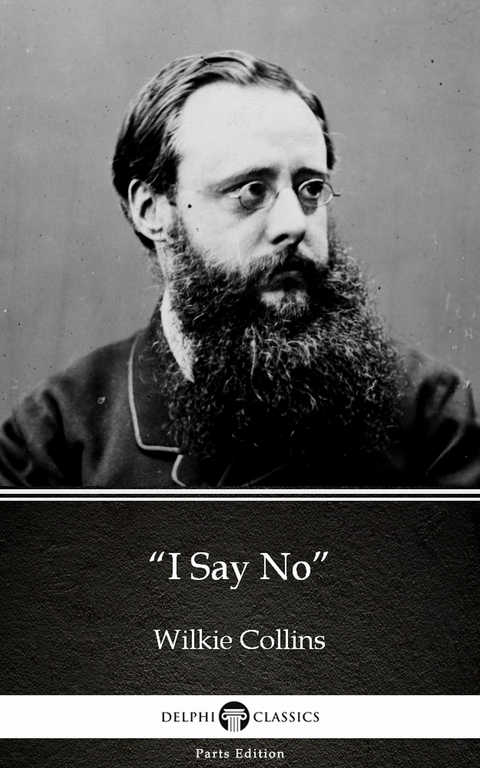
"e;I Say No"e; by Wilkie Collins - Delphi Classics (Illustrated) (eBook)
270 Seiten
Publishdrive (Verlag)
978-1-78877-080-4 (ISBN)

Having established their name as the leading publisher of classic literature and art, Delphi Classics produce publications that are individually crafted with superior formatting, while introducing many rare texts for the first time in digital print. The Delphi Classics edition of Collins includes original annotations and illustrations relating to the life and works of the author, as well as individual tables of contents, allowing you to navigate eBooks quickly and easily.
eBook features:* The complete unabridged text of ''I Say No' by Wilkie Collins - Delphi Classics (Illustrated)'
* Beautifully illustrated with images related to Collins's works
* Individual contents table, allowing easy navigation around the eBook
* Excellent formatting of the textPlease visit www.delphiclassics.com to learn more about our wide range of titles
This eBook features the unabridged text of '"e;I Say No"e; by Wilkie Collins - Delphi Classics (Illustrated)' from the bestselling edition of 'The Complete Works of Wilkie Collins'. Having established their name as the leading publisher of classic literature and art, Delphi Classics produce publications that are individually crafted with superior formatting, while introducing many rare texts for the first time in digital print. The Delphi Classics edition of Collins includes original annotations and illustrations relating to the life and works of the author, as well as individual tables of contents, allowing you to navigate eBooks quickly and easily.eBook features:* The complete unabridged text of '"e;I Say No"e; by Wilkie Collins - Delphi Classics (Illustrated)'* Beautifully illustrated with images related to Collins's works* Individual contents table, allowing easy navigation around the eBook* Excellent formatting of the textPlease visit www.delphiclassics.com to learn more about our wide range of titles
CHAPTER I. THE SMUGGLED SUPPER.
Outside the bedroom the night was black and still. The small rain fell too softly to be heard in the garden; not a leaf stirred in the airless calm; the watch-dog was asleep, the cats were indoors; far or near, under the murky heaven, not a sound was stirring.
Inside the bedroom the night was black and still.
Miss Ladd knew her business as a schoolmistress too well to allow night-lights; and Miss Ladd’s young ladies were supposed to be fast asleep, in accordance with the rules of the house. Only at intervals the silence was faintly disturbed, when the restless turning of one of the girls in her bed betrayed itself by a gentle rustling between the sheets. In the long intervals of stillness, not even the softly audible breathing of young creatures asleep was to be heard.
The first sound that told of life and movement revealed the mechanical movement of the clock. Speaking from the lower regions, the tongue of Father Time told the hour before midnight.
A soft voice rose wearily near the door of the room. It counted the strokes of the clock — and reminded one of the girls of the lapse of time.
“Emily! eleven o’clock.”
There was no reply. After an interval the weary voice tried again, in louder tones:
“Emily!”
A girl, whose bed was at the inner end of the room, sighed under the heavy heat of the night — and said, in peremptory tones, “Is that Cecilia?”
“Yes.”
“What do you want?”
“I’m getting hungry, Emily. Is the new girl asleep?”
The new girl answered promptly and spitefully, “No, she isn’t.”
Having a private object of their own in view, the five wise virgins of Miss Ladd’s first class had waited an hour, in wakeful anticipation of the falling asleep of the stranger — and it had ended in this way! A ripple of laughter ran round the room. The new girl, mortified and offended, entered her protest in plain words.
“You are treating me shamefully! You all distrust me, because I am a stranger.”
“Say we don’t understand you,” Emily answered, speaking for her schoolfellows; “and you will be nearer the truth.”
“Who expected you to understand me, when I only came here to-day? I have told you already my name is Francine de Sor. If want to know more, I’m nineteen years old, and I come from the West Indies.”
Emily still took the lead. “Why do you come here?” she asked. “Who ever heard of a girl joining a new school just before the holidays? You are nineteen years old, are you? I’m a year younger than you — and I have finished my education. The next big girl in the room is a year younger than me — and she has finished her education. What can you possibly have left to learn at your age?”
“Everything!” cried the stranger from the West Indies, with an outburst of tears. “I’m a poor ignorant creature. Your education ought to have taught you to pity me instead of making fun of me. I hate you all. For shame, for shame!”
Some of the girls laughed. One of them — the hungry girl who had counted the strokes of the clock — took Francine’s part.
“Never mind their laughing, Miss de Sor. You are quite right, you have good reason to complain of us.”
Miss de Sor dried her eyes. “Thank you — whoever you are,” she answered briskly.
“My name is Cecilia Wyvil,” the other proceeded. “It was not, perhaps, quite nice of you to say you hated us all. At the same time we have forgotten our good breeding — and the least we can do is to beg your pardon.”
This expression of generous sentiment appeared to have an irritating effect on the peremptory young person who took the lead in the room. Perhaps she disapproved of free trade in generous sentiment.
“I can tell you one thing, Cecilia,” she said; “you shan’t beat ME in generosity. Strike a light, one of you, and lay the blame on me if Miss Ladd finds us out. I mean to shake hands with the new girl — and how can I do it in the dark? Miss de Sor, my name’s Brown, and I’m queen of the bedroom. I — not Cecilia — offer our apologies if we have offended you. Cecilia is my dearest friend, but I don’t allow her to take the lead in the room. Oh, what a lovely nightgown!”
The sudden flow of candle-light had revealed Francine, sitting up in her bed, and displaying such treasures of real lace over her bosom that the queen lost all sense of royal dignity in irrepressible admiration. “Seven and sixpence,” Emily remarked, looking at her own night-gown and despising it. One after another, the girls yielded to the attraction of the wonderful lace. Slim and plump, fair and dark, they circled round the new pupil in their flowing white robes, and arrived by common consent at one and the same conclusion: “How rich her father must be!”
Favored by fortune in the matter of money, was this enviable person possessed of beauty as well?
In the disposition of the beds, Miss de Sor was placed between Cecilia on the right hand, and Emily on the left. If, by some fantastic turn of events, a man — say in the interests of propriety, a married doctor, with Miss Ladd to look after him — had been permitted to enter the room, and had been asked what he thought of the girls when he came out, he would not even have mentioned Francine. Blind to the beauties of the expensive night-gown, he would have noticed her long upper lip, her obstinate chin, her sallow complexion, her eyes placed too close together — and would have turned his attention to her nearest neighbors. On one side his languid interest would have been instantly roused by Cecilia’s glowing auburn hair, her exquisitely pure skin, and her tender blue eyes. On the other, he would have discovered a bright little creature, who would have fascinated and perplexed him at one and the same time. If he had been questioned about her by a stranger, he would have been at a loss to say positively whether she was dark or light: he would have remembered how her eyes had held him, but he would not have known of what color they were. And yet, she would have remained a vivid picture in his memory when other impressions, derived at the same time, had vanished. “There was one little witch among them, who was worth all the rest put together; and I can’t tell you why. They called her Emily. If I wasn’t a married man—” There he would have thought of his wife, and would have sighed and said no more.
While the girls were still admiring Francine, the clock struck the half-hour past eleven.
Cecilia stole on tiptoe to the door — looked out, and listened — closed the door again — and addressed the meeting with the irresistible charm of her sweet voice and her persuasive smile.
“Are none of you hungry yet?” she inquired. “The teachers are safe in their rooms; we have set ourselves right with Francine. Why keep the supper waiting under Emily’s bed?”
Such reasoning as this, with such personal attractions to recommend it, admitted of but one reply. The queen waved her hand graciously, and said, “Pull it out.”
Is a lovely girl — whose face possesses the crowning charm of expression, whose slightest movement reveals the supple symmetry of her figure — less lovely because she is blessed with a good appetite, and is not ashamed to acknowledge it? With a grace all her own, Cecilia dived under the bed, and produced a basket of jam tarts, a basket of fruit and sweetmeats, a basket of sparkling lemonade, and a superb cake — all paid for by general subscriptions, and smuggled into the room by kind connivance of the servants. On this occasion, the feast was especially plentiful and expensive, in commemoration not only of the arrival of the Midsummer holidays, but of the coming freedom of Miss Ladd’s two leading young ladies. With widely different destinies before them, Emily and Cecilia had completed their school life, and were now to go out into the world.
The contrast in the characters of the two girls showed itself, even in such a trifle as the preparations for supper.
Gentle Cecilia, sitting on the floor surrounded by good things, left it to the ingenuity of others to decide whether the baskets should be all emptied at once, or handed round from bed to bed, one at a time. In the meanwhile, her lovely blue eyes rested tenderly on the tarts.
Emily’s commanding spirit seized on the reins of government, and employed each of her schoolfellows in the occupation which she was fittest to undertake. “Miss de Sor, let me look at your hand. Ah! I thought so. You have got the thickest wrist among us; you shall draw the corks. If you let the lemonade pop, not a drop of it goes down your throat. Effie, Annis, Priscilla, you are three notoriously lazy girls; it’s doing you a true kindness to set you to work. Effie, clear the toilet-table for supper; away with the combs, the brushes, and the looking-glass. Annis, tear the leaves out of your book of exercises, and set them out for plates. No! I’ll unpack; nobody touches the baskets but me. Priscilla, you have the prettiest ears in the room. You shall act as sentinel, my dear, and listen at the door. Cecilia, when you have done devouring those tarts with your eyes, take that pair of scissors (Miss de Sor, allow me to apologize for the mean manner in which this school is carried on; the knives and...
| Erscheint lt. Verlag | 17.7.2017 |
|---|---|
| Reihe/Serie | Delphi Parts Edition (Wilkie Collins) | Delphi Parts Edition (Wilkie Collins) |
| Sprache | englisch |
| Themenwelt | Literatur ► Anthologien |
| Literatur ► Klassiker / Moderne Klassiker | |
| Literatur ► Romane / Erzählungen | |
| Schlagworte | Armadale • Dickens • Hide • leaves • Moonstone • Name • Stories • Woman |
| ISBN-10 | 1-78877-080-3 / 1788770803 |
| ISBN-13 | 978-1-78877-080-4 / 9781788770804 |
| Informationen gemäß Produktsicherheitsverordnung (GPSR) | |
| Haben Sie eine Frage zum Produkt? |
 EPUB (Adobe DRM)
Größe: 1,1 MB
Kopierschutz: Adobe-DRM
Adobe-DRM ist ein Kopierschutz, der das eBook vor Mißbrauch schützen soll. Dabei wird das eBook bereits beim Download auf Ihre persönliche Adobe-ID autorisiert. Lesen können Sie das eBook dann nur auf den Geräten, welche ebenfalls auf Ihre Adobe-ID registriert sind.
Details zum Adobe-DRM
Dateiformat: EPUB (Electronic Publication)
EPUB ist ein offener Standard für eBooks und eignet sich besonders zur Darstellung von Belletristik und Sachbüchern. Der Fließtext wird dynamisch an die Display- und Schriftgröße angepasst. Auch für mobile Lesegeräte ist EPUB daher gut geeignet.
Systemvoraussetzungen:
PC/Mac: Mit einem PC oder Mac können Sie dieses eBook lesen. Sie benötigen eine
eReader: Dieses eBook kann mit (fast) allen eBook-Readern gelesen werden. Mit dem amazon-Kindle ist es aber nicht kompatibel.
Smartphone/Tablet: Egal ob Apple oder Android, dieses eBook können Sie lesen. Sie benötigen eine
Geräteliste und zusätzliche Hinweise
Buying eBooks from abroad
For tax law reasons we can sell eBooks just within Germany and Switzerland. Regrettably we cannot fulfill eBook-orders from other countries.
EPUB (Ohne DRM)Digital Rights Management: ohne DRM
Dieses eBook enthält kein DRM oder Kopierschutz. Eine Weitergabe an Dritte ist jedoch rechtlich nicht zulässig, weil Sie beim Kauf nur die Rechte an der persönlichen Nutzung erwerben.
Dateiformat: EPUB (Electronic Publication)
EPUB ist ein offener Standard für eBooks und eignet sich besonders zur Darstellung von Belletristik und Sachbüchern. Der Fließtext wird dynamisch an die Display- und Schriftgröße angepasst. Auch für mobile Lesegeräte ist EPUB daher gut geeignet.
Systemvoraussetzungen:
PC/Mac: Mit einem PC oder Mac können Sie dieses eBook lesen. Sie benötigen dafür die kostenlose Software Adobe Digital Editions.
eReader: Dieses eBook kann mit (fast) allen eBook-Readern gelesen werden. Mit dem amazon-Kindle ist es aber nicht kompatibel.
Smartphone/Tablet: Egal ob Apple oder Android, dieses eBook können Sie lesen. Sie benötigen dafür eine kostenlose App.
Geräteliste und zusätzliche Hinweise
Buying eBooks from abroad
For tax law reasons we can sell eBooks just within Germany and Switzerland. Regrettably we cannot fulfill eBook-orders from other countries.
aus dem Bereich