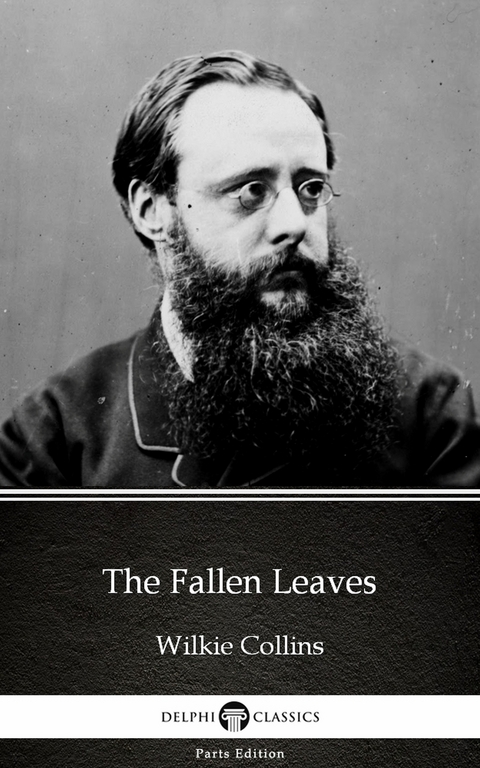
Fallen Leaves by Wilkie Collins - Delphi Classics (Illustrated) (eBook)
262 Seiten
Publishdrive (Verlag)
978-1-78877-076-7 (ISBN)
Having established their name as the leading publisher of classic literature and art, Delphi Classics produce publications that are individually crafted with superior formatting, while introducing many rare texts for the first time in digital print. The Delphi Classics edition of Collins includes original annotations and illustrations relating to the life and works of the author, as well as individual tables of contents, allowing you to navigate eBooks quickly and easily.
eBook features:* The complete unabridged text of 'The Fallen Leaves by Wilkie Collins - Delphi Classics (Illustrated)'
* Beautifully illustrated with images related to Collins's works
* Individual contents table, allowing easy navigation around the eBook
* Excellent formatting of the textPlease visit www.delphiclassics.com to learn more about our wide range of titles
This eBook features the unabridged text of 'The Fallen Leaves by Wilkie Collins - Delphi Classics (Illustrated)' from the bestselling edition of 'The Complete Works of Wilkie Collins'. Having established their name as the leading publisher of classic literature and art, Delphi Classics produce publications that are individually crafted with superior formatting, while introducing many rare texts for the first time in digital print. The Delphi Classics edition of Collins includes original annotations and illustrations relating to the life and works of the author, as well as individual tables of contents, allowing you to navigate eBooks quickly and easily.eBook features:* The complete unabridged text of 'The Fallen Leaves by Wilkie Collins - Delphi Classics (Illustrated)'* Beautifully illustrated with images related to Collins's works* Individual contents table, allowing easy navigation around the eBook* Excellent formatting of the textPlease visit www.delphiclassics.com to learn more about our wide range of titles
CHAPTER 1
Sixteen years after the date of Mr. Ronald’s disastrous discovery at Ramsgate — that is to say, in the year 1872 — the steamship Aquila left the port of New York, bound for Liverpool.
It was the month of September. The passenger-list of the Aquila had comparatively few names inscribed on it. In the autumn season, the voyage from America to England, but for the remunerative value of the cargo, would prove to be for the most part a profitless voyage to shipowners. The flow of passengers, at that time of year, sets steadily the other way. Americans are returning from Europe to their own country. Tourists have delayed the voyage until the fierce August heat of the United States has subsided, and the delicious Indian summer is ready to welcome them. At bed and board the passengers by the Aquila on her homeward voyage had plenty of room, and the choicest morsels for everybody alike on the well spread dinner-table.
The wind was favourable, the weather was lovely. Cheerfulness and good-humour pervaded the ship from stem to stern. The courteous captain did the honours of the cabin-table with the air of a gentleman who was receiving friends in his own house. The handsome doctor promenaded the deck arm-in-arm with ladies in course of rapid recovery from the first gastric consequences of travelling by sea. The excellent chief engineer, musical in his leisure moments to his fingers’ ends, played the fiddle in his cabin, accompanied on the flute by that young Apollo of the Atlantic trade, the steward’s mate. Only on the third morning of the voyage was the harmony on board the Aquila disturbed by a passing moment of discord — due to an unexpected addition to the ranks of the passengers, in the shape of a lost bird!
It was merely a weary little land-bird (blown out of its course, as the learned in such matters supposed); and it perched on one of the yards to rest and recover itself after its long flight.
The instant the creature was discovered, the insatiable Anglo-Saxon delight in killing birds, from the majestic eagle to the contemptible sparrow, displayed itself in its full frenzy. The crew ran about the decks, the passengers rushed into their cabins, eager to seize the first gun and to have the first shot. An old quarter-master of the Aquila was the enviable man, who first found the means of destruction ready to his hand. He lifted the gun to his shoulder, he had his finger on the trigger, when he was suddenly pounced upon by one of the passengers — a young, slim, sunburnt, active man — who snatched away the gun, discharged it over the side of the vessel, and turned furiously on the quarter-master. “You wretch! would you kill the poor weary bird that trusts our hospitality, and only asks us to give it a rest? That little harmless thing is as much one of God’s creatures as you are. I’m ashamed of you — I’m horrified at you — you’ve got bird-murder in your face; I hate the sight of you!”
The quarter-master — a large grave fat man, slow alike in his bodily and his mental movements — listened to this extraordinary remonstrance with a fixed stare of amazement, and an open mouth from which the unspat tobacco-juice tricked in little brown streams. When the impetuous young gentleman paused (not for want of words, merely for want of breath), the quarter-master turned about, and addressed himself to the audience gathered round. “Gentlemen,” he said, with a Roman brevity, “this young fellow is mad.”
The captain’s voice checked the general outbreak of laughter. “That will do, quarter-master. Let it be understood that nobody is to shoot the bird — and let me suggest to you, sir, that you might have expressed your sentiments quite as effectually in less violent language.”
Addressed in those terms, the impetuous young man burst into another fit of excitement. “You’re quite right, sir! I deserve every word you have said to me; I feel I have disgraced myself.” He ran after the quartermaster, and seized him by both hands. “I beg your pardon; I beg your pardon with all my heart. You would have served me right if you had thrown me overboard after the language I used to you. Pray excuse my quick temper; pray forgive me. What do you say? ‘Let bygones be bygones’? That’s a capital way of putting it. You’re a thorough good fellow. If I can ever be of the smallest use to you (there’s my card and address in London), let me know it; I entreat you let me know it.” He returned in a violent hurry to the captain. “I’ve made it up with the quarter-master, sir. He forgives me; he bears no malice. Allow me to congratulate you on having such a good Christian in your ship. I wish I was like him! Excuse me, ladies and gentlemen, for the disturbance I have made. It shan’t happen again — I promise you that.”
The male travellers in general looked at each other, and seemed to agree with the quarter-master’s opinion of their fellow-passenger. The women, touched by his evident sincerity, and charmed with his handsome blushing eager face, agreed that he was quite right to save the poor bird, and that it would be all the better for the weaker part of creation generally if other men were more like him. While the various opinions were still in course of expression, the sound of the luncheon bell cleared the deck of the passengers, with two exceptions. One was the impetuous young man. The other was a middle-aged traveller, with a grizzled beard and a penetrating eye, who had silently observed the proceedings, and who now took the opportunity of introducing himself to the hero of the moment.
“Are you not going to take any luncheon?” he asked.
“No, sir. Among the people I have lived with we don’t eat at intervals of three or four hours, all day long.”
“Will you excuse me,” pursued the other, “if I own I should like to know what people you have been living with? My name is Hethcote; I was associated, at one time of my life, with a college devoted to the training of young men. From what I have seen and heard this morning, I fancy you have not been educated on any of the recognized systems that are popular at the present day. Am I right?”
The excitable young man suddenly became the picture of resignation, and answered in a formula of words as if he was repeating a lesson.
“I am Claude-Amelius-Goldenheart. Aged twenty-one. Son, and only child, of the late Claude Goldenheart, of Shedfield Heath, Buckinghamshire, England. I have been brought up by the Primitive Christian Socialists, at Tadmor Community, State of Illinois. I have inherited an income of five hundred a year. And I am now, with the approval of the Community, going to London to see life.”
Mr. Hethcote received this copious flow of information, in some doubt whether he had been made the victim of coarse raillery, or whether he had merely heard a quaint statement of facts.
Claude-Amelius-Goldenheart saw that he had produced an unfavourable impression, and hastened to set himself right.
“Excuse me, sir,” he said, “I am not making game of you, as you seem to suppose. We are taught to be courteous to everybody, in our Community. The truth is, there seems to be something odd about me (I’m sure I don’t know what), which makes people whom I meet on my travels curious to know who I am. If you’ll please to remember, it’s a long way from Illinois to New York, and curious strangers are not scarce on the journey. When one is obliged to keep on saying the same thing over and over again, a form saves a deal of trouble. I have made a form for myself — which is respectfully at the disposal of any person who does me the honour to wish for my acquaintance. Will that do, sir? Very well, then; shake hands, to show you’re satisfied.”
Mr. Hethcote shook hands, more than satisfied. He found it impossible to resist the bright honest brown eyes, the simple winning cordial manner of the young fellow with the quaint formula and the strange name. “Come, Mr. Goldenheart,” he said, leading the way to a seat on deck, “let us sit down comfortably, and have a talk.”
“Anything you like, sir — but don’t call me Mr. Goldenheart.”
“Why not?”
“Well, it sounds formal. And, besides, you’re old enough to be my father; it’s my duty to call you Mister — or Sir, as we say to our elders at Tadmor. I have left all my friends behind me at the Community — and I feel lonely out here on this big ocean, among strangers. Do me a kindness, sir. Call me by my Christian name; and give me a friendly slap on the back if you find we get along smoothly in the course of the day.”
“Which of your names shall it be?” Mr. Hethcote asked, humouring this odd lad. “Claude?”
“No. Not Claude. The Primitive Christians said Claude was a finicking French name. Call me Amelius, and I shall begin to feel at home again. If you’re in a hurry, cut it down to three letters (as they did at Tadmor), and call me Mel.”
“Very good,” said Mr. Hethcote. “Now, my friend Amelius (or Mel), I am going to speak out plainly, as you do. The Primitive Christian Socialists must have great confidence in their system of education, to turn you adrift in the world without a companion to look after you.”
“You’ve hit it, sir,” Amelius...
| Erscheint lt. Verlag | 17.7.2017 |
|---|---|
| Reihe/Serie | Delphi Parts Edition (Wilkie Collins) | Delphi Parts Edition (Wilkie Collins) |
| Sprache | englisch |
| Themenwelt | Literatur ► Anthologien |
| Literatur ► Klassiker / Moderne Klassiker | |
| Literatur ► Romane / Erzählungen | |
| Schlagworte | Armadale • Dickens • Hide • leaves • Moonstone • Name • Stories • Woman |
| ISBN-10 | 1-78877-076-5 / 1788770765 |
| ISBN-13 | 978-1-78877-076-7 / 9781788770767 |
| Informationen gemäß Produktsicherheitsverordnung (GPSR) | |
| Haben Sie eine Frage zum Produkt? |
 EPUB (Adobe DRM)
Größe: 1,2 MB
Kopierschutz: Adobe-DRM
Adobe-DRM ist ein Kopierschutz, der das eBook vor Mißbrauch schützen soll. Dabei wird das eBook bereits beim Download auf Ihre persönliche Adobe-ID autorisiert. Lesen können Sie das eBook dann nur auf den Geräten, welche ebenfalls auf Ihre Adobe-ID registriert sind.
Details zum Adobe-DRM
Dateiformat: EPUB (Electronic Publication)
EPUB ist ein offener Standard für eBooks und eignet sich besonders zur Darstellung von Belletristik und Sachbüchern. Der Fließtext wird dynamisch an die Display- und Schriftgröße angepasst. Auch für mobile Lesegeräte ist EPUB daher gut geeignet.
Systemvoraussetzungen:
PC/Mac: Mit einem PC oder Mac können Sie dieses eBook lesen. Sie benötigen eine
eReader: Dieses eBook kann mit (fast) allen eBook-Readern gelesen werden. Mit dem amazon-Kindle ist es aber nicht kompatibel.
Smartphone/Tablet: Egal ob Apple oder Android, dieses eBook können Sie lesen. Sie benötigen eine
Geräteliste und zusätzliche Hinweise
Buying eBooks from abroad
For tax law reasons we can sell eBooks just within Germany and Switzerland. Regrettably we cannot fulfill eBook-orders from other countries.
EPUB (Ohne DRM)Digital Rights Management: ohne DRM
Dieses eBook enthält kein DRM oder Kopierschutz. Eine Weitergabe an Dritte ist jedoch rechtlich nicht zulässig, weil Sie beim Kauf nur die Rechte an der persönlichen Nutzung erwerben.
Dateiformat: EPUB (Electronic Publication)
EPUB ist ein offener Standard für eBooks und eignet sich besonders zur Darstellung von Belletristik und Sachbüchern. Der Fließtext wird dynamisch an die Display- und Schriftgröße angepasst. Auch für mobile Lesegeräte ist EPUB daher gut geeignet.
Systemvoraussetzungen:
PC/Mac: Mit einem PC oder Mac können Sie dieses eBook lesen. Sie benötigen dafür die kostenlose Software Adobe Digital Editions.
eReader: Dieses eBook kann mit (fast) allen eBook-Readern gelesen werden. Mit dem amazon-Kindle ist es aber nicht kompatibel.
Smartphone/Tablet: Egal ob Apple oder Android, dieses eBook können Sie lesen. Sie benötigen dafür eine kostenlose App.
Geräteliste und zusätzliche Hinweise
Buying eBooks from abroad
For tax law reasons we can sell eBooks just within Germany and Switzerland. Regrettably we cannot fulfill eBook-orders from other countries.
aus dem Bereich