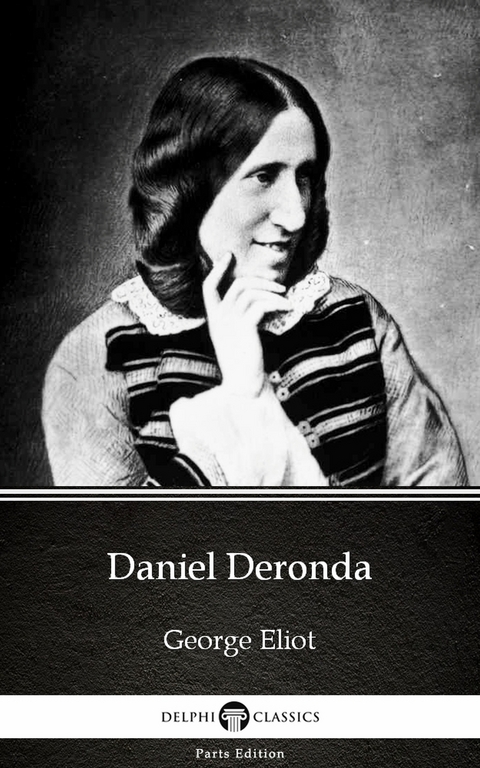
Daniel Deronda by George Eliot - Delphi Classics (Illustrated) (eBook)
554 Seiten
Publishdrive (Verlag)
978-1-78877-006-4 (ISBN)
Having established their name as the leading publisher of classic literature and art, Delphi Classics produce publications that are individually crafted with superior formatting, while introducing many rare texts for the first time in digital print. The Delphi Classics edition of Eliot includes original annotations and illustrations relating to the life and works of the author, as well as individual tables of contents, allowing you to navigate eBooks quickly and easily.
eBook features:* The complete unabridged text of 'Daniel Deronda by George Eliot - Delphi Classics (Illustrated)'
* Beautifully illustrated with images related to Eliot's works
* Individual contents table, allowing easy navigation around the eBook
* Excellent formatting of the textPlease visit www.delphiclassics.com to learn more about our wide range of titles
This eBook features the unabridged text of 'Daniel Deronda by George Eliot - Delphi Classics (Illustrated)' from the bestselling edition of 'The Complete Works of George Eliot'. Having established their name as the leading publisher of classic literature and art, Delphi Classics produce publications that are individually crafted with superior formatting, while introducing many rare texts for the first time in digital print. The Delphi Classics edition of Eliot includes original annotations and illustrations relating to the life and works of the author, as well as individual tables of contents, allowing you to navigate eBooks quickly and easily.eBook features:* The complete unabridged text of 'Daniel Deronda by George Eliot - Delphi Classics (Illustrated)'* Beautifully illustrated with images related to Eliot's works* Individual contents table, allowing easy navigation around the eBook* Excellent formatting of the textPlease visit www.delphiclassics.com to learn more about our wide range of titles
CHAPTER I.
Men can do nothing without the make-believe of a beginning. Even science, the strict measurer, is obliged to start with a make-believe unit, and must fix on a point in the stars’ unceasing journey when his sidereal clock shall pretend that time is at Nought. His less accurate grandmother Poetry has always been understood to start in the middle; but on reflection it appears that her proceeding is not very different from his; since Science, too, reckons backward as well as forward, divides his unit into billions, and with his clock-finger at Nought really sets off in medias res. No retrospect will take us to the true beginning; and whether our prologue be in heaven or on earth, it is but a fraction of that all-presupposing fact with which our story sets out.
Was she beautiful or not beautiful? and what was the secret of form or expression which gave the dynamic quality to her glance? Was the good or the evil genius dominant in those beams? Probably the evil; else why was the effect that of unrest rather than of undisturbed charm? Why was the wish to look again felt as coercion and not as a longing in which the whole being consents?
She who raised these questions in Daniel Deronda’s mind was occupied in gambling: not in the open air under a southern sky, tossing coppers on a ruined wall, with rags about her limbs; but in one of those splendid resorts which the enlightenment of ages has prepared for the same species of pleasure at a heavy cost of gilt mouldings, dark-toned color and chubby nudities, all correspondingly heavy — forming a suitable condenser for human breath belonging, in great part, to the highest fashion, and not easily procurable to be breathed in elsewhere in the like proportion, at least by persons of little fashion.
It was near four o’clock on a September day, so that the atmosphere was well-brewed to a visible haze. There was deep stillness, broken only by a light rattle, a light chink, a small sweeping sound, and an occasional monotone in French, such as might be expected to issue from an ingeniously constructed automaton. Round two long tables were gathered two serried crowds of human beings, all save one having their faces and attention bent on the tables. The one exception was a melancholy little boy, with his knees and calves simply in their natural clothing of epidermis, but for the rest of his person in a fancy dress. He alone had his face turned toward the doorway, and fixing on it the blank gaze of a bedizened child stationed as a masquerading advertisement on the platform of an itinerant show, stood close behind a lady deeply engaged at the roulette-table.
About this table fifty or sixty persons were assembled, many in the outer rows, where there was occasionally a deposit of new-comers, being mere spectators, only that one of them, usually a woman, might now and then be observed putting down a five-franc with a simpering air, just to see what the passion of gambling really was. Those who were taking their pleasure at a higher strength, and were absorbed in play, showed very distant varieties of European type: Livonian and Spanish, Graeco-Italian and miscellaneous German, English aristocratic and English plebeian. Here certainly was a striking admission of human equality. The white bejewelled fingers of an English countess were very near touching a bony, yellow, crab-like hand stretching a bared wrist to clutch a heap of coin — a hand easy to sort with the square, gaunt face, deep-set eyes, grizzled eyebrows, and ill-combed scanty hair which seemed a slight metamorphosis of the vulture. And where else would her ladyship have graciously consented to sit by that dry-lipped feminine figure prematurely old, withered after short bloom like her artificial flowers, holding a shabby velvet reticule before her, and occasionally putting in her mouth the point with which she pricked her card? There too, very near the fair countess, was a respectable London tradesman, blonde and soft-handed, his sleek hair scrupulously parted behind and before, conscious of circulars addressed to the nobility and gentry, whose distinguished patronage enabled him to take his holidays fashionably, and to a certain extent in their distinguished company. Not his gambler’s passion that nullifies appetite, but a well-fed leisure, which, in the intervals of winning money in business and spending it showily, sees no better resource than winning money in play and spending it yet more showily — reflecting always that Providence had never manifested any disapprobation of his amusement, and dispassionate enough to leave off if the sweetness of winning much and seeing others lose had turned to the sourness of losing much and seeing others win. For the vice of gambling lay in losing money at it. In his bearing there might be something of the tradesman, but in his pleasures he was fit to rank with the owners of the oldest titles. Standing close to his chair was a handsome Italian, calm, statuesque, reaching across him to place the first pile of napoleons from a new bagful just brought him by an envoy with a scrolled mustache. The pile was in half a minute pushed over to an old bewigged woman with eye-glasses pinching her nose. There was a slight gleam, a faint mumbling smile about the lips of the old woman; but the statuesque Italian remained impassive, and — probably secure in an infallible system which placed his foot on the neck of chance — immediately prepared a new pile. So did a man with the air of an emaciated beau or worn-out libertine, who looked at life through one eye-glass, and held out his hand tremulously when he asked for change. It could surely be no severity of system, but rather some dream of white crows, or the induction that the eighth of the month was lucky, which inspired the fierce yet tottering impulsiveness of his play.
But, while every single player differed markedly from every other, there was a certain uniform negativeness of expression which had the effect of a mask — as if they had all eaten of some root that for the time compelled the brains of each to the same narrow monotony of action.
Deronda’s first thought when his eyes fell on this scene of dull, gas-poisoned absorption, was that the gambling of Spanish shepherd-boys had seemed to him more enviable: — so far Rousseau might be justified in maintaining that art and science had done a poor service to mankind. But suddenly he felt the moment become dramatic. His attention was arrested by a young lady who, standing at an angle not far from him, was the last to whom his eyes traveled. She was bending and speaking English to a middle-aged lady seated at play beside her: but the next instant she returned to her play, and showed the full height of a graceful figure, with a face which might possibly be looked at without admiration, but could hardly be passed with indifference.
The inward debate which she raised in Deronda gave to his eyes a growing expression of scrutiny, tending farther and farther away from the glow of mingled undefined sensibilities forming admiration. At one moment they followed the movements of the figure, of the arms and hands, as this problematic sylph bent forward to deposit her stake with an air of firm choice; and the next they returned to the face which, at present unaffected by beholders, was directed steadily toward the game. The sylph was a winner; and as her taper fingers, delicately gloved in pale-gray, were adjusting the coins which had been pushed toward her in order to pass them back again to the winning point, she looked round her with a survey too markedly cold and neutral not to have in it a little of that nature which we call art concealing an inward exultation.
But in the course of that survey her eyes met Deronda’s, and instead of averting them as she would have desired to do, she was unpleasantly conscious that they were arrested — how long? The darting sense that he was measuring her and looking down on her as an inferior, that he was of different quality from the human dross around her, that he felt himself in a region outside and above her, and was examining her as a specimen of a lower order, roused a tingling resentment which stretched the moment with conflict. It did not bring the blood to her cheeks, but it sent it away from her lips. She controlled herself by the help of an inward defiance, and without other sign of emotion than this lip-paleness turned to her play. But Deronda’s gaze seemed to have acted as an evil eye. Her stake was gone. No matter; she had been winning ever since she took to roulette with a few napoleons at command, and had a considerable reserve. She had begun to believe in her luck, others had begun to believe in it: she had visions of being followed by a cortège who would worship her as a goddess of luck and watch her play as a directing augury. Such things had been known of male gamblers; why should not a woman have a like supremacy? Her friend and chaperon who had not wished her to play at first was beginning to approve, only administering the prudent advice to stop at the right moment and carry money back to England — advice to which Gwendolen had replied that she cared for the excitement of play, not the winnings. On that supposition the present moment ought to have made the flood-tide in her eager experience of gambling. Yet, when her next stake was swept away, she felt the orbits of her eyes getting hot, and the certainty she had (without looking) of that man still watching her was something like a pressure which begins to be torturing. The more reason to her why she should not flinch, but go on playing as if she were indifferent to loss or gain. Her friend touched her elbow and proposed that they should quit the table. For reply Gwendolen put...
| Erscheint lt. Verlag | 17.7.2017 |
|---|---|
| Reihe/Serie | Delphi Parts Edition (George Eliot) | Delphi Parts Edition (George Eliot) |
| Sprache | englisch |
| Themenwelt | Literatur ► Anthologien |
| Literatur ► Klassiker / Moderne Klassiker | |
| Literatur ► Romane / Erzählungen | |
| Schlagworte | Austen • Bede • deronda • Felix • Floss • Middlemarch • Silas |
| ISBN-10 | 1-78877-006-4 / 1788770064 |
| ISBN-13 | 978-1-78877-006-4 / 9781788770064 |
| Informationen gemäß Produktsicherheitsverordnung (GPSR) | |
| Haben Sie eine Frage zum Produkt? |
 EPUB (Adobe DRM)
Größe: 2,4 MB
Kopierschutz: Adobe-DRM
Adobe-DRM ist ein Kopierschutz, der das eBook vor Mißbrauch schützen soll. Dabei wird das eBook bereits beim Download auf Ihre persönliche Adobe-ID autorisiert. Lesen können Sie das eBook dann nur auf den Geräten, welche ebenfalls auf Ihre Adobe-ID registriert sind.
Details zum Adobe-DRM
Dateiformat: EPUB (Electronic Publication)
EPUB ist ein offener Standard für eBooks und eignet sich besonders zur Darstellung von Belletristik und Sachbüchern. Der Fließtext wird dynamisch an die Display- und Schriftgröße angepasst. Auch für mobile Lesegeräte ist EPUB daher gut geeignet.
Systemvoraussetzungen:
PC/Mac: Mit einem PC oder Mac können Sie dieses eBook lesen. Sie benötigen eine
eReader: Dieses eBook kann mit (fast) allen eBook-Readern gelesen werden. Mit dem amazon-Kindle ist es aber nicht kompatibel.
Smartphone/Tablet: Egal ob Apple oder Android, dieses eBook können Sie lesen. Sie benötigen eine
Geräteliste und zusätzliche Hinweise
Buying eBooks from abroad
For tax law reasons we can sell eBooks just within Germany and Switzerland. Regrettably we cannot fulfill eBook-orders from other countries.
EPUB (Ohne DRM)Digital Rights Management: ohne DRM
Dieses eBook enthält kein DRM oder Kopierschutz. Eine Weitergabe an Dritte ist jedoch rechtlich nicht zulässig, weil Sie beim Kauf nur die Rechte an der persönlichen Nutzung erwerben.
Dateiformat: EPUB (Electronic Publication)
EPUB ist ein offener Standard für eBooks und eignet sich besonders zur Darstellung von Belletristik und Sachbüchern. Der Fließtext wird dynamisch an die Display- und Schriftgröße angepasst. Auch für mobile Lesegeräte ist EPUB daher gut geeignet.
Systemvoraussetzungen:
PC/Mac: Mit einem PC oder Mac können Sie dieses eBook lesen. Sie benötigen dafür die kostenlose Software Adobe Digital Editions.
eReader: Dieses eBook kann mit (fast) allen eBook-Readern gelesen werden. Mit dem amazon-Kindle ist es aber nicht kompatibel.
Smartphone/Tablet: Egal ob Apple oder Android, dieses eBook können Sie lesen. Sie benötigen dafür eine kostenlose App.
Geräteliste und zusätzliche Hinweise
Buying eBooks from abroad
For tax law reasons we can sell eBooks just within Germany and Switzerland. Regrettably we cannot fulfill eBook-orders from other countries.
aus dem Bereich