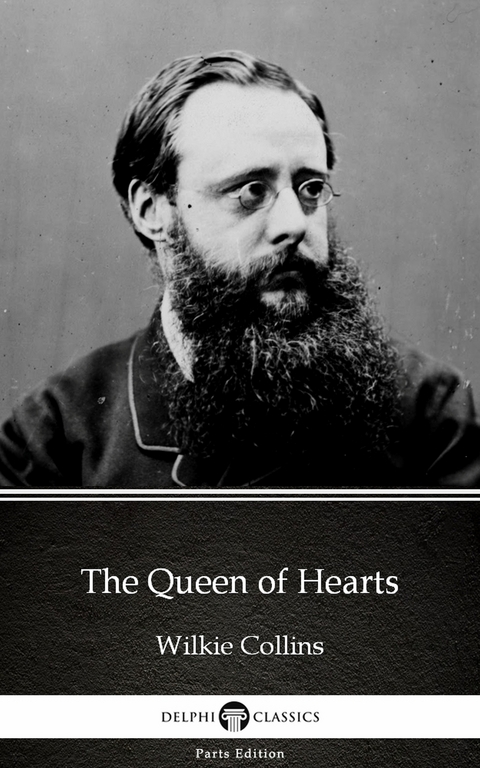
Queen of Hearts by Wilkie Collins - Delphi Classics (Illustrated) (eBook)
267 Seiten
Publishdrive (Verlag)
978-1-78877-086-6 (ISBN)
Having established their name as the leading publisher of classic literature and art, Delphi Classics produce publications that are individually crafted with superior formatting, while introducing many rare texts for the first time in digital print. The Delphi Classics edition of Collins includes original annotations and illustrations relating to the life and works of the author, as well as individual tables of contents, allowing you to navigate eBooks quickly and easily.
eBook features:* The complete unabridged text of 'The Queen of Hearts by Wilkie Collins - Delphi Classics (Illustrated)'
* Beautifully illustrated with images related to Collins's works
* Individual contents table, allowing easy navigation around the eBook
* Excellent formatting of the textPlease visit www.delphiclassics.com to learn more about our wide range of titles
This eBook features the unabridged text of 'The Queen of Hearts by Wilkie Collins - Delphi Classics (Illustrated)' from the bestselling edition of 'The Complete Works of Wilkie Collins'. Having established their name as the leading publisher of classic literature and art, Delphi Classics produce publications that are individually crafted with superior formatting, while introducing many rare texts for the first time in digital print. The Delphi Classics edition of Collins includes original annotations and illustrations relating to the life and works of the author, as well as individual tables of contents, allowing you to navigate eBooks quickly and easily.eBook features:* The complete unabridged text of 'The Queen of Hearts by Wilkie Collins - Delphi Classics (Illustrated)'* Beautifully illustrated with images related to Collins's works* Individual contents table, allowing easy navigation around the eBook* Excellent formatting of the textPlease visit www.delphiclassics.com to learn more about our wide range of titles
CHAPTER II. OUR DILEMMA.
WHO is the young lady? And how did she find her way into The Glen Tower?
Her name (in relation to which I shall have something more to say a little further on) is Jessie Yelverton. She is an orphan and an only child. Her mother died while she was an infant; her father was my dear and valued friend, Major Yelverton. He lived long enough to celebrate his darling’s seventh birthday. When he died he intrusted his authority over her and his responsibility toward her to his brother and to me.
When I was summoned to the reading of the major’s will, I knew perfectly well that I should hear myself appointed guardian and executor with his brother; and I had been also made acquainted with my lost friend’s wishes as to his daughter’s education, and with his intentions as to the disposal of all his property in her favor. My own idea, therefore, was, that the reading of the will would inform me of nothing which I had not known in the testator’s lifetime. When the day came for hearing it, however, I found that I had been over hasty in arriving at this conclusion. Toward the end of the document there was a clause inserted which took me entirely by surprise.
After providing for the education of Miss Yelverton under the direction of her guardians, and for her residence, under ordinary circumstances, with the major’s sister, Lady Westwick, the clause concluded by saddling the child’s future inheritance with this curious condition:
From the period of her leaving school to the period of her reaching the age of twenty-one years, Miss Yelverton was to pass not less than six consecutive weeks out of every year under the roof of one of her two guardians. During the lives of both of them, it was left to her own choice to say which of the two she would prefer to live with. In all other respects the condition was imperative. If she forfeited it, excepting, of course, the case of the deaths of both her guardians, she was only to have a life-interest in the property; if she obeyed it, the money itself was to become her own possession on the day when she completed her twenty-first year.
This clause in the will, as I have said, took me at first by surprise. I remembered how devotedly Lady Westwick had soothed her sister-in-law’s death-bed sufferings, and how tenderly she had afterward watched over the welfare of the little motherless child — I remembered the innumerable claims she had established in this way on her brother’s confidence in her affection for his orphan daughter, and I was, therefore, naturally amazed at the appearance of a condition in his will which seemed to show a positive distrust of Lady Westwick’s undivided influence over the character and conduct of her niece.
A few words from my fellow-guardian, Mr. Richard Yelverton, and a little after-consideration of some of my deceased friend’s peculiarities of disposition and feeling, to which I had not hitherto attached sufficient importance, were enough to make me understand the motives by which he had been influenced in providing for the future of his child.
Major Yelverton had raised himself to a position of affluence and eminence from a very humble origin. He was the son of a small farmer, and it was his pride never to forget this circumstance, never to be ashamed of it, and never to allow the prejudices of society to influence his own settled opinions on social questions in general.
Acting, in all that related to his intercourse with the world, on such principles as these, the major, it is hardly necessary to say, held some strangely heterodox opinions on the modern education of girls, and on the evil influence of society over the characters of women in general. Out of the strength of those opinions, and out of the certainty of his conviction that his sister did not share them, had grown that condition in his will which removed his daughter from the influence of her aunt for six consecutive weeks in every year. Lady Westwick was the most light-hearted, the most generous, the most impulsive of women; capable, when any serious occasion called it forth, of all that was devoted and self-sacrificing, but, at other and ordinary times, constitutionally restless, frivolous, and eager for perpetual gayety. Distrusting the sort of life which he knew his daughter would lead under her aunt’s roof, and at the same time gratefully remembering his sister’s affectionate devotion toward his dying wife and her helpless infant, Major Yelverton had attempted to make a compromise, which, while it allowed Lady Westwick the close domestic intercourse with her niece that she had earned by innumerable kind offices, should, at the same time, place the young girl for a fixed period of every year of her minority under the corrective care of two such quiet old-fashioned guardians as his brother and myself. Such is the history of the clause in the will. My friend little thought, when he dictated it, of the extraordinary result to which it was one day to lead.
For some years, however, events ran on smoothly enough. Little Jessie was sent to an excellent school, with strict instructions to the mistress to make a good girl of her, and not a fashionable young lady. Although she was reported to be anything but a pattern pupil in respect of attention to her lessons, she became from the first the chosen favorite of every one about her. The very offenses which she committed against the discipline of the school were of the sort which provoke a smile even on the stern countenance of authority itself. One of these quaint freaks of mischief may not inappropriately be mentioned here, inasmuch as it gained her the pretty nickname under which she will be found to appear occasionally in these pages.
On a certain autumn night shortly after the Midsummer vacation, the mistress of the school fancied she saw a light under the door of the bedroom occupied by Jessie and three other girls. It was then close on midnight; and, fearing that some case of sudden illness might have happened, she hastened into the room. On opening the door, she discovered, to her horror and amazement, that all four girls were out of bed — were dressed in brilliantly-fantastic costumes, representing the four grotesque “Queens” of Hearts, Diamonds, Spades, and Clubs, familiar to us all on the pack of cards — and were dancing a quadrille, in which Jessie sustained the character of The Queen of Hearts. The next morning’s investigation disclosed that Miss Yelverton had smuggled the dresses into the school, and had amused herself by giving an impromptu fancy ball to her companions, in imitation of an entertainment of the same kind at which she had figured in a “court-card” quadrille at her aunt’s country house.
The dresses were instantly confiscated and the necessary punishment promptly administered; but the remembrance of Jessie’s extraordinary outrage on bedroom discipline lasted long enough to become one of the traditions of the school, and she and her sister-culprits were thenceforth hailed as the “queens” of the four “suites” by their class-companions whenever the mistress’s back was turned, Whatever might have become of the nicknames thus employed in relation to the other three girls, such a mock title as The Queen of Hearts was too appropriately descriptive of the natural charm of Jessie’s character, as well as of the adventure in which she had taken the lead, not to rise naturally to the lips of every one who knew her. It followed her to her aunt’s house — it came to be as habitually and familiarly connected with her, among her friends of all ages, as if it had been formally inscribed on her baptismal register; and it has stolen its way into these pages because it falls from my pen naturally and inevitably, exactly as it often falls from my lips in real life.
When Jessie left school the first difficulty presented itself — in other words, the necessity arose of fulfilling the conditions of the will. At that time I was already settled at The Glen Tower, and her living six weeks in our dismal solitude and our humdrum society was, as she herself frankly wrote me word, quite out of the question. Fortunately, she had always got on well with her uncle and his family; so she exerted her liberty of choice, and, much to her own relief and to mine also, passed her regular six weeks of probation, year after year, under Mr. Richard Yelverton’s roof.
During this period I heard of her regularly, sometimes from my fellow-guardian, sometimes from my son George, who, whenever his military duties allowed him the opportunity, contrived to see her, now at her aunt’s house, and now at Mr. Yelverton’s. The particulars of her character and conduct, which I gleaned in this way, more than sufficed to convince me that the poor major’s plan for the careful training of his daughter’s disposition, though plausible enough in theory, was little better than a total failure in practice. Miss Jessie, to use the expressive common phrase, took after her aunt. She was as generous, as impulsive, as light-hearted, as fond of change, and gayety, and fine clothes — in short, as complete and genuine a woman as Lady Westwick herself. It was impossible to reform the “Queen of Hearts,” and equally impossible not to love her. Such, in few words, was my fellow-guardian’s report of his experience of our handsome young ward.
So the time passed till the year came of which I am now writing — the ever-memorable year, to England, of the Russian war. It happened that I had heard less than usual at this period, and indeed for many months before it, of Jessie and her proceedings. My son had been ordered out...
| Erscheint lt. Verlag | 17.7.2017 |
|---|---|
| Reihe/Serie | Delphi Parts Edition (Wilkie Collins) | Delphi Parts Edition (Wilkie Collins) |
| Sprache | englisch |
| Themenwelt | Literatur ► Anthologien |
| Literatur ► Klassiker / Moderne Klassiker | |
| Literatur ► Romane / Erzählungen | |
| Schlagworte | Armadale • Dickens • Hide • leaves • Moonstone • Name • Stories • Woman |
| ISBN-10 | 1-78877-086-2 / 1788770862 |
| ISBN-13 | 978-1-78877-086-6 / 9781788770866 |
| Informationen gemäß Produktsicherheitsverordnung (GPSR) | |
| Haben Sie eine Frage zum Produkt? |
 EPUB (Adobe DRM)
Größe: 1,1 MB
Kopierschutz: Adobe-DRM
Adobe-DRM ist ein Kopierschutz, der das eBook vor Mißbrauch schützen soll. Dabei wird das eBook bereits beim Download auf Ihre persönliche Adobe-ID autorisiert. Lesen können Sie das eBook dann nur auf den Geräten, welche ebenfalls auf Ihre Adobe-ID registriert sind.
Details zum Adobe-DRM
Dateiformat: EPUB (Electronic Publication)
EPUB ist ein offener Standard für eBooks und eignet sich besonders zur Darstellung von Belletristik und Sachbüchern. Der Fließtext wird dynamisch an die Display- und Schriftgröße angepasst. Auch für mobile Lesegeräte ist EPUB daher gut geeignet.
Systemvoraussetzungen:
PC/Mac: Mit einem PC oder Mac können Sie dieses eBook lesen. Sie benötigen eine
eReader: Dieses eBook kann mit (fast) allen eBook-Readern gelesen werden. Mit dem amazon-Kindle ist es aber nicht kompatibel.
Smartphone/Tablet: Egal ob Apple oder Android, dieses eBook können Sie lesen. Sie benötigen eine
Geräteliste und zusätzliche Hinweise
Buying eBooks from abroad
For tax law reasons we can sell eBooks just within Germany and Switzerland. Regrettably we cannot fulfill eBook-orders from other countries.
EPUB (Ohne DRM)Digital Rights Management: ohne DRM
Dieses eBook enthält kein DRM oder Kopierschutz. Eine Weitergabe an Dritte ist jedoch rechtlich nicht zulässig, weil Sie beim Kauf nur die Rechte an der persönlichen Nutzung erwerben.
Dateiformat: EPUB (Electronic Publication)
EPUB ist ein offener Standard für eBooks und eignet sich besonders zur Darstellung von Belletristik und Sachbüchern. Der Fließtext wird dynamisch an die Display- und Schriftgröße angepasst. Auch für mobile Lesegeräte ist EPUB daher gut geeignet.
Systemvoraussetzungen:
PC/Mac: Mit einem PC oder Mac können Sie dieses eBook lesen. Sie benötigen dafür die kostenlose Software Adobe Digital Editions.
eReader: Dieses eBook kann mit (fast) allen eBook-Readern gelesen werden. Mit dem amazon-Kindle ist es aber nicht kompatibel.
Smartphone/Tablet: Egal ob Apple oder Android, dieses eBook können Sie lesen. Sie benötigen dafür eine kostenlose App.
Geräteliste und zusätzliche Hinweise
Buying eBooks from abroad
For tax law reasons we can sell eBooks just within Germany and Switzerland. Regrettably we cannot fulfill eBook-orders from other countries.
aus dem Bereich