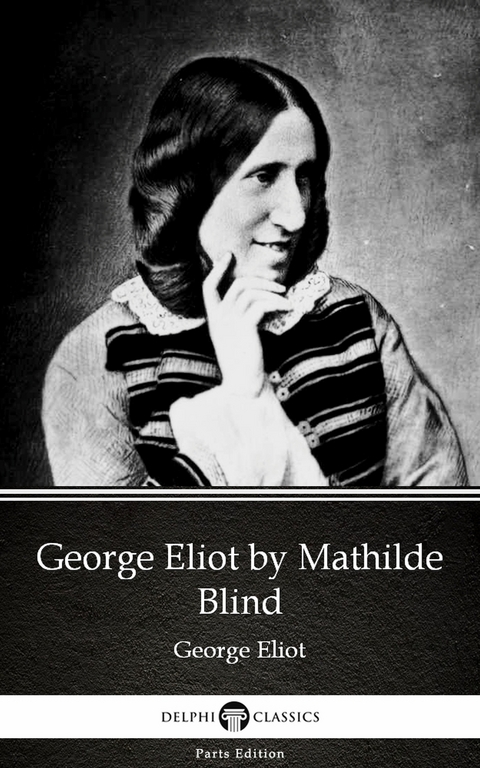
George Eliot by Mathilde Blind - Delphi Classics (Illustrated) (eBook)
128 Seiten
Publishdrive (Verlag)
978-1-78877-014-9 (ISBN)
Having established their name as the leading publisher of classic literature and art, Delphi Classics produce publications that are individually crafted with superior formatting, while introducing many rare texts for the first time in digital print. The Delphi Classics edition of Eliot includes original annotations and illustrations relating to the life and works of the author, as well as individual tables of contents, allowing you to navigate eBooks quickly and easily.
eBook features:* The complete unabridged text of 'George Eliot by Mathilde Blind by George Eliot - Delphi Classics (Illustrated)'
* Beautifully illustrated with images related to Eliot's works
* Individual contents table, allowing easy navigation around the eBook
* Excellent formatting of the textPlease visit www.delphiclassics.com to learn more about our wide range of titles
This eBook features the unabridged text of 'George Eliot by Mathilde Blind by George Eliot - Delphi Classics (Illustrated)' from the bestselling edition of 'The Complete Works of George Eliot'. Having established their name as the leading publisher of classic literature and art, Delphi Classics produce publications that are individually crafted with superior formatting, while introducing many rare texts for the first time in digital print. The Delphi Classics edition of Eliot includes original annotations and illustrations relating to the life and works of the author, as well as individual tables of contents, allowing you to navigate eBooks quickly and easily.eBook features:* The complete unabridged text of 'George Eliot by Mathilde Blind by George Eliot - Delphi Classics (Illustrated)'* Beautifully illustrated with images related to Eliot's works* Individual contents table, allowing easy navigation around the eBook* Excellent formatting of the textPlease visit www.delphiclassics.com to learn more about our wide range of titles
CHAPTER I. INTRODUCTORY.
Speaking of the contributions made to literature by her own sex, George Eliot, in a charming essay written in 1854, awards the palm of intellectual pre-eminence to the women of France. “They alone,” says the great English author, “have had a vital influence on the development of literature. For in France alone the mind of woman has passed, like an electric current, through the language, making crisp and definite what is elsewhere heavy and blurred; in France alone, if the writings of women were swept away, a serious gap would be made in the national history.”
The reason assigned by George Eliot for this literary superiority of Frenchwomen consists in their having had the courage of their sex. They thought and felt as women, and when they wrote, their books became the fullest expression of their womanhood. And by being true to themselves, by only seeking inspiration from their own life-experience, instead of servilely copying that of men, their letters and memoirs, their novels and pictures have a distinct, nay unique, value, for the student of art and literature. Englishwomen, on the other hand, have not followed the spontaneous impulses of nature. They have not allowed free play to the peculiarly feminine element, preferring to mould their intellectual products on the masculine pattern. For that reason, says George Eliot, their writings are “usually an absurd exaggeration of the masculine style, like the swaggering gait of a bad actress in male attire.”
This novel theory, concerning a specifically feminine manifestation of the intellect, is doubly curious when one compares it with Madame de Staël’s famous saying, “Le génie n’a pas de sexe.” But an aphorism, however brilliant, usually contains only one half the truth, and there is every reason to think that women have already, and will much more largely, by-and-by, infuse into their works certain intellectual and emotional qualities which are essentially their own. Shall we, however, admit George Eliot’s conclusion that Frenchwomen alone have hitherto shown any of this original bias? Several causes are mentioned by her in explanation of this exceptional merit. Among these causes there is one which would probably occur to every one who began to reflect on this subject. The influence of the “Salon” in developing and stimulating the finest feminine talents has long been recognised. In this school for women the gift of expression was carried to the utmost pitch of perfection. By their active co-operation in the discussion of the most vital subjects, thought became clear, luminous, and forcible; sentiment gained indescribable graces of refinement; and wit, with its brightest scintillations, lit up the sombre background of life.
But among other causes enumerated as accounting for that more spontaneous productivity of Frenchwomen, attributed to them by George Eliot, there is one which would probably have occurred to no other mind than hers, and which is too characteristic of her early scientific tendencies to be omitted. For according to her, the present superiority of Frenchwomen is mainly due to certain physiological peculiarities of the Gallic race. Namely, to the “small brain and vivacious temperament which permit the fragile system of woman to sustain the superlative activity requisite for intellectual creativeness,” whereas “the larger brain and slower temperament of the English and Germans are in the womanly organisation generally dreamy and passive. So that the physique of a woman may suffice as the substratum for a superior Gallic mind, but is too thin a soil for a superior Teutonic one.”
So knotty and subtle a problem must be left to the scientist of the future to decide. Perhaps some promising young physiologist, profiting by the “George Henry Lewes Studentship” founded by George Eliot, may some day satisfactorily elucidate this question. In the meanwhile it is at least gratifying to reflect that she does not deny the future possibilities of even English and German women. She admits that conditions might arise which in their case also would be favourable to the highest creative effort; conditions which would modify the existing state of things according to which, to speak in her own scientific phraseology: “The woman of large capacity can seldom rise beyond the absorption of ideas; her physical conditions refuse to support the energy required for spontaneous activity; the voltaic pile is not strong enough to produce crystallisations.”
But was the author of ‘Adam Bede’ not herself destined to be a triumphant refutation of her theory? Or had those more favourable circumstances mentioned as vague possibilities already arisen in her case? Not that we believe, for that matter, in the superior claims of illustrious Frenchwomen. It is true George Eliot enumerates a formidable list of names. But on the whole we may boast of feminine celebrities that need not shrink from the comparison.
There is, of course, much truth in the great Englishwoman’s generous praise of her French compeers. “Mme. de Sévigné remains,” she says, “the single instance of a woman who is supreme in a class of literature which has engaged the ambition of men; Mme. Dacier still reigns the queen of blue-stockings, though women have long studied Greek without shame; Mme. de Staël’s name still rises to the lips when we are asked to mention a woman of great intellectual power; Mme. Roland is still the unrivalled type of the sagacious and sternly heroic yet lovable woman; George Sand is the unapproached artist who, to Jean Jacques’ eloquence and deep sense of external nature, unites the clear delineation of character and the tragic depth of passion.”
Shall we be forced to admit that the representative women of England cannot justly be placed on as high a level? Is it so certain that they, too, did not speak out of the fulness of their womanly natures? That they too did not feel the genuine need to express modes of thought and feeling peculiar to themselves, which men, if at all, had but inadequately expressed hitherto?
Was not Queen Elizabeth the best type of a female ruler, one whose keen penetration enabled her to choose her ministers with infallible judgment? Did not Fanny Burney distil the delicate aroma of girlhood in one of the most delightful of novels? Or what of Jane Austen, whose microscopic fidelity of observation has a well-nigh scientific accuracy, never equalled unless in the pages of the author we are writing of? Sir Walter Scott apparently recognised the eminently feminine inspiration of her writings, as he says: “That young lady had a talent for describing the involvements, and feelings, and characters of ordinary life, which is for me the most wonderful I ever met with. The Bow-wow strain I can do myself like any now agoing; but the exquisite touch, which renders ordinary commonplace things and characters interesting from the truth of the descriptions and the sentiment, is denied to me.” Then turning to the Brontës, does not one feel the very heartbeats of womanhood in those powerful utterances that seem to spring from some central emotional energy? Again, does not Mrs. Browning occupy a unique place among poets? Is there not a distinctively womanly strain of emotion in the throbbing tides of her high-wrought melodious song? And, to come to George Eliot herself, will any one deny that, in the combination of sheer intellectual power with an unparalleled vision for the homely details of life, she takes precedence of all writers of this or any other country? To some extent this wonderful woman conforms to her own standard. She undoubtedly adds to the common fund of crystallised human experience, as literature might be called, something which is specifically feminine. But, on the other hand, her intellect excels precisely in those qualities habitually believed to be masculine, one of its chief characteristics consisting in the grasp of abstract philosophical ideas. This faculty, however, by no means impairs those instinctive processes of the imagination by which true artistic work is produced; George Eliot combining in an unusual degree the subtlest power of analysis with that happy gift of genius which enabled her to create such characters as Amos Barton, Hetty, Mrs. Poyser, Maggie, and Tom Tulliver, Godfrey Cass and Caleb Garth, which seem to come fresh from the mould of Nature itself. Indeed, she has hardly a rival among women in this power of objective imagination by which she throws her whole soul into natures of the most varied and opposite types, whereas George Sand only succeeds greatly when she is thoroughly in sympathy with her creations.
After George Eliot’s eulogium of French women, one feels tempted to institute a comparison between these two great contemporaries, who occupied the same leading position in their respective countries. But it will probably always remain a question of idiosyncracy which of the two one is disposed to rank higher, George Eliot being the greatest realist, George Sand the greatest idealist, of her sex. The works of the French writer are, in fact, prose poems rather than novels. They are not studies of life, but life interpreted by the poet’s vision. George Sand cannot give us a description of any scene in nature, of her own feelings, of a human character, without imparting to it some magical effect as of objects seen under the transfiguring influence of moonlight or storm clouds; whereas George Eliot loves to bathe her productions in the broad pitiless midday light, which leaves no room for illusion, but reveals all nature with uncompromising directness. The one has more of that primitive...
| Erscheint lt. Verlag | 17.7.2017 |
|---|---|
| Reihe/Serie | Delphi Parts Edition (George Eliot) | Delphi Parts Edition (George Eliot) |
| Sprache | englisch |
| Themenwelt | Literatur ► Anthologien |
| Literatur ► Klassiker / Moderne Klassiker | |
| Literatur ► Romane / Erzählungen | |
| Schlagworte | Austen • Bede • deronda • Felix • Floss • Middlemarch • Silas |
| ISBN-10 | 1-78877-014-5 / 1788770145 |
| ISBN-13 | 978-1-78877-014-9 / 9781788770149 |
| Informationen gemäß Produktsicherheitsverordnung (GPSR) | |
| Haben Sie eine Frage zum Produkt? |
 EPUB (Adobe DRM)
Größe: 1,0 MB
Kopierschutz: Adobe-DRM
Adobe-DRM ist ein Kopierschutz, der das eBook vor Mißbrauch schützen soll. Dabei wird das eBook bereits beim Download auf Ihre persönliche Adobe-ID autorisiert. Lesen können Sie das eBook dann nur auf den Geräten, welche ebenfalls auf Ihre Adobe-ID registriert sind.
Details zum Adobe-DRM
Dateiformat: EPUB (Electronic Publication)
EPUB ist ein offener Standard für eBooks und eignet sich besonders zur Darstellung von Belletristik und Sachbüchern. Der Fließtext wird dynamisch an die Display- und Schriftgröße angepasst. Auch für mobile Lesegeräte ist EPUB daher gut geeignet.
Systemvoraussetzungen:
PC/Mac: Mit einem PC oder Mac können Sie dieses eBook lesen. Sie benötigen eine
eReader: Dieses eBook kann mit (fast) allen eBook-Readern gelesen werden. Mit dem amazon-Kindle ist es aber nicht kompatibel.
Smartphone/Tablet: Egal ob Apple oder Android, dieses eBook können Sie lesen. Sie benötigen eine
Geräteliste und zusätzliche Hinweise
Buying eBooks from abroad
For tax law reasons we can sell eBooks just within Germany and Switzerland. Regrettably we cannot fulfill eBook-orders from other countries.
EPUB (Ohne DRM)Digital Rights Management: ohne DRM
Dieses eBook enthält kein DRM oder Kopierschutz. Eine Weitergabe an Dritte ist jedoch rechtlich nicht zulässig, weil Sie beim Kauf nur die Rechte an der persönlichen Nutzung erwerben.
Dateiformat: EPUB (Electronic Publication)
EPUB ist ein offener Standard für eBooks und eignet sich besonders zur Darstellung von Belletristik und Sachbüchern. Der Fließtext wird dynamisch an die Display- und Schriftgröße angepasst. Auch für mobile Lesegeräte ist EPUB daher gut geeignet.
Systemvoraussetzungen:
PC/Mac: Mit einem PC oder Mac können Sie dieses eBook lesen. Sie benötigen dafür die kostenlose Software Adobe Digital Editions.
eReader: Dieses eBook kann mit (fast) allen eBook-Readern gelesen werden. Mit dem amazon-Kindle ist es aber nicht kompatibel.
Smartphone/Tablet: Egal ob Apple oder Android, dieses eBook können Sie lesen. Sie benötigen dafür eine kostenlose App.
Geräteliste und zusätzliche Hinweise
Buying eBooks from abroad
For tax law reasons we can sell eBooks just within Germany and Switzerland. Regrettably we cannot fulfill eBook-orders from other countries.
aus dem Bereich