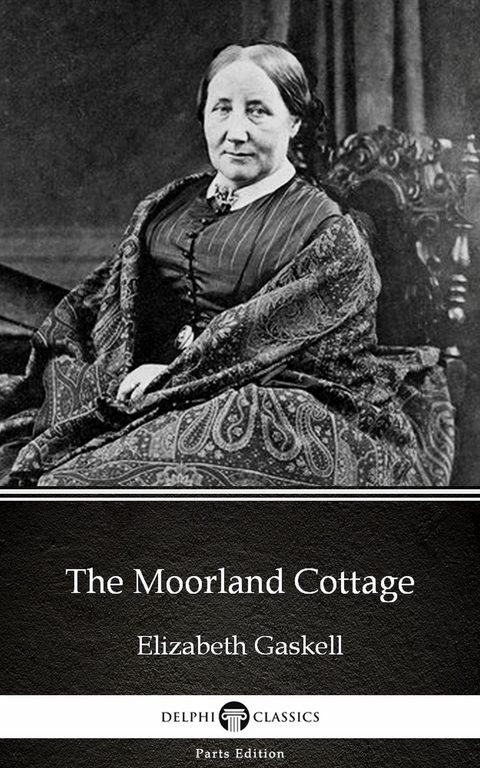
Moorland Cottage by Elizabeth Gaskell - Delphi Classics (Illustrated) (eBook)
95 Seiten
Publishdrive (Verlag)
978-1-78877-021-7 (ISBN)
Having established their name as the leading publisher of classic literature and art, Delphi Classics produce publications that are individually crafted with superior formatting, while introducing many rare texts for the first time in digital print. The Delphi Classics edition of Gaskell includes original annotations and illustrations relating to the life and works of the author, as well as individual tables of contents, allowing you to navigate eBooks quickly and easily.
eBook features:* The complete unabridged text of 'The Moorland Cottage by Elizabeth Gaskell - Delphi Classics (Illustrated)'
* Beautifully illustrated with images related to Gaskell's works
* Individual contents table, allowing easy navigation around the eBook
* Excellent formatting of the textPlease visit www.delphiclassics.com to learn more about our wide range of titles
This eBook features the unabridged text of 'The Moorland Cottage by Elizabeth Gaskell - Delphi Classics (Illustrated)' from the bestselling edition of 'The Complete Works of Elizabeth Gaskell'. Having established their name as the leading publisher of classic literature and art, Delphi Classics produce publications that are individually crafted with superior formatting, while introducing many rare texts for the first time in digital print. The Delphi Classics edition of Gaskell includes original annotations and illustrations relating to the life and works of the author, as well as individual tables of contents, allowing you to navigate eBooks quickly and easily.eBook features:* The complete unabridged text of 'The Moorland Cottage by Elizabeth Gaskell - Delphi Classics (Illustrated)'* Beautifully illustrated with images related to Gaskell's works* Individual contents table, allowing easy navigation around the eBook* Excellent formatting of the textPlease visit www.delphiclassics.com to learn more about our wide range of titles
CHAPTER II.
At length they were dressed, and Nancy stood on the court-steps, shading her eyes, and looking after them, as they climbed the heathery slope leading to Combehurst.
“I wish she’d take her hand sometimes, just to let her know the feel of her mother’s hand. Perhaps she will, at least after Master Edward goes to school.”
As they went along, Mrs. Browne gave the children a few rules respecting manners and etiquette.
“Maggie! you must sit as upright as ever you can; make your back flat, child, and don’t poke. If I cough, you must draw up. I shall cough whenever I see you do anything wrong, and I shall be looking at you all day; so remember. You hold yourself very well, Edward. If Mr. Buxton asks you, you may have a glass of wine, because you’re a boy. But mind and say, ‘Your good health, sir,’ before you drink it.”
“I’d rather not have the wine if I’m to say that,” said Edward, bluntly.
“Oh, nonsense! my dear. You’d wish to be like a gentleman, I’m sure.”
Edward muttered something which was inaudible. His mother went on:
Of course you’ll never think of being helped more than twice. Twice of meat, twice of pudding, is the genteel thing. You may take less, but never more.”
“Oh, mamma! how beautiful Combehurst spire is, with that dark cloud behind it!” exclaimed Maggie, as they came in sight of the town.
“You’ve no business with Combehurst spire when I’m speaking to you. I’m talking myself out of breath to teach you how to behave, and there you go looking after clouds, and such like rubbish. I’m ashamed of you.”
Although Maggie walked quietly by her mother’s side all the rest of the way, Mrs. Browne was too much offended to resume her instructions on good-breeding. Maggie might be helped three times if she liked: she had done with her.
They were very early. When they drew near the bridge, they were met by a tall, fine-looking boy, leading a beautiful little Shetland pony, with a side-saddle on it. He came up to Mrs. Browne, and addressed her.
“My father thought your little girl would be tired, and he told me to bring my cousin Erminia’s pony for her. It’s as quiet as can be.”
Now this was rather provoking to Mrs. Browne, as she chose to consider Maggie in disgrace. However, there was no help for it: all she could do was to spoil the enjoyment as far as possible, by looking and speaking in a cold manner, which often chilled Maggie’s little heart, and took all the zest out of the pleasure now. It was in vain that Frank Buxton made the pony trot and canter; she still looked sad and grave.
“Little dull thing!” he thought; but he was as kind and considerate as a gentlemanly boy could be.
At last they reached Mr. Buxton’s house. It was in the main street, and the front door opened upon it by a flight of steps. Wide on each side extended the stone-coped windows. It was in reality a mansion, and needed not the neighboring contrast of the cottages on either side to make it look imposing. When they went in, they entered a large hall, cool even on that burning July day, with a black and white flag floor, and old settees round the walls, and great jars of curious china, which were filled with pot-pourrie. The dusky gloom was pleasant, after the glare of the street outside; and the requisite light and cheerfulness were given by the peep into the garden, framed, as it were, by the large door-way that opened into it. There were roses, and sweet-peas, and poppies — a rich mass of color, which looked well, set in the somewhat sombre coolness of the hall. All the house told of wealth — wealth which had accumulated for generations, and which was shown in a sort of comfortable, grand, unostentatious way. Mr. Buxton’s ancestors had been yeomen; but, two or three generations back, they might, if ambitious, have taken their place as country gentry, so much had the value of their property increased, and so great had been the amount of their savings. They, however, continued to live in the old farm till Mr. Buxton’s grandfather built the house in Combehurst of which I am speaking, and then he felt rather ashamed of what he had done; it seemed like stepping out of his position. He and his wife always sat in the best kitchen; and it was only after his son’s marriage that the entertaining rooms were furnished. Even then they were kept with closed shutters and bagged-up furniture during the lifetime of the old couple, who, nevertheless, took a pride in adding to the rich-fashioned ornaments and grand old china of the apartments. But they died, and were gathered to their fathers, and young Mr. and Mrs. Buxton (aged respectively fifty-one and forty-five) reigned in their stead. They had the good taste to make no sudden change; but gradually the rooms assumed an inhabited appearance, and their son and daughter grew up in the enjoyment of great wealth, and no small degree of refinement. But as yet they held back modestly from putting themselves in any way on a level with the county people. Lawrence Buxton was sent to the same school as his father had been before him; and the notion of his going to college to complete his education was, after some deliberation, negatived. In process of time he succeeded his father, and married a sweet, gentle lady, of a decayed and very poor county family, by whom he had one boy before she fell into delicate health. His sister had married a man whose character was worse than his fortune, and had been left a widow. Everybody thought her husband’s death a blessing; but she loved him, in spite of negligence and many grosser faults; and so, not many years after, she died, leaving her little daughter to her brother’s care, with many a broken-voiced entreaty that he would never speak a word against the dead father of her child. So the little Erminia was taken home by her self-reproaching uncle, who felt now how hardly he had acted towards his sister in breaking off all communication with her on her ill-starred marriage.
“Where is Erminia, Frank?” asked his father, speaking over Maggie’s shoulder, while he still held her hand. “I want to take Mrs. Browne to your mother. I told Erminia to be here to welcome this little girl.”
“I’ll take her to Minnie; I think she’s in the garden. I’ll come back to you,” nodding to Edward, “directly, and then we will go to the rabbits.”
So Frank and Maggie left the great lofty room, full of strange rare things, and rich with books, and went into the sunny scented garden, which stretched far and wide behind the house. Down one of the walks, with a hedge of roses on either side, came a little tripping fairy, with long golden ringlets, and a complexion like a china rose. With the deep blue of the summer sky behind her, Maggie thought she looked like an angel. She neither hastened nor slackened her pace when she saw them, but came on with the same dainty light prancing step.
“Make haste, Minnie,” cried Frank.
But Minnie stopped to gather a rose.
“Don’t stay with me,” said Maggie, softly, although she had held his hand like that of a friend, and did not feel that the little fairy’s manner was particularly cordial or gracious. Frank took her at her word, and ran off to Edward.
Erminia came a little quicker when she saw that Maggie was left alone; but for some time after they were together, they had nothing to say to each other. Erminia was easily impressed by the pomps and vanities of the world; and Maggie’s new handsome frock seemed to her made of old ironed brown silk. And though Maggie’s voice was soft, with a silver ringing sound in it, she pronounced her words in Nancy’s broad country way. Her hair was cut short all round; her shoes were thick, and clumped as she walked. Erminia patronized her, and thought herself very kind and condescending; but they were not particularly friendly. The visit promised to be more honorable than agreeable, and Maggie almost wished herself at home again. Dinner-time came. Mrs. Buxton dined in her own room. Mr. Buxton was hearty, and jovial, and pressing; he almost scolded Maggie because she would not take more than twice of his favorite pudding: but she remembered what her mother had said, and that she would be watched all day; and this gave her a little prim, quaint manner, very different from her usual soft charming unconsciousness. She fancied that Edward and Master Buxton were just as little at their ease with each other as she and Miss Harvey. Perhaps this feeling on the part of the boys made all four children unite after dinner.
“Let us go to the swing in the shrubbery,” said Frank, after a little consideration; and off they ran. Frank proposed that he and Edward should swing the two little girls; and for a time all went on very well. But by-and-by Edward thought, that Maggie had had enough, and that he should like a turn; and Maggie, at his first word, got out.
“Don’t you like swinging?” asked Erminia.
“Yes! but Edward would like it now.” And Edward accordingly took her place. Frank turned away, and would not swing him. Maggie strove hard to do it, but he was heavy, and the swing bent unevenly. He scolded her for what she could not help, and at last jumped out so roughly, that the seat hit Maggie’s face, and knocked her down. When she got up, her lips quivered with pain, but she did not cry; she only looked anxiously at her frock. There was a great rent across the front breadth. Then she did shed tears — tears...
| Erscheint lt. Verlag | 17.7.2017 |
|---|---|
| Reihe/Serie | Delphi Parts Edition (Elizabeth Gaskell) | Delphi Parts Edition (Elizabeth Gaskell) |
| Sprache | englisch |
| Themenwelt | Literatur ► Anthologien |
| Literatur ► Klassiker / Moderne Klassiker | |
| Literatur ► Romane / Erzählungen | |
| Schlagworte | Bronte • cranford • Eliot • Mary • North • Penguin • wives |
| ISBN-10 | 1-78877-021-8 / 1788770218 |
| ISBN-13 | 978-1-78877-021-7 / 9781788770217 |
| Informationen gemäß Produktsicherheitsverordnung (GPSR) | |
| Haben Sie eine Frage zum Produkt? |
 EPUB (Adobe DRM)
Größe: 928 KB
Kopierschutz: Adobe-DRM
Adobe-DRM ist ein Kopierschutz, der das eBook vor Mißbrauch schützen soll. Dabei wird das eBook bereits beim Download auf Ihre persönliche Adobe-ID autorisiert. Lesen können Sie das eBook dann nur auf den Geräten, welche ebenfalls auf Ihre Adobe-ID registriert sind.
Details zum Adobe-DRM
Dateiformat: EPUB (Electronic Publication)
EPUB ist ein offener Standard für eBooks und eignet sich besonders zur Darstellung von Belletristik und Sachbüchern. Der Fließtext wird dynamisch an die Display- und Schriftgröße angepasst. Auch für mobile Lesegeräte ist EPUB daher gut geeignet.
Systemvoraussetzungen:
PC/Mac: Mit einem PC oder Mac können Sie dieses eBook lesen. Sie benötigen eine
eReader: Dieses eBook kann mit (fast) allen eBook-Readern gelesen werden. Mit dem amazon-Kindle ist es aber nicht kompatibel.
Smartphone/Tablet: Egal ob Apple oder Android, dieses eBook können Sie lesen. Sie benötigen eine
Geräteliste und zusätzliche Hinweise
Buying eBooks from abroad
For tax law reasons we can sell eBooks just within Germany and Switzerland. Regrettably we cannot fulfill eBook-orders from other countries.
EPUB (Ohne DRM)Digital Rights Management: ohne DRM
Dieses eBook enthält kein DRM oder Kopierschutz. Eine Weitergabe an Dritte ist jedoch rechtlich nicht zulässig, weil Sie beim Kauf nur die Rechte an der persönlichen Nutzung erwerben.
Dateiformat: EPUB (Electronic Publication)
EPUB ist ein offener Standard für eBooks und eignet sich besonders zur Darstellung von Belletristik und Sachbüchern. Der Fließtext wird dynamisch an die Display- und Schriftgröße angepasst. Auch für mobile Lesegeräte ist EPUB daher gut geeignet.
Systemvoraussetzungen:
PC/Mac: Mit einem PC oder Mac können Sie dieses eBook lesen. Sie benötigen dafür die kostenlose Software Adobe Digital Editions.
eReader: Dieses eBook kann mit (fast) allen eBook-Readern gelesen werden. Mit dem amazon-Kindle ist es aber nicht kompatibel.
Smartphone/Tablet: Egal ob Apple oder Android, dieses eBook können Sie lesen. Sie benötigen dafür eine kostenlose App.
Geräteliste und zusätzliche Hinweise
Buying eBooks from abroad
For tax law reasons we can sell eBooks just within Germany and Switzerland. Regrettably we cannot fulfill eBook-orders from other countries.
aus dem Bereich