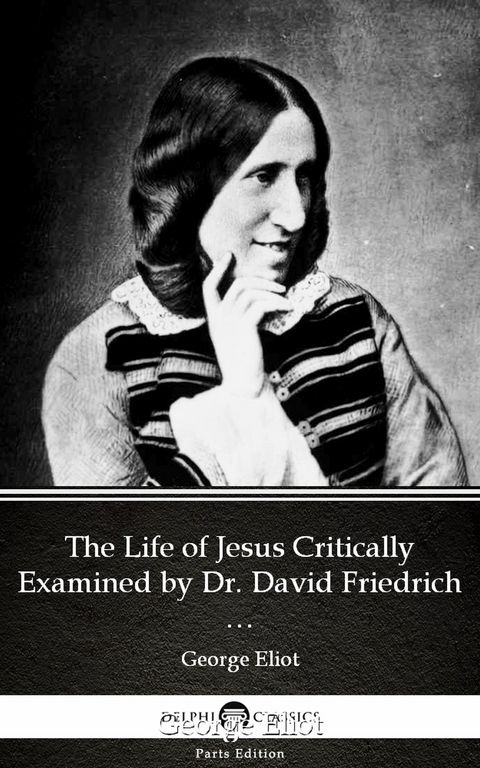
Life of Jesus Critically Examined by Dr. David Friedrich Strauss by George Eliot - Delphi Classics (Illustrated) (eBook)
737 Seiten
Publishdrive (Verlag)
978-1-78877-011-8 (ISBN)
Having established their name as the leading publisher of classic literature and art, Delphi Classics produce publications that are individually crafted with superior formatting, while introducing many rare texts for the first time in digital print. The Delphi Classics edition of Eliot includes original annotations and illustrations relating to the life and works of the author, as well as individual tables of contents, allowing you to navigate eBooks quickly and easily.
eBook features:* The complete unabridged text of 'The Life of Jesus Critically Examined by Dr. David Friedrich Strauss by George Eliot - Delphi Classics (Illustrated)'
* Beautifully illustrated with images related to Eliot's works
* Individual contents table, allowing easy navigation around the eBook
* Excellent formatting of the textPlease visit www.delphiclassics.com to learn more about our wide range of titles
This eBook features the unabridged text of 'The Life of Jesus Critically Examined by Dr. David Friedrich Strauss by George Eliot - Delphi Classics (Illustrated)' from the bestselling edition of 'The Complete Works of George Eliot'. Having established their name as the leading publisher of classic literature and art, Delphi Classics produce publications that are individually crafted with superior formatting, while introducing many rare texts for the first time in digital print. The Delphi Classics edition of Eliot includes original annotations and illustrations relating to the life and works of the author, as well as individual tables of contents, allowing you to navigate eBooks quickly and easily.eBook features:* The complete unabridged text of 'The Life of Jesus Critically Examined by Dr. David Friedrich Strauss by George Eliot - Delphi Classics (Illustrated)'* Beautifully illustrated with images related to Eliot's works* Individual contents table, allowing easy navigation around the eBook* Excellent formatting of the textPlease visit www.delphiclassics.com to learn more about our wide range of titles
CHAPTER I.
ANNUNCIATION AND BIRTH OF JOHN THE BAPTIST.
§ 17. ACCOUNT GIVEN BY LUKE.* IMMEDIATE, SUPERNATURAL CHARACTER OF THE REPRESENTATION.
EACH of the four Evangelists represents the public ministry of Jesus as preceded by that of John the Baptist; but it is peculiar to Luke to make the Baptist the precursor of the Messiah in reference also to the event of his birth. This account finds a legitimate place in a work devoted exclusively to the consideration of the life of Jesus: firstly, on account of the intimate connexion which it exhibits as subsisting from the very commencement between the life of John and the life of Jesus; and secondly, because it constitutes a valuable contribution, aiding essentially towards the formation of a correct estimate of the general character of the gospel narratives. The opinion that the two first chapters of Luke, of which this particular history forms a portion, are a subsequent and unauthentic addition, is the uncritical assumption of a class of theologians who felt that the history of the childhood of Jesus seemed to require a mythical interpretation, but yet demurred to apply the comparatively modern mythical view to the remainder of the Gospel. †
A pious sacerdotal pair had lived and grown old in the cherished, but unrealized hope, of becoming parents, when, on a certain day,
* It may here be observed, once for all, that whenever in the following inquiry the names “Matthew,” “Luke,” &c., are used, it is the author of the several Gospels who is thus briefly indicated, quite irrespective of the question whether either of the Gospels was written by an apostle or disciple of that name, or by a later unknown author.
† See Kuinol Comm. in Luc., Proleg. . as the priest is offering incense in the sanctuary, the angel Gabriel appears to him, and promises him a son, who shall live consecrated to God, and who shall be the harbinger of the Messiah, to prepare his way when he shall visit and redeem his people. Zacharias, however, is incredulous, and doubts the prediction on account of his own advanced age and that of his wife; whereupon the angel, both as a sign and as a punishment, strikes him dumb until the time of its accomplishment; an infliction which endures until the day of the circumcision of the actually born son, wlien the father, being called upon to assign to the child the name predetermined by the angel, suddenly recovers his speech, and with the regained powers of utterance, breaks forth in a hymn of praise. (Luke i. 5-25. 57-80.)
It is evidently the object of this gospel account to represent a series of external and miraculous occurrences. The announcement of the birth of the forerunner of the Messiah is divinely communicated by the apparition of a celestial spirit; the conception takes place under the particular and preternatural blessing ol God; and the infliction and removal of dumbness are effected by extraordinary means. But it is quite another question, whether we can accede to the view of the author, or can feel convinced that the birth of the Baptist was in fact preceded by such a series of miraculous events.
Tlie first offence against our modern notions in this narrative is the appearance of the angel: the event contemplated in itself, as well as the peculiar circumstances of the apparition. With respect to the latter, the angel announces himself to be Gabriel that stands in the presence of God. Now it is inconceivable that the constitution of the celestial hierarchy should actually correspond with the notions entertained by the Jews subsequent to the exile; and that the names given to the angels should be in the language of this people.* Here the supranaturalist finds himself in a dilemma, even upon his own ground. Had the belief in celestial beings, occupying a particular station in the court of heaven, and distinguished by particular names, originated from the revealed religion of the Hebrews, — had such a belief been established by Moses, or some later prophet, — then, according to the views of the supranaturalist, they might, nay they must, be admitted to be correct. But it is in the Maccabaean Daniel † and in the apocryphal Tobit ‡ that this doctrine of angels, in its more precise form, first appears; and it is evidently a product of the influence of the Zend religion of the Persians on the Jewish mind. We have the testimony of the Jews themselves, that they brought the names of the angels with them from Babylon.§
* Paulus, exeget. Handbuck, I A. S. 78 f. 96. Bauer, hebr. Mythol. 2 Bd. S. 218 f.
† Here Michael is called one of the chief princes.
‡ Here Raphael is represented as one of the seven angels which go in and out before the glory of the holy One; (Tobit, xii. 15.), almost the same as Gabriel in Luke i. 19., excepting the mention of the number. This number is in imitation of the Persian Amschaspands. Vid. De Wette, bibl. Dogmatik, § 171. b.
§ Hieros. rosch haschanah f. lvi. 4. (Lightfoot, horae hebr, et talmud. in IV. Evangg., ): R. Simeon ben Lachisch dicit: nomina angelorum ascenderant in manu Israelis ex Babylone. Nam anten dictum est: advolarit ad me unus twn Seraphim, Seraphim steterunt ante eum, Jes. vi.; at post: vir Gabriel, Dan. ix. 21, Michael princeps rester, Dan. x. 21.
Hence arises a series of questions extremely perplexing to the supranaturalist. Was the doctrine false so long as it continued to be the exclusive possession of the heathens, but true as soon as it became adopted by the Jews? or was it at all times equally true, and was an important truth discovered by an idolatrous nation sooner than by the people of God? If nations shut out from a particular and divine revelation, arrived at truth by the light of reason alone, sooner than the Jews who were guided by that revelation, then either the revelation was superfluous, or its influence was merely negative: that is, it operated as a check to the premature acquisition of knowledge. If, in order to escape this consequence, it be contended that truths were revealed by the divine influence to other people besides the Israelites, the supranaturalistic point of view is annihilated; and, since all things contained in religions which contradict each other cannot have been revealed, we are compelled to exercise a critical discrimination. Thus, we find it to be by no means in harmony with an elevated conception of God to represent him as an earthly monarch, surrounded by his court: and when an appeal is made, in behalf of the reality of angels standing round the throne, to the reasonable belief in a graduated scale of created intelligences,* the Jewish representation is not thereby justified, but merely a modern conception substituted for it. We should, thus, be driven to the expedient of supposing an accommodation on the part of God: that he sent a celestial spirit with the command to simulate a rank and title which did not belong to him, in order that, by this conformity to Jewish notions, he might insure the belief of the father of the Baptist. Since however it appears that Zacharias did not believe the angel, but was first convinced by the result, the accommodation proved fruitless, and consequently could not have been a divine arrangement. With regard to the name of the angel, and the improbability that a celestial being should bear a Hebrew name, it has been remarked that the word Gabriel, taken appellatively in the sense of Man of God, very appropriately designates the nature of the heavenly visitant; and since it may be rendered with this signification into every different language, the name cannot be said to be restricted to the Hebrew. † This explanation however leaves the difficulty quite unsolved, since it converts into a simple appellative a name evidently employed as a proper name. In this case likewise an accommodation must be supposed, namely, that the angel, in order to indicate his real nature, appropriated a name which he did not actually bear: an accommodation already judged in the foregoing remarks.
But it is not only the name and the alleged station of the angel which shock our modern ideas, we also feel his discourse and his conduct to be unworthy. Paulus indeed suggests that none but a levitical priest, and not an angel of Jehovah, could have conceived it
* Olshausen, biblischer Commentar zum N.T., 1 Thl. S. 29 (2te Auflage). Comp. Hoffmann, S. 124 f.
† Olshausen, ut sup. Hoffmann, S. 135. necessary that the boy should live in nazarite abstemiousness,* but to this it may be answered that the angel also might have known that under this form John would obtain greater influence with the people. But there is a more important difficulty. When Zacharias, overcome by surprise, doubts the promise and asks for a sign, this natural incredulity is regarded by the angel as a crime, and immediately punished with dumbness. Though some may not coincide with Paulus that a real angel would have lauded the spirit of inquiry evinced by the priest, yet all will agree in the remark, that conduct so imperious is less in character with a truly celestial being than with the notions the Jews of that time entertained of such. Moreover we do not find in the whole province of supranaturalism a parallel severity.
The instance, cited by Paulus, of Jehovah’s far milder treatment of Abraham, who asks precisely the same question unreproved, Gen. xv. 8, is refuted by Olshausen, because he considers the words of Abraham, chap. v. 6, an evidence of his faith; but this observation does not apply to chap. xviii. 12, where the greater incredulity of Sarah, in a similar case, remains unpunished; nor to chap. xvii. 17, where Abraham himself is not even blamed, though the divine promise...
| Erscheint lt. Verlag | 17.7.2017 |
|---|---|
| Reihe/Serie | Delphi Parts Edition (George Eliot) | Delphi Parts Edition (George Eliot) |
| Sprache | englisch |
| Themenwelt | Literatur ► Anthologien |
| Literatur ► Klassiker / Moderne Klassiker | |
| Literatur ► Romane / Erzählungen | |
| Schlagworte | Austen • Bede • deronda • Felix • Floss • Middlemarch • Silas |
| ISBN-10 | 1-78877-011-0 / 1788770110 |
| ISBN-13 | 978-1-78877-011-8 / 9781788770118 |
| Informationen gemäß Produktsicherheitsverordnung (GPSR) | |
| Haben Sie eine Frage zum Produkt? |
 EPUB (Adobe DRM)
Größe: 2,1 MB
Kopierschutz: Adobe-DRM
Adobe-DRM ist ein Kopierschutz, der das eBook vor Mißbrauch schützen soll. Dabei wird das eBook bereits beim Download auf Ihre persönliche Adobe-ID autorisiert. Lesen können Sie das eBook dann nur auf den Geräten, welche ebenfalls auf Ihre Adobe-ID registriert sind.
Details zum Adobe-DRM
Dateiformat: EPUB (Electronic Publication)
EPUB ist ein offener Standard für eBooks und eignet sich besonders zur Darstellung von Belletristik und Sachbüchern. Der Fließtext wird dynamisch an die Display- und Schriftgröße angepasst. Auch für mobile Lesegeräte ist EPUB daher gut geeignet.
Systemvoraussetzungen:
PC/Mac: Mit einem PC oder Mac können Sie dieses eBook lesen. Sie benötigen eine
eReader: Dieses eBook kann mit (fast) allen eBook-Readern gelesen werden. Mit dem amazon-Kindle ist es aber nicht kompatibel.
Smartphone/Tablet: Egal ob Apple oder Android, dieses eBook können Sie lesen. Sie benötigen eine
Geräteliste und zusätzliche Hinweise
Buying eBooks from abroad
For tax law reasons we can sell eBooks just within Germany and Switzerland. Regrettably we cannot fulfill eBook-orders from other countries.
EPUB (Ohne DRM)Digital Rights Management: ohne DRM
Dieses eBook enthält kein DRM oder Kopierschutz. Eine Weitergabe an Dritte ist jedoch rechtlich nicht zulässig, weil Sie beim Kauf nur die Rechte an der persönlichen Nutzung erwerben.
Dateiformat: EPUB (Electronic Publication)
EPUB ist ein offener Standard für eBooks und eignet sich besonders zur Darstellung von Belletristik und Sachbüchern. Der Fließtext wird dynamisch an die Display- und Schriftgröße angepasst. Auch für mobile Lesegeräte ist EPUB daher gut geeignet.
Systemvoraussetzungen:
PC/Mac: Mit einem PC oder Mac können Sie dieses eBook lesen. Sie benötigen dafür die kostenlose Software Adobe Digital Editions.
eReader: Dieses eBook kann mit (fast) allen eBook-Readern gelesen werden. Mit dem amazon-Kindle ist es aber nicht kompatibel.
Smartphone/Tablet: Egal ob Apple oder Android, dieses eBook können Sie lesen. Sie benötigen dafür eine kostenlose App.
Geräteliste und zusätzliche Hinweise
Buying eBooks from abroad
For tax law reasons we can sell eBooks just within Germany and Switzerland. Regrettably we cannot fulfill eBook-orders from other countries.
aus dem Bereich