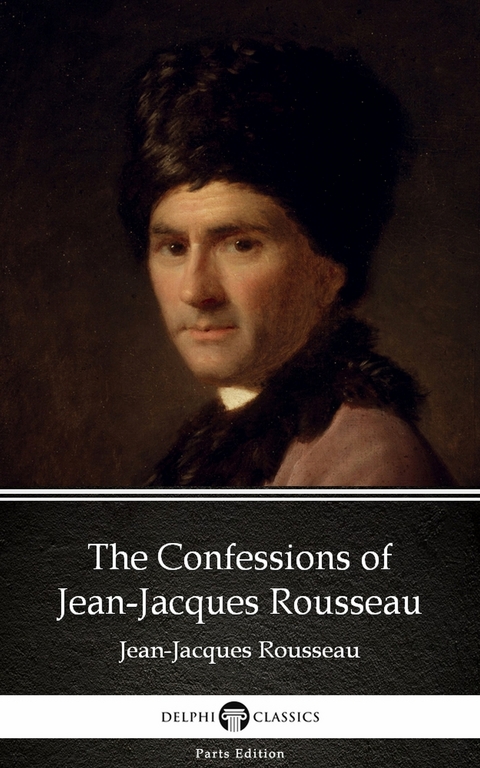
Confessions of Jean-Jacques Rousseau by Jean-Jacques Rousseau (Illustrated) (eBook)
431 Seiten
Publishdrive (Verlag)
978-1-78656-222-7 (ISBN)
Having established their name as the leading publisher of classic literature and art, Delphi Classics produce publications that are individually crafted with superior formatting, while introducing many rare texts for the first time in digital print. The Delphi Classics edition of Rousseau includes original annotations and illustrations relating to the life and works of the author, as well as individual tables of contents, allowing you to navigate eBooks quickly and easily.
eBook features:* The complete unabridged text of 'The Confessions of Jean-Jacques Rousseau'
* Beautifully illustrated with images related to Rousseau's works
* Individual contents table, allowing easy navigation around the eBook
* Excellent formatting of the textPlease visit www.delphiclassics.com to learn more about our wide range of titles
This eBook features the unabridged text of 'The Confessions of Jean-Jacques Rousseau' from the bestselling edition of 'The Collected Works of Jean-Jacques Rousseau'. Having established their name as the leading publisher of classic literature and art, Delphi Classics produce publications that are individually crafted with superior formatting, while introducing many rare texts for the first time in digital print. The Delphi Classics edition of Rousseau includes original annotations and illustrations relating to the life and works of the author, as well as individual tables of contents, allowing you to navigate eBooks quickly and easily.eBook features:* The complete unabridged text of 'The Confessions of Jean-Jacques Rousseau'* Beautifully illustrated with images related to Rousseau's works* Individual contents table, allowing easy navigation around the eBook* Excellent formatting of the textPlease visit www.delphiclassics.com to learn more about our wide range of titles
INTRODUCTION.
Among the notable books of later times — we may say, without exaggeration, of all time — must be reckoned The Confessions of Jean Jacques Rousseau. It deals with leading personages and transactions of a momentous epoch, when absolutism and feudalism were rallying for their last struggle against the modern spirit, chiefly represented by Voltaire, the Encyclopedists, and Rousseau himself — a struggle to which, after many fierce intestine quarrels and sanguinary wars throughout Europe and America, has succeeded the prevalence of those more tolerant and rational principles by which the statesmen of our own day are actuated.
On these matters, however, it is not our province to enlarge; nor is it necessary to furnish any detailed account of our author’s political, religious, and philosophic axioms and systems, his paradoxes and his errors in logic: these have been so long and so exhaustively disputed over by contending factions that little is left for even the most assiduous gleaner in the field. The inquirer will find, in Mr. John Money’s excellent work, the opinions of Rousseau reviewed succinctly and impartially. The ‘Contrat Social’, the ‘Lettres Ecrites de la Montagne’, and other treatises that once aroused fierce controversy, may therefore be left in the repose to which they have long been consigned, so far as the mass of mankind is concerned, though they must always form part of the library of the politician and the historian. One prefers to turn to the man Rousseau as he paints himself in the remarkable work before us.
That the task which he undertook in offering to show himself — as Persius puts it— ‘Intus et in cute’, to posterity, exceeded his powers, is a trite criticism; like all human enterprises, his purpose was only imperfectly fulfilled; but this circumstance in no way lessens the attractive qualities of his book, not only for the student of history or psychology, but for the intelligent man of the world. Its startling frankness gives it a peculiar interest wanting in most other autobiographies.
Many censors have elected to sit in judgment on the failings of this strangely constituted being, and some have pronounced upon him very severe sentences. Let it be said once for all that his faults and mistakes were generally due to causes over which he had but little control, such as a defective education, a too acute sensitiveness, which engendered suspicion of his fellows, irresolution, an overstrained sense of honour and independence, and an obstinate refusal to take advice from those who really wished to befriend him; nor should it be forgotten that he was afflicted during the greater part of his life with an incurable disease.
Lord Byron had a soul near akin to Rousseau’s, whose writings naturally made a deep impression on the poet’s mind, and probably had an influence on his conduct and modes of thought: In some stanzas of ‘Childe Harold’ this sympathy is expressed with truth and power; especially is the weakness of the Swiss philosopher’s character summed up in the following admirable lines:
“Here the self-torturing sophist, wild Rousseau,
The apostle of affliction, he who threw
Enchantment over passion, and from woe
Wrung overwhelming eloquence, first drew
The breath which made him wretched; yet he knew
How to make madness beautiful, and cast
O’er erring deeds and thoughts a heavenly hue
Of words, like sunbeams, dazzling as they passed
The eyes, which o’er them shed tears feelingly and fast.
“His life was one long war with self-sought foes,
Or friends by him self-banished; for his mind
Had grown Suspicion’s sanctuary, and chose,
For its own cruel sacrifice, the kind,
‘Gainst whom he raged with fury strange and blind.
But he was frenzied, — wherefore, who may know?
Since cause might be which skill could never find;
But he was frenzied by disease or woe
To that worst pitch of all, which wears a reasoning show.”
One would rather, however, dwell on the brighter hues of the picture than on its shadows and blemishes; let us not, then, seek to “draw his frailties from their dread abode.” His greatest fault was his renunciation of a father’s duty to his offspring; but this crime he expiated by a long and bitter repentance. We cannot, perhaps, very readily excuse the way in which he has occasionally treated the memory of his mistress and benefactress. That he loved Madame de Warens — his ‘Mamma’ — deeply and sincerely is undeniable, notwithstanding which he now and then dwells on her improvidence and her feminine indiscretions with an unnecessary and unbecoming lack of delicacy that has an unpleasant effect on the reader, almost seeming to justify the remark of one of his most lenient critics — that, after all, Rousseau had the soul of a lackey. He possessed, however, many amiable and charming qualities, both as a man and a writer, which were evident to those amidst whom he lived, and will be equally so to the unprejudiced reader of the Confessions. He had a profound sense of justice and a real desire for the improvement and advancement of the race. Owing to these excellences he was beloved to the last even by persons whom he tried to repel, looking upon them as members of a band of conspirators, bent upon destroying his domestic peace and depriving him of the means of subsistence.
Those of his writings that are most nearly allied in tone and spirit to the ‘Confessions’ are the ‘Reveries d’un Promeneur Solitaire’ and ‘La Nouvelle Heloise’. His correspondence throws much light on his life and character, as do also parts of ‘Emile’. It is not easy in our day to realize the effect wrought upon the public mind by the advent of ‘La Nouvelle Heloise’. Julie and Saint-Preux became names to conjure with; their ill-starred amours were everywhere sighed and wept over by the tender-hearted fair; indeed, in composing this work, Rousseau may be said to have done for Switzerland what the author of the Waverly Novels did for Scotland, turning its mountains, lakes and islands, formerly regarded with aversion, into a fairyland peopled with creatures whose joys and sorrows appealed irresistibly to every breast. Shortly after its publication began to flow that stream of tourists and travellers which tends to make Switzerland not only more celebrated but more opulent every year. It, is one of the few romances written in the epistolary form that do not oppress the reader with a sense of languor and unreality; for its creator poured into its pages a tide of passion unknown to his frigid and stilted predecessors, and dared to depict Nature as she really is, not as she was misrepresented by the modish authors and artists of the age. Some persons seem shy of owning an acquaintance with this work; indeed, it has been made the butt of ridicule by the disciples of a decadent school. Its faults and its beauties are on the surface; Rousseau’s own estimate is freely expressed at the beginning of the eleventh book of the Confessions and elsewhere. It might be wished that the preface had been differently conceived and worded; for the assertion made therein that the book may prove dangerous has caused it to be inscribed on a sort of Index, and good folk who never read a line of it blush at its name. Its “sensibility,” too, is a little overdone, and has supplied the wits with opportunities for satire; for example, Canning, in his ‘New Morality’:
“Sweet Sensibility, who dwells enshrined
In the fine foldings
Sweet child of sickly Fancy! — her of yore
From her loved France Rousseau to exile bore;
And while ‘midst lakes and mountains wild he ran,
Full of himself, and shunned the haunts of man,
Taught her o’er each lone vale and Alpine, steep
To lisp the story of his...
| Erscheint lt. Verlag | 17.7.2017 |
|---|---|
| Reihe/Serie | Delphi Parts Edition (Jean-Jacques Rousseau) | Delphi Parts Edition (Jean-Jacques Rousseau) |
| Sprache | englisch |
| Themenwelt | Literatur ► Anthologien |
| Literatur ► Klassiker / Moderne Klassiker | |
| Literatur ► Romane / Erzählungen | |
| Schlagworte | confessions • Diderot • discourse • Emile • Hume • Voltaire • Walker |
| ISBN-10 | 1-78656-222-7 / 1786562227 |
| ISBN-13 | 978-1-78656-222-7 / 9781786562227 |
| Informationen gemäß Produktsicherheitsverordnung (GPSR) | |
| Haben Sie eine Frage zum Produkt? |
 EPUB (Adobe DRM)
Größe: 2,7 MB
Kopierschutz: Adobe-DRM
Adobe-DRM ist ein Kopierschutz, der das eBook vor Mißbrauch schützen soll. Dabei wird das eBook bereits beim Download auf Ihre persönliche Adobe-ID autorisiert. Lesen können Sie das eBook dann nur auf den Geräten, welche ebenfalls auf Ihre Adobe-ID registriert sind.
Details zum Adobe-DRM
Dateiformat: EPUB (Electronic Publication)
EPUB ist ein offener Standard für eBooks und eignet sich besonders zur Darstellung von Belletristik und Sachbüchern. Der Fließtext wird dynamisch an die Display- und Schriftgröße angepasst. Auch für mobile Lesegeräte ist EPUB daher gut geeignet.
Systemvoraussetzungen:
PC/Mac: Mit einem PC oder Mac können Sie dieses eBook lesen. Sie benötigen eine
eReader: Dieses eBook kann mit (fast) allen eBook-Readern gelesen werden. Mit dem amazon-Kindle ist es aber nicht kompatibel.
Smartphone/Tablet: Egal ob Apple oder Android, dieses eBook können Sie lesen. Sie benötigen eine
Geräteliste und zusätzliche Hinweise
Buying eBooks from abroad
For tax law reasons we can sell eBooks just within Germany and Switzerland. Regrettably we cannot fulfill eBook-orders from other countries.
EPUB (Ohne DRM)Digital Rights Management: ohne DRM
Dieses eBook enthält kein DRM oder Kopierschutz. Eine Weitergabe an Dritte ist jedoch rechtlich nicht zulässig, weil Sie beim Kauf nur die Rechte an der persönlichen Nutzung erwerben.
Dateiformat: EPUB (Electronic Publication)
EPUB ist ein offener Standard für eBooks und eignet sich besonders zur Darstellung von Belletristik und Sachbüchern. Der Fließtext wird dynamisch an die Display- und Schriftgröße angepasst. Auch für mobile Lesegeräte ist EPUB daher gut geeignet.
Systemvoraussetzungen:
PC/Mac: Mit einem PC oder Mac können Sie dieses eBook lesen. Sie benötigen dafür die kostenlose Software Adobe Digital Editions.
eReader: Dieses eBook kann mit (fast) allen eBook-Readern gelesen werden. Mit dem amazon-Kindle ist es aber nicht kompatibel.
Smartphone/Tablet: Egal ob Apple oder Android, dieses eBook können Sie lesen. Sie benötigen dafür eine kostenlose App.
Geräteliste und zusätzliche Hinweise
Buying eBooks from abroad
For tax law reasons we can sell eBooks just within Germany and Switzerland. Regrettably we cannot fulfill eBook-orders from other countries.
aus dem Bereich