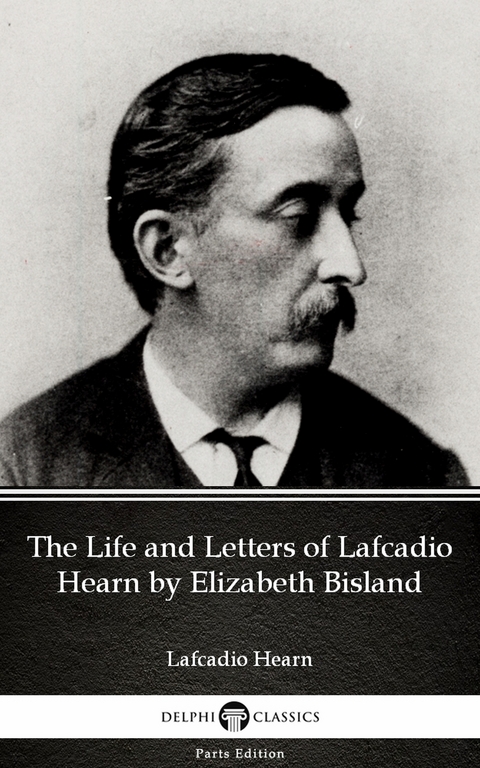
Life and Letters of Lafcadio Hearn by Elizabeth Bisland by Lafcadio Hearn (Illustrated) (eBook)
466 Seiten
Publishdrive (Verlag)
978-1-78656-401-6 (ISBN)
Having established their name as the leading publisher of classic literature and art, Delphi Classics produce publications that are individually crafted with superior formatting, while introducing many rare texts for the first time in digital print. The Delphi Classics edition of Hearn includes original annotations and illustrations relating to the life and works of the author, as well as individual tables of contents, allowing you to navigate eBooks quickly and easily.
eBook features:* The complete unabridged text of 'The Life and Letters of Lafcadio Hearn by Elizabeth Bisland'
* Beautifully illustrated with images related to Hearn's works
* Individual contents table, allowing easy navigation around the eBook
* Excellent formatting of the textPlease visit www.delphiclassics.com to learn more about our wide range of titles
This eBook features the unabridged text of 'The Life and Letters of Lafcadio Hearn by Elizabeth Bisland' from the bestselling edition of 'The Complete Works of Lafcadio Hearn'. Having established their name as the leading publisher of classic literature and art, Delphi Classics produce publications that are individually crafted with superior formatting, while introducing many rare texts for the first time in digital print. The Delphi Classics edition of Hearn includes original annotations and illustrations relating to the life and works of the author, as well as individual tables of contents, allowing you to navigate eBooks quickly and easily.eBook features:* The complete unabridged text of 'The Life and Letters of Lafcadio Hearn by Elizabeth Bisland'* Beautifully illustrated with images related to Hearn's works* Individual contents table, allowing easy navigation around the eBook* Excellent formatting of the textPlease visit www.delphiclassics.com to learn more about our wide range of titles
CHAPTER I. BOYHOOD
Lafcadio Hearn was born on the twenty-seventh of June, in the year 1850. He was a native of the Ionian Isles, the place of his birth being the Island of Santa Maura, which is commonly called in modern Greek Levkas, or Lefcada, a corruption of the name of the old Leucadia, which was famous as the place of Sappho’s self-destruction. This island is separated from the western coast of Greece by a narrow strait; the neck of land which joined it to the mainland having been cut through by the Corinthians seven centuries before Christ. To this day it remains deeply wooded, and scantily populated, with sparse vineyards and olive groves clinging to the steep sides of the mountains overlooking the blue Ionian sea. The child Lafcadio may have played in his early years among the high-set, half-obliterated ruins of the Temple of Apollo, from whence offenders were cast down with multitudes of birds tied to their limbs, that perchance the beating of a thousand wings might break the violence of the fall, and so rescue them from the last penalty of expiation.
In this place of old tragedies and romance the child was born into a life always to be shadowed by tragedy and romance to an extent almost fantastic in our modern workaday world. This wild, bold background, swimming in the half-tropical blue of Greek sea and sky, against which the boy first discerned the vague outlines of his conscious life, seems to have silhouetted itself behind all his later memories and prepossessions, and through whatever dark or squalid scenes his wanderings led, his heart was always filled by dreams and longings for soaring outlines, and the blue, “which is the colour of the idea of the divine, the colour pantheistic, the colour ethical.”
Long years afterward, in the “Dream of a Summer Day,” he says: —
“I have memory of a place and a magical time, in which the sun and the moon were larger and brighter than now. Whether it was of this life or of some life before, I cannot tell, but I know the sky was very much more blue, and nearer to the world — almost as it seems to become above the masts of a steamer steaming into equatorial summer.... The sea was alive and used to talk — and the Wind made me cry out for joy when it touched me. Once or twice during other years, in divine days lived among the peaks, I have dreamed for a moment the same wind was blowing — but it was only a remembrance.
“Also in that place the clouds were wonderful and of colours for which there are no names at all, — colours that used to make me hungry and thirsty. I remember, too, that the days were ever so much longer than these days, — and every day there were new pleasures and new wonders for me. And all that country and time were softly ruled by One who thought only of ways to make me happy.... When day was done, and there fell the great hush of light before moonrise, she would tell me stories that made me tingle from head to foot with pleasure. I have never heard any other stories half so beautiful. And when the pleasure became too great, she would sing a weird little song which always brought sleep. At last there came a parting day; and she wept and told me of a charm she had given that I must never, never lose, because it would keep me young, and give me power to return. But I never returned. And the years went; and one day I knew that I had lost the charm, and had become ridiculously old.”
A strange mingling of events and of race-forces had brought the boy into being.
Surgeon-Major Charles Bush Hearn, of the 76th Foot, came of an old Dorsetshire family in which there was a tradition of gipsy blood — a tradition too dim and ancient now to be verified, though Hearn is an old Romany name in the west of England, and the boy Lafcadio bore in his hand all his life that curious “thumb-print” upon the palm, which is said to be the invariable mark of Romany descent. The first of the Hearns to pass over into Ireland went as private chaplain to the Lord Lieutenant in 1693, and being later appointed Dean of Cashel, settled permanently in West Meath. From the ecclesiastical loins there appears to have sprung a numerous race of soldiers, for Dr. Hearn’s father and seven uncles served under Wellington in Spain. The grandfather of Lafcadio rose during the Peninsula Campaign to the position of lieutenant-colonel of the 43d regiment, and commanded his regiment in the battle of Vittoria. Later he married Elizabeth Holmes, a kinswoman of Sir Robert Holmes, and of Edmund Holmes the poet, another member of her family being Rice Holmes, the historian of the Indian Mutiny. Dr. Charles Hearn, the father of Lafcadio, was her eldest son, and another son was Richard, who was one of the Barbizon painters and an intimate friend of Jean François Millet.
It was in the late ‘40’s, when England still held the Ionian Isles, that the 76th Foot was ordered to Greece, and Surgeon-Major Hearn accompanied his regiment to do garrison duty on the island of Cerigo. Apparently not long after his arrival he made the acquaintance of Rosa Cerigote, whose family is said to have been of old and honourable Greek descent. Photographs of the young surgeon represent him as a handsome man, with the flowing side-whiskers so valued at that period, and with a bold profile and delicate waist. A passionate love affair ensued between the beautiful Greek girl and the handsome Irishman, but the connection was violently opposed by the girl’s brothers, the native bitterness toward the English garrison being as intense as was the sentiment in the South against the Northern army of occupation immediately after the American Civil War. The legend goes that the Cerigote men — there was hot blood in the family veins — waylaid and stabbed the Irishman, leaving him for dead. The girl, it is said, with the aid of a servant, concealed him in a barn and nursed him back to life, and after his recovery eloped with her grateful lover and married him by the Greek rites in Santa Maura. The first child died immediately after birth, and the boy, Lafcadio, was the second child; taking his name from the Greek name of the island, Lefcada. Another son, James, three years later in Cephalonia, was the fruit of this marriage, so romantically begun and destined to end so tragically.
When England ceded the Ionian Isles to Greece Dr. Hearn returned with his family to Dublin, pausing, perhaps, for a while at Malta, for in a letter written during the last years of his life Lafcadio says: “I am almost sure of having been in Malta as a child. My father told me queer things about the old palaces of the knights, and a story of a monk who on the coming of the French had the presence of mind to paint the gold chancel railing with green paint.”
The two boys were at this time aged six and three. It was inevitable, no doubt, that the young wife, who had never mastered the English tongue, though she spoke, as did the children, Italian and Romaic, should have regretted the change from her sunlit island to the dripping Irish skies and grey streets of Dublin, nor can it be wondered at that, an exile among aliens in race, speech, and faith, there should have soon grown up misunderstandings and disputes. The unhappy details have died into silence with the passage of time, but the wife seems to have believed herself repudiated and betrayed, and the marriage being eventually annulled, she fled to Smyrna with a Greek cousin who had come at her call, leaving the two children with the father. This cousin she afterwards married and her children knew her no more. The father also married again, and the boy Lafcadio being adopted by Dr. Hearn’s aunt, a Mrs. Brenane, and removing with her to Wales, never again saw either his father or his brother.
The emotions are not hard to guess at of a passionate, sensitive boy of seven, suddenly flung by the stormy emotions of his elders out of the small warm circle of his narrow sphere. To a young child the relations of its parents and the circle of the home seem as fundamental and eternal as the globe itself, and the sudden ravishment of all the bases of his life make his footing amid the ties and affections of the world forever after timid and uncertain.
A boy of less sensitive fibre might in time have forgotten these shocks, but the eldest son of Charles Hearn and Rosa Cerigote was destined to suffer always because of the violent rending of their ties. From this period seems to have dated his strange distrusts, his unconquerable terror of the potentialities which he suspected as lurking beneath the frankest exterior, and his constant, morbid dread of betrayal and abandonment by even his closest friends.
Whatever of fault there may have been on his mother’s part, his vague memories of her were always tender and full of yearning affection.
To the brother he never saw he wrote, when he was a man, “And you do not remember that dark and beautiful face — with large, brown eyes like a wild deer’s — that used to bend above your cradle? You do not remember the voice which told you each night to cross your fingers after the old Greek orthodox fashion, and utter the words — Ἔν τὸ ὄνομα τοὺ Πατρὸς καὶ τοὺ Υιοῦ καὶ τοῦ Ἀγίου Πνεύματος, ‘In the name of the Father, and of the Son, and of the Holy Ghost’? She made, or had made, three little wounds upon you when a baby — to place you, according to her childish faith, under the protection of those three powers, but specially that of Him for whom alone the Nineteenth Century still feels some reverence — the Lord and Giver of Life.... We were all very dark as children, very passionate, very...
| Erscheint lt. Verlag | 17.7.2017 |
|---|---|
| Reihe/Serie | Delphi Parts Edition (Lafcadio Hearn) | Delphi Parts Edition (Lafcadio Hearn) |
| Sprache | englisch |
| Themenwelt | Literatur ► Anthologien |
| Literatur ► Klassiker / Moderne Klassiker | |
| Literatur ► Romane / Erzählungen | |
| Schlagworte | Chinese • Creole • Ghosts • Japan • Japanese • Kwaidan • Stories |
| ISBN-10 | 1-78656-401-7 / 1786564017 |
| ISBN-13 | 978-1-78656-401-6 / 9781786564016 |
| Informationen gemäß Produktsicherheitsverordnung (GPSR) | |
| Haben Sie eine Frage zum Produkt? |
 EPUB (Adobe DRM)
Größe: 3,2 MB
Kopierschutz: Adobe-DRM
Adobe-DRM ist ein Kopierschutz, der das eBook vor Mißbrauch schützen soll. Dabei wird das eBook bereits beim Download auf Ihre persönliche Adobe-ID autorisiert. Lesen können Sie das eBook dann nur auf den Geräten, welche ebenfalls auf Ihre Adobe-ID registriert sind.
Details zum Adobe-DRM
Dateiformat: EPUB (Electronic Publication)
EPUB ist ein offener Standard für eBooks und eignet sich besonders zur Darstellung von Belletristik und Sachbüchern. Der Fließtext wird dynamisch an die Display- und Schriftgröße angepasst. Auch für mobile Lesegeräte ist EPUB daher gut geeignet.
Systemvoraussetzungen:
PC/Mac: Mit einem PC oder Mac können Sie dieses eBook lesen. Sie benötigen eine
eReader: Dieses eBook kann mit (fast) allen eBook-Readern gelesen werden. Mit dem amazon-Kindle ist es aber nicht kompatibel.
Smartphone/Tablet: Egal ob Apple oder Android, dieses eBook können Sie lesen. Sie benötigen eine
Geräteliste und zusätzliche Hinweise
Buying eBooks from abroad
For tax law reasons we can sell eBooks just within Germany and Switzerland. Regrettably we cannot fulfill eBook-orders from other countries.
EPUB (Ohne DRM)Digital Rights Management: ohne DRM
Dieses eBook enthält kein DRM oder Kopierschutz. Eine Weitergabe an Dritte ist jedoch rechtlich nicht zulässig, weil Sie beim Kauf nur die Rechte an der persönlichen Nutzung erwerben.
Dateiformat: EPUB (Electronic Publication)
EPUB ist ein offener Standard für eBooks und eignet sich besonders zur Darstellung von Belletristik und Sachbüchern. Der Fließtext wird dynamisch an die Display- und Schriftgröße angepasst. Auch für mobile Lesegeräte ist EPUB daher gut geeignet.
Systemvoraussetzungen:
PC/Mac: Mit einem PC oder Mac können Sie dieses eBook lesen. Sie benötigen dafür die kostenlose Software Adobe Digital Editions.
eReader: Dieses eBook kann mit (fast) allen eBook-Readern gelesen werden. Mit dem amazon-Kindle ist es aber nicht kompatibel.
Smartphone/Tablet: Egal ob Apple oder Android, dieses eBook können Sie lesen. Sie benötigen dafür eine kostenlose App.
Geräteliste und zusätzliche Hinweise
Buying eBooks from abroad
For tax law reasons we can sell eBooks just within Germany and Switzerland. Regrettably we cannot fulfill eBook-orders from other countries.
aus dem Bereich